
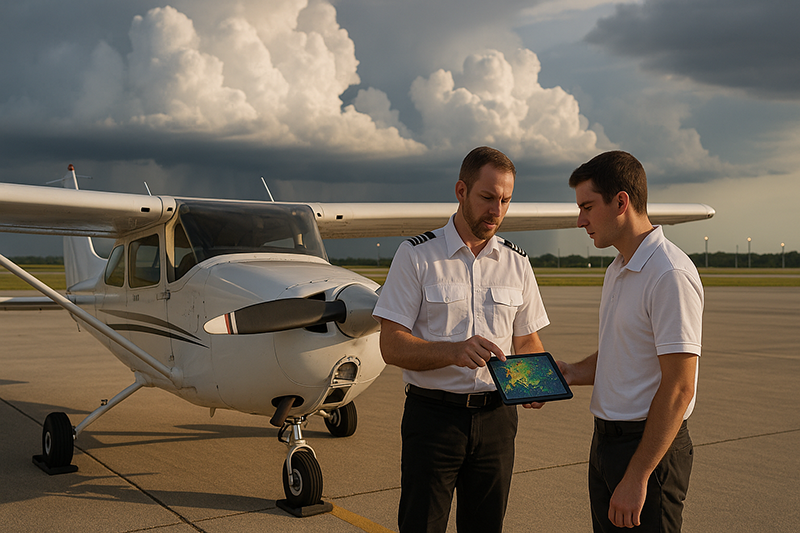
Thunderstorm risk along a route is one of the most important weather decisions a pilot can evaluate before and during flight. Convective weather can change quickly, cover large areas, hide behind benign-looking reports, and create hazards that extend well beyond visible rain shafts. For student pilots, flight instructors, instrument pilots, and aviation professionals, the question is rarely whether thunderstorms are dangerous. The harder question is how to recognize when a planned route is becoming unsuitable before the aircraft is committed.
This article explains how pilots can evaluate thunderstorm risk in practical terms. It is not a substitute for a formal weather briefing, current FAA guidance, company procedures, or aircraft-specific limitations. Instead, it is designed to help pilots think like risk managers: understand the atmosphere, compare weather products, identify convective trends, build conservative route options, and make timely decisions on the ground or in the air.
What Thunderstorm Risk Means for a Flight Route
Evaluating thunderstorm risk is different from simply asking whether thunderstorms are forecast somewhere along the route. A safe and useful evaluation considers where convective weather is expected, when it is expected to develop or move, how intense it may become, what escape options exist, and whether the pilot, aircraft, equipment, and mission are suitable for the conditions.
A route can look reasonable at departure time and still carry elevated risk if atmospheric conditions support rapid thunderstorm development later in the day. Likewise, an area of rain may not be a thunderstorm threat by itself, but embedded convective cells, lightning, strong updrafts, turbulence, hail, or low-level wind shear can make the same route unacceptable. The key is to evaluate both present weather and forecast convective potential.
For general aviation pilots, this evaluation often begins with a broad view of the weather pattern. Look for fronts, unstable air masses, moisture, lift, outflow boundaries, and upper-level support. These ingredients help explain why thunderstorms may form, where they may organize, and how they may move. A pilot does not need to become a meteorologist, but a pilot does need enough weather understanding to recognize when convective risk is beyond the comfort zone for the flight.
Why This Matters in Real-World Aviation
Thunderstorms can affect nearly every phase of flight. On the ground, they may produce strong surface winds, heavy rain, lightning, poor visibility, ramp hazards, and rapidly changing departure conditions. During takeoff and climb, a nearby cell or gust front can create wind shifts, turbulence, and performance concerns. En route, a thunderstorm complex can block a route, force deviations, increase fuel burn, and reduce the value of original alternates. During arrival, convective weather can create holding, reroutes, missed approaches, runway changes, and reduced margins near terrain or congested airspace.
The most important practical point is that thunderstorm hazards are not limited to the colored returns a pilot sees on a display. Strong turbulence, hail, lightning, wind shear, and outflow can exist outside the most intense precipitation core. A route that appears to thread between cells on a cockpit display may not be acceptable if the gaps are closing, if the cells are building vertically, or if the pilot is relying on delayed weather imagery.
Real-world aviation decisions also involve pressure. A pilot may be trying to complete a cross-country, meet a passenger schedule, return an aircraft before maintenance, or stay ahead of a line of storms. These pressures can encourage continued flight into a narrowing weather window. A disciplined thunderstorm risk evaluation helps counter that pressure with objective decision points: depart earlier, delay, choose a different route, land short, divert, or cancel.
Start With the Big Weather Picture
Before looking at radar colors or individual METARs, begin with the synoptic picture. The big picture helps you understand whether thunderstorms are isolated, scattered, organized in a line, associated with a frontal boundary, or likely to redevelop along a particular axis. This matters because an isolated afternoon storm may allow wide route flexibility, while an organized squall line may leave few safe options for a light aircraft.
A useful preflight review normally includes current surface analysis, prog charts, convective outlooks, area forecasts or graphical aviation weather products, TAFs, METARs, radar, satellite imagery, winds aloft, AIRMETs, SIGMETs, and convective SIGMET information when applicable. The value is not in memorizing every product. The value is in comparing them to answer a practical question: does the route pass through air that is likely to support thunderstorms during my time of flight?
Satellite imagery is especially useful because it shows cloud development before precipitation appears on radar. Growing cumulus fields, expanding cloud tops, and organized cloud bands can help a pilot see where convection is beginning to develop. Radar shows precipitation that is already occurring, while satellite can reveal the early stages of vertical cloud growth. Used together, they provide a better understanding than either product alone.
Surface observations help ground-truth the forecast. If stations along the route report falling ceilings, gusty winds, rapidly changing wind direction, thunderstorm remarks, or heavy rain, the route may be deteriorating faster than expected. TAFs provide forecast conditions at specific airports, but thunderstorms often affect areas between reporting stations. A good route evaluation considers airports, en route segments, and potential diversion areas, not just the departure and destination.
Understand the Ingredients of Thunderstorm Development
Thunderstorms generally need moisture, instability, and lift. Moisture provides the fuel, instability allows air to rise, and lift initiates or enhances upward motion. Lift may come from a cold front, warm front, sea breeze, dryline, terrain, outflow boundary, or daytime heating. When these ingredients overlap along your route during your flight window, risk increases.
Instability is the reason a warm, humid afternoon can produce towering cumulus and thunderstorms even when the morning weather looks pleasant. A stable atmosphere resists vertical motion. An unstable atmosphere allows rising air parcels to continue upward, which can produce strong updrafts and rapid storm development. For pilots, the practical question is not whether a numerical index is impressive. The practical question is whether the air mass is becoming supportive of deep convection during the period you intend to fly.
Wind shear also matters. In aviation weather discussions, wind shear often refers to a change in wind speed or direction over distance or altitude. In convective forecasting, wind shear can influence storm organization, movement, and longevity. Stronger organized convection can create wider operational problems than a brief isolated cell. A route near organized convective systems deserves conservative planning even if the aircraft is not expected to fly directly through the storm cores.
Outflow boundaries deserve special attention. These are zones of cooler, gusty air spreading outward from thunderstorms. They can travel away from the parent storm and trigger new convection. To a pilot, an outflow boundary may show up as a wind shift, blowing dust, low-level turbulence, or a line of developing echoes. A quiet-looking route ahead of a storm complex may not remain quiet if outflow arrives and initiates new cells.
Use Weather Products as a System, Not One Screen
No single weather product is enough to evaluate thunderstorm risk along a route. Radar, for example, is essential but incomplete. Ground-based radar shows precipitation location and intensity, but cockpit weather displays may be delayed, may not show the most current structure, and may not represent turbulence, lightning, or hail directly. Onboard weather radar, where installed and properly used, can be valuable, but it requires training, interpretation, and an understanding of attenuation, tilt management, and limitations.
Lightning data can help confirm convective activity, but the absence of displayed lightning does not guarantee safe passage. A developing cell may become hazardous before lightning appears on a given display. Likewise, METARs and TAFs are helpful at reporting points, but thunderstorms can exist between airports, develop after a TAF was issued, or move faster or slower than expected.
Convective SIGMETs and other advisory products help identify areas of significant convective weather, but pilots should not wait for a specific advisory to decide that a route is unsafe. Advisories support decision-making; they do not replace it. If radar, satellite, forecasts, and pilot reports suggest that a route is being blocked by convective weather, the pilot should act on the conditions rather than search for a label that justifies the decision.
A strong preflight process compares several sources for consistency. If the convective outlook, satellite trends, radar development, and TAFs all point to thunderstorm potential near the route, the risk picture is coherent. If the products disagree, that is not a reason to choose the most optimistic one. It is a reason to slow down, get an updated briefing, consider alternatives, and identify what information would change the go or no-go decision.
Evaluate Timing, Movement, and Escape Options
Thunderstorm risk is fundamentally a timing problem. A line of storms 150 miles west of your route may be irrelevant if it will arrive long after the flight is complete. The same line may be a serious threat if your aircraft, groundspeed, fuel reserves, and destination weather place you near it at arrival time. Always evaluate weather movement against your actual flight timeline, not just distance on a map.
Start by marking the departure time, estimated time en route, likely arrival time, and any planned fuel stop. Then compare those times with forecast thunderstorm development, radar trends, and storm movement. Consider whether the aircraft can reasonably stay ahead of the weather without reducing fuel reserves, rushing preflight, or compressing decision-making. A fast airplane may have more strategic options than a training aircraft, but speed does not make a thunderstorm route automatically acceptable.
Escape options are equally important. A route with frequent suitable airports, good VFR or IFR alternates away from the weather, and open airspace provides more flexibility than a route over mountains, water, remote terrain, restricted airspace, or areas with limited services. When thunderstorms are possible, a good diversion airport is not simply the nearest airport. It is an airport with weather that is likely to remain usable, fuel or services if needed, runway and approach options appropriate to the aircraft and pilot, and a position safely away from the convective threat.
When evaluating escape options, look behind you as well as ahead. Pilots sometimes continue toward deteriorating weather because the destination still appears possible, only to find that the route behind them has also closed. A thunderstorm risk evaluation should preserve at least one realistic out: turn around, land short, deviate around, hold safely, or wait on the ground.
Consider VFR and IFR Differences
Thunderstorm decision-making differs for VFR and IFR pilots, but the fundamental hazard is the same. VFR pilots must maintain legal weather minimums and visual separation from clouds, terrain, and other traffic. In convective environments, VFR flight can become challenging because visibility may drop quickly in rain, cloud bases may lower, and cells may form in areas that appeared open a short time earlier.
For VFR pilots, the biggest trap is trying to remain visual while navigating around showers and lowering ceilings without a stable escape plan. A scattered shower field can become a convective maze, especially near terrain or busy airspace. If the route depends on squeezing through narrow gaps between cells, staying under lowering cloud bases, or assuming that rain shafts are harmless, the risk is increasing.
IFR flight does not make thunderstorm penetration acceptable. IFR provides structure, ATC services, clearances, and instrument approach options, but it does not remove convective hazards. An instrument pilot still needs to avoid thunderstorms by a safe margin, maintain fuel flexibility for reroutes, and understand that ATC may be saturated during widespread convective weather. Radar vectors are helpful, but the pilot remains responsible for aircraft safety and weather avoidance decisions.
In busy terminal areas, IFR thunderstorm operations can be especially demanding. Arrivals may be rerouted, approaches changed, fixes blocked, and holding issued. A pilot who barely meets minimum fuel planning on paper may have little room for convective delays. When thunderstorms threaten the destination area, a conservative pilot evaluates alternates, holding fuel, route changes, and the possibility of landing before reaching the original destination.
How Pilots Should Interpret Radar Along a Route
Radar interpretation is one of the most common sources of pilot misunderstanding. A radar image is not a real-time window through the windshield. Depending on the source, processing, transmission, and cockpit display, the image may be several minutes old by the time the pilot sees it. In a fast-changing convective environment, several minutes can matter. A cell can strengthen, move, merge with another cell, or close a gap while the pilot is still looking at older data.
Color intensity is also not the whole story. A red or magenta area clearly deserves avoidance, but light or moderate returns near a developing storm can still be associated with turbulence, strong vertical motion, or rapidly changing conditions. A radar display should be interpreted as a strategic tool for large-scale avoidance, not as permission to pick through tight spaces close to convective cells.
Storm shape and trend are often more useful than one snapshot. A line of echoes that is expanding, bowing, or filling in along your route is a warning that the weather system is organizing or intensifying. Individual cells that appear to be building taller or producing new returns downwind may indicate a route that is becoming less workable. A gap that has been narrowing over the last several scans should not be treated the same as a stable, wide area clear of convection.
When using onboard weather radar, pilots must understand the system installed in the aircraft and receive appropriate training. Tilt, gain, range selection, beam geometry, attenuation, and precipitation type affect what the display shows. A weak-looking area behind heavy precipitation may not be benign if the radar energy is being attenuated. In aircraft without onboard radar, datalink weather can be extremely helpful for strategic planning, but it should not be used for close-range tactical penetration of convective weather.
Common Mistakes or Misunderstandings
One common mistake is treating thunderstorms as isolated dots rather than dynamic systems. A pilot may see a few cells near the route and assume that simple deviations will solve the problem. That may be true early in the day with widely spaced activity, but it can become false quickly if cells grow, merge, or form along a boundary. The route evaluation should ask what the storms are doing, not just where they are.
Another mistake is using destination weather as the main decision point. A destination METAR may be VFR while the route between departure and destination is becoming blocked by convective weather. Conversely, a destination TAF may mention thunderstorms in the vicinity during a broad time window, but the route may still be manageable earlier in the day with good alternates and an early arrival. The route and timing are the heart of the decision.
Pilots also overestimate the value of small radar gaps. A narrow opening between cells may look tempting on a tablet, especially when the direct route lies beyond it. But if the image is delayed, if the cells are moving toward each other, or if lightning and turbulence extend beyond the precipitation cores, the gap may not be a safe corridor. The more a plan depends on precision threading between convective cells, the weaker the plan becomes.
A related misunderstanding is assuming that ATC can always provide safe weather avoidance. Controllers can be an excellent resource, but their radar display, workload, and weather depiction are not the same as a pilot’s complete weather strategy. ATC may suggest deviations, but the pilot should request what is needed, decline unsafe clearances, and be ready to divert or land if the route becomes unworkable.
Finally, pilots sometimes focus on getting around the first storm while ignoring the second decision. After a major deviation, fuel remaining, daylight, passenger condition, alternate weather, and pilot workload may all change. A safe thunderstorm strategy is updated continuously. Each deviation should trigger a fresh review of fuel, route, alternates, and weather trend.
A Practical Route Evaluation Method
A practical thunderstorm risk evaluation does not need to be complicated, but it should be deliberate. Start with the broad forecast and identify whether convective weather is expected anywhere near the route during the flight period. Then look at current radar and satellite to see whether the atmosphere is already producing convection. Compare that with surface observations, TAFs, pilot reports if available, and advisory products.
Next, divide the route into segments: departure, climb-out area, en route corridor, fuel stop if any, destination area, and alternates. For each segment, ask whether thunderstorms are expected before, during, or shortly after your planned passage. If the risk appears concentrated after arrival, the flight may be reasonable with conservative margins. If the risk overlaps the route and timing, you need a different plan.
Then evaluate margins. Are there wide areas clear of convection, or would the aircraft need to navigate through tight gaps? Are airports available on both sides of the route? Is the weather improving or worsening behind you? Is the destination likely to remain usable if you arrive late? Do you have enough fuel for realistic deviations, not just the planned route? Are passengers prepared for a delay or diversion?
Finally, set decision points before departure. For example, if radar shows the line moving faster than forecast, delay. If storms develop within a certain part of the route corridor before takeoff, cancel or reroute. If en route deviations exceed a fuel threshold, land short. The exact numbers and criteria depend on aircraft, pilot qualification, route, and conditions, but the principle is universal: decide in advance what will cause you to stop pressing toward the original plan.
Practical Example: A Cross-Country With Afternoon Convection
Consider a private pilot planning a 230 nautical mile VFR cross-country in a normally aspirated single-engine training aircraft. The departure airport is clear in the morning. The destination is forecast to remain VFR through mid-afternoon, but the broader weather picture shows a humid air mass, daytime heating, and a weak boundary near the second half of the route. Scattered thunderstorms are possible later in the day.
At first glance, the flight may look acceptable. The direct route is simple, ceilings are high, and the departure area is calm. A more complete thunderstorm risk evaluation changes the picture. Satellite imagery shows growing cumulus near the boundary by late morning. Radar is mostly clear but beginning to show small returns along the route’s last 80 miles. Surface winds near several stations have shifted and become gusty. The pilot calculates that arrival would occur close to the expected convective development window.
Instead of departing on the original schedule, the pilot identifies three options. Option one is to depart earlier, if all preflight tasks can be completed without rushing and the weather supports it. Option two is to reroute north of the boundary where current and forecast conditions show better spacing from development, while confirming fuel and alternate options. Option three is to delay until the convective cycle weakens or cancel if storms become organized.
During the preflight update, radar begins to fill in near the destination, and the gap between developing cells narrows. The pilot chooses to delay rather than launch into a route that would require close visual maneuvering around building storms. That decision may feel conservative, but it preserves options. The pilot is not airborne with decreasing fuel, passenger pressure, and a destination becoming surrounded by convection. The lesson is not that every forecast thunderstorm cancels every flight. The lesson is that timing, trend, and escape options must support the plan.
Best Practices for Pilots
The best thunderstorm decisions are made early, before the aircraft is close to the weather. A pilot who evaluates convective risk only after seeing dark clouds ahead has already lost some strategic flexibility. Good practice is to begin with the weather pattern, update the picture before engine start, and continue monitoring trends throughout the flight.
Build wider margins than you think you will need. Thunderstorms can move, grow, and merge. A route that requires exact timing or narrow spacing is fragile. If a safe plan depends on a storm staying stationary, a gap staying open, or a destination remaining usable at the edge of a forecast window, the plan deserves skepticism.
Use all available resources wisely. A flight service briefing, aviation weather tools, ATC, onboard equipment, datalink weather, pilot reports, and local knowledge can all improve decision-making. But resources do not make the decision for you. The pilot’s task is to synthesize information into an operational plan that matches the aircraft, pilot proficiency, regulations, and weather reality.
When thunderstorms are possible, consider these habits:
- Review the broad weather pattern before focusing on the direct route.
- Compare forecast products with current radar, satellite, and surface observations.
- Evaluate the route by time of passage, not by current conditions alone.
- Preserve realistic alternates and fuel for deviations or delays.
- Avoid plans that depend on flying through narrow gaps between convective cells.
- Update the decision after every significant weather change or route deviation.
For instructors, thunderstorm risk evaluation is an excellent scenario-based training topic. Ask students not just whether they would go, but what information supports the decision, what would make them change the plan, and where they would land if conditions deteriorated. This develops judgment rather than rote weather product recognition.
Training Value for Student Pilots and Instructors
Student pilots often learn individual weather products before they learn how to combine them into a flight decision. That is understandable, but thunderstorm evaluation requires synthesis. A student may know how to decode a METAR, read a TAF, and identify radar colors, yet still miss the larger risk created by timing and atmospheric trend.
Instructors can help by using real weather days as ground training scenarios. On a convective afternoon, compare the morning forecast with noon radar and late afternoon observations. Discuss which cues appeared first: cloud growth, boundary movement, wind shifts, lightning, radar returns, or airport remarks. Then ask what a pilot could have done earlier to avoid being airborne at the wrong time.
Instrument students need similar training. Filing IFR should be presented as a tool for managing clouds, airspace, and procedures, not as a shield against convective hazards. An instrument cross-country in a convective environment should include discussions about reroutes, fuel planning, alternates, ATC workload, approach delays, and the limits of datalink weather. These are practical skills, not academic details.
When the Best Decision Is to Wait
Waiting is one of the most underappreciated weather strategies. Many thunderstorm patterns have a daily cycle, especially during warm-season convective weather. In some cases, an early departure avoids afternoon development. In other cases, waiting allows a line to pass and conditions to stabilize behind it. In still other situations, waiting reveals that storms are organizing and the flight should be canceled.
The important point is that delay is an active decision, not a failure. A pilot who waits for better information is buying certainty. That certainty may show a safe window, or it may show that no safe window exists. Either outcome is better than launching into a route with unclear convective timing and limited escape options.
Passengers and operators should understand this principle as well. Weather decisions are easier when expectations are set before the day of flight. If thunderstorms are possible, explain that the schedule may change and that the final decision will depend on current conditions and updated forecasts. A pilot who has already prepared passengers for a delay is less likely to feel trapped by the original schedule.
Frequently Asked Questions
Can pilots fly near thunderstorms if they stay out of the rain?
Staying out of visible rain is not enough by itself. Thunderstorm hazards can include turbulence, wind shear, hail, lightning, and strong outflow that may extend beyond the heaviest precipitation. Pilots should use conservative avoidance strategies based on current guidance, aircraft capability, company procedures if applicable, and real-time conditions.
Is datalink weather safe to use for thunderstorm avoidance?
Datalink weather is valuable for strategic planning, trend monitoring, and broad route decisions. It should not be used as a close-range tactical tool to thread between thunderstorms because displayed information may be delayed and may not show the current position or intensity of a cell.
Does flying IFR make thunderstorm routes safer?
IFR can improve structure, communication, and access to instrument procedures, but it does not remove thunderstorm hazards. IFR pilots still need to avoid convective weather, plan for deviations and delays, and maintain enough fuel and alternate options for changing conditions.
What is the first sign that a thunderstorm route is becoming unsafe?
There is rarely one single sign. Warning cues include building cumulus clouds, increasing radar returns, lightning, gusty or shifting surface winds, lowering visibility, pilot reports of turbulence, and forecasts that place convective development near the route during the planned flight window.
Should a pilot cancel whenever thunderstorms are forecast?
Not necessarily. Forecast thunderstorms require careful evaluation of timing, location, coverage, movement, aircraft capability, pilot proficiency, alternates, and escape options. Some flights may be completed safely before or after convective activity, while others should be delayed, rerouted, or canceled.
Key Takeaways
- Evaluate thunderstorm risk along the entire route by time of passage, not just by current radar or destination weather.
- Use multiple weather products together, including forecasts, radar, satellite, observations, advisories, and pilot reports when available.
- Avoid plans that depend on narrow gaps, optimistic timing, or delayed cockpit weather displays near active convection.
- Preserve fuel, alternates, and diversion options before the aircraft is close to convective weather.
- For training, teach thunderstorm decisions as scenario-based risk management rather than simple weather product recognition.