
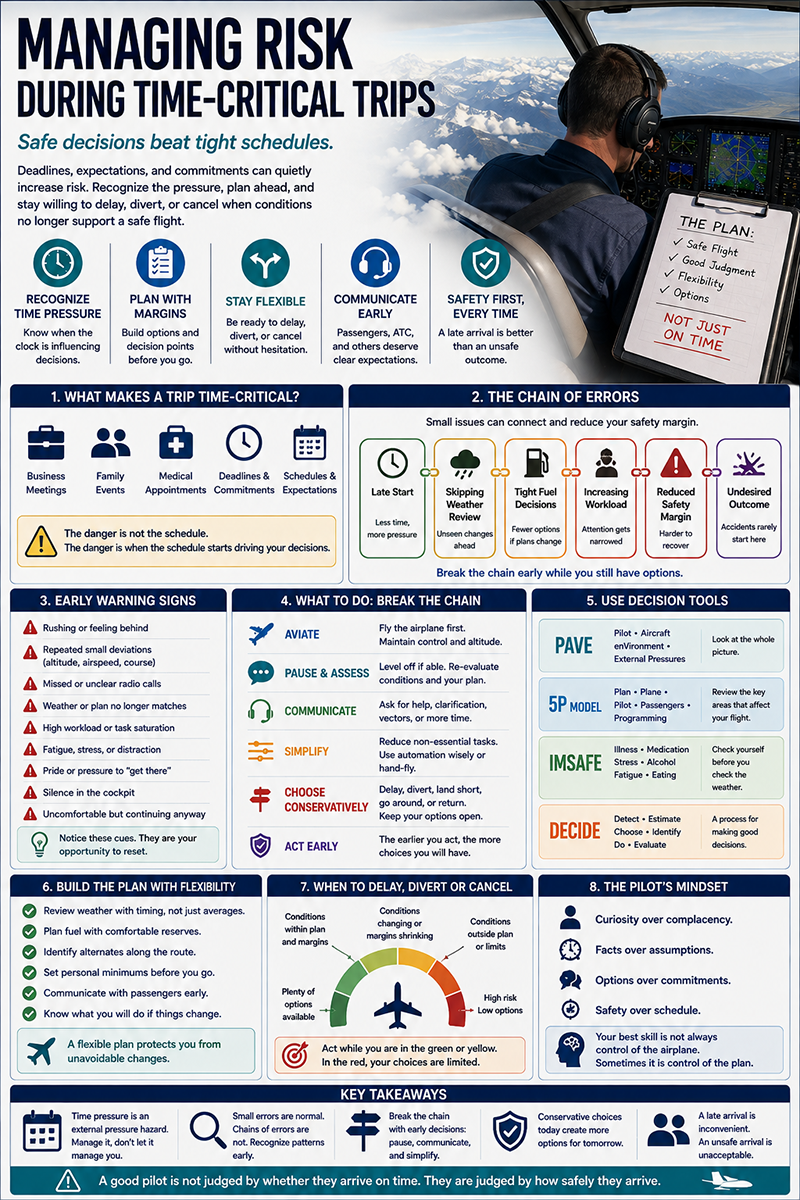
Managing risk during time-critical trips is one of the most important decision-making skills a pilot can develop. A flight that begins with a deadline, a business meeting, a family event, a medical appointment, a passenger expectation, or a return-to-work commitment can quietly change the way a pilot evaluates weather, fuel, fatigue, aircraft status, and personal readiness. The airplane may be airworthy, the pilot may be qualified, and the route may look familiar, yet the pressure to arrive can become the most significant hazard in the entire operation.
Time pressure does not automatically make a flight unsafe. Many aviation operations are built around schedules, and professional crews manage time-sensitive missions every day. The difference is that safe time-critical flying requires structure. The pilot must recognize external pressure early, build decision points before the pressure peaks, and remain willing to delay, divert, land short, or cancel when conditions no longer support the plan. This article explains how pilots, student pilots, flight instructors, and aviation professionals can approach time-critical trips with disciplined aeronautical decision-making rather than hope, momentum, or wishful thinking.
What Makes a Trip Time-Critical?
A time-critical trip is any flight where arrival time begins to influence the pilot’s willingness to accept risk. The pressure may come from passengers, employers, clients, family, aircraft scheduling, weather windows, daylight, rental return times, or personal pride. It may be obvious, such as a pilot trying to reach a business meeting. It may also be subtle, such as a student pilot feeling embarrassed about canceling a long-planned cross-country with an instructor.
The operational danger is not the schedule itself. The danger is schedule-driven decision drift. A pilot may begin the day with reasonable personal minimums, then gradually reinterpret those minimums as the trip becomes more inconvenient to change. Marginal weather becomes “probably good enough.” A fuel stop becomes “unnecessary if the winds hold.” A fatigue concern becomes “I can push through one more leg.” A maintenance discrepancy becomes “something to watch.” None of these thoughts is automatically reckless, but each one deserves deliberate analysis when a deadline is present.
Time-critical flying tends to compress decision-making. The pilot has less emotional space to evaluate alternatives and may feel that every option is costly. Canceling might disappoint passengers. Diverting might create hotel, rental car, or work complications. Delaying might miss a connection or event. Those consequences are real, but they must be separated from flight safety consequences. The airplane does not know why the pilot is late. Weather, fuel burn, night conditions, terrain, and aircraft performance do not become more forgiving because the purpose of the trip is important.
Why This Matters in Real-World Aviation
In real-world aviation, time pressure often interacts with other risks rather than standing alone. A pilot might be dealing with lowering ceilings, stronger-than-forecast headwinds, passenger discomfort, unfamiliar airspace, a late departure, or an aircraft that is not equipped for the most efficient route. Individually, each item may be manageable. Combined with a hard arrival time, the pilot may become more vulnerable to pressing on.
This is especially relevant in general aviation because many pilots operate without the layers of dispatch support, crew cross-checking, and formal operational control found in larger commercial environments. A single pilot may be acting as dispatcher, weather analyst, maintenance evaluator, passenger service representative, and aircraft commander. When the trip is important, the pilot must create personal systems that provide some of the discipline a professional operation would otherwise impose.
Flight instructors see this dynamic early in training. A student may want to complete a solo cross-country before a checkride deadline. A private pilot may want to keep a planned family trip after weeks of preparation. An instrument student may be tempted to view an instrument rating as a solution to all weather-related delays, even though instrument flying adds workload and requires proficiency, equipment, planning, and suitable alternates. A commercial pilot applicant may treat a long training day as something to endure rather than a risk factor to manage. These are teaching opportunities, not just scheduling problems.
Aviation professionals also face time-critical risk in more subtle forms. A corporate pilot may feel pressure to satisfy a principal’s schedule. A ferry pilot may be trying to meet a maintenance slot. A flight school may be trying to keep aircraft utilization high. A maintenance test flight may be squeezed between other commitments. The professional standard is not to ignore the schedule. The professional standard is to manage the schedule without allowing it to take command of the aircraft.
How Pilots Should Understand Time Pressure
Time pressure is best understood as an external pressure hazard. It is not visible on a weather chart and it does not appear on an engine display, but it can shape every decision the pilot makes. In practical terms, external pressure is anything outside the immediate safety of the flight that encourages the pilot to continue, launch, or accept a reduced margin.
One useful way to manage this risk is to separate the mission goal from the flight decision. The mission goal might be “arrive by 2:00 p.m.” The flight decision should be “is this operation acceptable under the conditions that exist now and are reasonably expected along the route?” Those are different questions. A safe answer to the second question may conflict with the first, and the pilot must be prepared for that conflict before starting the engine.
Decision-making models such as PAVE, 5P, and IMSAFE are valuable because they slow the pilot down and force a broader view. PAVE looks at the Pilot, Aircraft, enVironment, and External pressures. The 5P model encourages regular review of the Plan, Plane, Pilot, Passengers, and Programming. IMSAFE prompts a pilot to consider illness, medication, stress, alcohol, fatigue, and emotion. These models are not magic formulas. Their value is in creating a habit of asking disciplined questions before time pressure narrows the pilot’s judgment.
For time-critical trips, the external pressure category deserves special attention. A pilot should ask: What happens if I arrive late? What happens if I do not arrive today? Who needs to know that aviation plans can change? What alternative transportation is available? Where can I land and stop without making the situation worse? What decision will I be tempted to make later if I do not decide now?
The last question is especially important. Some decisions are easier on the ground than in the air. It is easier to plan a conservative fuel stop before departure than to accept one after realizing the headwind is stronger than expected. It is easier to brief passengers about possible delays before boarding than to disappoint them while descending toward an unplanned airport. It is easier to set a weather minimum before takeoff than to negotiate with yourself as ceilings lower ahead.
The Risk Chain in Time-Critical Trips
Time-critical trips rarely become difficult because of one dramatic event. More often, the risk increases through a chain of small compromises. The first compromise may be a late start. The second may be skipping a more detailed weather review because the pilot already checked earlier. The third may be loading quickly and missing a passenger briefing. The fourth may be deciding not to stop for fuel because the route still appears within range. The fifth may be continuing toward deteriorating weather because turning around would make the trip impossible.
Breaking the chain requires recognizing small compromises while they are still small. A late start is not just an inconvenience; it may affect daylight, winds, fatigue, convective timing, destination services, and passenger expectations. A fuel decision is not just a math problem; it affects options if the destination becomes unavailable. A weather deviation is not just a route change; it may affect terrain, airspace, communication, and fuel. Time pressure turns ordinary changes into decision traps when the pilot does not update the plan.
The safest pilots treat the original plan as a draft, not a promise. They actively revise it as new information becomes available. If the plan no longer provides acceptable margins, they do not try to force the aircraft back into the schedule. They change the schedule to fit the flight environment.
Building a Plan That Can Survive Delay
A strong time-critical trip plan includes more than a route and estimated time en route. It includes decision points, alternates, passenger communication, fuel strategy, weather timing, and a realistic look at pilot workload. The goal is not to remove all uncertainty. The goal is to prevent uncertainty from being handled at the worst possible time.
Start with the schedule. If the trip truly matters, ask whether flying is the only acceptable transportation option. Sometimes the safest aviation decision is to combine flying with another plan, such as departing earlier, positioning the aircraft the day before, arranging ground transportation from a nearby airport, or identifying a commercial airline backup. These options may be inconvenient, but they reduce the chance that the pilot will treat the aircraft as the only remaining solution.
Next, examine the weather with timing in mind. Weather that is acceptable in the morning may not be acceptable in the afternoon. A route that is comfortable in daylight may be far less comfortable at night. A destination with good conditions at departure time may be forecast to change by arrival. For instrument-capable pilots, the question is not simply whether the flight can be conducted under IFR. The question is whether the pilot, aircraft, route, weather, alternates, and workload support a safe operation from takeoff through landing, including missed approaches and diversions if needed.
Fuel planning should also be treated as an options strategy. Required reserves are minimums, not a reason to plan tightly. Extra fuel can buy time, but it does not solve every problem, and it may affect weight and balance or performance. A well-planned fuel stop can reduce uncertainty and fatigue, especially when headwinds, weather deviations, or holding are possible. The important point is to decide fuel strategy based on margins, not embarrassment about stopping.
Passenger management is another major part of the plan. Passengers may not understand that light aircraft operations are more sensitive to weather, daylight, turbulence, and airport conditions than airline travel. A clear preflight briefing can remove pressure before it begins. Tell passengers that safety decisions may result in delay, diversion, or cancellation, and that those decisions are normal aviation outcomes. When passengers understand that flexibility is part of the plan, they are less likely to become unintentional sources of pressure later.
Weather, Fuel, Fatigue, and Aircraft Status
Time-critical trips most often become challenging when multiple risk categories converge. Weather, fuel, fatigue, and aircraft status deserve deliberate attention because each can degrade the pilot’s choices, especially when the clock is working against the plan.
Weather is the most obvious factor, but the key is not just whether the weather is legal or forecast to be flyable. The key is whether the weather supports the pilot’s skill, recency, equipment, route, and escape options. A VFR pilot facing marginal visibility and lowering ceilings has a very different risk picture than a proficient instrument pilot in an appropriately equipped aircraft, but neither pilot is immune to pressure. Instrument proficiency is not a guarantee of comfort, and a legal instrument flight can still involve high workload, icing concerns, convective weather, strong winds, or challenging alternates.
Fuel is often where optimism enters the plan. A pilot may look at planned fuel burn, forecast winds, and reserve requirements and conclude that the flight works. But time-critical pressure can make the pilot less willing to update that conclusion when the winds are not as expected or routing changes. Good fuel management includes comparing planned fuel to actual fuel at regular intervals and being willing to land before the situation becomes urgent. The earlier a pilot chooses a fuel stop, the more airports and options usually remain available.
Fatigue is harder to quantify, which makes it easier to dismiss. A pilot who wakes early, works a full day, loads bags, manages passengers, flies multiple legs, and then faces night or weather may not be operating at the same level as during a short local flight. Fatigue affects attention, memory, hand-flying precision, communication, and the willingness to reconsider a plan. Time pressure may also increase stress, which can narrow focus and make the pilot more reactive.
Aircraft status should be treated plainly and conservatively. If equipment is inoperative, deferred, intermittent, or unfamiliar, the pilot should consider how that affects the specific trip. A minor discrepancy on a day VFR local flight may have a different practical effect than the same discrepancy on a long cross-country near sunset with weather along the route. The question is not only whether the aircraft is legal to fly. The question is whether the aircraft is suitable for this mission under these conditions.
Common Mistakes and Misunderstandings
One common mistake is believing that a good reason to arrive makes the flight more justifiable. In aviation decision-making, the importance of the destination does not reduce the hazards. It may increase them by making the pilot less objective. A wedding, business meeting, holiday, or medical appointment may be emotionally important, but it does not change weather, aircraft performance, or pilot limitations.
Another misunderstanding is treating personal minimums as flexible guidelines only when they are inconvenient. Personal minimums are most valuable when pressure is high. If a pilot lowers them in the moment, they stop functioning as a safety tool. That does not mean personal minimums can never evolve. They should evolve through training, proficiency, equipment, and experience. They should not be revised in flight because the pilot is late.
A third mistake is failing to tell passengers the truth early. Pilots sometimes avoid discussing uncertainty because they do not want to create concern. The result is that passengers board expecting airline-like certainty. Later, when conditions require delay or diversion, the pilot feels like they are breaking a promise. A better approach is to brief flexibility as normal. The pilot can be confident and professional without guaranteeing an arrival time.
Another risk is relying on technology without maintaining judgment. GPS, datalink weather, electronic flight bags, autopilots, and flight planning apps can significantly improve situational awareness when used correctly. They can also make a marginal plan look more precise than it really is. Weather products may have age, resolution, or interpretation limitations. Fuel calculations depend on accurate inputs. Automation reduces workload only when the pilot understands its modes, limitations, and failure modes. Technology supports decision-making; it does not make the decision.
Pilots also sometimes confuse legality with wisdom. Regulations define minimum standards and operating rules, but a flight can be legal and still be poorly planned for the pilot, aircraft, weather, or schedule involved. Good risk management asks a broader question: is this a sound operation with adequate margins and credible alternatives?
Practical Example: The Meeting That Can Wait
Consider a private pilot planning a 260 nautical mile daytime cross-country to attend a late-afternoon business meeting. The aircraft is a familiar single-engine airplane. The pilot is current and comfortable with the route. The forecast shows VFR conditions at departure and destination, but a weak frontal boundary is expected to bring lower ceilings and scattered rain near the destination later in the day. Surface winds are forecast to produce a moderate headwind. The pilot originally planned to depart at 9:00 a.m., arrive before lunch, and have plenty of time to reach the meeting.
The morning begins poorly. A work call runs long, fueling takes extra time, and passengers arrive late. The new departure time is 11:15 a.m. The pilot still wants to go because the trip looks possible and canceling would be inconvenient. At this point, the flight has not become unsafe by itself, but the risk picture has changed. The later departure reduces schedule margin, moves the arrival closer to the forecast weather change, increases the chance of fatigue later in the day, and makes a fuel stop more disruptive.
A disciplined pilot pauses before departure and rebuilds the plan. The pilot reviews updated weather, recalculates fuel with current winds, identifies two suitable en route airports, and calls the passengers together for a short briefing. The pilot explains that the flight will launch only if the updated plan provides comfortable margins, and that landing short or diverting is a normal option. The pilot also contacts the meeting organizer and explains that weather may affect arrival. This single communication reduces the psychological pressure to force the flight.
After departure, the headwind is stronger than planned and the destination ceiling trend is lower than expected. Instead of stretching the flight, the pilot lands at a planned intermediate airport with fuel, services, and ground transportation. The meeting is missed in person but attended remotely. The aircraft remains safely on the ground while the weather continues to change. No heroic decision was made. The safe outcome came from recognizing that the trip goal had changed and that the pilot still had good options before the situation became urgent.
This example is intentionally ordinary. Most good aviation decisions do not look dramatic. They look like early phone calls, conservative fuel stops, honest passenger briefings, and an aircraft parked safely at an airport that was not the original destination.
Best Practices for Pilots
The most effective time-critical risk management begins before the flight becomes stressful. Pilots should make the safest decision the easiest decision by building flexibility into the plan. That includes earlier departure options, realistic arrival commitments, alternate airports, backup transportation, and a willingness to tell others that aviation schedules are conditional.
Use personal minimums as pre-commitments. Before looking for reasons to go, decide what conditions would make the flight unacceptable. Consider ceiling, visibility, surface winds, crosswinds, convective activity, icing potential, fuel margin, night operations, terrain, pilot fatigue, and aircraft equipment. The exact minimums should reflect the pilot’s certificate, ratings, proficiency, aircraft, and operating environment. The important habit is deciding them before the pressure builds.
Plan decision points along the route. A decision point is a place or time where the pilot will deliberately reassess the flight rather than simply continue. It might be before crossing a mountain range, before passing the last convenient fuel stop, before sunset, before entering an area of lower ceilings, or before committing to a destination with limited alternates. The pilot should decide in advance what conditions will trigger a diversion or landing.
Manage passengers as part of the safety system. A passenger who understands the plan can become an ally. A passenger who expects guaranteed arrival can become pressure, even without saying a word. A brief, professional explanation is enough: “We are planning to go, but weather and safety drive the final decision. If conditions change, we may delay, stop for fuel, land short, or continue by ground transportation.”
Keep the aircraft and avionics workload realistic. If the trip involves unfamiliar avionics, busy airspace, instrument procedures, night conditions, or complex weather, the pilot should be honest about workload. Automation can help, but only if the pilot is proficient with it. A time-critical flight is not the best setting to learn a new flight planning app feature, unfamiliar autopilot mode, or complex avionics workflow.
Use short, practical triggers to interrupt get-there thinking. For example:
- If the actual fuel remaining is meaningfully below the plan, land earlier than planned.
- If the weather trend is worse than expected, reassess before entering the affected area.
- If fatigue is increasing, treat it as a flight condition, not a character flaw.
- If passengers or outside commitments are influencing the decision, say that out loud and reset the plan.
- If the safest option feels embarrassing, it is still the safest option.
These triggers are not substitutes for regulations, aircraft procedures, or sound judgment. They are reminders that risk management is most effective when the pilot acts early.
How Instructors Can Teach This Skill
Flight instructors have a unique opportunity to teach time-critical risk management before a pilot faces it alone. The lesson should go beyond telling students not to get pressured. Students need practical experience identifying pressure, communicating changes, and making conservative decisions without feeling like they failed.
Scenario-based training is especially useful. An instructor can present a planned cross-country with a changing forecast, a late passenger, a maintenance delay, or a stronger-than-expected headwind. The goal is not to trap the student. The goal is to help the student practice updating a plan, explaining the decision, and selecting alternatives. A student who learns that diverting can be a sign of good command judgment is better prepared for real-world flying.
Instructors should also model healthy cancellation culture. If every canceled flight is treated as a lost opportunity, students may learn that completing the schedule matters more than making a sound decision. A cancellation can still be a valuable lesson if the instructor reviews the weather, discusses alternatives, and explains what conditions would support a future go decision.
Operational Considerations for Aviation Professionals
For professional pilots and operators, time-critical risk management is also a communication and culture issue. The safest organizations make it clear that operational decisions belong to appropriately qualified aviation decision-makers and that schedule pressure should be surfaced, not hidden. When pilots feel they must absorb pressure silently, risk increases.
Professional operations benefit from clear preflight discussions about mission priorities, alternates, duty day considerations, aircraft status, weather, and passenger expectations. If a passenger, client, or manager needs to understand that a departure or arrival is conditional, that conversation should happen early. Clear language matters. “We will evaluate the weather again at noon and decide whether the trip remains practical” is better than implying certainty where none exists.
Maintenance and aircraft readiness also deserve attention. A time-sensitive mission can tempt people to minimize discrepancies or defer difficult conversations. The better approach is to evaluate the aircraft against the mission, not the calendar. If an aircraft limitation, equipment issue, or maintenance concern affects the safety or practicality of the trip, it should be addressed openly and early.
Frequently Asked Questions
Is it unsafe to fly when a trip has a deadline?
No. A deadline does not automatically make a flight unsafe. The risk increases when the deadline starts influencing decisions about weather, fuel, fatigue, aircraft condition, or alternatives. A time-critical trip can be managed safely when the pilot builds flexibility into the plan and remains willing to delay, divert, or cancel.
How can a pilot tell when external pressure is affecting judgment?
A useful warning sign is when the pilot begins looking for reasons to continue rather than objectively evaluating reasons to stop or change the plan. Other signs include minimizing weather trends, resisting a fuel stop, avoiding passenger conversations, feeling embarrassed about canceling, or treating a late arrival as unacceptable regardless of conditions.
Should pilots use personal minimums for time-critical trips?
Yes. Personal minimums are especially valuable when a trip is time-sensitive because they provide a decision framework before pressure builds. They should reflect the pilot’s proficiency, aircraft, equipment, terrain, weather, and recency. They should not be lowered in the moment simply to preserve a schedule.
What is the best way to brief passengers about possible delays?
Keep the briefing simple, calm, and professional. Explain that aviation plans depend on weather, aircraft status, pilot readiness, and safety margins. Tell passengers before departure that delay, diversion, a fuel stop, or cancellation may be part of the plan. This reduces surprise and helps prevent passenger expectations from becoming pressure.
Does an instrument rating solve the problem of time-critical weather?
No. An instrument rating can expand a pilot’s operating capability when the pilot is current, proficient, and flying a properly equipped aircraft, but it does not eliminate weather risk. Workload, icing potential, convective weather, alternate planning, fuel, terrain, and pilot fatigue still matter. The rating is a tool, not a guarantee of arrival.
When should a pilot decide to divert or land short?
The best time to decide is before options become limited. If fuel, weather, daylight, fatigue, aircraft status, or workload are trending in the wrong direction, an early diversion is usually easier and safer than waiting. Preplanned decision points help the pilot act while there are still several good choices available.
Key Takeaways
- Time-critical trips require deliberate risk management because schedule pressure can quietly distort weather, fuel, fatigue, and aircraft decisions.
- The safest pilots build options before departure, including conservative fuel planning, passenger briefings, alternate airports, and backup transportation.
- Personal minimums, decision points, and honest communication help pilots keep command authority with safety rather than the clock.