
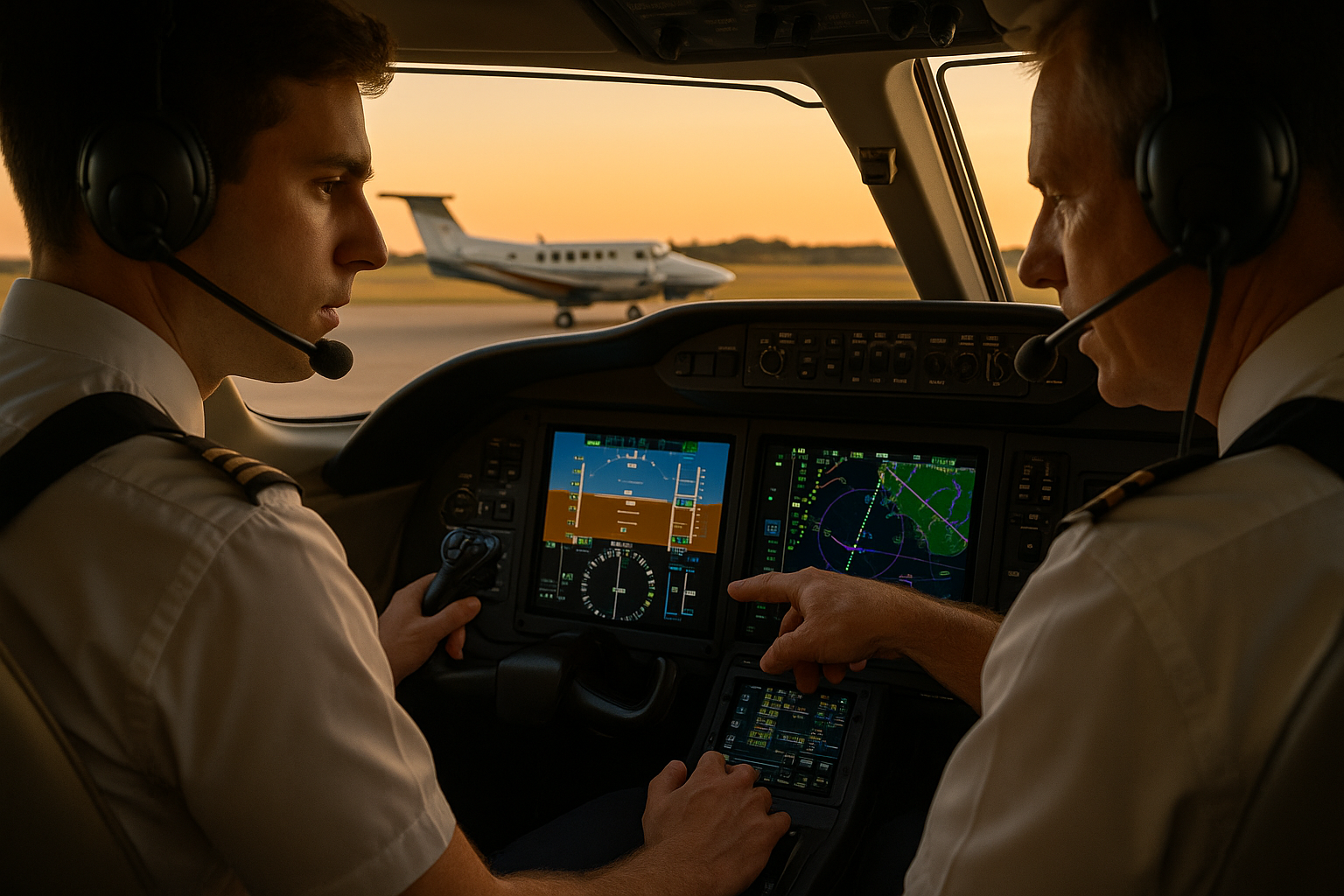
Transition to jets is a turning point in a pilot's career. Moving from piston or turboprop propeller aircraft to turbine-powered jets changes the aircraft's systems, aerodynamic behavior, speed management, and operational environment. For pilots, instructors, and aviation professionals, understanding these differences is essential to remain safe and effective when carrying passengers, flying at higher altitudes, or operating in commercial and corporate environments.
This article explains the operational and training implications of moving from propeller aircraft to jets. It focuses on the practical skills and judgment pilots must develop: systems knowledge, energy and speed management, high-altitude aerodynamics, automation use, and decision-making under different operational pressures. The goal is to give pilots a realistic, safety-centered road map for building competence and confidence in jets.
Core differences between propeller aircraft and jets
The most obvious difference when you step from a propeller airplane into a jet is speed, but speed is only part of the story. Jet transition involves changes across four broad areas: propulsion and power management, aerodynamic behavior at higher speeds and altitudes, aircraft systems complexity, and operational context.
Propeller aircraft typically respond quickly to power changes and are often flown with a pitch-for-speed mental model: add power, reduce pitch; reduce power, increase pitch. Turbine jets require a different approach. Thrust changes are subject to engine spool-up and spool-down lag. Pilots must think in terms of energy management: using pitch and thrust together to control airspeed and energy state. Jet handling emphasizes anticipating the aircraft's response rather than reacting to immediate throttle changes.
High-altitude aerodynamics also become a central concern. Jets routinely operate in flight levels where true airspeeds are much higher while indicated airspeeds are moderated by indicated Mach and flap placard speeds. Compressibility effects, Mach tuck tendencies, and the need for step climbs or managed cruise profiles are unfamiliar to many pilots who trained only in low-altitude, propeller aircraft.
Finally, systems complexity grows. Jets commonly have pressurization and environmental control systems, bleed air systems, FADEC or full-authority engine controls, automated flight management systems, complex electrical systems, and more elaborate anti-ice and fuel systems. Mastery of these systems is as important as stick-and-rudder skills. You will spend meaningful training time learning how and when to use automation safely.
Why this matters in real-world aviation
Transitioning to jets influences nearly every operational decision a pilot makes. In the real world, that includes planning for longer and higher flights, different fuel planning practices, performance considerations for shorter windows of acceptable runway conditions, and increased interactions with ATC at higher flight levels and faster closure rates.
Safety considerations multiply with speed and complexity. A small delay in recognizing an energy deviation at jet speeds can result in larger deviations at touchdown. Systems failures at cruise altitude require different priorities and procedures than similar failures in low-altitude propeller flying. Additionally, many jet operations involve multi-crew coordination, stricter standard operating procedures, and higher expectations for procedural discipline.
From a training standpoint, the jump to jets is not only about handling; it is an expansion of responsibility. Pilots must be prepared for a broader risk environment: passenger expectations, larger financial exposure, and, for many, operation in controlled or commercial airspace. Training for these responsibilities needs to emphasize both technical competence and judgment, and it should simulate real-world operational pressure whenever practical.
How pilots should understand the technical differences
Understanding the technical differences between propeller aircraft and jets helps you translate knowledge into safer flying. Break the transition down into systems, aerodynamics, performance, and cockpit management.
Systems: Jets introduce pressurization controls, more complex fuel management with multiple tanks and pumps, bleed-air-dependent systems, and electrical redundancy schemes. Engine management in jets relies on understanding turbine behavior. Unlike piston engines, turbine thrust development depends on spool-up time and may be governed by full-authority engine control. Familiarize yourself with normal and abnormal procedures for engine start, bleed air management, and pressurization limits.
Aerodynamics and handling: At jet cruise altitudes the relationship between indicated airspeed and true airspeed changes; Mach effects can influence stability and trim. Jets tend to be more sensitive to flap and slat settings when flown near flap speed limits, and their lift-to-drag characteristics vary differently with speed compared to propeller aircraft. Learn to interpret the airspeed indicator and Mach readout and to anticipate the effects of configuration changes at higher energy states.
Performance planning: Jets operate with higher takeoff and approach speeds, and runway distance planning must account for heavier weights and associated climb gradients. Jets often use takeoff derates, flaps, or other procedures to manage engine life and takeoff distances. Landing performance is influenced by Vref selection, which is typically higher than in prop aircraft, and by required touchdown zones that are more demanding because of higher energy.
Cockpit management: Modern jets include flight management systems (FMS) and autopilot/flight director modes that automate navigation, climb, cruise, and descent profile control. Learn mode awareness thoroughly. Understand VNAV, LNAV, managed versus selected modes, and how autopilot coupling affects flight path and energy. Automation can reduce workload but becomes a hazard when pilots lose mode awareness or rely on automation for tasks it was not configured to perform.
Common mistakes and misunderstandings
Many accidents and incidents during transitions stem from treating a jet like a propeller airplane. The most common misunderstandings are around power response, speed control, automation, and systems management.
Power misconception: Expecting immediate thrust response when advancing throttles can lead to late responses in critical phases like go-arounds. Spool lag means you must plan earlier and accept that power changes take longer to affect airspeed.
Speed and energy management errors: Pilots accustomed to lower speeds often let approach speed creep above safe margins or, conversely, reduce speed too aggressively. High approach speeds reduce landing margins and increase runway required. Failing to stabilize a jet approach early is a common error; the correct response is a timely go-around rather than forcing a landing.
Automation misuse: Overreliance on automation without understanding modes leads to mode confusion and unexpected aircraft behavior. Common issues include selecting conflicting modes, leaving the autopilot engaged when manual flying would be safer, and trusting the FMS to manage fuel or anti-ice decisions without crosschecking.
Systems underutilization or mismanagement: Not using temperature, pressurization, or ice protection systems correctly can compromise safety. For instance, misunderstanding bleed air usage or failing to set pressurization schedules can create uncomfortable or unsafe conditions at altitude.
Practical example: a first training flight in a light business jet
Imagine a pilot who is proficient in a high-performance single-engine piston aircraft preparing for a supervised first flight in a light business jet with an instructor. The preflight briefing emphasizes that this flight is primarily about situational awareness, systems familiarity, and the jet's handling at higher speeds and altitudes rather than full mission completion.
Preflight: The student and instructor walk through the aircraft's fuel plan, crossfeed logic, and electrical system. They review the pressurization schedule and confirm the oxygen and emergency descent procedures. Weight-and-balance is checked with a focus on how small CG shifts affect stability at higher speeds.
Takeoff and climb: The instructor demonstrates the takeoff with a focus on thrust management and trim. Instead of aggressively pitching to a climb attitude, the instructor shows how to set a target pitch attitude and use thrust to achieve the desired acceleration and climb rate while monitoring engine parameters for correct spool behavior. The student practices shallow bank turns and learns how the jet's higher airspeed changes the feel and roll rate.
Cruise and systems: At cruise altitudes the instructor introduces the FMS, shows how to enter a simple flight plan, and demonstrates VNAV-managed climb and cruise. The pilot practices monitoring the pressurization system, interpreting cabin differential readings, and performing a simulated avionics or bleed-air failure to observe diversion decisions and checklist flow.
Approach and landing: The instructor emphasizes a stabilized approach profile and sets firm go-around criteria. The student practices a go-around to experience managing thrust with spool-up lag while retracting flaps and setting the climb profile. The landing highlights energy judgment; the pilot learns how much speed reduction is safe in different flap settings and how to use runway markings and touchdown zone awareness to manage touchdown point.
Best practices for pilots transitioning to jets
Adopt a training strategy that balances systems study, simulator time, and real-world supervised flying. Use staged learning: begin with systems and procedures on the ground, progress to simulator practice of abnormal scenarios and high-altitude work, then move to supervised flights concentrating on energy management and automation use.
Key practical habits to develop:
- Learn systems actively. Don't memorize checklists without understanding what the systems do and why checks exist.
- Practice mode awareness. When using autopilot and FMS, verbalize modes and expected aircraft behavior to build a cognitive habit of crosschecking.
- Anticipate spool lag. Initiate power changes earlier than you would in a propeller airplane, and practice go-arounds to make the timing intuitive.
- Use stabilized approach criteria. Establish clear personal or operator criteria for when an approach must be continued or when a go-around is the safer choice.
- Build scenario-based training. Simulate failures and diversions so decision-making under pressure becomes practiced and predictable.
Human factors and cockpit resource management
Jet operations often place pilots in multi-crew environments where crew resource management (CRM) is essential. For single-pilot jet operations, the pilot must manage workload and automation with the same discipline multi-crew crews use. Communication, standardized callouts, and strict briefings reduce error potential.
Expectation management is another human factor. Passengers expect smooth, on-time travel. That expectation can create subtle pressure to accept marginal conditions or to continue unstable approaches. Train to protect your decision-making from external pressures and rehearse assertive go-around and diversion decisions.
Training pathway and credentialing considerations
The specific training pathway varies with aircraft complexity, operator standards, and regulatory requirements. Many successful transitions combine ground school covering systems and performance, simulator sessions for abnormal procedures and high-altitude operations, and line-oriented supervised flights focusing on real traffic and ATC interactions.
Check with your regulatory authority and the operator for certification, currency, and any type-rating requirements that may apply to the jets you will fly. Regulatory and operator standards determine whether you need a formal type rating, supervised line familiarization, or specific checkride or proficiency checks. Because requirements vary by aircraft and jurisdiction, consult the relevant regulatory guidance or an approved training organization for definitive answers.
Maintenance and operational planning differences
Operational planning for jets emphasizes fuel management, high-altitude considerations, and system redundancy. Jets may require more detailed alternates planning due to higher fuel burn and different diversion profiles. Weight-and-balance calculations and runway performance planning are usually more sensitive, particularly for smaller business jets operating from shorter runways or at higher density altitudes.
On the maintenance side, jets have different inspection and servicing needs. Turbine engines have different operating cycles and cooldown procedures. Systems such as pressurization require checks that are not present on many propeller aircraft. As a pilot, your preflight and walk-around vigilance improves safety by catching anomalies that could become larger problems in flight.
Common scenarios that warrant special attention
Several operational scenarios are particularly demanding for pilots transitioning to jets. These include high-density-altitude departures, single-engine failures during initial climb, inadvertent penetration into icing at climb or descent, and high-altitude systems failures such as loss of pressurization or electrical anomalies. Practice these scenarios in the simulator; the mental model and muscle memory built during rehearsal will significantly improve your handling when they occur in real flight.
Frequently Asked Questions
How much training do I need to transition to jets?
The amount of training depends on your prior experience, the complexity of the jet, and operator or regulatory requirements. Expect a combination of ground study, simulator practice, and supervised flights. Consult an approved training provider or your regulator for precise credentialing and currency rules.
Do I need a type rating to fly a jet?
Type-rating requirements vary by aircraft and regulatory jurisdiction. Some turbine-powered and transport-category aircraft require a type rating. Always confirm with the relevant aviation authority or your operator's training department to determine specific requirements for the aircraft you intend to fly.
What is the hardest skill to master when moving from prop aircraft to jets?
Many pilots identify energy management and automation mode awareness as the hardest skills. Learning to anticipate engine spool behavior and to control speed through coordinated pitch and thrust inputs, while maintaining situational awareness of autopilot/FMS modes, usually takes the most practice.
Can turboprop experience help when transitioning to jets?
Turboprop experience is valuable because it introduces turbine engine characteristics, systems complexity, and higher-performance operations. However, turboprops still differ in thrust response and typical cruise altitudes, so additional jet-specific training remains necessary.
How do I prepare physically and mentally for jet operations?
Study systems and standard operating procedures thoroughly, build scenario-based simulator practice, and adopt conservative personal minima. Mentally rehearse decision paths for diversions, go-arounds, and systems failures so you respond deliberately rather than reactively under pressure.
Key Takeaways
- Practical takeaway: Learn systems, practice energy management, and use simulators to rehearse abnormal scenarios before flying jets in operational settings.
- Safety takeaway: Prioritize stabilized approaches and maintain firm go-around criteria; anticipate engine spool lag and manage speed proactively.
- Training and decision-making takeaway: Combine ground systems study with scenario-based simulator and supervised flights; verify regulatory and operator credentialing requirements before operating a new jet type.
Transitioning from propeller aircraft to jets is a rich professional step that rewards careful study, measured training, and disciplined decision-making. Focus on systems understanding, refine your energy-management judgment, build automation mode awareness, and cultivate sound cockpit resource management. Those elements, practiced in realistic training environments, are the foundation for safe, confident jet operations.