
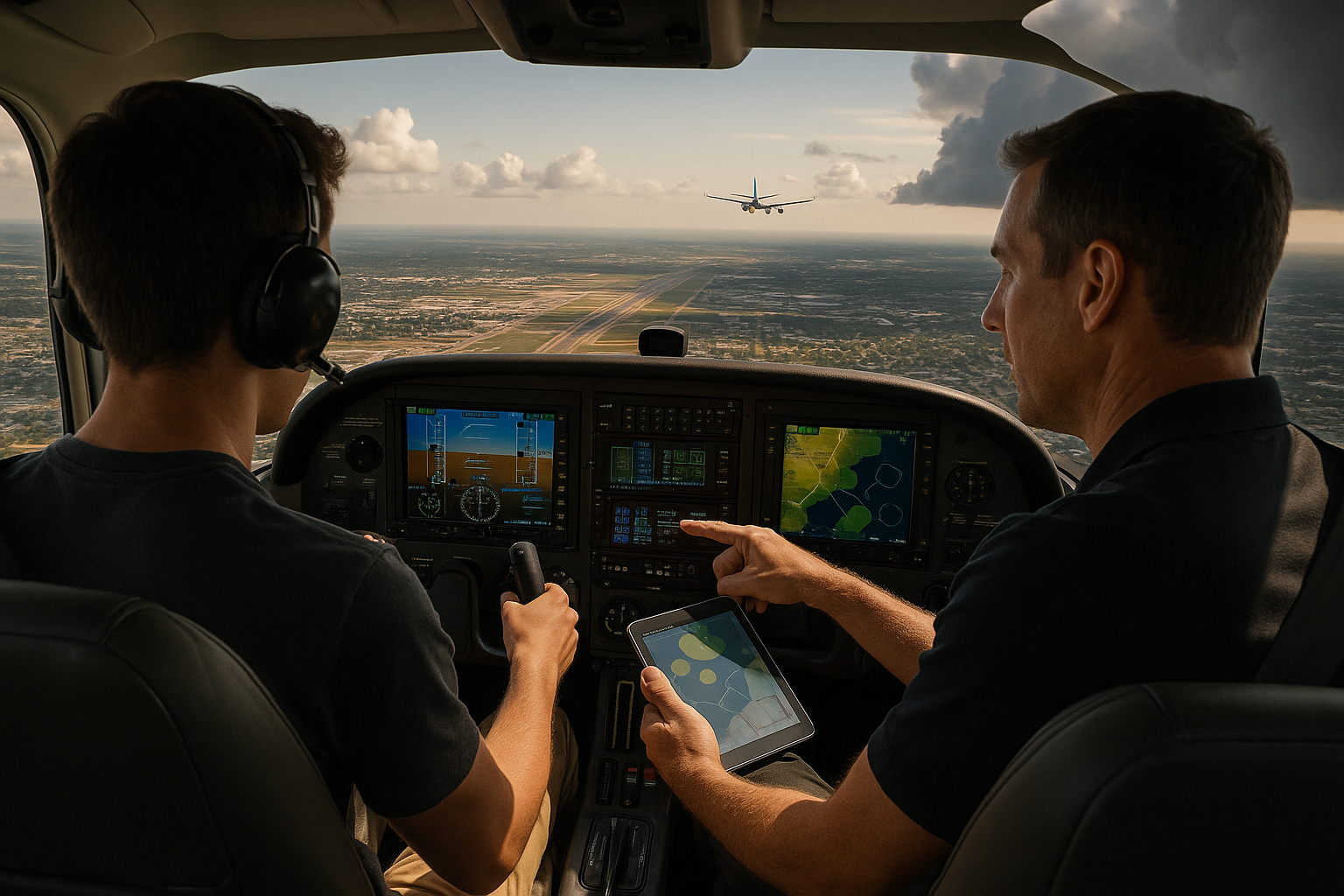
Turbulence avoidance is a core skill for every pilot operating in busy airspace. Whether you are a student pilot learning wind shear and wake turbulence concepts, a flight instructor training cross-country navigation into a Class B terminal area, or a professional flying scheduled routes, understanding how turbulence forms, how to recognize it, and how to make operational decisions around it reduces risk and improves passenger comfort.
This article explains turbulence avoidance with an emphasis on practical decision-making inside crowded airspace. You will get clear descriptions of common turbulence types, how to interpret weather and traffic information, what to communicate to air traffic control, and the mindset to balance safety, ATC constraints, and efficient flight. The primary keyword, turbulence avoidance, appears early because recognizing the problem is the first step toward managing it.
What turbulence avoidance means in practical terms
At its heart, turbulence avoidance is not an attempt to eliminate all bumps. It is a process that starts with planning, uses tools and communications to gather situational awareness, and culminates in safe, timely pilot actions to reduce exposure to hazardous or uncomfortable conditions. In busy airspace, the process must respect traffic density, ATC procedures, and airspace constraints. Effective turbulence avoidance reduces structural load risks, minimizes injuries to occupants, and helps maintain orderly traffic flow.
Think of turbulence avoidance as three linked activities: anticipation, recognition, and response. Anticipation happens on the ground during preflight planning. Recognition occurs in flight when you identify the turbulent source and intensity. Response includes decisions such as altering speed, changing altitude, requesting a vector, or delaying the flight. Each step requires information, judgment, and clear communication.
Why this matters in real-world aviation
Turbulence is a leading cause of in-flight injuries to unrestrained occupants and can contribute to loss of control incidents when combined with other hazards. In busy airspace, the margin for error is smaller because aircraft operate closer to one another, and ATC constraints may limit available routing or altitude changes. Pilots who can anticipate and respond to turbulence maintain safety margins while minimizing disruption to the flow of traffic.
For flight instructors and student pilots, working turbulence avoidance into training builds better judgment and prepares pilots for operational scenarios such as crossing boundaries between controlled sectors, joining approach patterns, or flying near large aircraft. For commercial and corporate operators, turbulence avoidance complements risk management programs and supports consistent decision procedures for dispatchers, pilots, and controllers.
Types of turbulence and their operational signatures
Understanding the source of turbulence helps you avoid or mitigate it. Common types you will encounter in busy airspace include wake turbulence, convective turbulence, mechanical turbulence, clear-air turbulence, wind shear, and mountain wave turbulence. Each has identifiable conditions and operational signs.
Wake turbulence comes from lift-generating surfaces of another aircraft and is concentrated behind and below the generating aircraft. In terminal areas with mixed traffic, wake encounters are common when following or crossing paths of larger aircraft. The severity correlates with aircraft weight, wing design, and configurations such as flaps and slats.
Convective turbulence is produced by strong vertical motion in thunderstorms and cumuliform clouds. In busy airspace, convective areas often force aircraft into narrow corridors, increasing exposure to turbulence from storm outflow or embedded shear zones. Convective turbulence can be abrupt and severe; avoidance via routing or delay is the preferred tactic.
Mechanical turbulence occurs where airflow is disrupted by terrain, buildings, or obstacles. Near airports surrounded by complex terrain or urban features, mechanical turbulence may create low-level bumps especially at lower altitudes during takeoff and landing phases.
Clear-air turbulence (CAT) typically occurs at cruise in the vicinity of jet streams, frontal zones, or strong vertical wind shear where there are no visual cues. It is often encountered at higher altitudes but can appear during climbs and descents when crossing shear layers. CAT is especially relevant to enroute segments through busy high-altitude corridors.
Wind shear involves a rapid change in wind speed and/or direction over a small distance. Low-level wind shear, including microbursts, is hazardous during approach and departure because it affects airspeed and lift close to the ground. Recognizing wind shear advisories and pilot reports is essential for safe operations in terminal areas.
Mountain wave turbulence and rotor activity form downwind of terrain and can extend far downstream. When operating near mountainous airports or through valleys, foresee wave-related turbulence even if the sky appears calm on one side of the ridge.
How pilots should understand turbulence avoidance in busy airspace
Start with preflight planning. Use available weather products, including terminal aerodrome forecasts, graphic weather briefings, SIGMETs and AIRMETs where applicable, and convective forecasts. Look for indicators of turbulence risk: strong winds aloft, frontal activity, convective development, rapidly changing temperatures, and reported pilot reports. Incorporate traffic flow and known heavy-jet schedules into your plan; arrival and departure waves often correlate with increased wake turbulence risk.
During taxi and before takeoff, brief turbulence contingencies with your passengers and crew. A simple, explicit brace and seatbelt call reduces injury risk if you encounter unexpected turbulence shortly after departure. Ensure cargo and cabin items are secured; loose items can become projectiles when the airplane experiences sudden motion.
In flight, maintain a vigilant scan for visual and instrumentation cues. PIREPs (pilot reports) are valuable real-time sources. When other pilots report turbulence at your planned altitude or beneath/above you, use that information intelligently: a report of moderate turbulence at a given altitude does not guarantee the same intensity a few miles away but signals a need for caution. If operating near larger aircraft, be mindful of wake turbulence separation and vortex avoidance techniques. When in doubt, adjust your timing or lateral position to reduce risk of encountering concentrated vortices.
Communicate proactively with ATC. In busy airspace you will often need a clearance to change altitude or route. State your request clearly and provide the reason, for example, "request 1,000-foot climb to avoid turbulence" or "request vector to avoid convective cells." Controllers are generally cooperative when safety is the rationale, but be prepared for traffic constraints and have alternatives in your mind. If you must deviate immediately for safety, communicate as soon as practicable and follow-up with your controller without delay.
Adjust speed thoughtfully. When turbulence is expected or encountered, reducing to maneuvering speed as defined in the aircraft flight manual helps protect the airframe and gives you better control margin. Avoid abrupt control inputs; use smooth, measured inputs to maintain attitude and energy. If you are flying a light aircraft, remember that maneuvering speed varies with weight. Refer to the POH for your aircraft rather than a fixed speed value.
Tools and data to support turbulence avoidance
Modern pilots have access to a range of tools that improve situational awareness. Onboard weather radar is effective for convective avoidance; use it to identify reflectivity cores and storm motion. Turbulence-specific products, such as turbulence forecasts and graphical turbulence guidance, provide clue lines about where CAT or wind shear risk exists. ADS-B traffic and weather can help identify other aircraft flying through rough air; a trailing aircraft's altitude and track combined with reported ride quality can be a practical indicator.
Flight planning tools and dispatch briefings often include turbulence indices and route-specific guidance. Incorporate these products into go/no-go decisions. If your operation has access to a dispatcher or operations control, coordinate to find routing or altitude changes that minimize turbulence for the whole flight. When flying single-pilot, make conservative choices and prioritize safety over schedule.
Common mistakes and misunderstandings
Pilots frequently underestimate the persistence of a turbulent area and overestimate the flexibility of their traffic environment. A few common errors show up repeatedly in training and operations.
Undercommunicating or delaying requests to ATC. In busy airspace, late requests to deviate or climb limit ATC options. Ask early, be concise, and include a reason. Controllers can often provide routing alternatives if given time. If turbulence is sudden and severe, communicate immediately that you are deviating for safety and follow up with formal coordination as required.
Failing to consider wake turbulence from heavy aircraft. A small airplane following a heavy on approach or departure is vulnerable to wake encounters. Simple timing or lateral spacing adjustments can reduce exposure. Do not assume standard separation automatically protects you; when operating visually, be conservative about following distances and approach positions.
Overreliance on a single data source. Weather radar, PIREPs, SIGMETs, and turbulence forecasts each have strengths and weaknesses. Relying exclusively on one source can create blind spots. Combine tools and adapt to what the sky and reports are telling you.
Improper speed technique. Some pilots instinctively speed up in turbulence, seeking control authority. The safer approach is to slow to the appropriate maneuvering speed and fly a stable pitch attitude. Significant speed excursions increase structural loads and reduce margin for recovery.
Neglecting passenger and cabin briefings. Unsecured occupants or service items increase injury risk. Brief passengers and secure the cabin before known turbulent segments such as climb through inversion layers or descent into a congested terminal area affected by terrain-induced turbulence.
Practical example: approaching a busy terminal with patchy turbulence
Scenario: You are flying a single-engine turboprop on an IFR approach to a busy Class B airport. A heavy-jet arrival stream precedes you, and ATC has vectoring options that place you near the heavy-jet final approach track. The weather briefing indicated moderate turbulence aloft and scattered cumulus with gusty surface winds.
Anticipation: Before leaving cruise, you note the heavy-jet arrival peaks at specific times. You review the approach chart and identify alternative approach fixes and initial approach altitudes that give lateral separation from the heavy-jet final. You brief the approach and turbulence plan with your crew and secure loose items.
Recognition: While descending, you receive a PIREP from a pilot at your planned altitude reporting moderate turbulence. You also observe that the heavy jets are generating wake vectors that could drift into your inbound path. Your onboard instruments show occasional airspeed fluctuations consistent with gusts.
Response: You contact ATC and request a slightly higher initial approach altitude or an early vector to stay above the wake vortex layer. You state the operational reason: avoiding reported turbulence and potential wake. ATC accommodates by giving an offset vector that increases lateral separation. You slow to maneuvering speed and brief the passengers. On final, you maintain a stabilized approach, avoid sudden flare inputs, and accept a slightly higher approach speed to retain control authority while keeping sink rate steady. You note the heavy's landing and wait additional time before crossing its touchdown point if your departure timing requires it.
Outcome: By anticipating risk, using reports, and communicating clearly with ATC, you reduce your exposure to turbulence and maintain a stable, safe approach in a busy environment.
Best practices for pilots
Adopt a risk-based mindset. Treat turbulence avoidance as one more risk element in your flight. Use conservative margins when operating single-pilot or with non-technical passengers.
Plan early: review weather, traffic flows, and turbulence forecasts during preflight and briefing.
Communicate clearly: request deviations or altitude changes with a simple reason tied to safety, and be prepared with alternatives.
Adjust speed: reduce to the aircraft's appropriate maneuvering speed as listed in the POH; avoid abrupt control movements.
Prioritize restraint: brief passengers and secure cabin items before turbulent segments and enforce seatbelt use.
Use PIREPs and ATC traffic advisories: they are often the best real-time indicator of turbulence in busy corridors.
When crossing behind large aircraft, allow time or lateral separation to avoid wake vortices; if uncertain, consult ATC for recommended spacing.
Training implications and instructor guidance
Flight instructors should incorporate turbulence avoidance into both preflight briefings and in-flight decision-making exercises. Practical training includes recognizing turbulence sources, interpreting PIREPs and weather products, and practicing radio calls to ATC requesting deviations. Simulated scenarios that constrain ATC options help students learn to prioritize safety while managing workload and communication demands.
Use scenario-based training to present competing demands: a tight fuel state, a passenger who is uncomfortable, and an ATC traffic restriction. Teaching students to present clear, concise requests to ATC and to manage aircraft configuration and speed under stress improves their ability to handle real events. Emphasize that safe deviation comes first when the aircraft is in immediate danger, but prompt communication is essential to preserve traffic flow and maintain coordination.
Dealing with ATC constraints and crowded airspace
Busy airspace means controllers are balancing many aircraft, and their options may be limited. When requesting turbulence-related deviations, be concise, include the safety reason, and offer alternatives. For example, "request 500-foot climb to avoid moderate turbulence" or "request vector around convective cells." If ATC cannot immediately accommodate, ask for suggested altitudes or vectors rather than insisting on a particular fix. Controllers may propose a different solution that achieves both safety and traffic flow goals.
Remember that ATC provides separation based on clearances. If you deviate without coordination for immediate safety reasons, inform ATC as soon as practical. In many busy operations, a short delay in communication can create conflicts; keeping the controller informed preserves safety for everyone.
Common misunderstandings about turbulence avoidance tools
Onboard weather radar is powerful for convective avoidance but not a cure-all. Radar reflectivity shows precipitation and vertical development but does not directly measure turbulence intensity. Bright radar returns often indicate strong updrafts and potential severe turbulence, but light returns can still be associated with mechanically induced turbulence. Similarly, satellite imagery provides a useful big-picture view but lacks the resolution to identify localized shear or wake vortices.
Another misconception is that turbulence reports are universally reliable. PIREPs are subjective and depend on aircraft type, weight, and pilot perception. A light aircraft pilot may report moderate turbulence where a heavier aircraft experiences only light turbulence. Use PIREPs as directional indicators rather than absolute measures.
When to delay or cancel an approach
Decisions to delay or cancel an approach hinge on safety, aircraft capability, and operational considerations. If you encounter unexpected severe turbulence, or if clearing hazards such as convective cells or wind shear affect the airport environment, a go-around, hold, or diversion is a valid and safe option. In busy terminals, discuss your intentions with ATC and coordinate for a safe alternate. Safety-driven diversions are appropriate when continued approach would place the aircraft or occupants at unacceptable risk.
Frequently asked questions
How should I change speed when I encounter turbulence?
When turbulence is expected or encountered, slow to the maneuvering speed published in your aircraft flight manual or POH. That speed provides a buffer to prevent structural overstress from abrupt control inputs. Use smooth, measured control inputs rather than abrupt corrections and avoid rapid changes in power or configuration unless required for safe flight.
Can I deviate from my clearance to avoid turbulence?
If deviation is necessary for immediate safety, a prompt deviation is appropriate. Communicate with ATC as soon as practicable to advise of the deviation and intentions. When possible, request a deviation before making major changes so ATC can coordinate traffic. In busy airspace, be prepared to accept alternate routing and to work with controllers to find a safe resolution.
What is the best way to avoid wake turbulence in approach and departure?
Increase spacing and avoid the flight path of a heavy aircraft. When possible, fly at or above the heavy's flight path and avoid flying directly behind. Use lateral offsets where feasible and follow published separation guidance and ATC instructions. When operating visually, allow additional time and distance before crossing the heavy's touchdown or lift-off point.
How reliable are PIREPs for turbulence avoidance?
PIREPs provide timely information but are subjective. Consider the type of aircraft that reported the turbulence and its altitude. Use PIREPs in combination with other radar, forecasts, and your own observations. Treat them as useful situational clues rather than definitive measurements.
What should I brief to passengers before entering expected turbulence?
Brief passengers that turbulence is likely and ask them to fasten seatbelts, stow loose items, and follow crew instructions. Explain how long the turbulence may last if you have a reliable estimate and reassure them that you will make adjustments to improve comfort and safety. A calm, clear briefing reduces anxiety and improves compliance with safety measures.
Key Takeaways
- Plan and anticipate turbulence hazards during preflight and approach briefings to reduce exposure and increase safety.
- Prioritize safety and communication: slow to maneuvering speed, secure the cabin, and coordinate with ATC for deviations when possible.
- Train with scenario-based exercises: practice decision-making in busy airspace to build the judgment needed for safe turbulence avoidance.
Managing turbulence in busy airspace is as much about judgment and communication as it is about flying technique. By integrating weather awareness, traffic information, and established control techniques you will reduce risk, maintain safe flight paths, and preserve the integrity of traffic flows. Use the concepts in this guide as a foundation for continued training, and expand them through scenario practice and real-world experience.