
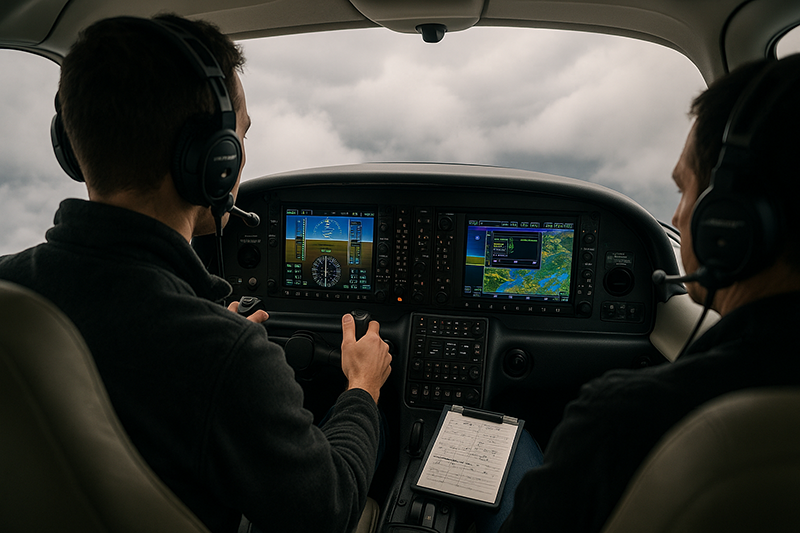
Unexpected route amendments are a normal part of instrument flying, but they can quickly turn a calm cockpit into a high-workload environment. A route amendment may be a simple new fix, a full reroute, a revised departure or arrival transition, a vector to join a new airway, or a clearance that changes the flight plan you briefed on the ground. For pilots, student pilots, instructors, and aviation professionals, the skill is not just copying the clearance. The real skill is understanding the new clearance, confirming it, programming it correctly, and making sure the aircraft can safely fly it.
Handling unexpected route amendments well requires more than fast handwriting or familiarity with the GPS. It combines communication discipline, aircraft control, navigation awareness, fuel and weather judgment, and workload management. A pilot who treats a reroute as an operational decision instead of a clerical task is far less likely to accept a clearance that creates confusion, terrain concerns, fuel pressure, airspace issues, or an avoidable cockpit distraction.
What Is an Unexpected Route Amendment?
A route amendment is any ATC-issued change to the route previously cleared, filed, briefed, or expected. In IFR operations, route amendments often occur because of traffic flow, weather, special-use airspace, runway configuration, equipment outages, preferred routing, or coordination between facilities. A pilot might receive an amendment before takeoff, during climb, in cruise, while being vectored, or near the terminal environment.
Some amendments are small. ATC may clear you direct to a nearby fix, assign a heading to intercept an airway, or revise one waypoint in the route. Other amendments are more consequential. A controller may issue an entirely new route containing unfamiliar fixes, airway segments, altitude restrictions, or a different arrival. The operational risk increases when the pilot is hand-flying, in weather, close to terrain, approaching busy airspace, or already managing a task such as a frequency change, checklist, abnormal indication, or avionics setup.
In VFR operations, pilots receiving flight following may also hear suggested or assigned routing, especially around busy terminal airspace. The exact nature of the instruction depends on the operation and airspace, but the same cockpit principles apply: aviate first, understand the instruction, clarify anything uncertain, and avoid allowing navigation changes to degrade aircraft control or situational awareness.
Why Route Amendments Happen in Real-World Aviation
Pilots often file a route that makes sense from the cockpit: efficient, familiar, weather-aware, and compatible with aircraft performance. The air traffic system has a broader picture. It must sequence aircraft, separate traffic, manage sector workload, comply with flow programs, protect restricted areas, and adapt to rapidly changing weather and runway use. A route that looks ideal during preflight planning may not be the route ATC can use at the time you depart or arrive.
Weather is one of the most common practical reasons for route changes. Thunderstorms, icing potential, widespread low ceilings, turbulence, convective SIGMET areas, or embedded precipitation can push aircraft away from originally planned fixes. Even when your aircraft can legally and physically fly through certain conditions, ATC may be moving many aircraft around the same weather. A reroute may be designed to keep traffic organized while allowing pilots to avoid the worst areas.
Traffic flow can also drive amendments. On busy days, especially near major terminal areas, ATC may use preferred routes or arrival streams that differ from what a pilot expected. A general aviation aircraft, a training flight, a turboprop, and a jet may all be using the same sectors at different speeds and altitudes. A new route may help a controller fit your aircraft into the system in a predictable way.
Equipment status and procedure availability matter as well. NAVAID outages, GPS interference areas, unusable fixes, closed routes, temporary flight restrictions, and runway changes can all lead to route amendments. The key point for pilots is that a route amendment is not automatically a problem. It becomes a problem when the cockpit handles it casually, copies it incorrectly, programs it under pressure, or accepts it without understanding the operational consequences.
How Pilots Should Understand a Route Amendment
The best way to handle a route amendment is to separate it into three questions: What exactly did ATC clear me to do, can I safely comply, and how will I execute it without losing control of the bigger flight picture? This sounds simple, but the pressure of real-time radio communication can cause pilots to skip one of those steps.
First, identify the clearance limit and the route. If ATC says, “cleared direct” to a fix, the instruction may be straightforward. If ATC issues a longer reroute, listen for the sequence of fixes, airways, transitions, and any altitude or heading instructions that affect how the route begins. If the controller gives a heading to join a route, do not treat it the same as direct navigation. A heading, an intercept, and direct-to navigation are different commands that can produce different ground tracks.
Second, determine whether you can comply. “Can comply” means more than “the GPS can draw the line.” Consider aircraft performance, fuel, weather, terrain, airspace, alternates, pilot workload, and avionics capability. If a reroute adds meaningful distance, fuel planning deserves immediate attention. If a route takes you near convective weather, icing conditions, mountainous terrain, or unfamiliar busy airspace, you may need clarification, a different routing, or more time before accepting a complex change.
Third, manage execution. When workload is high, it is often better to ask ATC to “say again,” request a delay vector, or advise that you need a moment before programming. In a two-pilot cockpit, one pilot should maintain aircraft control and radio awareness while the other enters and verifies the route. In a single-pilot cockpit, the pilot must be willing to slow the tempo. Aircraft control, terrain clearance, and traffic awareness are more important than rushing to load a new clearance into the navigator.
The Readback Is a Safety Tool, Not a Formality
A good readback protects both the pilot and the controller. It confirms that the clearance was heard correctly and gives ATC a chance to catch an error before the aircraft proceeds in the wrong direction. When a route amendment is short, a concise readback may be enough. When it is complex, the readback should include the critical elements that define the clearance: fix names, airways, headings, altitudes if assigned, and any transition or arrival information that changes the flight path.
Pilots should resist the temptation to read back only the last part of a long reroute or to respond with “roger” when a full readback is needed. “Roger” means the transmission was received, but it does not confirm that the pilot correctly understood the amended routing. If the clearance includes unfamiliar fixes, similar-sounding waypoints, or a complicated airway sequence, ask for phonetic spelling or a slower repeat.
Student pilots and instrument trainees sometimes feel that asking ATC to repeat a clearance signals weakness. In reality, clarifying a clearance is professional cockpit behavior. Controllers would rather repeat a route than watch an aircraft proceed incorrectly, miss an intercept, or require corrective vectors. A pilot who is uncertain should not pretend otherwise.
Avionics Programming and Verification
Modern avionics make route amendments easier, but they also introduce new failure modes. A GPS navigator, flight management system, or electronic flight bag can accept a revised route quickly, but the pilot still must verify that the displayed course matches the clearance. Automation does not know what ATC meant unless the pilot enters the correct fix, transition, airway, procedure, and activation point.
One common trap is selecting the wrong waypoint with a similar identifier or name. Another is activating a leg that bypasses an intermediate fix the controller expected you to fly. Pilots can also create an unintended course reversal, delete a hold or procedure segment, or load an arrival transition that does not match the amended clearance. These are not equipment failures. They are human-machine interface errors that occur when time pressure, unfamiliar avionics, and incomplete verification overlap.
The moving map is helpful, but it should not be the only verification. Compare the route line to the clearance, the chart, and your mental picture of the flight. Ask: Does the new line go generally where I expect? Does it join the correct airway? Does it take me toward the correct arrival gate? Is the active leg the one I intend to fly? Are there discontinuities, course reversals, or unexpected turns? If the route does not make sense, stop and resolve it before allowing the aircraft to wander into uncertainty.
For training, instructors should teach students to verbalize the verification step. A simple spoken flow such as “cleared direct ABC, then V123 to DEF, loaded, active leg direct ABC, course agrees, distance reasonable” helps build disciplined habits. The words matter less than the mental process: enter, verify, brief, and monitor.
Fuel, Weather, and Alternate Planning After a Reroute
A route amendment can change the economics and safety margins of a flight. Even a modest-looking deviation may add distance, time, or headwind exposure. In IFR operations, especially at night, over sparsely populated areas, or in marginal weather, fuel planning should be revisited whenever a route change is significant.
The question is not only whether the aircraft has enough fuel to continue. The better question is whether the new plan preserves appropriate reserves, keeps alternates realistic, and leaves room for additional delay. If the reroute moves the aircraft away from planned alternates or over less favorable terrain, that matters. If it pushes arrival later into deteriorating weather or reduces options for fuel stops, that matters too.
Weather avoidance also requires judgment. A route amendment may help with system flow but not perfectly match the pilot’s onboard weather picture, visual observations, or aircraft capability. Conversely, onboard weather information can have latency or limitations, and it should not be treated as a perfect tactical display. Pilots should use all available information, including ATC assistance when appropriate, to avoid accepting a route that leads into conditions beyond the aircraft, pilot, or mission.
Common Mistakes and Misunderstandings
The first common mistake is treating every route amendment as mandatory in the practical sense. If a pilot cannot safely comply, does not understand the clearance, lacks the equipment, or needs more time, the professional response is to say so. The phrase “unable” exists for a reason. It should be used respectfully and with useful context, such as “unable direct due weather” or “unable at this time, request present heading while we program.”
A second mistake is accepting a route before understanding where it goes. This often happens when a pilot is trying to sound efficient on the radio. The clearance is copied, read back, and entered, but the pilot never builds a mental picture. Minutes later, the aircraft is heading toward unexpected terrain, weather, airspace, or a large course change. Understanding must come before blind execution.
A third mistake is over-focusing on the panel. In single-pilot IFR, a reroute can pull the pilot’s head down at the worst possible time. Airspeed, altitude, heading, vertical mode, traffic, and terrain awareness can all deteriorate while the pilot scrolls through waypoint pages. If the amendment is complex, ask for help. A delay vector, heading, or repeat of the clearance can be a practical way to buy time.
A fourth misunderstanding involves “direct-to” navigation. Direct-to a fix is not the same as being cleared for every route segment beyond that fix unless the rest of the clearance provides that route. Likewise, being assigned a heading does not mean the pilot should independently turn direct to the next fix unless cleared or instructed. Pilots should fly the clearance actually issued, not the route they assume ATC intended.
Another error is failing to update the rest of the cockpit plan. If the route changes, the arrival briefing may change. Fuel numbers may change. The top-of-descent point may change. Frequencies, alternates, terrain considerations, and weather decisions may change. A reroute is not fully handled until the flight plan, avionics, charts, crew briefing, and pilot expectations are aligned.
Practical Example: A Reroute During IFR Cruise
Consider a single-pilot instrument flight in a piston aircraft cruising at 7,000 feet on an IFR flight plan. The pilot filed a familiar route through two VOR fixes and then direct to the destination area. Midway through the flight, buildups appear ahead and ATC issues: “Amended routing, advise ready to copy.” The pilot is in smooth air, but the aircraft is near a layer of cloud tops and the autopilot is maintaining altitude.
A disciplined response begins before copying. The pilot confirms the autopilot mode, checks that the aircraft is stable, and prepares to write. If workload is not manageable, the pilot can say, “stand by” or request the clearance again when ready. Once ready, the pilot copies the amended route: direct to a new fix, then an airway segment, then a different arrival transition.
The pilot reads back the route carefully, including the unfamiliar fix and airway. One fix sounds similar to another in the database, so the pilot asks for spelling. ATC clarifies. The pilot then enters the route, but does not immediately trust it. The moving map shows the new route bending north around weather, then joining the arrival from the northwest. The pilot compares the displayed line to the chart, confirms the active leg is direct to the clarified fix, and checks the estimated time and fuel at destination.
The fuel calculation shows the reroute adds enough time to reduce the margin more than expected. The pilot still has legal and practical options, but a nearby fuel stop and an alternate become more attractive. The pilot advises ATC of a possible fuel stop if further delays occur and continues while monitoring weather and fuel trends. The key lesson is that the pilot did not treat the reroute as finished after the readback. The pilot stabilized the aircraft, clarified the clearance, verified the avionics, reassessed fuel, and kept decision options open.
Best Practices for Pilots
Good reroute management starts before the flight. During preflight planning, study likely preferred routes, nearby fixes, major airways, terminal procedures, terrain, alternates, and weather escape options. You do not need to memorize every possible clearance, but you should understand the geography of the route well enough to recognize when an amendment makes sense or creates a concern.
In the cockpit, keep a reliable clearance-copy method available. Some pilots use paper, some use a kneeboard, and others use an electronic scratchpad. The tool matters less than the habit of capturing the clearance accurately. Relying on memory for a complex amendment is a poor technique, especially in turbulence, IMC, or busy airspace.
Use plain language when workload rises. ATC does not need a long explanation if you need help. Short, clear transmissions are effective: “say again amended route,” “request vectors while programming,” “unable due weather,” “confirm cleared direct ABC,” or “we need a minute for fuel planning.” These calls are not signs of poor skill. They are signs that the pilot is managing risk instead of chasing the radio.
The following habits are especially useful when route amendments appear unexpectedly:
- Maintain aircraft control before copying, programming, or briefing the new route.
- Read back the specific routing elements that define the amended clearance.
- Ask for clarification when fixes, airways, headings, or transitions are uncertain.
- Verify the avionics route against the clearance and chart before relying on it.
- Recheck fuel, weather, terrain, alternates, and arrival planning after any meaningful reroute.
- Use ATC as a resource, but do not accept a clearance you cannot safely fly.
Training Implications for Students and Instructors
Route amendment training should not be limited to copying clearances on the ground. Instructors can make this skill realistic by introducing amendments during high-workload phases of simulated IFR flight, while still maintaining safe training conditions. The goal is not to overwhelm the student. The goal is to teach prioritization, communication, and verification.
A useful training scenario might begin with a student flying a published route under the hood or in a simulator. The instructor issues an amended route with one familiar fix, one unfamiliar fix, and an airway intercept. The student must keep the aircraft stable, ask for a repeat if needed, read back the clearance, enter it correctly, and explain how the new route affects fuel and arrival planning. The debrief should focus on process rather than speed.
Instructors should also teach students that real-world flying rarely rewards blind compliance. Compliance with clearances matters, but safe compliance requires understanding. If a student does not know where a fix is, cannot load the route, or is unsure whether the aircraft can meet an instruction, the correct training outcome is to communicate clearly and manage the risk.
Single-Pilot IFR Workload Management
Single-pilot IFR places special demands on the pilot during route amendments. There is no second pilot to copy while you fly or to verify the FMS while you talk. That makes pacing essential. The pilot must know when to slow down the operation, use automation appropriately, and ask ATC for practical assistance.
Autopilot use, when available and properly monitored, can reduce workload during a reroute. However, it should never become an excuse to stop monitoring the aircraft. Confirm the autopilot is doing what you expect, especially after changing navigation sources, activating legs, or switching from heading mode to navigation mode. Many reroute problems begin when the pilot assumes the airplane is following the newly programmed course, but the autopilot remains in a different mode or captures an unintended leg.
If hand-flying, consider whether immediate programming is necessary. A heading from ATC can provide time to copy and set up the route. If you are in IMC, in turbulence, or near a level-off, it may be safer to fly the assigned heading and altitude first, then program when stable. The correct priority remains aircraft control, navigation, and communication, in that order when workload is critical.
Frequently Asked Questions
What should I do if I cannot copy a route amendment fast enough?
Tell ATC you need the clearance repeated or ask them to standby until you are ready. If the aircraft is in a high-workload phase, stabilize the flight path first. It is better to request a repeat than to accept a clearance you copied incorrectly.
Can I refuse an amended route from ATC?
If you cannot safely comply, do not understand the clearance, lack required capability, or need to avoid weather, advise ATC promptly and explain the reason briefly. ATC can often offer an alternative, but they need to know the limitation.
Should I load the new route before reading it back?
Usually, the readback should confirm what you copied and understood from the clearance. Programming may come after the readback, especially if the route is long. In all cases, verify the loaded route before relying on it for navigation.
How do I avoid choosing the wrong waypoint in the GPS?
Check the identifier, name, region, bearing, distance, and chart context. Similar identifiers and multiple database entries can lead to mistakes. If a fix seems geographically wrong, stop and verify before activating the leg.
What if a reroute creates a fuel concern?
Recalculate promptly and communicate early if fuel may become limiting. Consider alternate airports, fuel stops, weather trends, and additional delay. Waiting until the situation is urgent reduces options.
Are route amendments only an IFR issue?
No. They are most formal and common in IFR operations, but VFR pilots receiving ATC services can also receive routing instructions or suggested changes. The same principles of clarification, workload management, and safe compliance still apply.
Key Takeaways
- Unexpected route amendments should be handled as operational decisions, not just radio-copy tasks.
- Aircraft control, clearance understanding, avionics verification, fuel planning, and weather awareness all matter after a reroute.
- If a clearance is unclear or unsafe for your situation, ask for clarification, request time, or advise ATC that you are unable.