
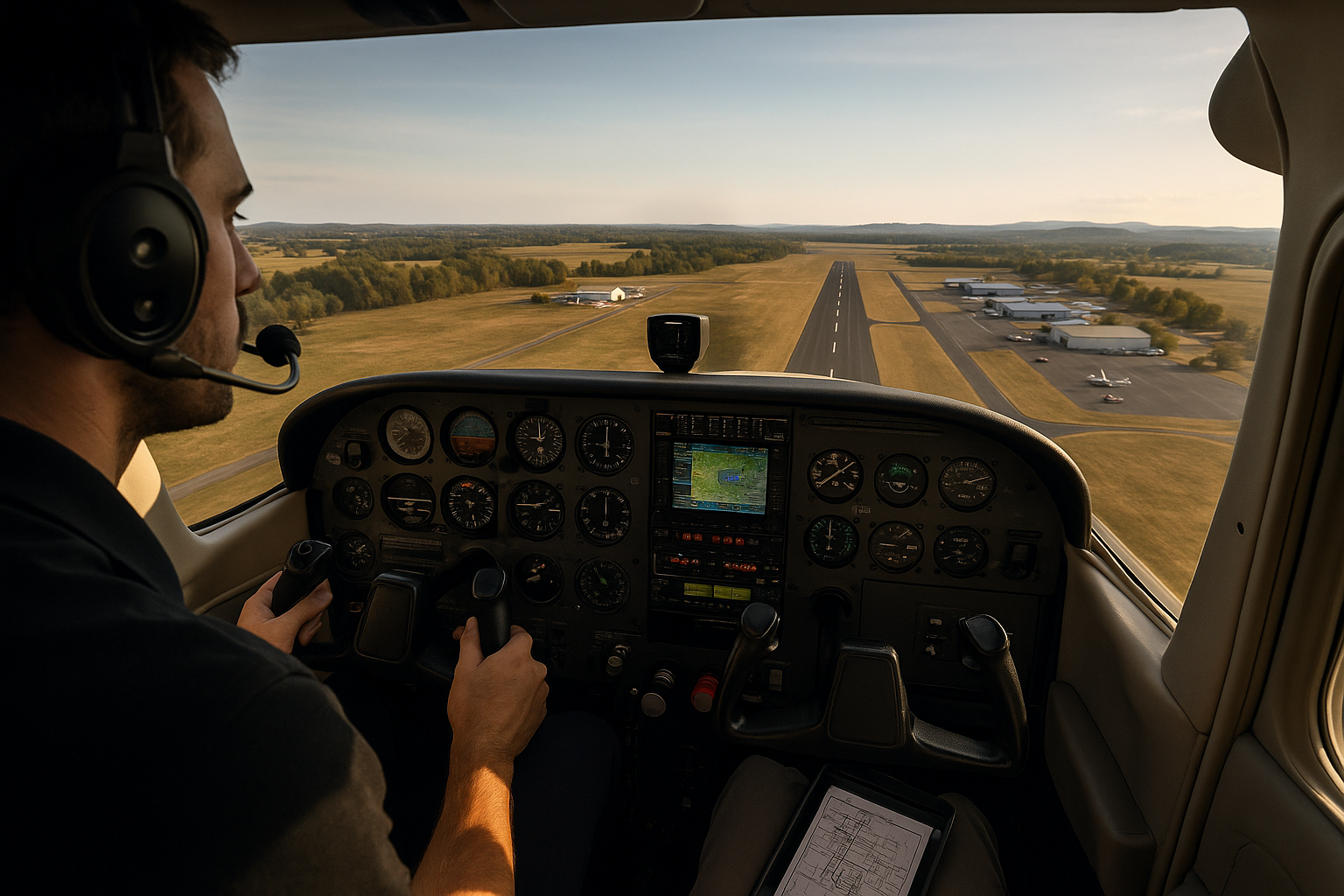
Flying into an unfamiliar airport is one of the most common situations where otherwise capable pilots can become task saturated. The runway may be easy to see on a chart, but the real arrival includes airspace, terrain, traffic flow, runway markings, lighting, communications, wind, taxi routes, and the subtle local habits that do not always become obvious until the airplane is already close to the pattern.
A safe unfamiliar airport arrival begins long before the descent. It starts with disciplined preflight planning, a realistic mental picture of the airport environment, and a willingness to slow the operation down when something does not look right. For student pilots, this is a major step in learning cross-country judgment. For certificated pilots, it is a recurring proficiency challenge. For instructors and aviation professionals, it is a reminder that airport familiarization is not a paperwork exercise. It is part of risk management.
This article explains how to approach an airport you have never visited, or have not visited recently, in a way that supports good decisions in the cockpit. It focuses on practical flying habits: studying airport information, understanding traffic patterns, briefing the arrival, using avionics intelligently, managing communications, recognizing visual illusions, and staying prepared to go around or divert. The goal is not to create a rigid checklist. The goal is to build a repeatable way of thinking that helps pilots arrive with a clear plan and enough spare attention to adapt.
Start With a Complete Airport Picture
Before flying to an unfamiliar airport, a pilot should build a complete picture of the destination environment. That picture should include the runway layout, surface type, runway lengths, traffic pattern information, airport elevation, available services, lighting, communication frequencies, nearby airspace, terrain, obstructions, and any current notices that may affect the flight. The specific tools vary by country, operation, and aircraft equipment, but the principle is the same: do not let the first real understanding of the airport occur from the downwind leg.
Many pilots begin with a moving-map display or flight planning app. These tools are useful, but they should not be the only source of understanding. A moving map can show where the runway is, but it may not make the pilot appreciate a displaced threshold, a short taxiway connector, a right-hand traffic pattern, a runway slope, a noise-sensitive area, nearby towers, or a confusing ramp layout. A good preflight review combines the airport diagram, chart supplement information, NOTAMs or local notices, weather resources, satellite imagery when helpful, and the aircraft performance data needed for that specific runway and condition.
The airport diagram deserves special attention. A pilot should be able to answer several practical questions before arrival: Which runway is most likely based on wind and local flow? Where are the taxiways that connect to parking? Are there hotspots or areas where aircraft and vehicles may converge? Is there a parallel runway or intersecting runway that could create confusion? Where will the pilot exit the runway, and what taxi route is likely after landing? If the airport is towered, the exact taxi route may be assigned by ATC, but pre-briefing the airport layout reduces the chance of missing, misunderstanding, or accepting a clearance that the pilot cannot visualize.
Runway length is another area where pilots should think beyond the published number. A runway that appears adequate in a generic sense may be less forgiving when temperature, elevation, aircraft weight, wind, runway condition, obstacles, or pilot technique are considered. The correct source for performance planning is the aircraft’s approved or manufacturer-provided performance information, used with current conditions and appropriate margins. If the numbers are close, or if the pilot is relying on unusually precise technique to make the arrival work, the safer decision may be to choose another airport, reduce loading, wait for better conditions, or obtain additional instruction.
Why Unfamiliar Airports Increase Pilot Workload
An unfamiliar airport increases workload because it removes the advantage of recognition. At the home airport, a pilot often knows where to look, when to descend, what the traffic flow usually looks like, where the crosswind tends to develop, and which taxiway leads to parking. At a new airport, those familiar cues are missing. The pilot must interpret more information in less time.
That workload often peaks during the arrival phase, when the airplane is descending, the pilot is communicating, configuring, navigating, looking for traffic, listening for runway assignments or position reports, and preparing to land. If the pilot also has to solve basic questions such as “Which runway is that?” or “Where is the pattern entry?” the margin for error decreases. This is why unfamiliar airport flying is not just a navigation task. It is a cockpit workload management task.
Weather can intensify that workload. Haze, low sun angle, precipitation, snow cover, unfamiliar terrain, or a featureless landscape can make the airport harder to identify visually. Wind can also complicate the plan. A pilot may expect one runway based on preflight planning, only to find a different runway in use because the actual wind, traffic flow, runway availability, or local operating practice favors another direction. A safe pilot remains mentally flexible and avoids forcing a preplanned arrival onto conditions that have changed.
Traffic is another major factor. At a nontowered airport, the pilot must integrate with other aircraft using standard practices and local information. At a towered airport, ATC provides sequencing and clearances, but the pilot still remains responsible for aircraft control, compliance with instructions, and avoiding confusion. In either environment, unfamiliarity can lead to missed radio calls, wrong-frequency monitoring, runway misidentification, or poor spacing decisions.
The airport’s surrounding environment matters as much as the runways themselves. Nearby controlled airspace, restricted areas, terrain, noise-sensitive neighborhoods, water, towers, birds, parachute activity, glider operations, military routes, and high-density training areas can all influence the arrival. Some of these items may appear in formal airport data. Others may become apparent through local knowledge, recent pilot reports, or a phone call to the airport, FBO, flight school, or operator when appropriate.
How Pilots Should Brief an Unfamiliar Airport Arrival
A good arrival briefing is short, specific, and timed early enough to be useful. It should not be a rushed monologue at 800 feet above pattern altitude. Ideally, the pilot reviews the arrival during cruise, before the descent, while workload is still manageable. The briefing should create a mental movie of the arrival from the top of descent to shutdown.
For a VFR arrival, the briefing might include the expected runway, traffic pattern direction, field elevation, pattern altitude if published or locally provided, communication frequency, airspace considerations, visual landmarks, anticipated entry method, wind plan, go-around plan, and taxi plan. It should also include an alternate strategy if the airport cannot be identified, traffic is heavier than expected, weather is worse than forecast, or the pilot becomes uncomfortable with the approach.
For an IFR arrival, the briefing should include the assigned or expected instrument approach, approach minimums as applicable to the operation, missed approach procedure, runway environment, expected taxi routing, and transition from instrument to visual references. Even when flying under IFR, the final phase at many airports still requires visual identification, runway alignment, and taxi awareness. The fact that an approach leads to a runway does not eliminate the need to understand the airport layout.
The go-around plan should be part of every arrival briefing. At an unfamiliar airport, a go-around can be triggered by many normal events: unstable approach, unexpected traffic, runway confusion, wind shear, poor spacing, floating beyond the intended touchdown area, late configuration, or simply the pilot not being satisfied with the landing setup. A go-around is not a failure. It is a continuation of controlled flight when the landing conditions are not right.
The taxi plan should also be included. Many pilots mentally stop the flight at touchdown, but runway exits and ground movement at an unfamiliar airport can be just as demanding. Review the likely exit points, ramp location, tower or ground frequency if applicable, and any complex intersections. If unsure after landing, stop at a safe location clear of the runway when appropriate, ask for progressive taxi instructions at a towered airport, or carefully reorient using the airport diagram before continuing at a nontowered airport.
Using Charts, Airport Diagrams, and Avionics Wisely
Modern avionics and electronic flight bags have greatly improved situational awareness, but they can also create overconfidence. The display may show the airplane perfectly aligned with a runway centerline, yet the pilot still needs to verify the actual runway visually, confirm the landing clearance or traffic situation, and maintain proper aircraft control. Technology should support outside visual scanning, not replace it.
When reviewing an airport diagram, pay attention to runway labels, magnetic orientation, displaced thresholds, runway intersections, hold-short lines, and taxiway naming. If the airport has multiple runways with similar orientation, runway identification becomes especially important. Parallel runways, closely spaced airports, and nearby private strips can all create visual traps. The pilot should correlate the runway number, compass heading, GPS track, visual layout, and radio information before committing to land.
Satellite imagery can be helpful for recognizing landmarks and ramp locations, but it has limits. Imagery may be outdated. Construction, closed taxiways, new pavement markings, or changed parking arrangements may not be reflected. Use satellite views as a visual familiarization aid, not as operational authority. Current aeronautical information and real-time airport conditions remain essential.
Traffic displays can also help, especially in busy training areas, but they are not a substitute for seeing and avoiding traffic where visual separation is required. Not all aircraft may be displayed, and displayed targets can lag or lack context. At nontowered airports, a pilot should combine traffic display information with radio calls, visual scanning, predictable pattern behavior, and conservative spacing.
Autopilot use can be valuable during descent and arrival preparation if the pilot is proficient and the system is functioning normally. It can reduce workload while the pilot reviews weather, frequencies, and airport layout. However, automation must not lead to delayed configuration, poor energy management, or heads-down fixation. If automation becomes a distraction, hand-flying a simpler profile may be safer.
Communications at Towered and Nontowered Airports
Clear communication helps reduce uncertainty at an unfamiliar airport, but phraseology alone does not guarantee understanding. A pilot should know which frequency to use, when to use it, and what information is needed before entering the arrival area. Confusion often begins when a pilot is still on an en route frequency, monitoring the wrong common traffic advisory frequency, or delaying the switch until already close to the airport.
At a towered airport, the pilot should listen before transmitting when practical. The flow of radio traffic often reveals the runway in use, traffic sequence, local terminology, and current workload. If a clearance or instruction is unclear, ask for clarification before acting. A concise request for confirmation is better than taxiing, descending, or turning based on a guess.
At a nontowered airport, self-announcing position and intentions is most useful when it is timely, accurate, and easy for other pilots to understand. The pilot should use the correct airport name, position relative to the airport, altitude when helpful, intended runway, and direction of flight. Long or overly detailed calls can clutter the frequency. Short, relevant calls help other traffic build the same mental picture.
One common problem at unfamiliar airports is mixing up airport names or frequencies, especially when nearby airports share similar runway orientations or are located close together. Pilots should verify the frequency, airport identifier, and runway alignment before assuming they are communicating with the traffic they see. If radio traffic does not match the visual picture, pause and resolve the discrepancy.
For student pilots and instructors, unfamiliar airport communications provide excellent training value. The objective is not simply to make the correct radio calls. It is to teach students to listen, interpret, prioritize, and act safely. A well-phrased call is useful only if it supports good situational awareness and aircraft control.
Pattern Entry, Runway Selection, and Visual Verification
Pattern entry at an unfamiliar airport should be predictable and considerate of other traffic. The pilot should use available airport information, observe the wind, listen to traffic, and integrate smoothly. A rushed entry, a nonstandard maneuver, or a late runway change can surprise other pilots and increase collision risk. If the pilot is unsure of the traffic flow, it may be better to remain outside the pattern, gather information, and enter only when the situation is understood.
Runway selection should be based on wind, runway availability, traffic flow, aircraft performance, and local information. A pilot should avoid choosing a runway solely because it appears convenient from the arrival direction. Landing with an unnecessary tailwind, using an unsuitable runway, or entering opposite the established flow can create avoidable risk.
Visual runway verification matters. Runway numbers are based on magnetic direction, rounded to the nearest ten degrees, and should generally agree with the aircraft’s heading when aligned. If the runway number, heading, and airport diagram do not make sense together, the pilot should question the alignment before descending further. This is especially important at airports with intersecting runways, parallel runways, or nearby airports.
Depth perception and approach path judgment can be affected by runway width, slope, surrounding terrain, lighting, and visibility. A narrow runway may make the airplane appear high. A wide runway may make it appear low. An upsloping runway can create the impression of being high, while a downsloping runway can create the impression of being low. These visual effects do not change the aircraft’s actual energy state, but they can influence pilot control inputs. A stabilized approach, proper airspeed, known aiming point, and runway environment awareness help counter those illusions.
Lighting can create its own challenges. At night, an unfamiliar airport may be difficult to distinguish from roads, buildings, or other lighted areas. Pilot-controlled lighting, if available and appropriate, requires knowing the correct frequency and activation method for that airport. At towered airports, lighting may be controlled by the tower. In any case, pilots should not rely on a single cue to identify the runway. Use multiple confirmations.
Energy Management and Stabilized Approaches
Energy management is central to every safe arrival, but it becomes especially important at an unfamiliar airport. When the pilot is busy identifying the runway or listening to traffic, it is easy to arrive too high, too fast, or not properly configured. A stabilized approach gives the pilot a simple standard: the airplane should be on the correct flight path, at an appropriate airspeed, properly configured, aligned with the landing runway, and descending at a manageable rate with only small corrections required.
The exact stabilized approach criteria may vary by aircraft, operation, training program, and company procedure. The important point for personal flying is to define the standard before the approach becomes unstable. If the pilot does not know what “stable” means until after the airplane is fast and floating, the decision point has already moved too late.
At an unfamiliar airport, pilots should be cautious about steep, tight, or improvised approaches unless they are trained, current, and the maneuver is appropriate for the aircraft and environment. A wide, well-planned pattern often provides more time to configure, assess wind, identify traffic, and align with the runway. Conversely, a pattern that is too wide can create spacing problems or make glidepath judgment more difficult. The right answer depends on the airport, aircraft, traffic, and conditions.
A common trap is continuing an approach because the airport was difficult to reach or because the pilot wants to complete the flight. This is a classic decision-making hazard. If the airplane is not in a safe position to land, the pilot should go around. If the second attempt is not improving, consider holding away from the airport, requesting assistance if available, or diverting. Completing the flight at the planned destination is less important than preserving options.
Common Mistakes When Flying Into an Unfamiliar Airport
One common mistake is treating the destination airport as a single point on a GPS route rather than a real operating environment. The magenta line can take the airplane near the field, but it does not determine how to enter the pattern, which runway to use, where the traffic is, or how to taxi after landing. Airport arrival planning must be more detailed than direct-to navigation.
Another mistake is failing to update the plan. A pilot may brief Runway 18 before departure, then discover on arrival that the wind favors Runway 36, traffic is using a different runway, or the airport has an active notice affecting operations. The original plan was useful, but it should not become a mental anchor. Pilots must revise the plan as new information appears.
Runway misidentification is also a risk. This can occur when an airport has multiple runways, when another airport is nearby, when the runway is hard to see, or when the pilot turns final based on expectation rather than verification. Cross-checking heading, runway markings, airport layout, and communications reduces this risk.
Poor frequency management is another recurring issue. Pilots may monitor the wrong frequency, switch too late, miss important traffic information, or transmit with the wrong airport name. This is especially easy when airports are close together or when a pilot is using stored frequencies without confirming them. Frequency setup should be part of the arrival briefing, not an afterthought.
On the ground, unfamiliar airport mistakes often involve taxi confusion. Pilots can miss a turnoff, cross a hold-short line without intending to, enter a ramp incorrectly, or become disoriented after landing. Taxi slowly enough to read signs and markings. If unsure, stop the aircraft in a safe place and reestablish orientation. At towered airports, ask for clarification or progressive taxi instructions if needed.
A more subtle mistake is allowing passengers, schedule pressure, or personal pride to influence the arrival. A pilot may not want to admit uncertainty, go around, ask for help, or divert. Professionalism is the opposite. A safe pilot uses every available resource and is willing to make conservative decisions early.
Practical Example: A First Visit to a Busy Training Airport
Consider a private pilot flying a single-engine airplane to a busy nontowered airport for the first time. The airport has two paved runways, several flight schools, and a ramp on the east side of the field. The pilot plans the flight during the afternoon, when training traffic is likely. The weather is VFR, but visibility is slightly reduced by haze, and the sun will be low during arrival.
During preflight planning, the pilot reviews the runway layout, traffic pattern information, airport elevation, common traffic frequency, and taxiway route from the expected landing runway to the transient ramp. The pilot also checks aircraft landing performance for the expected runway and conditions. Satellite imagery is used only to understand the ramp location and nearby visual landmarks. The pilot notes that another airport lies several miles away on a similar heading, so positive identification will be important.
In cruise, the pilot listens to the destination frequency early enough to build a picture of the traffic flow. Several aircraft are using Runway 27. The pilot had expected Runway 18 based on the initial forecast, but the actual radio traffic and wind information suggest Runway 27 is the better plan. Instead of forcing the original briefing, the pilot updates the arrival plan, reviews the pattern entry for Runway 27, and sets up the airport diagram for quick reference.
Approaching the airport, the pilot remains outside the pattern until the traffic picture is clear. A training aircraft reports midfield downwind, another reports departing, and a third reports a practice approach inbound. The pilot identifies the correct airport using the runway orientation, nearby highway, GPS position, and visible runway layout. The pilot announces position and intentions concisely, enters the flow predictably, and maintains extra attention outside for traffic.
On final, the airplane is slightly high and fast because the pilot extended downwind to follow traffic. Rather than forcing the landing, the pilot reduces power, evaluates the approach, and recognizes that the airplane will not be stabilized by the desired point. The pilot announces a go-around, climbs straight ahead as appropriate for the situation, and re-enters the pattern after confirming traffic. The second approach is stable, aligned, and unhurried.
After landing, the pilot exits the runway, stops clear where appropriate, and reviews the taxi diagram before proceeding to the ramp. The flight took a few extra minutes, but the pilot managed the unfamiliar environment deliberately. The key decisions were made before they became urgent: reviewing the airport, updating the runway plan, delaying pattern entry until traffic was understood, going around when unstable, and taxiing with care.
Best Practices for Pilots Arriving at a New Airport
The best technique for an unfamiliar airport is to move information gathering as early as possible. The more the pilot understands before descent, the less must be solved close to the ground. A disciplined arrival briefing should include the airport layout, runway plan, communications plan, traffic plan, missed or go-around plan, and taxi plan.
Build redundancy into your verification. Do not rely on only one cue to identify the airport or runway. Use the charted layout, runway heading, runway markings, GPS position, visual landmarks, radio traffic, and wind information together. When multiple cues agree, confidence improves. When they do not, slow down and resolve the conflict.
Manage cockpit workload by preparing frequencies, charts, avionics pages, and performance information before arrival. If flying with another pilot or instructor, divide tasks clearly. If flying solo, use automation when appropriate, but avoid spending extended time heads-down during the most traffic-intensive part of the arrival.
Use conservative decision points. Decide in advance when the approach must be stable, when a go-around will be initiated, and when a diversion becomes the better option. These decisions are easier to make before ego, fatigue, passenger expectations, or fuel concerns begin to narrow the pilot’s thinking.
For instructors, unfamiliar airport training should be intentional. Ask the student to brief not only how to get to the airport, but how to operate at the airport. Have the student explain the runway choice, pattern entry, communication plan, taxi route, and go-around plan. This develops judgment rather than rote navigation.
The following habits help pilots arrive more safely without turning the operation into a rigid script:
- Review current airport information, notices, runway layout, and expected services before departure.
- Brief the arrival early, including runway selection, pattern or approach plan, communications, and taxi route.
- Listen to traffic or ATC early enough to understand the current flow.
- Verify the airport and runway using multiple cues before descending to land.
- Maintain a stabilized approach and go around when the landing setup is not right.
- Taxi slowly and deliberately, using the airport diagram until parked.
Special Considerations for Night and Marginal Conditions
Night arrivals to unfamiliar airports require additional caution. Airport lighting, surrounding terrain, and nearby city lights can distort depth perception. A runway surrounded by dark terrain can create a black-hole effect, where the pilot may perceive the aircraft as higher or lower than it actually is. Without good visual references, approach path control depends heavily on instruments, available visual guidance, and disciplined airspeed and descent management.
Before a night arrival, confirm lighting availability and operating method, runway length, obstacles, terrain, and alternates. If pilot-controlled lighting is part of the plan, verify the correct frequency and understand that lighting expectations should be confirmed before relying on them. If the airport environment does not appear as expected, do not descend blindly in search of it.
Marginal VFR conditions can be particularly challenging at unfamiliar airports. Legal weather minimums, where applicable, are not the same as personal safety margins. A pilot who is unfamiliar with local terrain, towers, traffic flows, and visual landmarks may need better conditions than a local pilot who knows the airport well. Personal minimums should account for familiarity, proficiency, aircraft capability, workload, and available alternates.
Wind and turbulence can also have a local character. Terrain, tree lines, buildings, water, and runway orientation can create mechanical turbulence, wind shifts, or sink near the runway. Pilots should be ready for a go-around if the aircraft becomes difficult to control or if the approach becomes unstable. A runway that appears straightforward from above may feel quite different in the flare when gusts, slope, or crosswind are involved.
When to Call Ahead or Seek Local Knowledge
There is no weakness in calling ahead. For many unfamiliar airports, a brief call to the airport manager, FBO, flight school, or operator can provide useful practical information that is not obvious from the chart alone. This may include preferred transient parking, current construction impacts, fuel availability, snow removal status, local traffic density, gate access, or special ramp procedures.
Local knowledge should be treated as helpful context, not a replacement for current aeronautical information or pilot judgment. If a local comment conflicts with published information, current notices, ATC instructions, or what the pilot observes, resolve the discrepancy before proceeding. The pilot in command must still make the final operational decision.
Instructors can use this as a teaching point. Students sometimes believe that asking for help is unprofessional. In aviation, timely clarification is a strength. Whether the question is about parking, pattern flow, fuel, runway condition, or taxi routing, obtaining reliable information before it becomes urgent is sound aeronautical decision-making.
Frequently Asked Questions
How early should I start planning for an unfamiliar airport?
Start during preflight and update the plan during cruise. The arrival briefing should be complete before the descent becomes busy. Waiting until the airport is in sight often leaves too little time to understand runway layout, traffic flow, communications, and taxi routing.
What is the biggest risk when flying into an unfamiliar airport?
The biggest practical risk is usually not one single item. It is the combination of unfamiliar layout, traffic, communications, changing wind, and pilot workload. When several small uncertainties occur at once, the pilot can become task saturated. Early planning and conservative decisions reduce that risk.
Should I overfly a nontowered airport before entering the pattern?
It depends on the airport, traffic, altitude, local procedures, and conditions. Overflying can help a pilot observe the windsock and traffic flow in some situations, but it must be done without creating conflict. Use current airport information, communicate clearly, and integrate predictably with existing traffic.
What should I do if I cannot positively identify the runway?
Do not continue descending toward a runway you have not verified. Maintain safe altitude, cross-check the airport diagram, heading, GPS position, runway markings, and communications. If necessary, leave the immediate area, reorient, ask ATC for assistance if available, or divert.
Is it acceptable to ask ATC for progressive taxi instructions?
Yes. At a towered airport, if you are unsure of the taxi route or airport layout, ask for clarification or progressive taxi instructions. It is far better to request help than to taxi based on uncertainty. At nontowered airports, stop in a safe location when appropriate and recheck the airport diagram before continuing.
How should instructors teach unfamiliar airport operations?
Instructors should require students to brief the entire airport operation, not just the route. That includes runway selection, traffic pattern entry, communications, aircraft performance, go-around plan, and taxi plan. The training objective is judgment and situational awareness, not memorization.
Key Takeaways
- A safe unfamiliar airport arrival begins with a clear airport picture that includes runway layout, traffic flow, communications, performance, and taxi planning.
- Use multiple cues to verify the correct airport and runway, and go around whenever the approach becomes unstable or uncertain.
- Good pilot judgment includes asking for clarification, updating the plan as conditions change, and choosing a diversion when the destination no longer supports a safe arrival.