
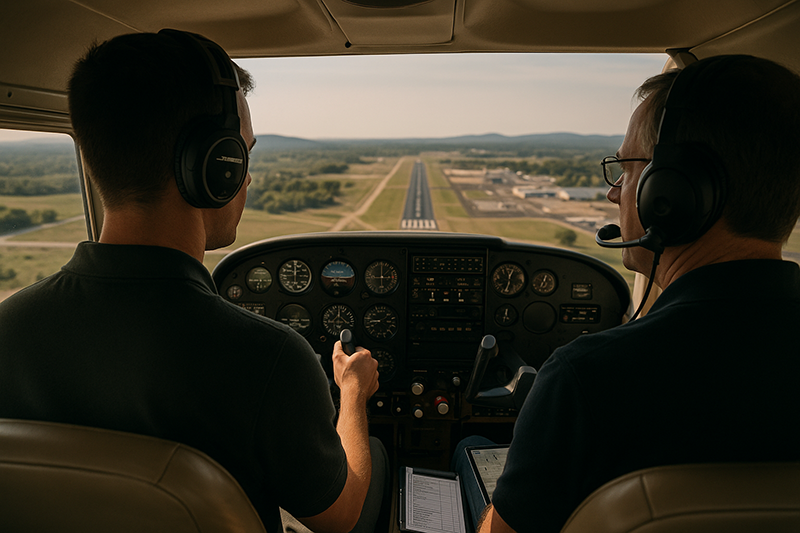
Flying into unfamiliar airports safely is one of the most practical skills a pilot can develop. The runway may be long enough, the weather may be legal, and the airplane may be performing normally, yet the arrival can still become demanding if the pilot is surprised by terrain, traffic flow, runway geometry, airspace, lighting, taxi routes, or local procedures. A familiar airport gives the pilot mental shortcuts. An unfamiliar airport removes those shortcuts and requires better preparation, better cockpit discipline, and more conservative decision-making.
For student pilots, unfamiliar airport operations are often introduced during cross-country training. For certificated pilots, they are a routine part of personal flying, business travel, ferry flights, aircraft delivery, instruction, and proficiency work. For flight instructors and aviation professionals, they are also a valuable window into a pilot’s planning habits. This article explains how to approach an unfamiliar destination with the mindset of a professional pilot: build a usable mental picture before arrival, manage workload early, keep navigation and communication simple, and remain willing to delay, divert, or go around when the situation does not match the plan.
What Makes an Airport Unfamiliar?
An unfamiliar airport is not just a place where the pilot has never landed before. It may be an airport the pilot visited years ago, an airport with a recent runway or taxiway change, a towered field with local traffic patterns that differ from the pilot’s home airport, or a nontowered airport where terrain, noise-sensitive areas, or nearby airspace complicate the arrival. Even a visually simple airport can become unfamiliar at night, in marginal weather, during high workload, or when the pilot is flying a different aircraft than usual.
The central challenge is that the pilot lacks a deeply practiced mental model of the airport environment. At a home airport, a pilot may know where to expect traffic, how the runway looks from downwind, which taxiways lead to the ramp, how the wind tends to behave over nearby obstacles, and where radio calls often become busy. At a new airport, those details must be built deliberately before and during the flight.
Safe arrival planning begins with a simple question: What could surprise me at this airport? The answer may involve runway slope, short or narrow pavement, displaced thresholds, water or terrain near the final approach path, nonstandard traffic pattern entries, parachute activity, glider activity, special use airspace nearby, complex taxiway geometry, limited services, runway lighting limitations, or nearby airports that are easy to confuse with the destination. The goal is not to memorize every possible detail. The goal is to identify the items most likely to affect safety, workload, and decision-making.
Start With the Big Picture Before Studying Details
Many pilots begin their airport review by zooming directly into the airport diagram or runway data. That information matters, but it is more useful after the pilot understands the larger operating environment. Before focusing on taxiways and ramp locations, study where the airport sits in relation to airspace, terrain, water, nearby cities, reporting points, communication frequencies, and other airports.
From a planning standpoint, a good big-picture review answers several questions. What airspace will be crossed or entered? Is the airport towered or nontowered? Are there nearby airports that could be mistaken for the destination? Does terrain affect the arrival route, pattern altitude selection, or missed approach options if operating under instrument procedures? Are there prominent roads, rivers, shorelines, ridgelines, or urban features that can help confirm the airport visually? Is the airport close to busy terminal airspace where radio workload or sequencing may increase?
For VFR pilots, the big picture helps prevent the common problem of arriving near the destination without a clear visual orientation. For IFR pilots, it supports better situational awareness when transitioning from an instrument clearance to visual maneuvering, circling, a visual approach, or taxi. For instructors, it provides an opportunity to teach students that navigation does not end when the airport appears on the horizon. The last ten miles often contain the highest concentration of traffic, frequency changes, configuration tasks, and decision points.
Use Current Airport Information as a Safety Tool
Airport information changes. Runways close, taxiways are renamed, lighting systems may be out of service, fuel availability can vary, and construction can alter the expected route from runway to ramp. A pilot planning to fly into an unfamiliar airport should use current, official, and operationally appropriate information before departure and update that information as needed during the flight. This includes airport data, NOTAMs, weather, runway conditions when applicable, charted procedures, and any available tower or automated weather information.
The practical value is not simply knowing facts. It is reducing surprise. A runway closure discovered during preflight may turn a straightforward arrival into a planned arrival on an alternate runway. A taxiway closure noticed early may prevent confusion after landing. A lighting outage may affect whether a night arrival remains reasonable. A change in fuel availability may alter reserve planning or make a different airport more appropriate.
For many general aviation flights, the airport review should include runway length, width, surface, slope if published, traffic pattern information, field elevation, lighting, communication frequencies, available approaches if relevant, services, ramp or parking arrangements, and known hazards or remarks. Pilots should also compare those details with the aircraft’s performance data, the expected weight, wind, temperature, density altitude, pilot proficiency, and company or personal minimums. An airport is not suitable merely because it appears in a database. It must be suitable for the aircraft, conditions, and pilot.
Build a Mental Picture of the Arrival
The most useful arrival plan is a mental rehearsal, not a stack of disconnected facts. Before descent, the pilot should be able to describe the expected flow in plain language: how the aircraft will approach the area, what frequency will be used, what runway is expected, how traffic will be identified, where the pattern or approach path lies, what altitude changes are anticipated, and what the plan is if the runway is not acquired, the traffic picture is unclear, or the approach becomes unstable.
A strong mental picture includes visual orientation. If approaching from the west, what will the airport look like? Is the runway aligned with a highway, shoreline, valley, or industrial area? Are there parallel runways, closed runways, or nearby airports that could create ambiguity? At night, will the airport be surrounded by dark terrain or bright city lights? A runway in a dark rural area may be difficult to judge visually, while an airport inside a brightly lit city may be hard to distinguish from surrounding lighting until close in.
For instrument pilots, the mental picture should also include the transition from procedure to runway environment. The pilot should understand the approach course, step-down fixes if applicable, missed approach instructions, circling considerations if relevant, and how the aircraft will transition from an instrument procedure to a stabilized landing. If the pilot expects a visual approach, that expectation should not replace planning for terrain, traffic, and runway identification.
Why This Matters in Real-World Aviation
Unfamiliar airport arrivals compress several tasks into a short period of time. The pilot may be descending, changing frequencies, listening for traffic, briefing the approach, configuring the aircraft, checking weather, identifying the runway, responding to ATC, managing passengers, and preparing to land. Each task may be normal by itself. The risk increases when several tasks compete for attention at the same time.
Workload management is therefore central to safety. The best time to reduce arrival workload is not on final approach. It is during preflight and cruise. Program avionics early. Review the expected runway before the descent begins. Set up frequencies in a logical order. Brief the taxi plan before landing if the airport is complex. Decide in advance what conditions would trigger a go-around or diversion. The pilot who waits until entering the traffic pattern to solve every problem has created avoidable pressure.
This matters in training because unfamiliar airports reveal whether a pilot is navigating ahead of the airplane or reacting behind it. A student who can fly a good traffic pattern at the home field may still struggle when the runway orientation, entry angle, radio traffic, and visual cues change. A private pilot who routinely flies to the same few airports may need a deliberate proficiency plan before visiting a busy towered airport, a high-elevation airport, a short runway, or a destination surrounded by complex airspace.
It also matters operationally because decisions made near an unfamiliar airport can become emotionally loaded. After a long flight, pilots may feel pressure to land at the planned destination. Passengers may be expecting arrival. Fuel planning may be adequate but not generous. Weather may be changing. A pilot who has already identified alternates, personal minimums, and go-around triggers is better positioned to make calm decisions when the arrival does not unfold as expected.
How Pilots Should Understand Local Procedures
Local procedures are not a substitute for regulations, clearances, or standard operating practices, but they are often important to understanding how traffic actually flows. Some airports have published traffic pattern information, preferred runways, right traffic for certain runways, noise-sensitive areas, helicopter operations, parachute activity, glider activity, seaplane areas, or other remarks that affect how pilots should plan and communicate. Towered airports may use runway assignments, reporting points, pattern instructions, and taxi routes that are unfamiliar to a visiting pilot.
The key is to separate mandatory instructions and clearances from helpful local knowledge. At a towered airport, pilots must operate in accordance with clearances and instructions applicable to the operation. At a nontowered airport, pilots should use recommended communication and traffic pattern practices appropriate to the airport environment while maintaining see-and-avoid vigilance. In either case, the pilot should not assume that local custom is obvious, universal, or safe in every situation.
When local information is unclear, the professional response is to ask early and plainly. A pilot can request clarification from ATC, call an FBO or airport operator before departure, or plan an arrival that provides extra time to observe traffic. At a nontowered airport, an overflight at an appropriate altitude, when safe and operationally suitable, can help a pilot assess winds, runway condition cues, traffic flow, and airport layout. That technique must be used with care and should not create conflict with established traffic.
Runway Selection and Performance Planning
Runway selection at an unfamiliar airport is more than choosing the pavement most aligned with the wind. Wind matters, but so do runway length, width, surface, obstacles, slope, lighting, approach path, go-around area, aircraft performance, pilot proficiency, and traffic flow. A runway that is acceptable for a local pilot in a familiar aircraft may not be the best choice for a visiting pilot managing higher workload.
Before departure, pilots should compare runway data with aircraft performance information from the appropriate aircraft documents. That review should consider expected landing distance, aircraft weight, wind, temperature, elevation, runway surface, and any relevant operational factors. Pilots should be careful about relying on memory or rule-of-thumb assumptions. Performance planning is especially important when the destination has a short runway, high field elevation, soft or contaminated surface, obstacles, or forecast conditions that may change significantly before arrival.
Runway width can also affect visual perception. A runway that is narrower than the pilot is used to may create the illusion of being higher than actual, potentially encouraging a lower approach. A wider runway can have the opposite effect, sometimes making the aircraft appear lower than it is. Runway slope and surrounding terrain can also distort visual judgment. These are not exotic concerns. They are everyday human factors that become more noticeable when the pilot lacks familiar visual references.
For night operations, runway lighting and surrounding terrain deserve additional attention. Pilots should understand what lighting is available and how it is activated if pilot-controlled lighting is used. A safe night arrival requires more than legal weather and a lit runway. It requires a realistic assessment of visual cues, terrain awareness, aircraft equipment, pilot currency, and the ability to execute a missed approach or go-around without relying on familiar landmarks.
Traffic Pattern Planning at Nontowered Airports
Nontowered airport operations require disciplined listening, clear position reporting when appropriate, and a strong visual scan. At an unfamiliar nontowered airport, the pilot should determine the expected runway and traffic pattern direction before arrival, then monitor the common traffic advisory frequency early enough to develop a traffic picture. The goal is not to dominate the frequency with unnecessary calls. The goal is to communicate useful information and listen actively for other aircraft.
A safe pattern entry begins before the airport is in sight. The pilot should know the field elevation, traffic pattern altitude if available, runway orientation, likely wind, and nearby reporting points. If there is uncertainty about traffic flow, slowing down early and creating extra time is often better than pressing toward the airport at cruise speed. The pilot should avoid arriving high, fast, and close to the airport with no plan for entry.
At many nontowered airports, multiple types of aircraft may share the airspace, including training aircraft, high-performance singles, twins, helicopters, gliders, agricultural aircraft, ultralights, or skydiving aircraft, depending on the airport. Not every aircraft will communicate in the same way, and some may not be radio equipped. A radio call is helpful, but it does not replace looking outside. Pilots should treat the pattern as a see-and-avoid environment, not a place where the frequency provides complete traffic separation.
Arriving at Towered Airports You Do Not Know
At unfamiliar towered airports, the major workload often shifts from finding traffic to managing instructions, clearances, airspace, runway assignments, and taxi routing. A pilot who is comfortable at a quiet home tower may be surprised by the pace of communications at a busier airport. The solution is not to sound polished on the radio. The solution is to prepare, listen, and ask for clarification when needed.
Before calling the tower or approach control, the pilot should know the aircraft position, altitude, ATIS or weather information if available, requested action, and any operational limitations or needs. If the pilot is unfamiliar, it is acceptable and often wise to say so in plain language. Controllers can provide more useful instructions when they understand the pilot’s situation, but they cannot read the pilot’s mind.
Taxi planning is especially important after landing. Many runway incursions and surface navigation errors begin with a pilot who relaxes after touchdown, then receives a taxi clearance at an airport with unfamiliar geometry. Before landing, review the airport diagram and identify likely runway exits, hold short areas, hot spots if depicted, ramp location, and the general direction of taxi. After landing, clear the runway as instructed or appropriate, stop if necessary when safe, and write down or verify taxi instructions before moving in a complex area. If unsure, ask.
Weather, Terrain, and Airspace Considerations
Unfamiliar airports often require more conservative weather thinking because the pilot has fewer local references. A ceiling and visibility combination that feels comfortable at a familiar airport may be much more demanding at a new destination near terrain, water, busy airspace, or multiple nearby airports. VFR pilots should consider whether they can maintain legal and practical weather margins while also navigating, identifying traffic, and entering the pattern without rushing. IFR pilots should consider approach availability, alternate planning, missed approach terrain, fuel, and the likelihood of needing to transition visually near the airport.
Terrain deserves specific attention. Airport elevation alone does not describe the surrounding environment. An airport may sit in a valley, near rising terrain, along a shoreline, on a plateau, or near obstacles that affect approach and departure paths. Pilots should avoid creating a descent profile based only on distance from the airport. A safer method is to review charted altitudes, terrain, obstacles, and airspace ahead of time, then descend in a way that preserves options.
Airspace can also create traps. A pilot focused on finding an unfamiliar runway may drift toward controlled airspace, restricted areas, special flight rules areas, or traffic flows associated with nearby airports. Good avionics can help, but they do not remove the need for planning. The pilot should understand the boundaries, communication requirements, and safe routing before workload increases near the destination.
Common Mistakes or Misunderstandings
One common mistake is assuming that GPS direct-to navigation solves the unfamiliar airport problem. GPS can guide the aircraft to a point, but it does not ensure the pilot understands the traffic pattern, runway environment, airspace, terrain, or taxi route. A magenta line is not an arrival plan.
Another mistake is briefing only the landing runway while ignoring the missed approach, go-around, or diversion plan. At an unfamiliar airport, a go-around may involve terrain, noise-sensitive areas, conflicting traffic, or airspace boundaries the pilot did not consider. A go-around should be treated as a normal maneuver that may be needed, not as an emergency improvised at low altitude.
Pilots also sometimes overestimate how easy it will be to identify the correct airport. This is especially true when several airports are located close together, when runway orientations are similar, or when a destination is embedded in urban lighting at night. Verification should include charted position, runway orientation, airport layout, navigational references, and, when available, communication with ATC or traffic in the area.
A fourth mistake is continuing an unstabilized approach because the airport was hard to find and the pilot does not want to lose the runway again. This is a classic workload trap. If the aircraft is not configured, aligned, at an appropriate speed, and descending in a controlled manner by the pilot’s normal stabilization point, a go-around is often the safer choice. The fact that the destination is unfamiliar is a reason to be more disciplined, not less.
Finally, some pilots neglect the surface operation. Landing safely is not the end of the flight. At unfamiliar airports, wrong turns, runway crossings, missed hold short instructions, and ramp confusion can create serious risk. The taxi phase deserves the same professional attention as the approach, especially at night, in low visibility, or at complex airports.
Practical Example: A Cross-Country Arrival
Consider a private pilot flying a single-engine airplane to an airport 150 nautical miles away for a weekend trip. The airport is nontowered, has two paved runways, sits near a small city, and has another airport about eight miles away with a similar runway orientation. The weather is VFR, but the wind is forecast to shift during the afternoon. The pilot has never been there before.
A weak arrival plan would be simple: load the destination into the GPS, fly direct, call ten miles out, and look for the runway. That may work on a quiet day, but it leaves too much to chance. The pilot could misidentify the nearby airport, enter the wrong pattern, arrive with the wrong runway expectation, or become distracted while searching for traffic and landmarks.
A stronger plan begins before takeoff. The pilot reviews the airport layout, runway dimensions, field elevation, pattern information, communication frequency, fuel and parking details, and current notices. The pilot compares both runways with the aircraft’s landing performance and considers which runway is likely based on wind. The pilot notes the nearby airport and identifies differences in runway layout and surrounding landmarks. During cruise, the pilot listens to destination weather if available, updates the expected runway, and sets the communication frequency in standby.
About twenty miles out, the pilot slows slightly to reduce workload and begins listening to the advisory frequency. Traffic reports suggest aircraft are using Runway 27. The pilot approaches from the southwest, plans a pattern entry that avoids crossing directly over the departure path, and uses the GPS, chart orientation, runway heading, and visual landmarks to confirm the correct airport. If the traffic picture becomes unclear, the pilot is prepared to remain outside the immediate pattern area, climb or maneuver as appropriate, and re-enter with better spacing.
On downwind, the pilot notices the aircraft is higher and faster than desired because of a tailwind on the entry. Instead of forcing the airplane down, the pilot extends downwind slightly, configures early, and stabilizes the approach. If the approach is not stable by the normal point, the pilot will go around and fly a predictable pattern. After landing, the pilot clears the runway, stops short of movement or conflict areas as appropriate, and reviews the taxi route to the parking area before proceeding. Nothing about this example is dramatic. That is the point. Good unfamiliar airport technique makes the arrival routine by removing avoidable surprise.
Best Practices for Flying Into Unfamiliar Airports
Experienced pilots tend to use simple habits that protect them from high workload. These habits are not glamorous, but they are reliable. They help the pilot stay ahead of the airplane and preserve decision-making capacity when the arrival becomes busier than expected.
- Review the destination early. Study the airport environment before departure, not just during descent.
- Confirm runway suitability. Compare runway length, surface, obstacles, elevation, wind, temperature, and aircraft performance using appropriate aircraft information.
- Develop a traffic plan. Know whether the airport is towered or nontowered, what frequencies apply, and how you expect to enter or be sequenced.
- Brief the go-around. Decide what an unstable approach looks like and what you will do if the landing should not continue.
- Use avionics without becoming dependent on them. GPS, moving maps, and airport diagrams are excellent tools, but visual verification and judgment remain essential.
- Manage speed and descent early. Arriving slower and more organized often reduces risk more than arriving quickly.
- Plan the taxi route. Review the airport diagram before landing, especially at towered or complex airports.
- Ask for help before uncertainty becomes risk. Clarify instructions, request progressive taxi when appropriate, or delay the approach to build a better picture.
The best practice behind all of these is humility. Unfamiliar airports do not reward assumptions. A pilot who admits, “I need another minute to sort this out,” is usually making a safer decision than one who presses ahead to preserve the appearance of confidence.
Instructor Techniques for Teaching Unfamiliar Airport Operations
Flight instructors can use unfamiliar airports to teach risk management without creating unnecessary stress. The objective is not to surprise the student for entertainment. The objective is to help the student build repeatable planning and decision-making habits. Before the flight, ask the student to brief the airport as if they were the pilot in command carrying passengers. The briefing should include the route, airspace, weather, runway options, pattern entry, performance considerations, and a diversion plan.
During the flight, instructors should observe whether the student updates the plan as conditions change. Does the student listen early to the destination frequency? Do they recognize when the expected runway changes? Can they identify the airport without relying exclusively on the GPS? Do they verbalize a go-around point? Do they manage descent and speed so the pattern is not rushed?
After landing, debrief the surface operation as carefully as the approach. Many students assume the training event ends at touchdown. Instructors should reinforce that runway exit, hold short awareness, taxi clearance readback when required, airport diagram use, and ramp situational awareness are all part of the arrival. A well-taught unfamiliar airport lesson produces a pilot who is calmer, more methodical, and more willing to ask for clarification.
Decision-Making: When to Delay, Divert, or Go Around
Safe unfamiliar airport operations depend on the pilot’s willingness to change the plan. Delaying, diverting, or going around should not be viewed as failure. These are normal tools for managing risk. A pilot should consider delaying the flight if the destination is unfamiliar and the combination of weather, darkness, aircraft performance, or pilot workload leaves little margin. The more unfamiliar the airport, the more valuable daylight, good weather, and extra fuel become.
Diversion should remain a live option throughout the arrival. If the pilot cannot confirm the correct airport, cannot establish a safe traffic pattern entry, cannot maintain comfortable weather margins, or finds conditions meaningfully different from the preflight plan, diverting to a better option may be the most professional decision. The alternate does not need to be perfect. It needs to offer a safer combination of runway, weather, services, and workload.
A go-around is appropriate whenever the landing should not continue. That may be because of unstable speed or descent rate, poor alignment, traffic conflict, runway uncertainty, wind shear indications, unexpected obstacle concerns, or simply a sense that the aircraft is not where it needs to be. Pilots should practice go-arounds enough that they feel routine. At an unfamiliar airport, the decision to go around should be made early, flown positively, and followed by a deliberate plan for re-entry, another approach, or diversion.
Frequently Asked Questions
How far in advance should I review an unfamiliar airport?
Review the airport during preflight planning, then refresh the key details before descent. For more complex airports, night operations, short runways, terrain, or busy airspace, the review should be more thorough and completed early enough to change the plan if needed.
What is the most important item to check before flying into a new airport?
No single item is always most important. Runway suitability, weather, airspace, traffic flow, terrain, NOTAMs, communications, and aircraft performance all matter. The practical priority is to identify anything that could make the arrival unsafe or significantly increase workload.
Should I tell ATC I am unfamiliar with the airport?
If you need extra help, clarification, or a less compressed sequence, plain language can be useful. Saying that you are unfamiliar may help ATC provide clearer instructions, workload permitting. Pilots should still comply with applicable clearances and ask promptly if any instruction is unclear.
How can I avoid landing at the wrong airport?
Use multiple confirmation methods. Check the airport’s position, runway orientation, layout, nearby landmarks, chart depiction, navigation display, and communications. Be especially careful where several airports are close together or where runway alignments look similar.
Is it safer to overfly a nontowered airport before entering the pattern?
It can be useful in some situations, but it is not automatically the best choice. An overflight should be planned to avoid conflict with traffic and should be conducted at an appropriate altitude and location for the circumstances. If traffic flow is already clear, a standard, predictable pattern entry may be better.
What should I do if I become confused after landing?
Stop in a safe location if able, keep clear of runways and protected areas as appropriate, and ask for clarification. At towered airports, request progressive taxi if needed. It is better to pause and verify than to continue taxiing while uncertain.
Key Takeaways
- Flying into unfamiliar airports safely begins before departure with a usable mental picture of the airport, surrounding airspace, runway options, and arrival flow.
- The highest-risk moments often occur when workload increases near the airport, so manage descent, communication, traffic awareness, and configuration early.
- Professional pilot judgment includes asking for clarification, going around when the approach is not right, and diverting when conditions exceed the plan or pilot comfort level.