
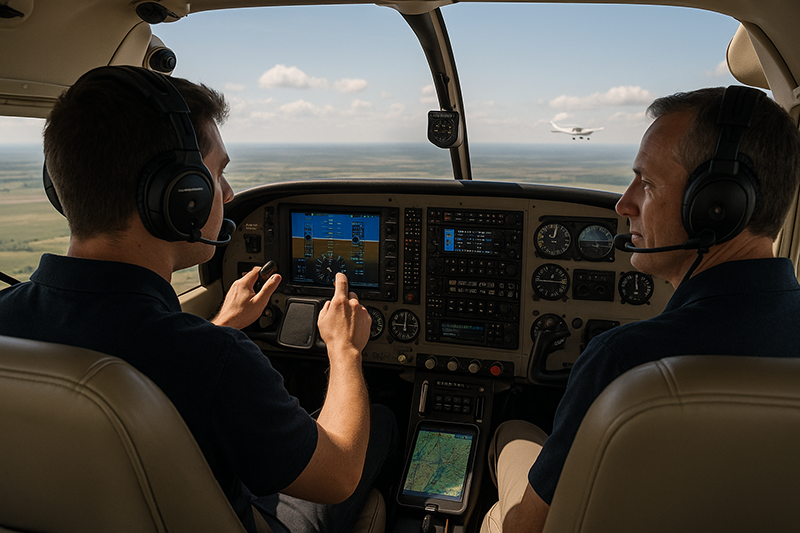
VFR flight following is one of the most useful services available to pilots operating under visual flight rules, yet many pilots use it only occasionally or do not use it as effectively as they could. At its best, flight following gives a VFR pilot an extra layer of situational awareness through radar-based traffic advisories, safety alerts when available, and a direct communications link with air traffic control while the pilot remains responsible for VFR navigation, weather avoidance, terrain clearance, and see-and-avoid.
For student pilots, flight following can reduce uncertainty on cross-country flights and build confidence in real ATC communication. For certificated pilots, it can improve cockpit organization, support better route decisions, and make transitions around busy airspace more predictable. For instructors, it is an excellent training environment for teaching radio technique, workload management, and disciplined pilot-in-command decision-making. The key is understanding what the service is, what it is not, when to request it, and how to manage it without letting it distract from flying the airplane.
What VFR Flight Following Actually Provides
VFR flight following is a common pilot term for radar traffic advisory service provided by ATC to VFR aircraft when available. In normal use, the pilot contacts an approach control, departure control, or air route traffic control center, provides aircraft identification, position, altitude, destination, and request, and ATC may assign a transponder code and establish radar contact. Once radar identified, the controller can issue traffic advisories and other information as workload, radar coverage, and communications capability allow.
The word “following” can be misleading if a pilot imagines that ATC is continuously supervising the flight in the same way it manages an IFR aircraft. A VFR aircraft receiving flight following is still operating under VFR. The pilot remains responsible for maintaining visual meteorological conditions, complying with applicable airspace rules, navigating the route, avoiding terrain and obstacles, and seeing and avoiding other aircraft. ATC assistance is valuable, but it is not a substitute for pilot responsibility.
Traffic advisories usually include the relative position of the traffic, distance, direction of movement when known, and altitude information when available. A controller might call, “Traffic twelve o’clock, three miles, opposite direction, altitude indicates four thousand five hundred.” That information helps the pilot focus the visual scan and make earlier decisions. Sometimes traffic may not be called because of workload, radar limitations, altitude reporting issues, or other priorities. Pilots should treat flight following as an important supplement to visual scanning, not as a guarantee that every aircraft will be announced.
Flight following can also help in less obvious ways. It gives the pilot a frequency to use if an abnormal situation develops. It allows ATC to provide useful information about nearby traffic flows, restricted or active airspace when known, frequency changes, or weather-related observations that affect the route. It can make it easier to coordinate around busy terminal areas because the pilot is already talking to the controlling facility rather than making a rushed call at the edge of complex airspace.
Why This Matters in Real-World Aviation
Most VFR flying is a blend of planning, observation, and continuous adjustment. A pilot may depart in good visibility, climb into a busy training corridor, cross beneath arrival traffic, skirt a military operations area, or navigate around buildups on a summer afternoon. Flight following does not solve those problems automatically, but it adds professional coordination to the pilot’s decision process.
In training, flight following helps connect classroom concepts to real operations. Students learn that radio communication is not a script to memorize. It is a practical exchange of information. They also learn that ATC services are dependent on the situation. A controller may provide immediate radar service on one flight and be unable to offer it on another. That variability is not a failure of the system. It is part of how pilots must think operationally.
For experienced pilots, flight following is especially useful on flights that pass near busy terminal areas, through high-density practice environments, or along popular VFR corridors. A pilot who routinely flies the same local route may become comfortable with familiar landmarks and frequencies, but the traffic picture changes daily. Flight following helps the pilot build a broader mental model of the airspace rather than relying only on what is visible out the windshield or displayed on a cockpit screen.
Modern cockpit traffic displays can be very helpful, but they do not eliminate the value of ATC communication. A cockpit display may show traffic targets that are not visually acquired, or it may fail to show aircraft not properly equipped or not received by the system. ATC may have information that helps interpret the situation, while the pilot’s eyes remain the final defense for collision avoidance in VFR conditions. The safest mindset is to integrate all available information: outside scan, chart awareness, onboard avionics, and ATC advisories.
How to Request Flight Following Clearly
The most effective flight following request is brief, complete, and made at a time when the pilot can listen and respond. Before calling, have the basic information ready: who you are calling, who you are, where you are, your altitude, your destination or route, and what you want. Pilots often make the first call too long. A good initial call can be simple: “Potomac Approach, Cessna One Two Three Four Five, VFR request.” After ATC responds, provide the details: “Cessna One Two Three Four Five is five miles west of Frederick, four thousand five hundred, VFR to Charlottesville, request flight following.”
That format gives the controller time to prepare for the request and keeps the frequency usable. If the controller is busy, the shorter initial call is easier to acknowledge. If ATC asks the pilot to standby, the pilot should continue flying the aircraft, maintain the current plan, and wait for the controller to return. Do not assume radar service has started until ATC provides the necessary response, typically including a transponder code and radar contact when applicable.
Position reporting matters. A pilot who says, “We’re near the lake,” may be understandable locally but not helpful to a busy controller managing many aircraft over a large area. Use a known airport, navaid, fix, or clear geographic reference. Include direction and distance when practical. If departing from a towered airport, the pilot may be handed to departure after takeoff if the service was coordinated. If departing a non-towered airport, the pilot usually contacts the appropriate ATC facility after takeoff when at a safe altitude and clear of immediate local traffic duties.
Altitude also matters. State the current altitude and, if useful, the planned cruising altitude. This helps ATC identify the aircraft and understand whether the flight will affect other traffic flows. If climbing or descending, say so. For example, “three thousand climbing four thousand five hundred” is more useful than a single altitude that will be outdated moments later.
Understanding What Flight Following Does Not Do
One of the most important parts of using flight following effectively is knowing its limits. VFR flight following does not turn a VFR flight into an IFR flight. It does not provide obstacle clearance, cloud clearance, or automatic route protection. It does not authorize a pilot to enter airspace that requires a specific clearance or communication requirement unless that requirement has actually been satisfied.
A common trap is assuming that talking to ATC automatically means every airspace issue is handled. That is not a safe assumption. For example, entry into Class B airspace requires a specific clearance. A VFR aircraft receiving flight following near Class B airspace should not enter unless the controller has clearly issued a Class B clearance. Similarly, flight following does not authorize a pilot to fly through a temporary flight restriction, active restricted area, or other airspace that requires avoidance or specific authorization. The pilot must maintain chart awareness and ask early if uncertain.
Another limit is radar and radio coverage. Low altitude, terrain, distance from radar sites, or frequency congestion can make service unavailable or intermittent. In some areas, especially at lower altitudes or in mountainous terrain, ATC may not be able to establish or maintain radar contact. A pilot should have a plan that works even if ATC says “radar service terminated” or cannot provide service at all.
Flight following also does not guarantee traffic separation for VFR aircraft in the same sense that IFR separation standards apply to IFR operations. Controllers provide traffic advisories and safety alerts when able, but the pilot must still visually acquire and avoid traffic. If a traffic call is not understood, ask for clarification. If traffic is not in sight and the advisory sounds close, consider a safe heading or altitude adjustment consistent with VFR rules and the surrounding airspace, then advise ATC as appropriate.
Making Flight Following Part of Cross-Country Planning
The best use of flight following begins before engine start. During preflight planning, identify the facilities and frequencies likely to serve the route. Sectional charts, chart supplements, airport information, and onboard databases may help pilots determine appropriate approach, departure, center, or flight service frequencies, depending on location and equipment. The point is not to script the entire flight perfectly. The point is to know whom you are likely to call and where frequency changes may occur.
Planning also includes airspace review. Mark or mentally note Class B, Class C, restricted areas, military operations areas, alert areas, special flight rules areas, and temporary flight restrictions as applicable. Flight following can help with awareness, but it should not be the primary method of discovering that the route crosses complicated airspace. If a route skirts a Class B shelf or passes near a restricted area boundary, consider how you will navigate precisely enough to remain clear unless cleared or authorized.
Weather planning remains equally important. A VFR pilot receiving flight following is still responsible for staying in VFR conditions. If lowering ceilings, reduced visibility, smoke, haze, convective activity, or terrain begin to limit options, the pilot should make decisions early. ATC can sometimes provide vectors or information when requested and available, but a VFR pilot should not wait until trapped by weather to ask for help. Early communication is almost always easier than late communication.
Fuel and alternates should also be considered in the flight following plan. If ATC suggests a heading or route that would add distance, the pilot should evaluate whether it is acceptable. A VFR pilot may accept, decline, or negotiate based on safety, fuel, weather, terrain, and aircraft performance. Good communication sounds like this: “Unable extended routing due fuel planning. We can accept ten degrees right for traffic.” That kind of response is professional, concise, and preserves pilot-in-command authority.
Radio Technique That Helps ATC Help You
Effective radio work is not about sounding impressive. It is about accuracy, brevity, timing, and listening. Before transmitting, listen long enough to avoid blocking another aircraft or stepping on an ATC instruction. Use standard aviation phraseology where practical, but do not freeze if you cannot remember the perfect wording. Plain, concise language is better than a long, uncertain transmission.
When ATC assigns a transponder code, read it back accurately and set it carefully. If ATC says radar contact, note that service has begun. If ATC provides a traffic advisory, respond with useful information: “looking,” “traffic in sight,” or “negative contact.” If the traffic is in sight and no longer a concern, say so. If you do not see it, continue scanning and be prepared to maneuver if needed.
Frequency changes are a normal part of longer flights. When ATC hands you off, read back the new frequency and your call sign, then check in promptly with the next facility. A concise check-in might be, “Atlanta Center, Cessna One Two Three Four Five, four thousand five hundred.” If the new controller needs more information, they will ask. Avoid repeating your entire route unless requested.
If workload becomes high, communicate that clearly. For example, a student pilot managing turbulence, navigation, and traffic may need to pause nonessential communication. It is acceptable to say, “Standby,” when you need a moment to fly the airplane, provided you are not ignoring an urgent instruction or safety alert. Aviate, navigate, communicate remains a useful priority model. Flight following should support that order, not reverse it.
Common Mistakes and Misunderstandings
The first common mistake is waiting too long to request flight following. Some pilots call only when approaching complicated airspace or when workload is already high. It is usually better to establish service earlier, while the cockpit is calm and the pilot has time to communicate clearly. Early contact also gives ATC more time to understand the flight and provide useful advisories.
The second mistake is assuming ATC is navigating for you. A controller may issue a heading for traffic or sequencing, but the pilot should always know the aircraft’s position relative to the planned route, airspace, terrain, and weather. If a heading would take the flight toward clouds, terrain, restricted airspace, or an undesired area, speak up. ATC cannot know every cockpit constraint unless the pilot communicates.
The third misunderstanding is treating “radar contact” as permission to relax the visual scan. Radar contact means ATC has identified the aircraft on radar. It does not mean the controller sees every nearby hazard, nor does it remove the pilot’s see-and-avoid responsibility. Continue scanning outside, especially in practice areas, near airports, under arrival corridors, and along common VFR routes.
The fourth mistake is poor frequency management. Pilots sometimes change frequencies without being released, miss handoffs, or forget to return after briefly leaving the frequency for weather or airport information. If you need to leave the frequency, ask. If you lose contact, try the last assigned frequency, a previous frequency, or another appropriate facility frequency. If radar service is terminated, acknowledge it, set the appropriate transponder code for VFR unless otherwise instructed, and continue with the flight plan.
The fifth mistake is accepting instructions or suggestions without evaluating them. VFR pilots may receive headings, altitude suggestions, or route recommendations for traffic or airspace flow. These can be helpful, but the pilot must ensure they are safe and legal for the flight. If an altitude would put the aircraft too close to clouds or into an uncomfortable terrain situation, advise ATC and request an alternative.
Practical Example: A VFR Cross-Country Near Busy Airspace
Consider a private pilot flying a normally aspirated single-engine airplane on a daytime VFR cross-country from a non-towered airport to another airport 140 nautical miles away. The direct route passes beneath the outer shelves of a busy Class B area, then near a Class C airport, and finally across a region with several flight schools and practice areas. The weather is VFR, but visibility is somewhat hazy, making distant traffic harder to see.
Before departure, the pilot reviews the route, notes the Class B shelf altitudes, selects a cruising altitude that remains clear of the shelves, and identifies the approach control frequency likely to provide service after takeoff. The pilot also reviews alternate airports and keeps a simple kneeboard note with expected frequencies. After departing and climbing away from local traffic, the pilot contacts approach: “Metro Approach, Skyhawk Eight Seven Six Five Kilo, VFR request.” When acknowledged, the pilot continues: “Skyhawk Eight Seven Six Five Kilo, eight miles northwest of Franklin County, climbing three thousand five hundred, VFR to Lakeside, request flight following.”
ATC assigns a transponder code and later advises radar contact. As the flight approaches the Class B shelves, the pilot monitors position carefully and does not climb into the shelf. ATC calls traffic at two o’clock, four miles, opposite direction, altitude indicates three thousand. The pilot responds, “Looking,” then later, “Traffic in sight.” A few minutes later, ATC suggests a ten-degree right turn for traffic. The pilot accepts because the heading remains clear of the Class B boundary and weather.
Near the Class C area, ATC hands the pilot to another frequency. The pilot checks in promptly and continues monitoring the route. The controller eventually advises that radar service is terminated due to workload and instructs a frequency change. The pilot acknowledges, sets the appropriate VFR transponder code unless otherwise instructed, and continues using the planned navigation and visual scan. The flight remains safe because flight following was treated as a helpful service, not as the foundation of the entire plan.
Best Practices for Pilots
Using flight following well is mostly about preparation and judgment. A pilot who knows the route, communicates clearly, and stays ahead of the airplane will gain far more from the service than a pilot who calls late, gives vague information, or assumes ATC has taken over responsibility for the flight.
- Call early when practical. Establish service before workload increases near busy airspace, weather, or unfamiliar terrain.
- Make the first call short. Use a brief initial request, then provide details after ATC responds.
- Know your position and altitude. Clear position reporting helps ATC identify you and provide better service.
- Maintain your own navigation. Continue tracking route, airspace, terrain, fuel, and weather independently.
- Clarify airspace permissions. Do not assume that flight following equals clearance into airspace requiring explicit clearance or authorization.
- Respond meaningfully to traffic calls. “Looking,” “traffic in sight,” and “negative contact” help ATC understand your situation.
- Speak up when needed. If a heading, altitude, or route is not acceptable, say so promptly and professionally.
Instructors can strengthen these habits by making flight following part of cross-country training rather than treating it as an optional add-on. Students should practice identifying frequencies, making requests, reading back transponder codes, responding to traffic advisories, and recognizing when ATC communication is increasing workload. The training objective is not simply to “talk on the radio.” It is to integrate ATC services into safe pilot decision-making.
Using Flight Following in Training
Flight following is especially valuable because it exposes students to authentic ATC cadence without the full structure of IFR training. A student learns to listen for a call sign, extract relevant information, and respond while maintaining aircraft control. That skill is difficult to build through ground study alone.
A good training progression starts with instructor demonstration. The instructor explains the planned call, points out the frequency source, and models concise communication. Next, the student makes the request with coaching. Later, the student handles the entire sequence, including handoffs and traffic advisories, while the instructor monitors. This gradual approach prevents radio work from becoming a distraction from basic aircraft control.
Debriefing is essential. After the flight, discuss what went well and what could improve. Did the student call at a good time? Was the position report accurate? Did the student understand the traffic advisory? Did ATC issue any heading or altitude suggestions, and did the student evaluate them before complying? These questions turn a routine ATC exchange into meaningful aeronautical decision-making practice.
When Flight Following May Not Be the Right Priority
Although flight following is useful, there are moments when making or continuing a request should not be the pilot’s top priority. During a high-workload departure from a short runway, an abnormal engine indication, unexpected turbulence near terrain, or a complex traffic pattern departure, the first priority is aircraft control and local traffic awareness. Contact ATC when the aircraft is stable and the pilot has capacity.
Similarly, if a pilot is already saturated, adding another frequency may not help. The better decision may be to level off, slow down if appropriate, navigate to a less demanding area, or ask a passenger or instructor to help with nonflying tasks if qualified and briefed. Flight following is a tool. Like any tool, it should be used when it improves the situation, not when it adds confusion.
If an emergency or urgent situation develops, the calculus changes. A pilot already receiving flight following has an immediate ATC contact and should communicate the problem as soon as practical. If not already receiving service, the pilot may contact the most appropriate ATC facility, tower, approach, center, or emergency frequency depending on the situation. The exact choice depends on altitude, location, radios, and urgency. The important point is to communicate clearly, state the nature of the problem, and request what is needed.
Frequently Asked Questions
Is VFR flight following required?
For ordinary VFR operations, flight following is generally not required. It is an ATC service provided when available. Pilots should still review the requirements for the specific airspace and operation they plan to conduct, because some airspace and procedures have separate communication, clearance, equipment, or authorization requirements.
Does flight following clear me into Class B airspace?
No. A VFR aircraft should not treat flight following as a Class B clearance. The pilot needs an explicit Class B clearance before entering Class B airspace. If there is any doubt, ask the controller before entering.
Can ATC deny or terminate flight following?
Yes. ATC may be unable to provide or continue flight following because of workload, radar coverage, communications limitations, or other operational factors. Pilots should be prepared to continue safely without the service.
What should I say when requesting flight following?
Start with a short initial call such as, “Approach, Cessna One Two Three Four Five, VFR request.” When ATC responds, provide your position, altitude, destination or route, and request for flight following. Keep it concise and be ready to copy a transponder code.
Does flight following replace looking outside for traffic?
No. Flight following supports situational awareness, but the pilot must continue to see and avoid other aircraft in VFR conditions. Use ATC advisories, cockpit traffic information, and an active visual scan together.
Should student pilots use flight following?
Yes, when appropriate and with proper instruction. Flight following can be an excellent training tool for cross-country flying, radio communication, traffic awareness, and cockpit workload management. Students should practice it progressively with instructor guidance.
Key Takeaways
- VFR flight following is most effective when requested early, communicated clearly, and integrated into a well-planned route.
- ATC traffic advisories add valuable situational awareness, but pilots remain responsible for VFR weather, navigation, terrain clearance, airspace compliance, and see-and-avoid.
- Good training should teach pilots to use flight following as a decision-making aid, not as a substitute for pilot-in-command judgment.