
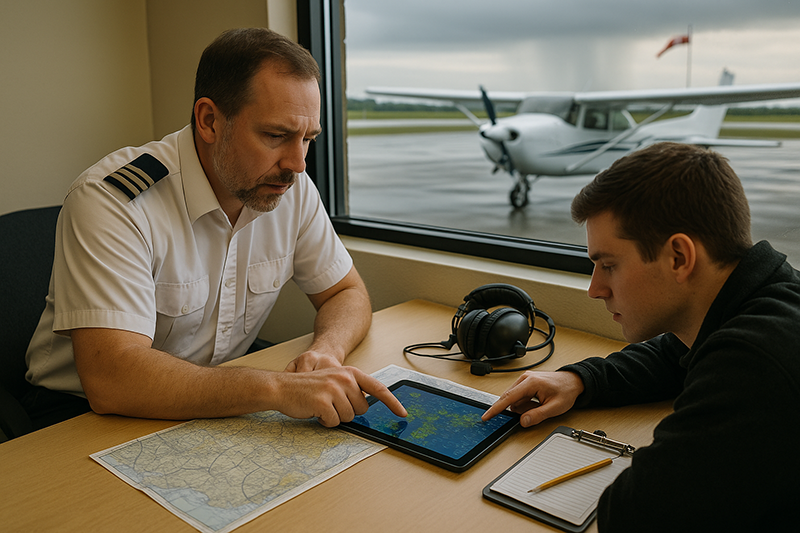
Weather briefing habits shape the quality of a pilot’s go/no-go decision long before the aircraft reaches the runway. A weather briefing is not just a preflight formality or a last-minute scan of METARs on a phone. It is a structured way to understand what the atmosphere is doing, what it is expected to do, and how those conditions may affect the specific aircraft, route, pilot, passengers, and mission.
For student pilots, better briefing habits build the foundation for safe cross-country planning and sound aeronautical decision-making. For certificated pilots, they help prevent complacency, especially on familiar routes. For instructors and aviation professionals, they provide a teachable process that turns weather data into operational judgment. The goal is not to memorize every weather product. The goal is to develop a repeatable method that helps a pilot identify hazards, notice trends, ask better questions, and make conservative decisions when the margin is thin.
What Better Weather Briefing Habits Really Mean
A better weather briefing habit is a repeatable process, not a single source or app. A pilot may use approved aviation weather services, Flight Service, cockpit weather, flight planning software, weather charts, aviation forecasts, airport observations, and local knowledge. Those tools are useful, but the habit is the disciplined way the pilot uses them.
A weak briefing asks, “Can I legally go?” A stronger briefing asks, “What weather could affect this flight, when could it change, how much margin do I have, and what will I do if the forecast does not match reality?” That shift is important. Legal minimums, personal minimums, aircraft capability, pilot proficiency, terrain, airspace, daylight, fuel planning, alternates, and passenger pressure all interact with the weather picture.
Good briefing habits also recognize that weather is dynamic. A METAR is an observation at a specific time and place. A TAF is a forecast for a terminal area. Radar imagery can show precipitation location and movement, but it may not show every hazard important to a flight. Winds aloft forecasts help with groundspeed and fuel planning, but they do not remove the need to evaluate turbulence, convective potential, icing risk, cloud bases, visibility, frontal movement, and route-specific escape options.
The best pilots treat weather information as evidence. They compare observations to forecasts, look for trends, identify uncertainty, and consider what the flight will look like at departure, en route, destination, and possible diversion airports. This is the difference between collecting weather data and conducting a meaningful weather briefing.
Why This Matters in Real-World Aviation
Weather affects nearly every phase of flight. It influences aircraft performance, fuel planning, navigation, visibility, workload, passenger comfort, terrain clearance, runway selection, traffic patterns, instrument procedures, and emergency options. Even on a simple local training flight, surface winds, convective build-up, visibility, and ceilings can change the risk picture quickly.
In flight training, weather briefing habits are often where students begin to connect book knowledge with pilot judgment. A student may understand the definition of marginal VFR, but still need coaching to recognize why a lowering ceiling near sunset, rising terrain, and limited diversion airports can produce a much more demanding flight than the raw category suggests. Similarly, a student may read a crosswind component correctly, yet not appreciate how gusts, runway width, mechanical turbulence, and recent landing proficiency affect the decision.
For instrument pilots, a weather briefing is not simply a search for whether the ceiling and visibility are above minimums. It includes assessing the climb and descent environment, freezing levels, convective activity, embedded cells, alternate planning, approach options, missed approach considerations, fuel reserves, and the likelihood that the destination will remain usable when the aircraft arrives. An instrument rating increases capability, but it does not make all weather acceptable.
For VFR pilots, weather briefing habits are especially important because visual flight depends on maintaining adequate visibility, cloud clearance, horizon reference, and terrain awareness. A route that looks acceptable at departure may become challenging if haze, smoke, precipitation, or lowering ceilings reduce options. The risk is not limited to encountering instrument meteorological conditions. A VFR pilot can also be pressured into lower altitudes, reduced route flexibility, or rising workload because the original briefing did not identify the weather trend clearly enough.
Professional aviation operations often formalize weather review through procedures, dispatch support, operational control, and standardized risk management. General aviation pilots may not have that structure unless they build it themselves. That makes personal briefing discipline essential.
How Pilots Should Understand a Weather Briefing
A weather briefing should answer practical flight questions. What is happening now? What is expected to happen later? Where are the hazards? How confident is the forecast? What are the alternatives? What conditions would cause a delay, route change, diversion, or cancellation?
One useful way to think about the briefing is to move from the big picture to the specific flight. Start with the broad weather pattern. Identify fronts, pressure systems, areas of precipitation, convective outlooks, widespread low ceilings, strong winds, or temperature patterns that may affect icing risk. Then narrow the focus to the route, altitude, departure window, destination arrival time, and potential alternates.
After the broad picture, compare current observations with forecasts. If the forecast predicted improving ceilings, are nearby observations actually improving? If winds were expected to remain light, are stations along the route reporting gusts or shifting wind direction? If visibility is marginal at one airport, are surrounding stations similar or is the observation isolated? These comparisons help the pilot judge whether the forecast is performing as expected.
Next, evaluate timing. Weather timing is often the key variable. A flight that is reasonable at 0900 may be poor at 1400 because of afternoon thunderstorms, convective turbulence, sea breeze effects, mountain winds, fog burn-off uncertainty, or frontal passage. A briefing is incomplete if it does not connect forecast conditions to the actual departure and arrival times.
Finally, translate the weather into decisions. If the route has lowering ceilings, what is the minimum acceptable ceiling for that route and pilot? If a crosswind is near the pilot’s comfort limit, what is the backup runway or airport? If convective weather is possible, what is the plan to remain well clear and avoid being trapped by building cells? If icing is possible in the altitude band needed for terrain or IFR routing, what is the safest alternative? These questions make the briefing operational rather than academic.
Building a Weather Picture Instead of Reading Isolated Products
A common training challenge is that pilots learn weather products one at a time. METARs, TAFs, winds aloft, radar, surface analysis charts, prognostic charts, pilot reports, and advisories each have their own format and purpose. That knowledge matters, but operational weather decisions require synthesis.
For example, a METAR may report acceptable VFR at the departure airport. The TAF may suggest a temporary reduction in visibility later. Radar may show precipitation moving toward the route. Nearby stations may already be reporting lower ceilings. A surface chart may show a frontal boundary in the area. A pilot who reads only the departure METAR may think the flight looks easy. A pilot who integrates all of the information sees a developing trend that deserves a more conservative plan.
Think of each weather product as one window into the atmosphere. No single product tells the whole story. Observations show what has happened and what is happening at reporting points. Forecasts estimate what may happen in the future. Radar, satellite, and graphical products help show structure and movement. Pilot reports can provide real-world information about turbulence, cloud tops, icing, and visibility conditions, although availability varies by location and time.
A good habit is to brief the flight in layers. First, identify the synoptic pattern and large-scale hazards. Second, review departure, en route, destination, and alternate weather. Third, examine altitude-specific information such as winds aloft, freezing levels, turbulence potential, and cloud layers. Fourth, consider airport-specific operating issues such as wind direction, runway conditions, lighting, approach availability, terrain, and nearby weather reporting gaps. Fifth, decide whether the flight fits the pilot’s personal minimums and aircraft capabilities.
The Role of Personal Minimums in Weather Briefing
Personal minimums turn a weather briefing into a decision framework. They help pilots avoid negotiating with themselves under schedule pressure. A newly certificated private pilot, a rusty instrument pilot, and a professional pilot operating under a structured system may all evaluate the same weather differently because their experience, proficiency, aircraft equipment, and mission requirements differ.
Personal minimums should be specific enough to guide decisions, but flexible enough to account for the whole situation. Ceiling, visibility, crosswind, gust factor, convective distance, night operations, terrain, fuel reserves, runway length, and alternate availability may all matter. The important point is that the pilot should establish conservative limits before facing the emotional pull of a planned trip.
Instructors can make this practical by asking students to explain their decision rather than simply recite the weather. For example, “The destination is reporting VFR” is not enough. A better answer would include the forecast trend, winds, expected arrival conditions, nearby alternates, fuel plan, terrain considerations, and the student’s personal limits. That kind of discussion builds judgment.
Personal minimums should also evolve with proficiency. A pilot who has not flown in gusty crosswinds recently may choose a more conservative limit for a particular flight. An instrument pilot who has not flown actual IMC in months may prefer higher ceilings and better visibility than the published procedure minimums. That is not weakness. It is risk management.
Timing: The Most Underestimated Part of a Briefing
Many weather surprises are not surprises in the data. They are timing problems. The pilot looked at good conditions, but not at the correct time window. Weather may be acceptable at departure and unsuitable at arrival. It may improve after the planned departure, making a delay the safest choice. It may deteriorate sooner than expected, making an early departure unwise if diversion options are limited.
Timing is especially important with fog, thunderstorms, frontal passages, mountain weather, coastal weather, and winter conditions. Morning fog may burn off later than expected. Thunderstorms may develop along an outflow boundary. A front may bring wind shifts and lower ceilings. Mountain obscuration may persist even while nearby valleys report usable visibility. Freezing precipitation or icing conditions may affect a narrow time and altitude band, but that band may be exactly where the flight needs to operate.
A strong briefing habit includes checking the weather more than once. The first look may happen the night before to evaluate whether the plan is generally reasonable. A second look before departure confirms the current trend. For longer flights, pilots should continue monitoring weather en route through appropriate resources, ATC assistance when available, onboard equipment when installed, and updated observations or forecasts before committing to a destination.
This does not mean a pilot should constantly chase every new data point or allow cockpit weather to distract from flying the aircraft. It means the pilot should treat weather as a changing environment and maintain enough awareness to update the plan.
Common Mistakes or Misunderstandings
One common mistake is treating the briefing as a box to check. A pilot may obtain weather information, but fail to use it to make a meaningful risk decision. The question is not whether weather was viewed. The question is whether the pilot understood the operational effect of the weather on that specific flight.
Another mistake is relying too heavily on a single product or display. A colorful map can be helpful, but it can also encourage oversimplification. Green, blue, red, and magenta flight category depictions do not explain every hazard. A route may appear visually acceptable while still containing strong winds, turbulence, icing potential, convective threats, or terrain-related risks.
Pilots also sometimes confuse legality with safety margin. A flight may be legal but still unwise for a particular pilot in a particular aircraft on a particular day. The weather briefing should support a decision that accounts for proficiency, workload, fatigue, passenger expectations, night conditions, and escape options.
A related misunderstanding is assuming that an instrument rating automatically solves weather risk. Instrument training is valuable, but instrument pilots must still avoid convective weather, manage icing risk, evaluate alternate requirements and fuel planning, and maintain proficiency. An instrument clearance is not protection from weather hazards.
Another common weakness is failing to define a diversion trigger before takeoff. If the pilot decides, “I’ll see how it looks,” the decision may be delayed until options are fewer. A stronger habit is to decide in advance what conditions will trigger a turnback, diversion, delay, or landing short of the destination.
Finally, pilots may underestimate local effects. Terrain, large bodies of water, urban heat, valley fog, sea breezes, mechanical turbulence, and localized convective development can produce conditions that differ meaningfully from the broad forecast. Local knowledge is valuable, but it should supplement the briefing, not replace it.
Practical Example: A VFR Cross-Country Decision
Consider a private pilot planning a daytime VFR cross-country in a single-engine training aircraft. The route is 160 nautical miles, crossing mixed terrain with several airports along the way. The departure airport is reporting good VFR, light winds, and scattered clouds. At first glance, the trip looks straightforward.
A better briefing looks deeper. The destination forecast calls for ceilings to lower during the afternoon, with visibility remaining acceptable but not generous. Stations west of the route are already reporting a gradual ceiling decrease. Winds aloft suggest a stronger headwind than expected, increasing time en route and reducing the fuel margin if the pilot does not adjust the plan. Radar shows light precipitation developing along the last third of the route, and the broad weather picture suggests the system is moving toward the destination area.
The pilot now has a different decision. The departure is still VFR, but the arrival window may be tighter than originally assumed. A delay might make the destination worse, not better. A direct route may leave fewer comfortable diversion options near the end of the flight. The pilot compares the route to personal minimums and decides to depart earlier only if updated observations show the destination trend remains stable. The pilot also selects two realistic diversion airports, adds extra fuel planning margin, briefs passengers that the flight may land short, and sets a firm trigger: if ceilings along the last half of the route fall below the pilot’s preselected comfort level, the flight will divert before pressing into a narrowing weather corridor.
This example shows how better weather briefing habits change the conversation. The pilot is not just asking whether the airplane can legally depart. The pilot is managing timing, trends, route flexibility, fuel, passenger expectations, and decision points before workload rises in flight.
Best Practices for Pilots
Better weather briefing habits are built through repetition. The most useful process is one you can perform consistently, explain clearly, and adapt to different aircraft and missions. It should be simple enough to use before a local flight, yet complete enough to support a cross-country or IFR operation.
Start early. A first look at the weather the night before can reveal whether the flight is likely to be simple, questionable, or unsuitable. This early review helps reduce schedule pressure because the pilot can discuss alternatives before passengers arrive or business commitments tighten.
Use a broad-to-specific flow. Begin with the big weather picture, then narrow to airport observations, forecasts, route conditions, altitude effects, and operating constraints. This helps prevent fixation on a single favorable report.
Compare forecasts to actual observations. If the weather is not behaving as forecast, treat that as an important signal. A forecast that is already wrong at departure deserves caution when used to predict arrival conditions.
Plan alternates and escape routes realistically. A diversion airport is useful only if it is reachable, suitable for the aircraft, compatible with the weather, and within the pilot’s capability. In VFR flying, an escape route may be as simple as turning toward better visibility, landing at a nearby airport, or delaying departure until the trend improves. In IFR flying, it may involve alternate airport planning, fuel strategy, and avoiding routes that leave no good options in deteriorating weather.
Brief passengers honestly. Passenger pressure is often subtle. A simple statement such as, “We will go only if the weather gives us enough margin, and we may delay or land short,” can reduce pressure later. It also reinforces the pilot’s authority and decision-making plan.
Keep learning after each flight. Compare the briefing to what actually happened. Were the ceilings lower than expected? Were winds stronger? Did turbulence appear where you anticipated it? Did the alternate plan make sense? This post-flight review is one of the best ways to improve weather judgment over time.
- Use more than one weather product to build a complete picture.
- Connect the briefing to the actual departure, en route, and arrival times.
- Set decision points before takeoff, not after the weather becomes uncomfortable.
- Match the flight to personal minimums, aircraft capability, and recent proficiency.
- Update the plan when the weather trend changes.
Weather Briefing Habits for Flight Instructors
Flight instructors have an important role in shaping how pilots think about weather. Students often learn by watching what instructors emphasize. If the instructor treats weather as a quick preflight hurdle, the student may adopt the same habit. If the instructor models curiosity, structure, and conservative judgment, the student learns that weather planning is part of airmanship.
A productive instructional technique is to ask students to brief the weather as a story. What is the atmosphere doing? What will it likely do next? What hazards matter to this aircraft and route? What would make us delay or cancel? This approach encourages understanding rather than rote decoding.
Instructors should also expose students to marginal decision-making scenarios without forcing unsafe flights. Ground discussions, simulator sessions, and preflight weather reviews on non-flying days can be excellent training opportunities. The student can practice evaluating low ceilings, gusty crosswinds, convective forecasts, or questionable visibility without the pressure of an actual departure.
For instrument students, instructors should emphasize that the rating is a tool for controlled flight in clouds, not a license to ignore weather risk. Briefing habits should include icing awareness, convective avoidance, alternate planning, fuel management, missed approach expectations, and workload management. For VFR students, instructors should emphasize trends, terrain, visibility, and the discipline to turn around early.
Using Technology Without Letting It Replace Judgment
Modern flight planning tools have made weather information more accessible than ever. That is a major safety benefit when pilots use the information thoughtfully. Graphical displays, route overlays, winds aloft planning, airport weather pages, radar imagery, and in-flight updates can help a pilot understand weather faster and maintain situational awareness.
Technology can also create traps. A display may appear precise even when the underlying weather is uncertain or delayed. A route line through areas of precipitation may look manageable on a screen, but the real atmosphere may include turbulence, reduced visibility, embedded convective activity, or rapidly changing conditions. Cockpit weather should support judgment, not replace looking outside, listening to ATC when appropriate, and maintaining conservative separation from hazards.
Pilots should understand the limitations of the tools they use. They should know whether weather data is current or delayed, whether a product is observational or forecast, what geographic area it represents, and whether it is appropriate for tactical decisions. If a pilot does not understand what a displayed product means, that product should not become the basis for a close-call decision.
The best use of technology is disciplined and calm. Use it to see the larger trend, confirm expectations, identify changes, and support preplanned decisions. Avoid using it to justify continuing into a situation that already feels wrong.
Frequently Asked Questions
What is the most important part of a weather briefing?
The most important part is understanding how the weather affects the specific flight. A complete briefing should consider current conditions, forecast trends, timing, route hazards, aircraft capability, pilot proficiency, alternates, and decision points. Reading a few observations is not the same as making a weather decision.
Should VFR pilots get a full weather briefing for short local flights?
Yes, VFR pilots should still review weather appropriate to the flight. A local flight may require less route analysis than a long cross-country, but surface winds, ceilings, visibility, convective activity, turbulence, temperature, density altitude, and nearby weather changes can still affect safety and training value.
How often should pilots update the weather before a flight?
A good habit is to review the weather early in planning, again before departure, and as needed during the flight. The exact timing depends on the mission, duration, weather stability, and available resources. Rapidly changing weather deserves more frequent attention than a stable high-pressure day.
Can cockpit weather replace a preflight briefing?
No. Cockpit weather can be very useful, but it should not replace a thoughtful preflight briefing. In-flight displays may have limitations, delays, coverage gaps, or product-specific constraints. The pilot should depart with a weather strategy already in place.
What should a pilot do if the forecast and observations do not match?
The pilot should treat the mismatch as a reason to slow down the decision. If observations are worse than forecast, or if the trend is unclear, consider delaying, changing the route, selecting better alternates, or canceling. A forecast that is not verifying reduces confidence in later portions of the plan.
How can student pilots improve weather judgment?
Student pilots improve by briefing real flights, comparing forecasts with actual conditions, discussing decisions with instructors, and reviewing weather on days they do not fly. Judgment grows when pilots connect weather products to real operational consequences.
Key Takeaways
- Better weather briefing habits help pilots turn weather data into practical go/no-go, routing, timing, and diversion decisions.
- Safety improves when pilots evaluate trends, timing, personal minimums, aircraft capability, and realistic escape options before takeoff.
- For training and professional development, the goal is not simply to obtain weather information, but to understand and apply it with disciplined aeronautical judgment.