
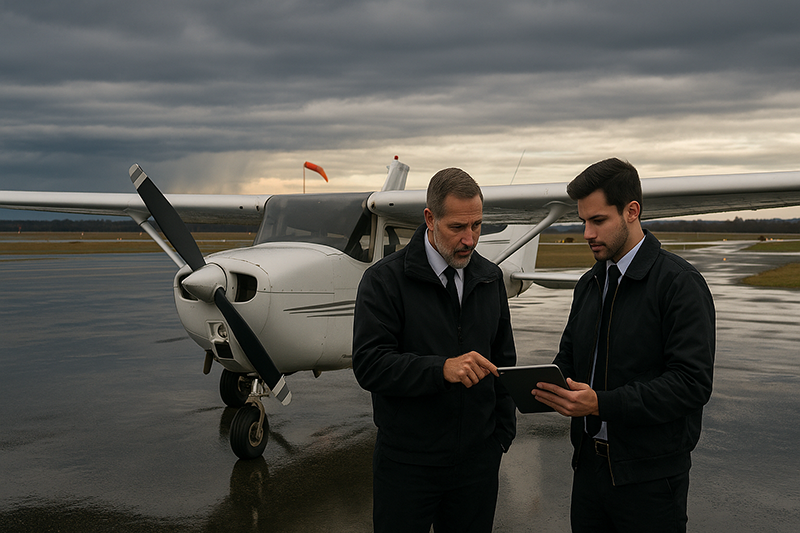
Weather risks during seasonal transitions deserve special attention from pilots because the atmosphere rarely changes seasons politely. Spring does not simply replace winter overnight, and autumn does not always arrive with a steady, predictable cooling trend. Instead, pilots often see rapid temperature swings, shifting pressure systems, stronger frontal passages, changing moisture patterns, and airport surface conditions that can vary widely from one day to the next.
For student pilots, flight instructors, aircraft owners, dispatchers, and professional aviation operators, these transition periods can be deceptively challenging. A route that was routine in late summer may become a wind shear and low-ceiling problem in early fall. A short local training flight that looked benign in the morning may face convective development, gusty surface winds, or a fast-moving cold front by afternoon. The goal is not to make seasonal flying sound dangerous by default. The goal is to help pilots recognize when seasonal change is adding complexity to weather decision-making.
This article explains how pilots should think about transitional weather, why it matters in practical flight operations, what mistakes are common, and how to build better preflight and in-flight judgment. It is written for pilots who want to move beyond simply reading a forecast and toward understanding what the atmosphere is trying to tell them.
What Seasonal Transition Weather Means in Aviation
Seasonal transition weather refers to the changing weather patterns that occur as one season gives way to another. In aviation, the most operationally significant transitions are often winter to spring and summer to fall, although every region has its own local patterns. These periods can bring a mix of seasonal hazards rather than a clean handoff from one familiar weather regime to the next.
During winter-to-spring transitions, cold air masses may still be present while increasing sun angle and warming surface temperatures begin to destabilize the lower atmosphere. That can support stronger gusts, rapidly changing ceilings, showery precipitation, turbulence, and convective activity in some areas. In colder regions, pilots may still need to consider icing potential aloft while also dealing with springtime wind, rain, and runway contamination from melting snow or standing water.
During summer-to-fall transitions, warm moist air can linger near the surface while nights become longer and cooling becomes more effective. This can increase the likelihood of fog, low stratus, or reduced visibility under the right conditions. Frontal systems may become more defined, winds may strengthen, and temperature differences between air masses may become more noticeable. In some areas, early cold air outbreaks can create sharp changes in density altitude, icing levels, and wind patterns.
The key aviation issue is variability. Seasonal transition weather often produces a wider gap between what happened yesterday and what may happen today. Pilots who rely too heavily on recent experience, personal routine, or a quick glance at a single forecast product may miss the larger pattern. A safe weather decision starts with recognizing when the atmosphere is in a changing state.
Why This Matters in Real-World Aviation
Weather is not only a preflight planning item. It directly affects aircraft performance, pilot workload, navigation choices, fuel planning, passenger comfort, emergency options, and the decision to continue or divert. Seasonal transition periods can increase uncertainty across all of those areas at once.
For flight training, transition weather often arrives just when students are developing confidence. A student who trained through calm summer mornings may be surprised by fall crosswinds, gust factors, lower ceilings, and earlier sunset times. A pilot who became comfortable with winter cold-weather performance may be caught off guard by spring turbulence, convective buildups, or rapidly changing altimeter settings associated with passing systems.
For instructors, these periods create excellent teaching opportunities, but they also require careful risk management. A lesson in crosswind landings can be valuable, but only when the conditions remain within the student’s ability, the aircraft’s limitations, the instructor’s safety margin, and the airport environment. A weather briefing discussion can become more meaningful when the student sees how a surface analysis, terminal forecast, winds aloft forecast, radar picture, and actual pilot reports fit together.
For aviation professionals, seasonal transitions can influence dispatch reliability and operating margins. A planned VFR repositioning flight may need an IFR-capable aircraft and crew, or a flexible departure window. A maintenance ferry flight may require more conservative planning if ceilings, winds, or freezing levels are changing rapidly. Airport operations may also be affected by wet runways, frost, standing water, snowmelt, or changing braking conditions, depending on the region and time of year.
The practical lesson is simple: seasonal transition weather adds layers. A pilot may not be dealing with only wind, only ceilings, only icing potential, or only convection. The challenge is often the combination of multiple moderate hazards that together create a higher-risk flight environment.
Major Weather Risks During Seasonal Transitions
Not every seasonal transition creates the same hazards, and regional differences matter. A coastal pilot, a mountain pilot, a Great Plains pilot, and a desert pilot may see very different weather expressions of the same seasonal change. Even so, several recurring aviation concerns deserve attention.
Rapidly Changing Ceilings and Visibility
Ceilings and visibility can change quickly when moisture, temperature, and wind patterns are in flux. A warm front, cold front, marine layer, upslope flow, or nighttime cooling can turn a comfortable VFR plan into a marginal VFR or IFR situation. Seasonal transitions often involve temperature and dew point relationships that change substantially between afternoon and early morning, which can influence fog or low cloud development.
For VFR pilots, the risk is not simply encountering lower-than-expected ceilings. The larger problem is being gradually squeezed between lowering clouds, terrain, airspace, and personal minimums. For IFR pilots, the concern may be approach minimums, alternate planning, missed approach fuel, and the availability of suitable airports if conditions deteriorate along the route.
Stronger and More Variable Winds
As seasons change, pressure gradients can strengthen and frontal passages can become more active. Surface winds may become gustier, and winds aloft may differ sharply from surface winds. This can create wind shear, turbulence, challenging groundspeeds, and crosswind issues during takeoff and landing.
Many pilots pay attention to the reported surface wind at departure and destination but spend less time considering the vertical wind profile. A significant change in wind direction or speed with altitude can affect climb performance, turbulence, approach stability, and fuel planning. During transition seasons, that vertical structure can be especially important near fronts, inversions, and terrain.
Turbulence and Mechanical Mixing
Seasonal heating, frontal boundaries, mountain waves, low-level jets, and gusty surface conditions can all contribute to turbulence. Spring often brings stronger daytime mixing in many areas as surface heating increases. Autumn can also produce bumpy conditions when cooler air moves over warmer ground or when stronger winds interact with terrain and obstacles.
Turbulence is not only a passenger comfort issue. It affects aircraft control, workload, airspeed management, and fatigue. For training flights, turbulence can make it harder for students to learn new maneuvers or maintain precise aircraft control. For instrument flying, turbulence can complicate altitude, heading, and approach path management, particularly in lighter aircraft.
Convective Weather Outside Peak Summer
Pilots often associate thunderstorms with summer, but convective weather can occur during seasonal transitions when instability, moisture, and lifting mechanisms are present. Spring thunderstorms may develop along fronts or drylines in some regions. Autumn convection can occur when warm, moist air remains in place ahead of a strong system.
The mistake is assuming that because it is not midsummer, convection is no longer a serious planning issue. Embedded convective activity, fast-moving lines of showers, and localized heavy precipitation can create hazards even when the radar picture does not resemble a classic summer thunderstorm day at first glance. Pilots should treat any convective potential as a reason to examine timing, route options, escape plans, and fuel reserves carefully.
Icing Potential During Shoulder Seasons
Icing risk is often associated with winter, but shoulder seasons can produce conditions where temperatures aloft support structural icing while surface temperatures may seem relatively mild. A pilot departing a cool rainy airport in spring or fall may climb into temperatures favorable for icing if visible moisture is present at altitude.
The practical issue is mindset. If the ramp temperature feels comfortable, pilots may not immediately think about freezing levels. Yet aircraft experience the atmosphere at altitude, not just at the departure airport. Any flight into clouds or precipitation when temperatures aloft may be near or below freezing requires careful planning, equipment awareness, and a conservative exit strategy.
Fog, Frost, and Low Stratus
Longer nights, moist ground, light winds, and cooling temperatures can support fog or low stratus, especially in valleys, near water, and over recently wet terrain. In autumn, these conditions can become a routine morning planning factor. In spring, snowmelt, wet soil, and changing temperatures may contribute to low-level moisture problems in some areas.
Frost is another transition-season concern. Even a thin layer of frost can disrupt airflow over a wing, and pilots should treat contamination seriously. The specific procedures for removing frost and determining aircraft airworthiness depend on the aircraft, operator, and applicable guidance, but the broad safety principle is clear: a clean aircraft is essential for expected aerodynamic performance.
Runway and Airport Surface Conditions
Seasonal transitions can bring wet runways, puddling, slush, patchy snow, frost, soft turf, or standing water. Even when the sky conditions are acceptable, the airport environment may create performance and control concerns. Braking action, hydroplaning risk, runway slope, turf condition, and crosswind component can all become more important when surface conditions are changing.
For pilots operating from non-towered airports, turf strips, or airports without extensive weather reporting, a phone call to airport management, a local pilot, or an FBO can be valuable. Weather products provide a broad picture, but local surface condition knowledge can be the difference between a good plan and an unpleasant surprise.
How Pilots Should Understand Transition Weather
The best way to understand seasonal transition weather is to think in terms of air masses, moisture, stability, and timing. A forecast is important, but a pilot who understands the setup behind the forecast is better prepared when conditions evolve faster or slower than expected.
Start with the air mass. Is cold dry air moving in, or is warm moist air returning? Is the flight crossing a boundary between the two? A route that stays within one stable air mass may be relatively predictable. A route that crosses a front or travels near a developing low-pressure system may require more caution.
Next, look at moisture. Moisture near the surface can affect visibility, cloud bases, and fog potential. Moisture aloft can affect cloud layers, precipitation, and icing potential when temperatures support it. In transition seasons, moisture may not be obvious from surface conditions alone. A clear afternoon can be followed by a foggy morning if the ingredients align.
Then consider stability. Stable air may support widespread stratus, lower ceilings, and smooth but persistent instrument conditions. Unstable air may produce showers, turbulence, rapidly changing visibility, and convective development. Neither stable nor unstable air is automatically safe or unsafe. The operational question is how that stability affects the flight you intend to conduct.
Finally, study timing. Many seasonal transition hazards are manageable when the pilot understands when they are expected to arrive or improve. A front arriving three hours earlier than planned can change the entire risk picture. Fog lifting later than expected can create fuel and alternate challenges. Afternoon wind gusts may make a training lesson unsuitable even if the morning conditions were excellent.
Good pilots do not ask only, “Is the weather legal?” They ask, “What is changing, how fast is it changing, and what will I do if the timing is wrong?”
Preflight Weather Planning During Seasonal Change
A strong preflight weather process uses several pieces of information rather than relying on one product or one observation. Pilots should review current conditions, forecasts, radar or satellite imagery when appropriate, winds aloft, surface analysis, freezing levels or icing-related information when relevant, NOTAMs, and available pilot reports. The exact products vary by flight type and region, but the purpose is consistent: build a three-dimensional picture of the atmosphere.
For VFR pilots, seasonal transition planning should include a realistic assessment of ceiling and visibility trends along the entire route, not only at the departure and destination airports. Terrain, towers, airspace, and available diversion airports matter. A route over flat terrain with many airports offers different options than a route over mountains or sparsely populated areas.
For IFR pilots, the planning focus shifts but does not disappear. IFR capability is not a shield against all weather risk. Low ceilings, convective activity, icing potential, turbulence, strong winds, and fuel planning still matter. Approach availability, alternate requirements, aircraft equipment, pilot proficiency, and expected workload should all be considered.
For flight instructors and students, a seasonal transition day can be an excellent time to conduct a weather decision-making lesson even if the flight is delayed or canceled. Reviewing why the flight is not appropriate can be as valuable as flying. Students learn that cancellation is not failure. It is part of professional aeronautical decision-making.
Why Personal Minimums Need Seasonal Adjustment
Personal minimums are most useful when they reflect the pilot’s current proficiency, aircraft capability, route environment, and weather complexity. A single set of numbers used all year may not fully capture seasonal risk. The same reported ceiling, visibility, or wind speed can mean different things depending on temperature, terrain, daylight, runway condition, and forecast trend.
For example, a crosswind that is manageable on a dry, wide runway during daylight may deserve more caution on a wet runway near sunset with gusts and mechanical turbulence. A marginal VFR ceiling that might be acceptable in flat familiar terrain may be inappropriate near rising terrain with lowering visibility. A morning departure may be reasonable if fog is lifting and trends are improving, but questionable if ceilings are lowering ahead of a front.
Seasonal personal minimums do not need to be complicated. A pilot might choose more conservative wind limits during the first gusty weeks of spring until proficiency is refreshed. An instrument pilot might require higher ceilings for practice approaches after a period of limited IFR flying. A student pilot might avoid solo flights when surface winds are forecast to become gusty near the planned return time.
The important point is that personal minimums should be living tools. Seasonal transitions are a reminder to update them before the weather forces the issue.
Common Mistakes or Misunderstandings
One common mistake is treating seasonal weather as a calendar event. Pilots may assume that icing is over because spring has arrived, or that thunderstorms are no longer a concern because summer has ended. The atmosphere does not follow the calendar as neatly as pilots may prefer. Operational decisions should be based on actual and forecast conditions, not on the name of the month.
Another misunderstanding is focusing only on the departure airport. A local observation can look excellent while a route of flight includes lower ceilings, stronger winds, precipitation, or terrain-related hazards. Seasonal transition systems can have sharp gradients, meaning conditions can change significantly over a relatively short distance.
A third mistake is underestimating wind. Pilots may consider only the direct crosswind component for takeoff or landing, but gusts, wind shear, turbulence, and changing winds aloft can matter just as much. A flight may be technically possible but still unproductive or uncomfortable for training.
A fourth mistake is allowing recent experience to drive the decision. If the last several weeks were calm and predictable, a pilot may not be mentally prepared for a strong frontal passage or a sudden return of low ceilings. Seasonal transitions require pilots to reset their expectations.
A fifth mistake is pressing on because the flight is short. Short flights are not immune to weather risk. In fact, local training flights can be vulnerable because pilots may launch with the assumption that they can simply return if conditions change. That assumption works only if the departure airport remains usable and the pilot has maintained good escape options.
Practical Example: A Spring Training Flight
Consider a private pilot student scheduled for a late afternoon cross-country training flight in early spring. The morning weather looks acceptable, with good visibility and a broken cloud layer well above the planned altitude. Surface winds are light at sunrise, and the destination forecast appears manageable. At first glance, the lesson seems straightforward.
During the preflight briefing, the instructor and student notice that a cold front is forecast to move through the region later in the day. Winds aloft are stronger than the surface winds, and the temperature spread suggests that gusty surface conditions may develop as daytime heating increases. Radar shows scattered showers well west of the route, and the terminal forecasts indicate a wind shift near the planned return time.
The instructor uses the situation as a teaching moment. The question is not whether the aircraft can fly in wind or whether the forecast is technically within limits at departure. The better question is whether the lesson objective can be accomplished safely with a student who is still learning cross-country workload management. The planned route includes a destination with one runway, nearby terrain, and limited diversion options along one segment.
Instead of launching into a tightening weather window, the instructor modifies the plan. They conduct a shorter local lesson earlier in the afternoon, remain near several suitable airports, and focus on weather interpretation, wind correction, and stabilized approaches. They set a firm return time before the expected frontal passage and continue monitoring updated observations. If conditions deteriorate sooner than expected, they are close to home and have options.
This example illustrates a mature weather decision. The lesson was not canceled out of fear, nor was it flown blindly because the first observation looked good. The plan was adjusted to match the changing atmosphere, the student’s experience, and the training objective.
Best Practices for Pilots
Flying during seasonal transitions is manageable when pilots approach it with curiosity, discipline, and flexibility. The best practices are not complicated, but they require consistency.
- Brief the trend, not just the snapshot. Current weather matters, but transition-season safety depends heavily on what is changing.
- Compare multiple weather products. Use observations, forecasts, radar or satellite imagery when appropriate, winds aloft, and pilot reports to build a complete picture.
- Respect timing uncertainty. Fronts, fog, ceilings, and wind shifts may not arrive exactly when expected. Build a margin for early or late changes.
- Revisit freezing levels and cloud temperatures. Mild surface weather does not eliminate icing concerns aloft when visible moisture and suitable temperatures are present.
- Account for runway condition. Wet, frosty, slushy, or soft surfaces can change the operational picture even when the ceiling and visibility are acceptable.
- Use conservative training judgment. A weather condition that is safe for an experienced pilot may not be productive for a student learning a new task.
- Keep diversion options alive. Know where you can go before you need to go there.
These habits help pilots avoid binary thinking. The question is rarely only “go” or “no-go.” Often, the better decision is “go earlier,” “go later,” “change the route,” “stay local,” “file IFR,” “take an instructor,” or “make this a ground lesson.”
Training Value for Student Pilots and Instructors
Seasonal transition weather is one of the best classrooms in aviation because it shows how interconnected the atmosphere is. A student can see how temperature, dew point, pressure, wind, clouds, and terrain combine to affect a flight. Instructors can use these days to teach weather interpretation rather than simply weather avoidance.
A productive training discussion might begin with the student explaining the current METAR and TAF, then expanding outward to the route, nearby alternates, winds aloft, frontal position, and expected trend. The instructor can ask scenario-based questions: What if the ceiling lowers 1,000 feet? What if the wind shifts earlier than forecast? What if the destination becomes unsuitable? What if the return airport becomes gusty?
This method builds judgment. Students learn that weather planning is not memorizing abbreviations. It is an operational decision process. They also learn that conservative decisions can be made with confidence and professionalism. That lesson may be more valuable than another lap around the pattern.
Operational Considerations for Cross-Country Flights
Cross-country flying during seasonal transitions requires extra attention because the route may cross different weather zones. A pilot may depart in one air mass, fly through a frontal boundary, and arrive in another. That can mean changes in cloud bases, visibility, turbulence, winds, precipitation type, and temperature.
Fuel planning should account for changing winds, possible deviations, and alternate airports. A strong headwind aloft can make a familiar route much less efficient. A diversion around weather may add time. A hold for traffic or weather may be more consequential if the pilot planned fuel too tightly.
Terrain is another major consideration. Lower ceilings and visibility can remove options quickly near mountains, ridgelines, or rising terrain. Even in non-mountainous areas, towers and obstacles become more relevant when pilots are tempted to remain low to stay below clouds. Seasonal transition weather can create exactly the type of marginal conditions that pressure a VFR pilot into poor altitude choices.
Night flying deserves special caution. Seasonal transitions often bring changing sunset times, cooler evening temperatures, and increased risk of fog or low cloud formation in some areas. A flight that begins in visual conditions before sunset may end in darkness with reduced surface references and fewer comfortable diversion choices.
Decision-Making: When to Delay, Divert, or Cancel
Delaying, diverting, or canceling is not an admission that a pilot lacks skill. It is evidence that the pilot understands risk. Seasonal transition weather often creates situations where waiting one hour, departing earlier, choosing a different altitude, or selecting a different route can substantially improve the safety margin.
A delay may be appropriate when fog is expected to lift, when a front has not yet passed, or when updated observations are needed to confirm a trend. A diversion may be appropriate when actual conditions do not match the forecast, when passenger comfort is deteriorating, when turbulence is increasing, or when the destination is trending below the pilot’s comfort level. A cancellation may be appropriate when several moderate hazards combine into a flight that offers little margin.
The best decisions are made early. Once airborne, workload increases and options can narrow. Pilots should identify decision points before departure. For example, “If the destination ceiling is below my personal minimum by the halfway point, I will divert,” or “If surface gusts exceed my training limit before engine start, we will change the lesson.” Clear triggers reduce the temptation to rationalize deteriorating conditions.
Frequently Asked Questions
Why are seasonal transitions challenging for pilots?
Seasonal transitions are challenging because weather patterns are often less stable and less familiar. Pilots may encounter rapid changes in ceilings, visibility, winds, temperature, precipitation, and turbulence. The risk increases when several moderate hazards occur together.
Is icing still a concern in spring or fall?
Yes, icing can still be a concern when an aircraft is flying in visible moisture and temperatures at altitude support ice formation. Mild surface temperatures do not guarantee that the air aloft is warm enough to eliminate icing risk.
Should VFR pilots avoid all marginal weather during seasonal changes?
Not necessarily, but VFR pilots should be especially cautious with marginal conditions when trends are worsening, terrain is nearby, daylight is limited, or diversion options are poor. Personal minimums should reflect the full operating environment, not just legal weather minimums.
How can instructors use transition weather safely in training?
Instructors can use transition weather to teach briefing skills, trend analysis, crosswind technique, and aeronautical decision-making. The key is matching the lesson to the student’s ability and maintaining conservative margins with clear return or cancellation criteria.
What is the most important habit for seasonal weather planning?
The most important habit is to brief the trend. Pilots should ask what is changing, how quickly it is changing, and what options remain if the forecast timing is wrong. A single observation is not enough during dynamic weather periods.
Key Takeaways
- Seasonal transition weather requires pilots to evaluate trends, timing, and combinations of hazards rather than relying on a single current observation.
- Changing ceilings, gusty winds, turbulence, icing potential, fog, and runway surface conditions can quickly reduce safety margins.
- Strong aeronautical decision-making includes flexible plans, conservative personal minimums, and early choices to delay, divert, modify, or cancel when conditions warrant.