
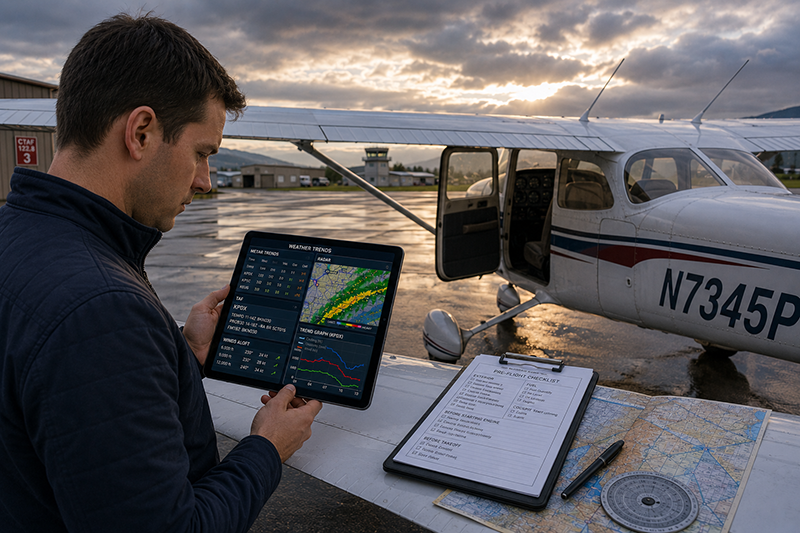
Weather trends before departure are one of the most important clues a pilot can use to decide whether a planned flight is still reasonable, needs a delay, requires a different route, or should be canceled. A single METAR, TAF, radar image, or winds aloft forecast is only a snapshot. Trend detection is the process of comparing those snapshots over time and asking a practical aviation question: is the weather getting better, getting worse, moving faster than expected, or behaving differently than the forecast suggested?
For student pilots, this skill builds judgment beyond memorizing weather products. For certificated pilots and flight instructors, it supports safer preflight planning and better in-flight decision-making. Detecting trends does not require a meteorology degree, but it does require disciplined comparison, healthy skepticism, and a willingness to update the plan when the atmosphere is telling a different story than the original briefing.
What It Means to Detect Weather Trends Before Departure
Detecting a weather trend means looking for direction, rate, and significance. Direction tells you whether ceilings are rising or lowering, visibility is improving or deteriorating, winds are veering or backing, pressure is falling or rising, and convective weather is developing, weakening, or moving. Rate tells you how quickly those changes are happening. Significance tells you whether the change matters for your aircraft, route, airport, pilot capability, fuel planning, alternates, terrain clearance, passenger comfort, or operational limits.
A pilot who checks only the latest observation may miss the larger picture. A current METAR showing VFR conditions can be misleading if ceilings have dropped steadily for three hours, the temperature and dew point are converging, and nearby stations are already reporting lower conditions. Conversely, a marginal observation may be less concerning if an organized system has passed, ceilings are lifting across the route, winds are stabilizing, and satellite or radar trends support the improvement.
Preflight weather analysis should not be a search for a single answer. It should be a search for consistency. Do the observations match the forecast? Do nearby reporting stations tell the same story? Is radar movement consistent with winds aloft and the surface pattern? Are PIREPs confirming turbulence, icing, cloud tops, or visibility concerns? When multiple weather products point in the same direction, confidence improves. When they conflict, the pilot should slow down, ask why, and consider a more conservative plan.
Start With the Big Picture Before Studying the Airport
A common preflight mistake is beginning with the departure airport METAR and staying there too long. Local observations are important, but they make more sense when viewed inside the larger weather system. Before deciding whether the runway, ceiling, or crosswind looks acceptable, first identify the larger pattern affecting the flight.
Look at the position and movement of fronts, pressure systems, troughs, ridges, precipitation areas, convective outlooks, and widespread cloud shields. A cold front approaching the route may bring wind shifts, lowering ceilings, showers, turbulence, or thunderstorms depending on moisture and instability. A warm front can produce widespread low ceilings, precipitation, and poor visibility over a broad area. High pressure may bring generally stable conditions, but in some seasons and regions it can also support fog, haze, smoke, or low stratus.
Once the big picture is understood, individual products become more meaningful. A dropping ceiling at the departure airport has a different implication if it is associated with a widespread moist flow than if it is a brief local shower. A gusty surface wind may be routine in one pressure pattern and a warning sign in another. Weather trend detection improves when pilots stop treating each product as a separate answer and start using each product as evidence in a larger operational picture.
Use METARs as a Time Series, Not a Single Report
METARs are among the most familiar aviation weather products, but their value increases when pilots compare them over time. The latest observation tells you what was recently reported at a station. The previous several observations tell you whether the airport environment is changing.
When reviewing METARs before departure, compare at least the recent sequence when available. Watch the ceiling, visibility, wind direction, wind speed, gust spread, altimeter setting, temperature, dew point, present weather, and remarks. The trend may be subtle at first. A ceiling that moves from 4,500 feet to 3,200 feet to 2,300 feet may still look acceptable for a VFR flight in the moment, but the trend deserves attention. Visibility dropping from 10 miles to 6 miles to 4 miles with mist or precipitation may signal a worsening moisture problem. A temperature and dew point spread that narrows in the evening or early morning may suggest increasing fog or low cloud risk, especially if other local factors support it.
Surface wind trends also deserve careful review. A steady wind may be manageable, while a rapidly shifting wind can indicate a frontal passage, outflow boundary, sea breeze, terrain-driven change, or convective influence. Gusts that build over successive observations may affect crosswind planning, takeoff distance, climb performance, passenger comfort, or the decision to delay. The key is not only whether the wind is within your personal minimums right now, but whether it is moving toward or away from them.
Nearby METARs are equally important. Weather rarely respects airport boundaries. If the departure airport reports good VFR but stations upstream show lowering ceilings, rain, reduced visibility, or shifting winds, that upstream weather may arrive during taxi, climbout, or shortly after departure. If your destination is reporting acceptable conditions but surrounding stations are deteriorating, the destination may be the last place to show the problem rather than an island of safety.
Read TAFs for Timing, Confidence, and Change
Terminal forecasts are valuable because they provide expected changes over time for specific airport areas. For trend detection, the most important question is not simply whether the TAF is VFR or IFR at departure time. The better question is whether the forecast timing, trend direction, and uncertainty align with the current observations.
Look for forecast groups that show changing ceilings, visibility, wind shifts, precipitation, thunderstorms, or temporary conditions. A forecast that calls for improving weather may be encouraging, but only if actual observations support the improvement. If the TAF forecast expected lifting ceilings two hours ago and the actual observations have continued to deteriorate, confidence should decrease. If a forecast expects a wind shift with a frontal passage near your departure time, the runway, taxi plan, climbout, and turbulence expectations may change quickly.
TAFs should also be interpreted in the context of the route. A good destination forecast does not remove concerns about lower conditions en route, terrain, rising minimum en route altitudes, fuel stops, or alternate options. A conservative pilot compares the TAF with METAR trends, radar, satellite, and nearby stations. When these products agree, the trend is more reliable. When they do not, the pilot should consider why the mismatch exists and whether the flight plan needs more flexibility.
Use Radar to Study Movement, Growth, and Gaps
Weather radar is useful, but pilots can misuse it when they focus only on colors at one moment. Radar trend analysis means watching movement, growth, decay, coverage, and the relationship between precipitation and the planned route. A line of showers that appears manageable on a single image may be strengthening, filling gaps, or moving faster than expected. A scattered area may become more organized. A gap that looks convenient may close before the aircraft reaches it.
Before departure, consider how precipitation has changed over the previous images. Are cells building vertically and expanding? Are returns weakening behind a front? Is the precipitation shield moving toward the departure corridor, destination, or alternate? Are storms moving with the forecast winds, or are outflow boundaries creating new development? A pilot does not need to perform advanced meteorological analysis to recognize that rapidly developing or poorly organized convective weather requires caution.
Radar also has limitations. It shows precipitation, not all cloud, turbulence, icing, or visibility hazards. A route can look clear on radar and still have low ceilings, fog, smoke, mountain obscuration, or turbulence. Radar images can also have age, resolution, and coverage limitations depending on the source and display. In practical terms, radar is a trend tool, not permission to thread through weather.
Satellite Imagery Helps Explain Clouds and Moisture
Satellite imagery can help pilots understand where clouds are forming, moving, and thinning. Visible satellite imagery is especially useful in daylight for seeing cloud coverage and texture. Infrared imagery can provide information about cloud-top temperatures and high cloud patterns at any time, though interpretation requires care. Water vapor imagery can help show larger-scale moisture and atmospheric flow, but it is more advanced and should be used as part of a broader picture.
For pilots, the practical value of satellite imagery is often simple: it helps reveal whether the cloud problem is local or widespread. If low clouds are expanding upstream and moving toward the route, the trend may be more important than the current departure airport observation. If clearing is spreading consistently from the west and nearby stations are improving, that may support a delay until conditions are better established.
Satellite also helps identify cloud shields associated with fronts, organized systems, and convective development. When radar returns are limited but satellite shows a large area of clouds over rising terrain, a VFR pilot should be alert to potential terrain and ceiling concerns. When high clouds thicken ahead of a system and pressure begins to fall, that may indicate the weather pattern is evolving even before precipitation reaches the airport.
Compare Winds Aloft With Surface Wind and Cloud Movement
Winds aloft forecasts help pilots anticipate groundspeed, fuel burn, drift correction, turbulence potential, and weather movement. They also provide context for what is happening at the surface. A strong change in wind speed or direction with altitude can support mechanical turbulence, wind shear concerns near terrain or frontal boundaries, and rapidly changing cloud or precipitation movement.
Before departure, compare the forecast winds aloft with the surface winds and observed movement of clouds or precipitation. If surface winds are light but winds just above the surface are much stronger, expect that conditions may not feel as calm after takeoff. If cloud movement differs sharply from surface wind, the atmosphere may have significant directional shear. If winds aloft create a strong headwind on a marginal fuel plan, the weather trend may affect operational feasibility even if ceilings and visibility remain acceptable.
Wind trend analysis is also important for airport selection. A crosswind that is manageable during preflight may increase or shift as a front approaches. A tailwind component at the destination may affect landing runway choice, fuel planning, or the need to divert to a more favorable airport. Pilots should avoid treating wind as a static number. Like ceiling and visibility, wind is a trend.
Look for Fog, Low Stratus, and Visibility Trends
Fog and low stratus often create some of the most frustrating preflight decisions because small changes in temperature, moisture, wind, terrain, and time of day can produce large operational effects. Trend detection can help pilots identify when conditions are likely to improve, worsen, or remain stubbornly low.
Temperature and dew point spread is one useful clue, but it should not be used alone. A small spread may support fog or low cloud formation when winds are light, skies are clear overnight, or moist air is present. However, fog formation also depends on local factors such as terrain, water sources, soil moisture, wind, cloud cover, and air mass characteristics. A widening spread after sunrise may support improvement, but only if observations confirm that visibility and ceiling are actually improving.
Low stratus can be more persistent than expected, particularly when moist flow, stable air, or terrain effects keep clouds in place. If the forecast calls for clearing but nearby stations remain low and satellite shows a broad cloud deck, a pilot should be cautious about launching based solely on expected improvement. A short delay can sometimes reveal whether the forecast trend is verifying.
Evaluate Convective Trends With Extra Conservatism
Thunderstorms and convective weather deserve special respect because they can change quickly and affect a flight well beyond the visible precipitation core. Before departure, pilots should consider whether the atmosphere is becoming more unstable, whether storms are initiating earlier than expected, whether cells are growing in coverage or intensity, and whether the route includes limited escape options.
Trend detection for convective weather is not about finding a narrow path between cells. It is about deciding whether the overall environment is becoming less suitable for the planned flight. If storms are developing along a boundary, if gaps are closing, or if outflow boundaries are triggering new cells, the trend may be more important than the current route view. For training flights, local sightseeing, or nonessential operations, waiting for a more stable period is often the more disciplined decision.
Convective weather can also influence surface winds, visibility, turbulence, and runway conditions even when the main cell is not over the airport. Gust fronts and outflow can arrive ahead of precipitation. A departure that looked acceptable during engine start may become uncomfortable or unsafe before takeoff if conditions change rapidly. Pilots should keep monitoring weather during preflight, taxi, and run-up when convective activity is nearby.
Use PIREPs to Add the Human Weather Layer
Pilot reports can add information that automated products may not fully capture. PIREPs may describe cloud bases, cloud tops, turbulence, icing, visibility, and ride conditions along routes and at altitudes relevant to actual aircraft. They are especially useful when the reported condition affects operational decisions, such as moderate turbulence near a mountain pass, cloud tops above a practical climb altitude, or icing conditions at commonly used cruise levels.
Like any weather product, PIREPs should be interpreted in context. Aircraft type, altitude, location, time, and pilot description all matter. A turbulence report from a larger aircraft may not feel the same in a light trainer, and a report that is old or distant may not represent current conditions. Still, when PIREPs align with other trends, they can significantly improve the pilot’s understanding of what is happening beyond the airport fence.
Instructors can use PIREPs during training to help students connect forecasts with operational experience. Ask what the report means for route, altitude, passenger briefing, fuel, alternate airports, and the go/no-go decision. This turns weather review into risk management rather than a decoding exercise.
Why This Matters in Real-World Aviation
Weather trend detection matters because most flights unfold over time. A pilot may depart in legal and comfortable conditions, but the aircraft still has to climb, cruise, descend, approach, land, and possibly divert. A preflight decision based only on present conditions can become fragile if the trend is moving against the flight.
For VFR pilots, trend awareness helps protect against gradual reductions in ceiling and visibility, terrain traps, disappearing horizon references, and pressure to continue toward deteriorating conditions. For IFR pilots, it supports alternate planning, fuel strategy, approach selection, missed approach expectations, and workload management. For flight instructors, it creates teachable moments about aeronautical decision-making and personal minimums. For operators, it helps align dispatch, crew communication, and passenger expectations with a realistic weather picture.
Trend detection also helps pilots avoid surprise. Weather surprises are not always caused by bad forecasts. Sometimes the clues were available, but the pilot did not connect them. A lowering ceiling across multiple stations, a forecast amendment, a line of precipitation moving faster than expected, and a narrowing temperature-dew point spread are all signals. The more signals that point in the same direction, the more seriously the pilot should take them.
How Pilots Should Understand This Topic
The practical goal is not to become perfectly predictive. Weather is complex, and forecasts can change. The goal is to build a defensible decision using the best available information, then keep updating that decision as conditions evolve.
A useful method is to compare weather in four dimensions: time, space, altitude, and operational effect. Time means reviewing past observations, current conditions, and forecast changes. Space means comparing departure, destination, alternates, route stations, and upstream weather. Altitude means considering surface conditions, cloud layers, winds aloft, freezing levels when relevant, turbulence, and icing potential when appropriate. Operational effect means translating weather into practical questions: Can I depart safely? Can I maintain required terrain and obstacle clearance? Can I remain within my personal minimums? Do I have enough fuel and suitable alternates? Is the flight still worth the risk and workload?
One of the most valuable habits is to form an expectation, then test it. For example, if the TAF indicates improving ceilings after a certain time, check whether nearby METARs and satellite imagery show improvement beginning upstream. If the forecast calls for winds to shift after frontal passage, look for pressure changes, precipitation movement, and actual wind shifts at nearby airports. If thunderstorms are expected later in the day, monitor whether development is starting earlier than planned.
This expectation-testing mindset keeps the pilot active rather than passive. Instead of accepting a weather product as a final answer, the pilot asks whether reality is confirming or challenging the plan.
Common Mistakes or Misunderstandings
One common mistake is treating marginal weather as acceptable because it is technically above a minimum at the moment. Weather that is barely acceptable and deteriorating deserves a different decision than weather that is barely acceptable and improving. The direction and rate of change matter.
Another mistake is focusing on the departure airport while ignoring the route. This is especially risky for VFR flights near terrain, over sparsely populated areas, or through regions with limited airports. Good weather at the departure airport does not guarantee usable weather ahead. For IFR flights, a destination forecast may look manageable, but en route icing, convective weather, turbulence, or strong headwinds may change the risk picture.
Pilots also sometimes overvalue a single favorable product and discount unfavorable evidence. A TAF may look acceptable while METARs are trending lower. Radar may show a gap while satellite and lightning trends show growing convection. A weather app may present a clean route line while nearby PIREPs describe conditions that would be uncomfortable or unsuitable. Good preflight analysis weighs all relevant evidence, not just the product that supports the desired departure.
Another misunderstanding is assuming that automated decision tools replace pilot judgment. Graphical tools can be excellent for situational awareness, but the pilot remains responsible for understanding limitations, timing, and operational consequences. Colors, route overlays, and simplified labels can hide important detail. Pilots should know what each product is showing, what it is not showing, and how old it may be.
Finally, pilots can miss the emotional side of weather decisions. Get-there pressure, passenger expectations, training schedule pressure, rental booking windows, and confidence from previous successful flights can all influence interpretation. A disciplined weather trend review gives the pilot a structured way to challenge optimism before it becomes a hazard.
Practical Example: A Morning Cross-Country Decision
Consider a private pilot planning a morning VFR cross-country in a single-engine training aircraft. The departure airport currently reports VFR conditions with a ceiling well above the pilot’s personal minimums and good visibility. The destination also reports VFR. At first glance, the flight looks reasonable.
The pilot then reviews the trend. Over the past three hours, the departure airport ceiling has gradually lowered. Two airports southwest of the route now report lower ceilings and light rain. The temperature and dew point spread at the destination has narrowed since sunrise, and satellite imagery shows a broad low cloud deck spreading toward the route. The TAF suggests conditions should remain VFR for the next few hours, but the nearby observations are less encouraging than they were earlier.
The pilot calls for an official briefing, reviews updated products, and compares route alternates. The briefer notes that the low cloud deck has been slower to lift than expected. The pilot also sees that an airport near the midpoint has recently dropped to marginal VFR. The aircraft is capable, and the pilot is current, but the route includes few good visual references if ceilings continue to lower.
Instead of departing immediately, the pilot delays one hour and sets a specific reassessment point. During that hour, the midpoint airport improves slightly, but the destination visibility decreases and the cloud deck continues spreading. The pilot cancels the VFR cross-country and chooses a local training flight in better conditions later in the day. Nothing dramatic happened. That is the point. Good weather trend detection often prevents pilots from launching into a situation that would have become difficult only after options narrowed.
The same scenario could produce a different decision for an instrument-rated pilot in an appropriately equipped aircraft under a suitable IFR plan, but the trend analysis would still matter. The IFR pilot would need to consider alternate requirements, fuel, cloud tops, turbulence, icing potential if relevant, approach options, missed approach planning, and whether the actual weather is verifying the forecast. Trend detection supports the decision. It does not make the decision automatically.
Best Practices for Pilots
Strong predeparture weather habits are built around comparison and timing. Start early enough that you can make a real decision, not merely confirm a decision you have already made. Then update the weather close enough to departure that the information is still operationally useful.
Use multiple weather products, but do not collect them randomly. Build a flow. Begin with the synoptic picture, then review METAR trends, TAF timing, radar and satellite movement, winds aloft, NOTAM and airport considerations when relevant, PIREPs, and any hazards appropriate to the route and season. If you obtain a briefing, ask specific trend-based questions: What has changed in the last few hours? Is the forecast verifying? Where is the weather moving faster or slower than expected? What are the primary hazards for my route and altitude?
It is also wise to define personal triggers before the engine is running. A trigger might be a ceiling that drops below a personal minimum, a wind gust spread that exceeds comfort level, thunderstorms developing within an area that removes safe options, or an alternate becoming unsuitable. Triggers help pilots make decisions while calm rather than negotiating with themselves during taxi or climbout.
- Compare current observations with several previous reports instead of relying on one METAR.
- Check nearby and upstream stations to see what may be moving toward the route.
- Test forecasts against actual observations before relying on expected improvement.
- Use radar and satellite for movement and coverage trends, not just a single image.
- Translate every weather trend into an operational effect on route, altitude, fuel, alternates, and workload.
- Keep monitoring weather during taxi and run-up, especially when conditions are changing quickly.
For instructors, the best practice is to make students explain their weather decision in plain language. Ask them what is improving, what is deteriorating, what information conflicts, and what would cause them to delay or cancel. This develops judgment more effectively than simply asking them to decode weather abbreviations.
Frequently Asked Questions
How far back should I look when checking METAR trends?
There is no single time window that fits every situation, but reviewing several recent observations is usually more useful than looking only at the latest report. The right lookback period depends on how quickly the weather is changing, the type of system involved, and the length of the planned flight.
What is the most important sign that weather is deteriorating before departure?
No single sign is always most important. Pilots should look for a combination of lowering ceilings, decreasing visibility, strengthening or shifting winds, falling pressure, increasing precipitation, convective development, and nearby stations reporting worse conditions. Multiple unfavorable trends deserve more weight than one isolated data point.
Can I rely on a TAF if the current weather is worse than forecast?
A TAF is valuable, but if actual observations are not matching the forecast, confidence should decrease until you understand why. Compare nearby stations, radar, satellite, and updated information. If the forecast improvement is not verifying, consider delaying, changing the plan, or choosing a more conservative option.
How do radar trends help a pilot before departure?
Radar trends show precipitation movement, coverage, growth, and weakening over time. Pilots can use this to estimate whether rain, showers, or storms are moving toward the departure path, destination, or alternate. Radar should be combined with other products because it does not show every aviation weather hazard.
What should student pilots focus on first when learning weather trend analysis?
Student pilots should first learn to compare current and previous METARs, then relate those observations to the TAF and nearby stations. Once that habit is established, radar, satellite, winds aloft, PIREPs, and larger weather patterns become easier to understand in an operational context.
When should changing weather cause a pilot to cancel instead of delay?
Cancellation is appropriate when the trend, uncertainty, aircraft capability, pilot proficiency, route options, or mission value no longer support a safe and reasonable flight. A delay is useful only if it creates a better decision point. If the larger pattern is clearly worsening or suitable options are disappearing, cancellation may be the better risk-management choice.
Key Takeaways
- Weather trends before departure are best detected by comparing observations, forecasts, radar, satellite, winds, and PIREPs over time rather than relying on one product.
- Deteriorating trends matter even when current conditions still appear acceptable, especially for VFR flights, marginal routes, terrain, convective weather, and limited alternate options.
- Pilots should turn weather information into operational decisions about route, timing, fuel, altitude, alternates, workload, and personal minimums before committing to departure.