
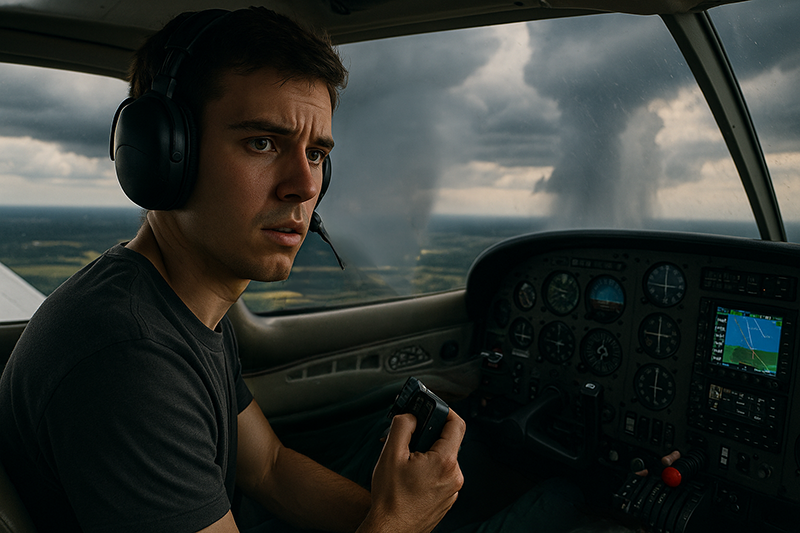
Knowing when to request help from ATC is one of the most important judgment skills a pilot can develop. Air traffic control is not only a traffic sequencing and separation service. In day-to-day flying, controllers are also a critical communication link when a pilot needs clarification, workload relief, weather information, vectors, priority handling, or assistance during an abnormal or emergency situation.
Many pilots, especially student pilots and low-time private pilots, wait too long to ask for help because they do not want to sound inexperienced or create extra work for the controller. That hesitation can increase cockpit workload at the worst possible time. A professional pilot does not measure competence by never needing help. A professional pilot recognizes when safety margins are shrinking and uses every available resource, including ATC, before a small problem becomes a serious one.
The Core Principle: Ask Early, Clearly, and Honestly
The best time to request help from ATC is before the situation becomes unmanageable. If you are uncertain, overloaded, disoriented, unable to comply with an instruction, concerned about weather, dealing with a passenger issue, or troubleshooting an aircraft problem, a timely radio call can preserve options. ATC cannot fly the aircraft for you, but controllers can often reduce your workload by providing vectors, coordinating with other facilities, offering traffic and weather information when available, clearing airspace around you, or helping you reach a suitable airport.
Pilots sometimes imagine ATC assistance as something reserved only for dramatic emergencies. In reality, help exists on a spectrum. At one end is a simple request such as, 'say again,' 'unable,' or 'request progressive taxi.' In the middle are situations where a pilot needs vectors around weather, help locating an airport, clarification of a clearance, or a frequency change back to the previous controller. At the far end are urgent or emergency situations involving engine problems, instrument failures, smoke, fuel concerns, medical issues, or loss of situational awareness in instrument meteorological conditions.
The common thread is communication. If ATC knows what you need, controllers can usually do more for you. If they do not know, they must assume you are operating normally and can comply with issued instructions. Silence may look like competence from the cockpit, but it gives ATC very little to work with.
Why This Matters in Real-World Aviation
Requesting help from ATC matters because aviation problems rarely arrive one at a time. A pilot might be navigating unfamiliar airspace, monitoring deteriorating weather, managing passengers, configuring the aircraft, and trying to copy a complex clearance all at once. Each task may be manageable by itself. Together, they can consume attention rapidly.
Flight training often emphasizes self-reliance, and for good reason. Pilots must be able to aviate, navigate, communicate, and make decisions without depending on someone else to solve the problem. But self-reliance is not the same as isolation. Sound aeronautical decision-making includes using available resources. ATC is one of those resources when you are in communication range and on an appropriate frequency.
In real-world operations, early communication also gives ATC time to build a plan. If a pilot waits until the aircraft is already low on fuel, deep in weather, or uncertain of position, the controller may still help, but fewer options may remain. By contrast, a pilot who speaks up early may receive a vector, a climb or descent, coordination with another facility, or a suggestion to contact flight service or another resource as appropriate. The earlier the controller understands the problem, the more room everyone has to work.
This is especially important in busy airspace. Controllers manage multiple aircraft, frequencies, handoffs, and traffic flows. A clear request helps them prioritize. You do not need to deliver a long explanation on the first call. A concise statement such as 'request vectors due weather,' 'student pilot, request help with airspace transition,' or 'unable assigned heading due buildups' gives ATC enough information to begin assisting.
How Pilots Should Understand ATC Assistance
ATC assistance is not a substitute for pilot-in-command responsibility. The pilot remains responsible for the safe operation of the aircraft, including aircraft control, terrain clearance when applicable, fuel management, weather decisions, and compliance with regulations. ATC can support the decision-making process, but the pilot must still evaluate whether an instruction is safe and appropriate for the aircraft and situation.
The word 'unable' is one of the most useful and underused words in aviation communication. If an ATC instruction would put the aircraft or flight at risk, the pilot should say so. That could involve performance limitations, weather avoidance, terrain concerns, equipment issues, passenger concerns, or workload. A pilot should not accept a clearance or instruction that cannot be safely complied with simply to be agreeable on the radio.
There is also a difference between a request, an urgency condition, and an emergency. A routine request might be for a heading, altitude change, or clarification. An urgency situation may involve a condition that requires priority handling but is not yet immediately life-threatening. An emergency involves distress or a condition requiring immediate assistance. Pilots should not be reluctant to use plain language if they are unsure which category applies. A clear statement such as 'we need priority handling' or 'we have an engine problem and need to land' communicates the need far better than trying to sound polished while the situation deteriorates.
Standard phraseology is valuable because it is efficient and widely understood. Plain language is also appropriate when standard phrasing does not fit. Controllers would rather hear a clear description of the problem than a technically perfect transmission that hides the urgency. For example, 'Approach, Cessna Three Four Five, I am a student pilot and I am unsure of my position, request vectors to the airport' is practical, professional, and useful.
Situations Where Pilots Should Request Help From ATC
There are many moments in flight when asking ATC for help is appropriate. Not every request means something is wrong. Often, it simply means the pilot is managing workload and preserving safety margins.
Uncertainty About a Clearance or Instruction
If you do not understand a clearance, heading, altitude, route, taxi instruction, hold short instruction, or frequency change, ask for clarification immediately. Guessing is a poor cockpit strategy. On the ground, a misunderstood taxi clearance can lead to a runway incursion risk. In the air, a misunderstood altitude or heading can create traffic or airspace conflicts. 'Say again,' 'confirm,' and 'request clarification' are simple tools that prevent confusion from becoming a hazard.
Workload Is Becoming Too High
High workload can appear during arrival, instrument approach setup, abnormal procedures, passenger distractions, turbulence, or unfamiliar airport operations. If ATC gives a rapid sequence of instructions while you are already behind the aircraft, ask for help. You might request a delay vector, slower speed if appropriate, a longer final, or a moment to complete cockpit tasks. A short delay can be far safer than rushing an approach briefing, missing a checklist item, or accepting a clearance you cannot properly process.
Weather Is Affecting Your Route
Weather avoidance is a common reason to request help from ATC. Pilots may need deviations around thunderstorms, areas of precipitation, icing conditions, turbulence, low ceilings, or reduced visibility. ATC may be able to approve a deviation, provide vectors, suggest headings based on traffic and airspace, or coordinate with adjacent sectors. Controllers may not see every weather hazard the way the pilot sees it from the cockpit or through onboard equipment, so the pilot must still make the final safety decision.
You Are Unsure of Position or Orientation
Modern avionics have reduced, but not eliminated, the risk of disorientation. A pilot can still become confused by unfamiliar terrain, complex airspace, GPS setup errors, poor visibility, or a high workload diversion. If you are unsure where you are, ask for help promptly. Radar identification, when available and appropriate, may allow ATC to provide position information, vectors, or assistance getting reoriented. Waiting because you feel embarrassed only allows the situation to develop further.
Fuel, Mechanical, or System Concerns
Any aircraft system concern that could affect safety is a valid reason to involve ATC. This includes engine roughness, electrical problems, alternator failure, vacuum or instrument problems, landing gear concerns, abnormal indications, fuel uncertainty, smoke or fumes, or degraded navigation capability. You do not need to diagnose the entire problem before calling. Tell ATC what you know, what you need, and whether you require priority handling.
Medical or Passenger Issues
Pilots sometimes underestimate passenger-related issues. A sick passenger, panic attack, incapacitated crewmember, or medical concern can become a flight safety issue. ATC can help coordinate priority handling, identify suitable airports, and alert emergency services when requested. Even in a single-pilot general aviation aircraft, passenger management can significantly affect workload and decision-making.
Training Flights and Student Pilot Operations
Student pilots should understand that requesting help is not a failure. It is part of safe training. If a student pilot becomes unsure of a radio call, airport entry, airspace boundary, or taxi route, asking ATC for assistance is appropriate. Flight instructors should teach students how to ask for help before sending them solo, including how to identify themselves as student pilots when useful. That simple phrase can help controllers adjust their expectations and communication style.
What ATC Can and Cannot Do for You
Understanding ATC capabilities prevents two opposite mistakes. One mistake is failing to ask for useful help. The other is expecting ATC to solve problems that remain the pilot’s responsibility.
ATC may be able to provide headings, altitude assignments, traffic advisories, sequencing, runway and airport information, vectors, coordination with emergency services, and assistance with lost or disoriented aircraft. In radar coverage, controllers may be able to help establish position and provide navigation assistance. In non-radar environments or at lower altitudes, assistance may be more limited, but a radio call can still begin the process of getting help.
ATC cannot guarantee weather avoidance, aircraft performance, terrain clearance in every operating context, fuel sufficiency, or safe completion of a pilot’s chosen course of action. Controllers also may not know your aircraft’s equipment status, climb capability, endurance, icing exposure, passenger condition, or cockpit workload unless you tell them. The pilot must communicate operational limits clearly and decline instructions that are unsafe.
This distinction is particularly important in marginal weather. A controller may issue a heading that works for traffic flow, but the pilot may see a buildup, lowering ceiling, or visibility concern that makes the heading undesirable. In that case, the proper response is not silent compliance. It is a clear request or refusal, such as 'unable due weather, request right deviation' or 'unable maintain VFR on that heading, request alternate instructions.'
How to Make an Effective Request
A good ATC request is short enough to be usable on a busy frequency and specific enough to guide the controller. Start with who you are, where you are if needed, and what you need. If the situation is urgent, say that early. If you are a student pilot, unfamiliar with the area, experiencing equipment problems, or unable to accept a clearance, include that information.
For routine requests, concise language works well. Examples include 'request flight following,' 'request vectors to final,' 'request lower for clouds,' 'request right deviation for weather,' 'request progressive taxi,' or 'request delay vectors for setup.' These are normal, professional requests.
For more serious situations, clarity becomes more important than polish. A pilot might say, 'Approach, Archer Two Three Four, engine running rough, request nearest suitable airport and priority handling.' Another might say, 'Center, Skylane Six Seven Eight, we are encountering icing and need lower or a 180-degree turn.' If a pilot is in distress, emergency phraseology and plain language should be used as appropriate. The key is to communicate the condition, intention, and assistance needed.
When time permits, include useful details. These may include fuel remaining in time, persons on board, aircraft type, nature of the problem, altitude, weather conditions, and pilot intentions. In a fast-moving situation, fly the airplane first and provide details as workload allows. ATC can ask follow-up questions, but the first priority in the cockpit remains aircraft control.
Common Mistakes or Misunderstandings
One common mistake is believing that asking for help makes a pilot look unskilled. In professional aviation, early communication is a sign of sound judgment. Controllers regularly work with pilots of different experience levels, aircraft types, and operational missions. A pilot who communicates clearly is easier to help than a pilot who hides uncertainty until the situation becomes urgent.
Another mistake is waiting for perfect phraseology. Standard terminology is useful, but it should not prevent a pilot from speaking. If you cannot remember the exact phrase, use plain language. 'I need help getting back to the airport' is far better than silence.
A third misunderstanding is assuming ATC automatically knows what the pilot is experiencing. A controller may see your altitude, transponder code, route, or track, but not your cockpit conditions. They may not know that you are hand-flying in turbulence, dealing with a failed display, trying to keep a nervous passenger calm, or unable to maintain visual conditions. If the condition affects safety or compliance, say it.
Pilots also sometimes accept clearances that are technically possible but operationally unwise. For example, a pilot may accept a tight visual approach while still high, fast, and unfamiliar with the airport. A safer response may be to request extended vectors, a 360-degree turn if appropriate and approved, or a different approach. The goal is not to prove skill by forcing a bad setup to work. The goal is to maintain a stable, manageable operation.
On the ground, pilots may be reluctant to ask for progressive taxi instructions at large or unfamiliar airports. That hesitation can create unnecessary risk. If you are uncertain of the taxi route, ask before moving or stop in a safe location and ask. Airport surface operations require the same discipline as flight operations: clarify early, do not guess, and never allow embarrassment to drive the decision.
Practical Example: Weather, Workload, and an Early Request
Consider a private pilot flying a cross-country in a single-engine airplane under visual flight rules. The pilot is receiving flight following and approaching a busy terminal area. The forecast allowed the trip, but scattered showers have developed along the route. Visibility remains legal for VFR, but the pilot is navigating around lowering cloud bases, monitoring fuel, and preparing to transition near controlled airspace.
At first, the pilot tries to continue without bothering ATC. The GPS shows the destination ahead, but the direct route now points toward darker precipitation. The controller issues a frequency change and traffic advisory while the pilot is also adjusting power, checking the chart, and looking for a better path. Workload rises quickly.
A late request might sound rushed: 'Approach, I need to turn somewhere, I am not sure where I am going.' A better early request would be: 'Approach, Cessna Five Six Seven, request right deviation twenty degrees for weather, then vectors toward Springfield when able.' This tells ATC the aircraft needs a deviation, why it is needed, and what the pilot intends afterward.
If the situation continues to deteriorate, the pilot can update the request: 'Unable maintain comfortable VFR ahead, request vectors to nearest suitable airport with better weather.' If the pilot becomes unsure of position or feels overloaded, saying so is appropriate. The controller now has a clear picture of the pilot’s needs and can provide assistance within available services and traffic constraints.
The lesson is not that ATC will always provide the perfect route around weather. The lesson is that early, specific communication preserves options. It gives the controller time to coordinate and gives the pilot permission to stop improvising silently under pressure.
Best Practices for Pilots
The best practice is to normalize asking for help before you need it urgently. Make clarification and workload management part of your everyday radio technique. When a clearance is unclear, ask. When a taxi route is confusing, ask. When weather avoidance requires a change, ask. When you cannot comply safely, say unable and explain briefly.
Good pilots also brief themselves on likely ATC interactions before high-workload phases. Before taxi, review the airport diagram. Before arrival, review expected airspace, frequencies, runways, approaches, terrain, and alternates. Before flying near complex airspace, know your plan if you do not receive the clearance or service you hoped for. Preparation reduces the number of times you need help, but it also makes your requests more effective when you do.
Use the following habits to improve your ATC communication without turning every flight into a script:
- Ask for clarification immediately when you do not understand an instruction.
- Use 'unable' when compliance would be unsafe, impractical, or beyond the aircraft’s capability.
- Tell ATC when you are a student pilot, unfamiliar, disoriented, overloaded, or dealing with an abnormal condition.
- Make weather deviation requests early, before the only remaining option is a sharp turn or rushed descent.
- Request progressive taxi instructions at unfamiliar or complex airports when needed.
- Use plain language when standard phraseology does not fully describe the problem.
- Declare an emergency or communicate urgency when the situation requires immediate priority handling.
Instructors should reinforce these habits during training. Rather than treating ATC as an examiner to impress, present controllers as part of the operating environment. Students should practice requesting clarification, declining unsafe instructions, asking for vectors, and communicating abnormal situations. These skills are easier to learn in training than during a real event.
Training Value for Flight Instructors and Student Pilots
Flight instructors play a major role in shaping how pilots view ATC. If students hear instructors apologize for every request or criticize themselves for needing clarification, they may absorb the idea that help is embarrassing. If they see instructors communicate calmly, directly, and professionally, they learn that ATC interaction is part of good cockpit management.
Scenario-based training is especially useful. An instructor can simulate unfamiliar airport taxi instructions and have the student request progressive taxi. During cross-country training, the instructor can ask the student what they would say if the weather ahead looked worse than expected. In instrument training, students can practice asking for delay vectors when they are not ready for an approach clearance. These scenarios teach more than phraseology. They teach timing, prioritization, and confidence.
Students should also learn that ATC services vary by airspace, workload, radar coverage, altitude, and facility capability. A controller may not always be able to approve a request exactly as made. That does not mean the request was wrong. It means the pilot should be ready to negotiate, accept an alternative if safe, or choose another course of action.
When Help Becomes Urgency or Emergency Communication
Some situations require more than a routine request. If safety is in doubt, if immediate assistance is needed, or if the aircraft or occupants are threatened, the pilot should communicate urgency or distress clearly. Pilots should not minimize a serious problem in the hope of avoiding paperwork, attention, or inconvenience. The purpose of emergency communication is to protect life and preserve options.
There are times when a pilot may not know whether the condition fully qualifies as an emergency. In that case, plain language is useful. Tell ATC what is happening and what you need. If an engine is running rough, smoke is present, fuel state is uncertain, a passenger is having a serious medical issue, or the pilot is losing situational awareness in poor weather, the controller needs to know immediately.
Once ATC understands that the flight needs priority, the controller can begin coordinating. The pilot should continue to fly the airplane, run appropriate checklists as workload permits, and communicate intentions. If radio workload becomes excessive, it is acceptable to tell ATC to stand by while handling the aircraft.
Frequently Asked Questions
Should I request help from ATC if I am only confused, not in danger?
Yes. Confusion is a valid reason to ask for clarification or assistance. Many serious situations begin as small uncertainties. If you do not understand an instruction, taxi route, clearance, position, or frequency change, ask early and keep the situation routine.
Will ATC be annoyed if I ask for help?
Controllers are trained to manage traffic and communicate with pilots in a wide range of situations. A concise, professional request is normal. A pilot who asks early is usually easier to assist than a pilot who waits until workload or risk has increased.
What should I say if I cannot comply with an ATC instruction?
Say 'unable' and briefly explain the reason if workload permits. For example, 'unable due weather,' 'unable maintain VFR,' or 'unable climb at that rate.' Then request an alternative or state your intention.
Can a student pilot tell ATC they are a student?
Yes. Identifying as a student pilot can be helpful when the pilot needs slower communication, clarification, or extra assistance. It is not an excuse to be unprepared, but it is useful information for the controller.
Should I use plain language if I forget the correct phraseology?
Yes. Standard phraseology is preferred when you know it, but plain language is better than silence or confusion. State who you are, what is happening, and what you need.
When should I declare an emergency?
Declare an emergency or clearly communicate distress when immediate assistance or priority handling is needed for the safety of the flight. If you are unsure, describe the problem plainly and tell ATC what assistance you need.
Key Takeaways
- Request help from ATC early when uncertainty, workload, weather, navigation, aircraft condition, or passenger issues begin reducing your safety margin.
- ATC can often reduce workload and coordinate assistance, but the pilot remains responsible for aircraft control, safe decision-making, and declining unsafe instructions.
- Professional communication does not require perfect phraseology. Clear, timely plain language is far better than waiting too long or guessing.