Chapter 10
Performance Maneuvers
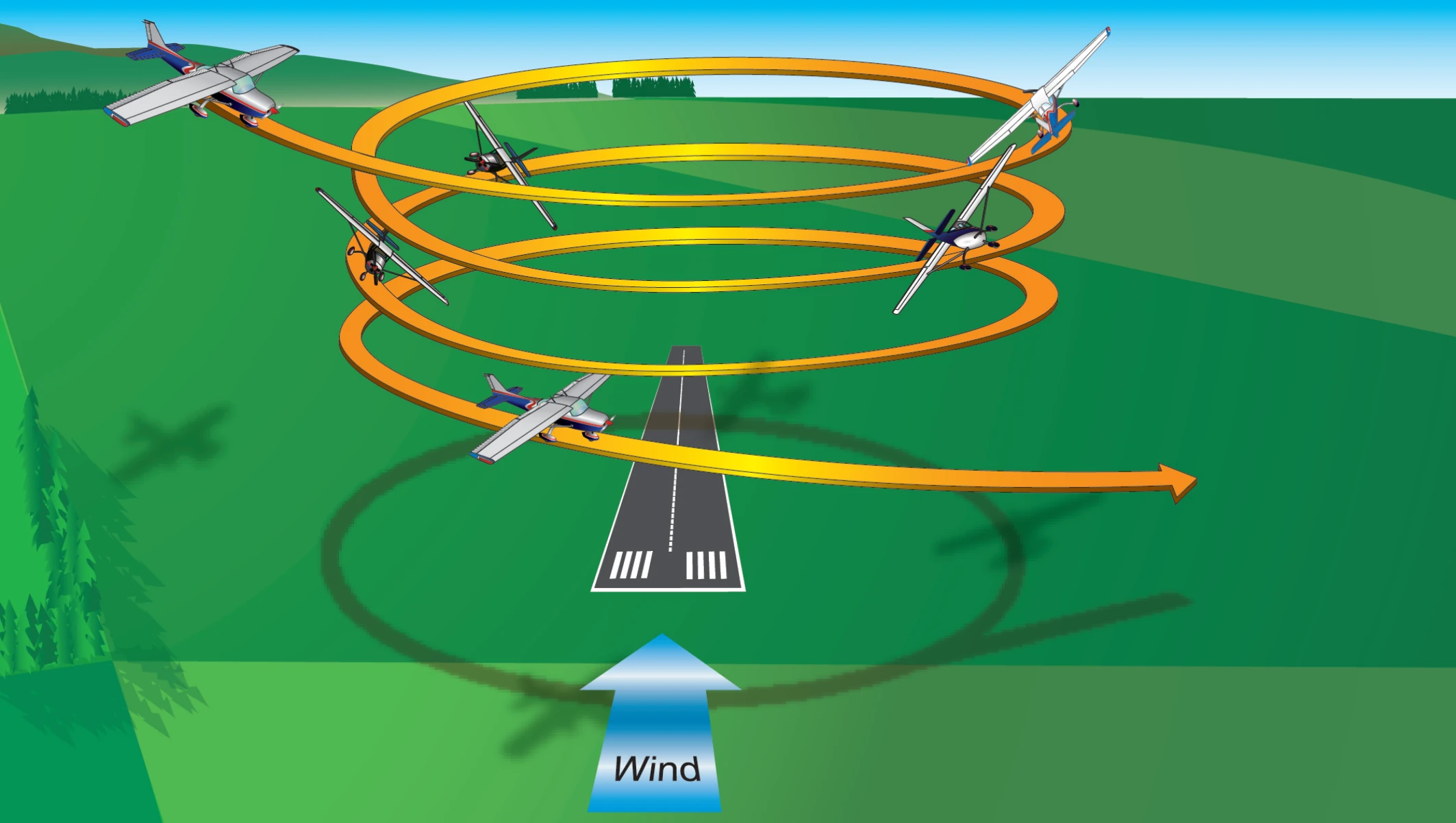
The steep spiral is initiated by properly clearing the airspace for air traffic and hazards. In general, the throttle is closed to idle, carburetor heat is applied if equipped, and gliding speed is established. Once the proper airspeed is attained, the pitch should be lowered and the airplane rolled to the desired bank angle as the reference point is reached. The pilot should consider the distance from the reference point since that establishes the turning radius, and the steepest bank should not exceed 60°. The gliding spiral should be a turn of constant radius while maintaining the airplane’s position relative to the reference. This can only be accomplished by proper correction for wind drift by steepening the bank on downwind headings and shallowing the bank on upwind headings. During the steep spiral, the pilot should continually correct for any changes in wind direction and velocity to maintain a constant radius.
Operating the engine at idle speed for any prolonged period during the glide may result in excessive engine cooling, spark plug fouling, or carburetor ice. To assist in avoiding these issues, the throttle should be periodically advanced and sustained for a few seconds. Monitoring cylinder head temperature gauges, if available, provides a pilot with additional information on engine cooling. When advancing the throttle, the pitch attitude should be adjusted to maintain a constant airspeed and, preferably, this should be done when headed into the wind.
Maintaining a constant airspeed throughout the maneuver is an important skill for a pilot to develop. This is necessary because the airspeed tends to fluctuate as the bank angle is changed throughout the maneuver. The pilot should anticipate pitch corrections as the bank angle is varied throughout the maneuver. During practice of the maneuver, the pilot should execute at least three turns and roll out toward a definite object or on a specific heading. To make the exercise more challenging, the pilot rolls out on a heading perpendicular to or directly into the wind rather toward a specific object. This ability would be a particularly useful skill in the event of an actual emergency. In addition, noting the altitude lost during each revolution would help the pilot determine when to roll out in an actual emergency so as not to be too high or too low to make a safe approach. During rollout, the smooth and accurate application of the flight controls allow the airplane to recover to a wings-level glide with no change in airspeed. Recovering to normal cruise flight would proceed after the establishment of a wings-level glide.
Common errors when performing steep spirals are:
- Not clearing the area
- Inadequate pitch control on entry or rollout
- Not correcting the bank angle to compensate for wind
- Poor flight control coordination
- Ineffective use of trim
- Inadequate airspeed control
- Becoming disoriented
- Performing by reference to the flight instruments rather than visual references
- Not scanning for other traffic during the maneuver
- Not completing the turn on the designated heading or reference
Chandelle
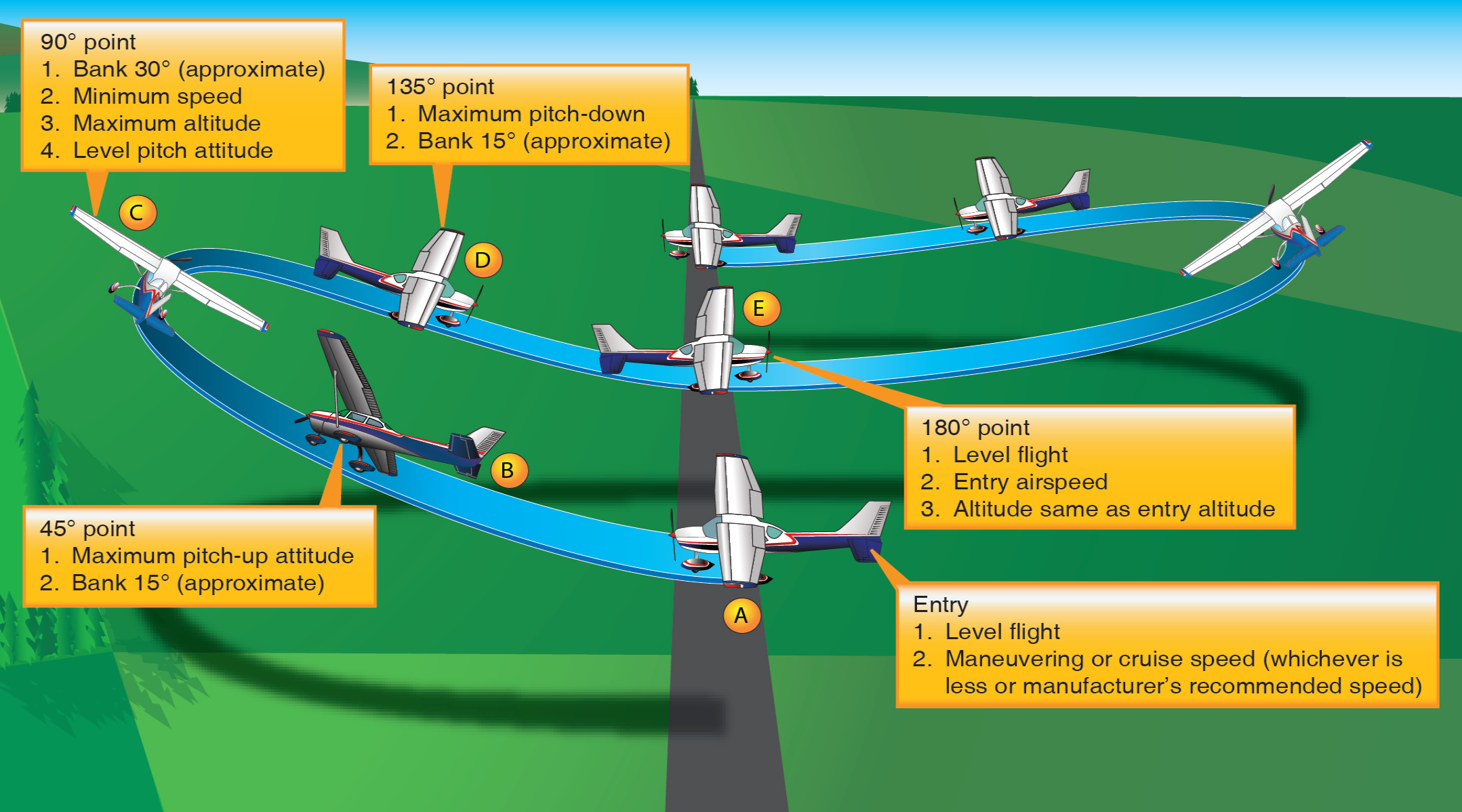
A chandelle is a maximum performance, 180° climbing turn that begins from approximately straight-and-level flight and concludes with the airplane in a wings-level, nose-high attitude just above stall speed. [Figure 10-3] The goal is to gain the most altitude possible for a given bank angle and power setting; however, the standard used to judge the maneuver is not the amount of altitude gained, but rather the pilot’s proficiency as it pertains to maximizing climb performance for the power and bank selected, as well as the skill demonstrated.
A chandelle is best described in two specific phases: the first 90° of turn and the second 90° of turn. The first 90° of turn is described as constant bank and continuously increasing pitch; and the second 90° as constant pitch and continuously decreasing bank. During the first 90°, the pilot will set the bank angle, increase power, and increase pitch attitude at a rate such that maximum pitch-up occurs at the completion of the first 90°. The maximum pitch-up attitude achieved at the 90° mark is held for the remainder of the maneuver. If the pitch attitude is set too low, the airplane’s airspeed will never decrease to just above stall speed. If the pitch attitude is set too high, the airplane may aerodynamically stall prior to completion of the maneuver. Starting at the 90° point, and while maintaining the pitch attitude set at the end of the first 90°, the pilot begins a slow and coordinated constant rate rollout so as to have the wings level when the airplane is at the 180° point. If the rate of rollout is too rapid or sluggish, the airplane either exceeds the 180° turn or does not complete the turn as the wings come level to the horizon.
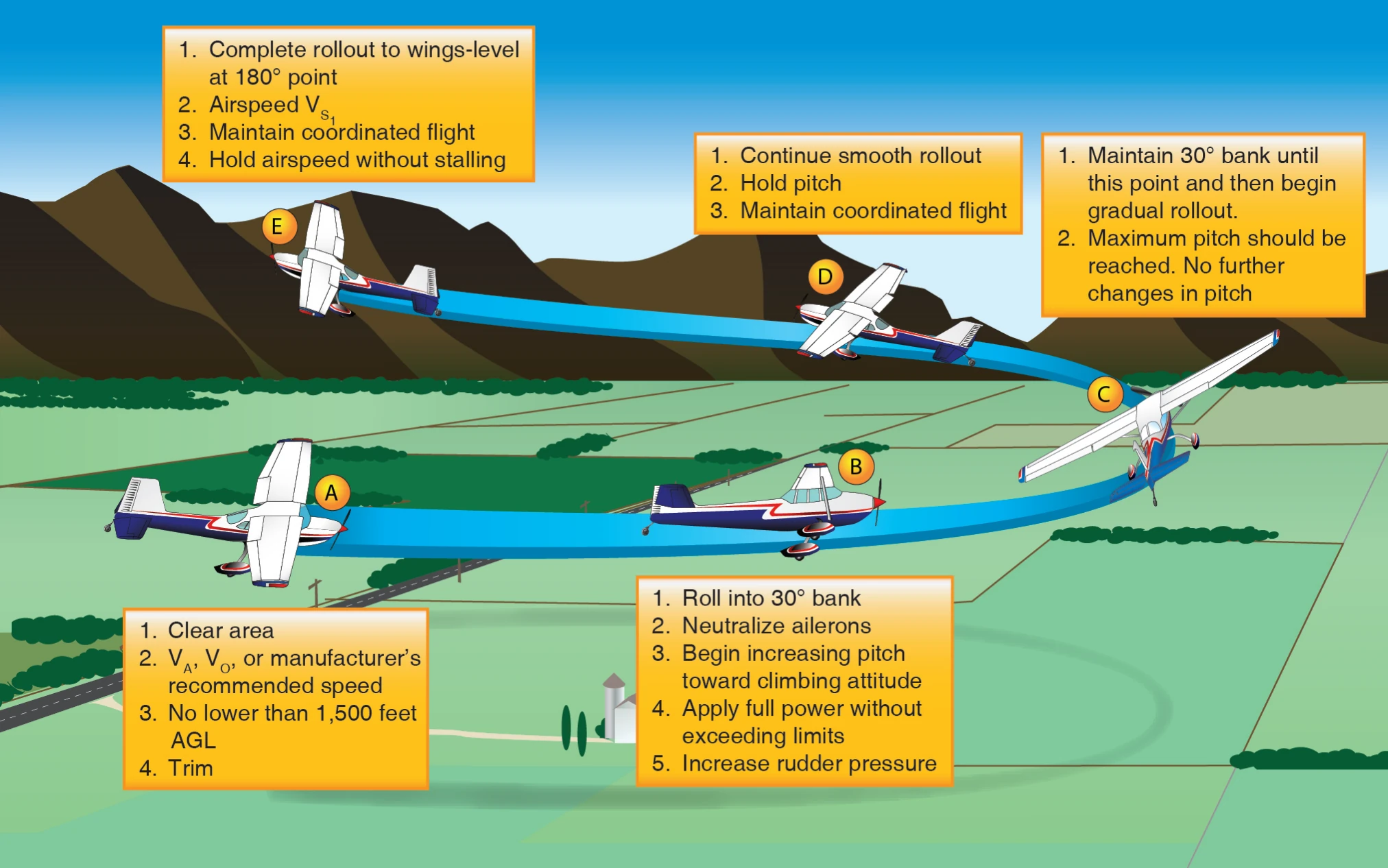
Prior to starting the chandelle, the flaps and landing gear (if retractable) should be in the UP position. The chandelle is initiated by properly clearing the airspace for air traffic and hazards. The maneuver should be entered from straight-and-level flight or a shallow dive at an airspeed recommended by the manufacturer—in many cases this is the airplane’s design maneuvering speed (VA ) or operating maneuvering speed (VO ). [Figure 10-3A] After the appropriate entry airspeed has been established, the chandelle is started by smoothly entering a coordinated turn to the desired angle of bank. Once the bank angle is established, which is generally 30°, a climbing turn should be started by smoothly applying elevator back pressure at a constant rate while simultaneously increasing engine power to the recommended setting. In airplanes with a fixed-pitch propeller, the throttle should be set so as to not exceed rotations per minute (rpm) limitations. In airplanes with constant-speed propellers, power may be set at the normal cruise or climb setting as appropriate. [Figure 10-3B]
As airspeed decreases during the chandelle, left-turning tendencies, such as P-factor, have greater effect. As airspeed decreases, right rudder pressure is progressively increased to ensure that the airplane remains in coordinated flight. The pilot maintains coordinated flight by sensing physical slipping or skidding, by glancing at the ball in the turn-and-slip or turn coordinator, and by using appropriate control pressures.
At the 90° point, the pilot should begin to smoothly roll out of the bank at a constant rate while maintaining the pitch attitude attained at the end of the first 90°. While the angle of bank is fixed during the first 90°, recall that as airspeed decreases, the overbanking tendency increases. [Figure 10-3C] As a result, proper use of the ailerons allows the bank to remain at a fixed angle until rollout is begun at the start of the final 90°. As the rollout continues, the vertical component of lift increases. However, as speed continues to decrease, a slight increase of elevator back pressure is required to keep the pitch attitude from decreasing.
When the airspeed is slowest, near the completion of the chandelle, right rudder pressure is significant, especially when rolling out from a left chandelle due to left adverse yaw and left-turning tendencies, such as P-factor. [Figure 10-3D] When rolling out from a right chandelle, the yawing moment is to the right, which partially cancels some of the left-turning tendency’s effect. Depending on the airplane, either very little left rudder or a reduction in right rudder pressure is required during the rollout from a right chandelle. At the completion of 180° of turn, the wings should be level to the horizon, the airspeed should be just above the power-on stall speed, and the airplane’s pitch-high attitude should be held momentarily. [Figure 10-3E]
Once the airplane is in controlled flight, the pitch attitude may be reduced and the airplane returned to straight-and-level cruise flight.
Common errors when performing chandelles are:
- Not clearing the area
- Initial bank is too shallow resulting in a stall
- Initial bank is too steep resulting in failure to gain maximum performance
- Allowing the bank angle to increase after initial establishment
- Not starting the recovery at the 90° point in the turn
- Allowing the pitch attitude to increase as the bank is rolled out during the second 90° of turn
- Leveling the wings prior to the 180° point being reached
- Pitch attitude is low on recovery resulting in airspeed well above stall speed
- Application of flight control pressures is not smooth
- Poor flight control coordination
- Stalling at any point during the maneuver
- Execution of a steep turn instead of a climbing maneuver
- Not scanning for other traffic during the maneuver
- Performing by reference to the instruments rather than visual references
Lazy Eight
The lazy eight is a maneuver that is designed to develop the proper coordination of the flight controls across a wide range of airspeeds and attitudes. It is the only standard flight training maneuver in which flight control pressures are constantly changing. In an attempt to simplify the discussion about this maneuver, the lazy eight can be loosely compared to the ground reference maneuver, S-turns across the road. Recall that S-turns across the road are made of opposing 180° turns. For example, first a 180° turn to the right, followed immediately by a 180° turn to the left. The lazy eight adds both a climb and descent to each 180° segment. The first 90° is a climb; the second 90° is a descent. [Figure 10-4]