
Chapter 13
Transition to Multiengine Airplanes
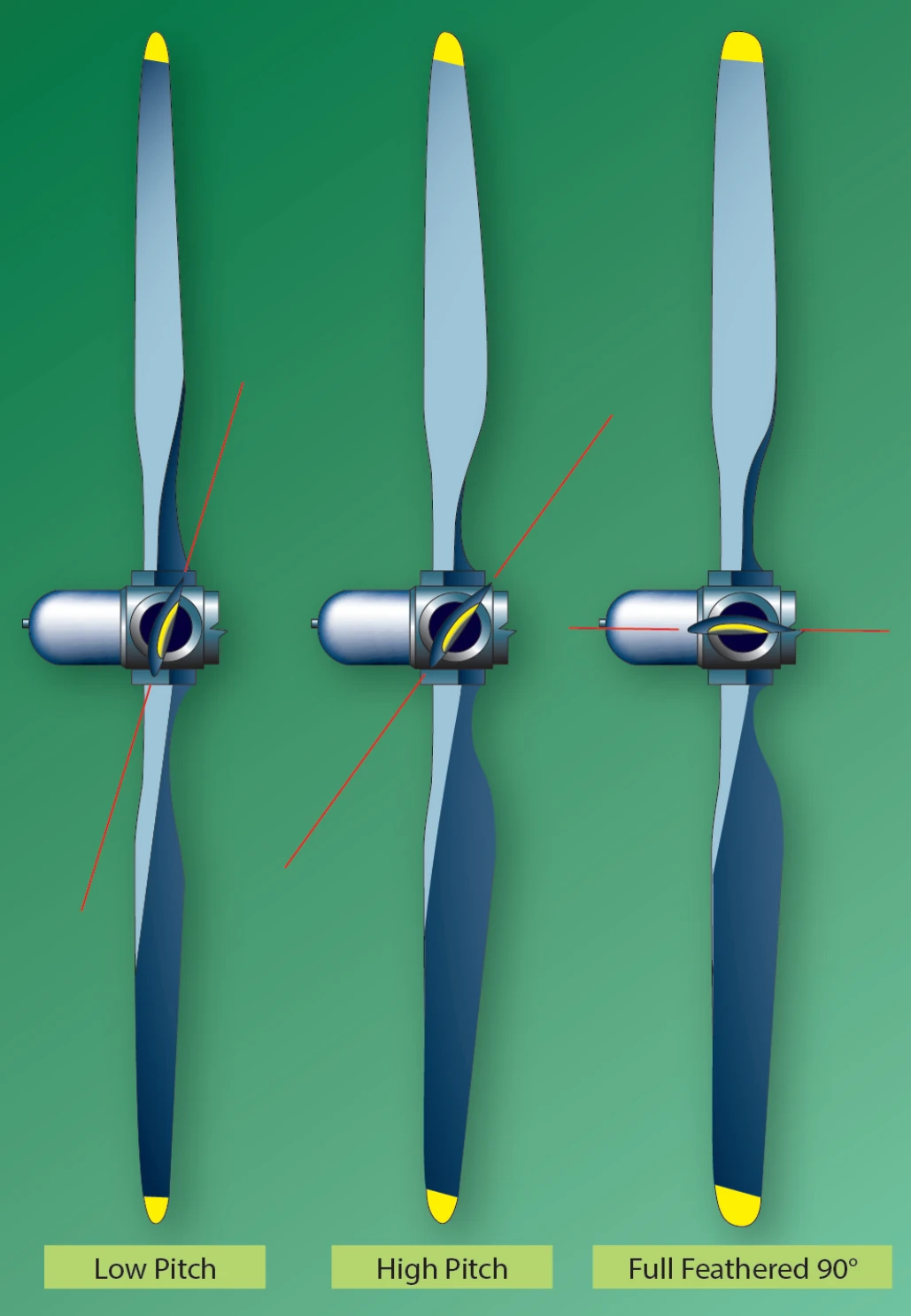
Although the propellers of a multiengine airplane may appear identical to a constant-speed propeller used in many single-engine airplanes, this is usually not the case. The pilot of a typical multiengine airplane can feather the propeller of an inoperative engine. Since it stops engine rotation with the propeller blade streamlined with the airplane’s relative wind, feathering the propeller of an inoperative engine minimizes propeller drag. [Figure 13-2] Depending upon single-engine performance, this feature often permits continued flight to a suitable airport following an engine failure.
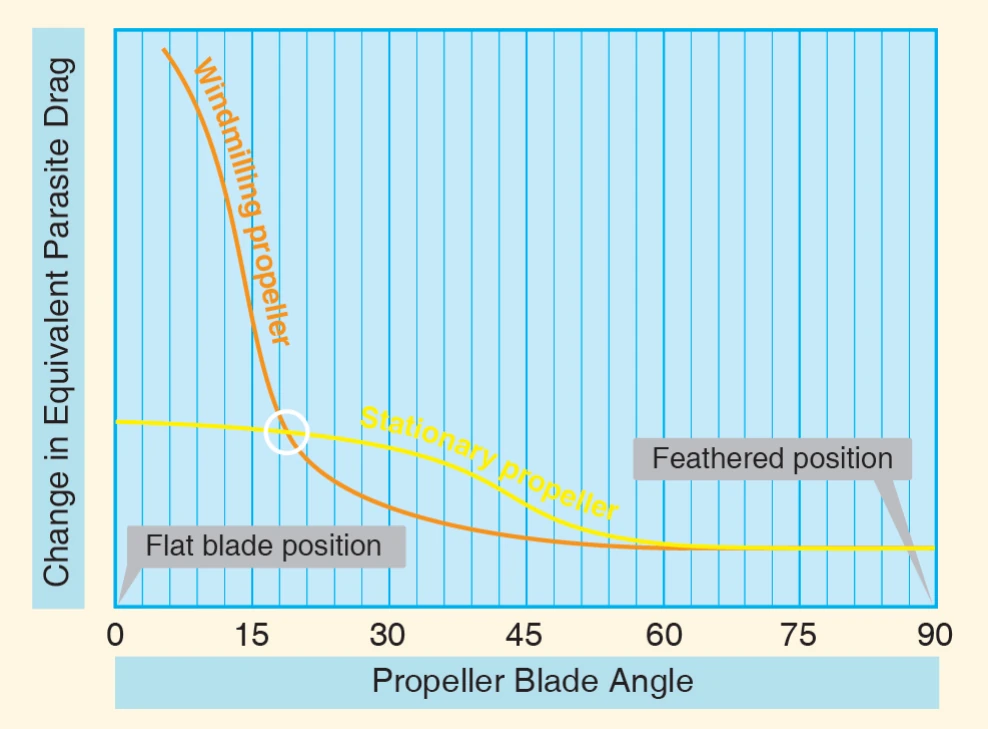
Feathering is important because of the change in parasite drag with propeller blade angle. [Figure 13-3] When the propeller blade angle is in the feathered position, parasite drag from the propeller is at a minimum. In a typical multiengine airplane, the parasite drag from a single, feathered propeller is a small part the airplane's total drag.
At the smaller blade angles near the flat pitch position, the drag added by the propeller is large. At these small blade angles, the propeller windmilling at high revolutions per minute (rpm) can create enough drag to make the airplane difficult or impossible to control. A propeller windmilling at high speed in the low range of blade angles can produce parasite drag as great as the parasite drag of the entire airframe.
As a review, the constant-speed propellers on almost all single-engine airplanes are of the non-feathering, oil-pressure-to-increase-pitch design. In this design, increased oil pressure from the propeller governor drives the blade angle towards high pitch, low rpm.
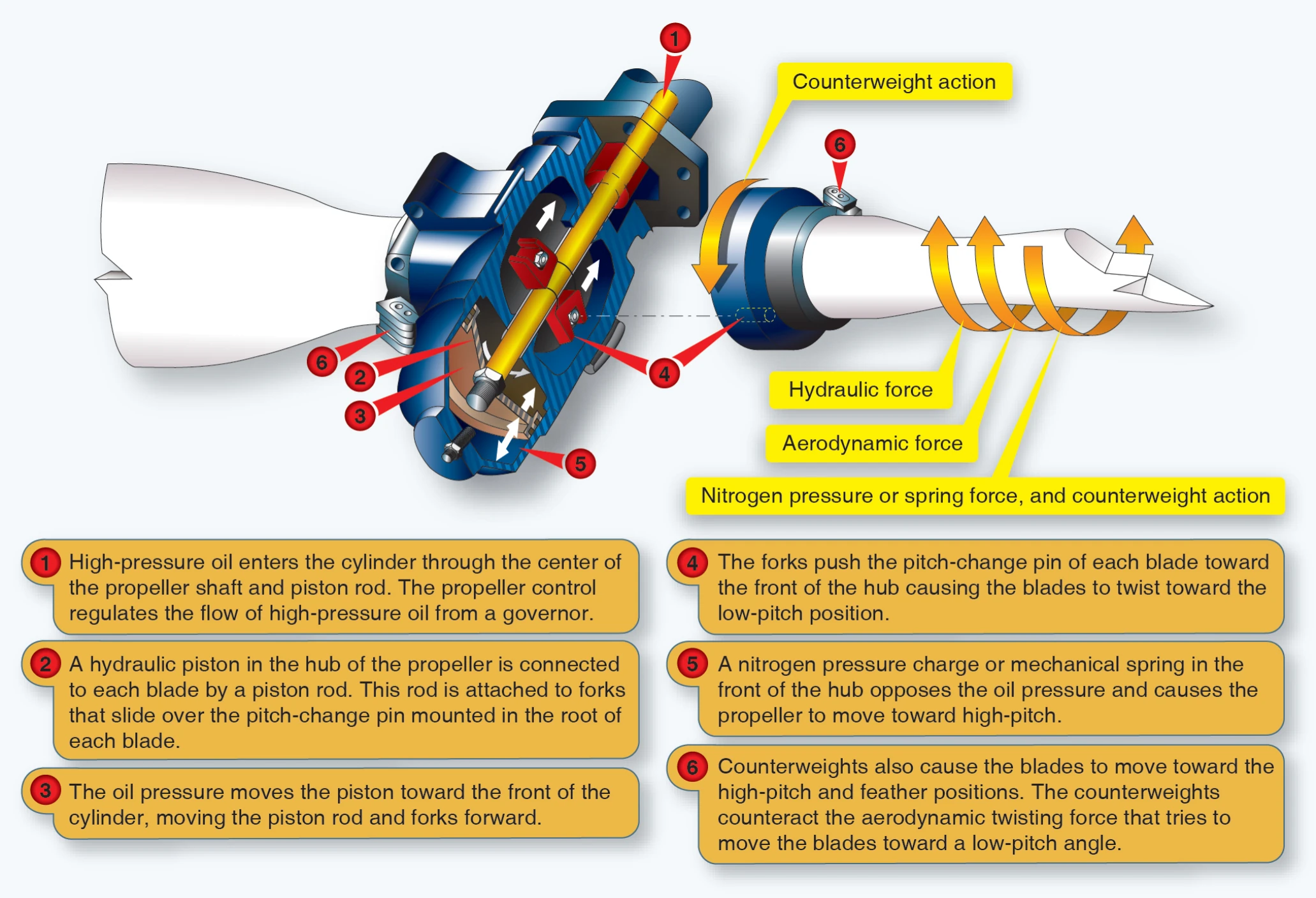
In contrast, the constant-speed propellers installed on most multiengine airplanes are full feathering, counterweighted, oil-pressure-to-decrease-pitch designs. In this design, increased oil pressure from the propeller governor drives the blade angle toward low pitch, high rpm—away from the feather blade angle. In effect, the only thing that keeps these propellers from feathering is a constant supply of high-pressure engine oil. This is a necessity to enable propeller feathering in the event of a loss of oil pressure or a propeller governor failure.
Aerodynamic forces acting upon a windmilling propeller tend to drive the blades to low pitch, high rpm. Counterweights attached to the shank of each blade tend to force the blades to high pitch, low rpm. Inertia, or the apparent force (called centrifugal force) acting through the counterweights, is generally slightly greater than the aerodynamic forces. Therefore, centrifugal force would drive the blades to high pitch and low rpm were it not for an additional force acting through the propeller governor. A controlling force generated from high pressure oil from the propeller governor pushes the propeller blade angles toward low pitch and high rpm. Thus, a reduction in oil pressure allows the counterweights to drive the blades to a higher pitch and decreases engine rpm. [Figure 13-4]
To feather the propeller, the propeller control is brought fully aft. All oil pressure is dumped from the governor, and the counterweights drive the propeller blades toward feather. As centrifugal force acting on the counterweights decays from decreasing rpm, additional forces are needed to completely feather the blades. This additional force comes from either a spring or high-pressure air stored in the propeller dome, which forces the blades into the feathered position. The entire process may take up to 10 seconds.
Feathering a propeller only alters blade angle and stops engine rotation. To completely secure the engine, the pilot turns off the fuel (mixture, electric boost pump, and fuel selector), ignition, alternator/generator, and closes the cowl flaps. If the airplane is pressurized, there may also be an air bleed to close for the failed engine. Some airplanes are equipped with firewall shutoff valves that secure several of these systems with a single switch.
Completely securing a failed engine may not be necessary or even desirable depending upon the failure mode, altitude, and time available. The position of the fuel controls, ignition, and alternator/generator switches of the failed engine has no effect on aircraft performance, and the pilot might manipulate the incorrect switch under conditions of haste or pressure.
To unfeather a propeller, the engine should be rotated so that oil pressure can be generated to move the propeller blades from the feathered position. The ignition is turned on prior to engine rotation with the throttle at low idle and the mixture rich. With the propeller control in a high rpm position, the starter is engaged. The engine begins to windmill, start, and run as oil pressure moves the blades out of feather. As the engine starts, the propeller rpm should be immediately reduced until the engine has had several minutes to warm up; the pilot should monitor cylinder head and oil temperatures.
An unfeathering accumulator is a device that permits starting a feathered engine in-flight without the use of the electric starter. An accumulator is any device that stores a reserve of high pressure. On multiengine airplanes, the unfeathering accumulator stores a small reserve of engine oil under pressure from compressed air or nitrogen. To start a feathered engine in-flight, the pilot moves the propeller control out of the feather position to release the accumulator pressure. The oil flows under pressure to the propeller hub and drives the blades toward the high rpm, low pitch position, whereupon the propeller usually begins to windmill. If fuel and ignition are present, the engine starts and runs. High oil pressure from the propeller governor recharges the accumulator just moments after engine rotation begins making it available for another unfeathering cycle, if needed. For airplanes used in training, an unfeathering accumulator may prolong the life of the electric starter and battery. If the accumulator fails to bring the propeller out of feather, the electric starter may be engaged.
In any event, the AFM/POH procedures should be followed for the exact unfeathering procedure. Both feathering and starting a feathered reciprocating engine on the ground are strongly discouraged by manufacturers due to the excessive stress and vibrations generated.
As just described, a loss of oil pressure from the propeller governor allows the counterweights, spring, and/or dome charge to drive the blades to feather. Logically then, the propeller blades should feather every time an engine is shut down as oil pressure falls to zero. However, below approximately 800 rpm, a reduction in centrifugal force allows small anti-feathering lock pins in the pitch changing mechanism of the propeller hub to move into place and block feathering. Therefore, if a propeller is to be feathered, it needs to be done before engine rpm decays below approximately 800. On one popular model of turboprop engine, the propeller blades do, in fact, feather with each shutdown. This propeller is not equipped with such centrifugally-operated pins due to a unique engine design.
Propeller Synchronization
Many multiengine airplanes have a propeller synchronizer (prop sync) installed to eliminate the annoying “drumming” or “beat” of propellers whose rpm are close, but not precisely the same. To use prop sync, the propeller rpms are coarsely matched by the pilot and the system is engaged. The prop sync adjusts the rpm of the “slave” engine to precisely match the rpm of the “master” engine and then maintains that relationship.
The prop sync should be disengaged when the pilot selects a new propeller rpm and then re-engaged after the new rpm is set. The prop sync should always be off for takeoff, landing, and single-engine operation. The AFM/POH should be consulted for system description and limitations.
A variation on the propeller synchronizer is the propeller synchrophaser. A propeller synchrophaser acts much like a synchronizer to precisely match rpm, but the synchrophaser goes one step further. It not only matches rpm but actually compares and adjusts the positions of the individual blades of the propellers in their arcs. There can be significant propeller noise and vibration reductions with a propeller synchrophaser. From the pilot’s perspective, operation of a propeller synchronizer and a propeller synchrophaser are very similar. A synchrophaser is also commonly referred to as prop sync, although that is not entirely correct nomenclature from a technical standpoint.