
Chapter 2
Ground Operations
A few simple precautions help to avoid accidents when hand propping the engine. While touching a propeller, always assume that the ignition is on. The switches that control the magnetos operate on the principle of short-circuiting the current to turn the ignition off. If the switch is faulty, it can be in the “off” position and still permit current to flow in the magneto primary circuit. This condition could allow the engine to start when the switch is off.
Hand propping an aircraft is a hazardous procedure when done perfectly. Not mitigating the hazards associated with hand propping can lead to serious injury and a runaway airplane. A spinning propeller can be lethal should it strike someone. Persons not trained, not competent, or who do not understand how to mitigate the hazards associated with hand propping should never perform this procedure!
Hand propping requires a team of two properly trained people. Both individuals should be familiar with the airplane and hand propping techniques. The first person is responsible for directing the procedure including pulling the propeller blades through. The second person sits in the airplane to ensure that the brakes are set and to exercise controls as directed by the person pulling the propeller. When hand propping occurs, a person unfamiliar with the controls should never occupy the pilot’s seat.
When hand propping is necessary, the ground surface near the propeller should be stable and free of debris. Loose gravel, wet grass, grease, mud, oil, ice, or snow might cause the person pulling the propeller through to slip into the rotating blades as the engine starts. Unless a firm footing is available, relocate the airplane to mitigate this hazardous consequence.
Both participants should discuss the procedure and agree on voice commands and expected actions. To begin the procedure, the fuel system and engine controls (tank selector, primer, pump, throttle, and mixture) are set for normal start. The ignition/magneto switch should be checked to be sure that it is OFF. Then, the descending propeller blade should be rotated so that it assumes a position slightly above the horizontal. The person doing the hand propping should face the descending blade squarely and stand slightly less than one arm’s length from the blade. If a stance too far away were assumed, it would be necessary to lean forward in an unbalanced condition to reach the blade, which may cause the person to fall forward into the rotating blades when the engine starts. Allowing space for the person to be able to step away as the propeller is pulled down, and the engine starts, serves as safeguard in case the brakes fail.
The procedure and commands for hand propping are:
- Person out front says, “FUEL ON, SWITCH OFF, THROTTLE CLOSED, BRAKES SET.”
- Pilot seat occupant, after making sure the fuel is ON, mixture is RICH, magneto switch is OFF, throttle is CLOSED, and brakes are SET, says, “FUEL ON, SWITCH OFF, THROTTLE CLOSED, BRAKES SET.”
- Person out front, after pulling the propeller through to prime the engine says, “BRAKES AND CONTACT.”
- Pilot seat occupant checks the brakes SET and turns the magnetos switch ON, then says, “BRAKES AND CONTACT.”
The words CONTACT (magnetos ON) and SWITCH OFF (magnetos OFF) are used because they are significantly different from each other. Under noisy conditions or high winds, the words CONTACT and SWITCH OFF are less likely to be misunderstood than SWITCH ON and SWITCH OFF.
The propeller is swung by forcing the blade downward rapidly, pushing with the palms of both hands. If the blade is gripped tightly with the fingers, the person’s body may be drawn into the propeller blades should the engine misfire, "kickback," or rotate momentarily in the opposite direction. As the blade is pushed down, the person should step backward, away from the propeller. If the engine does not start, the propeller should not be repositioned for another attempt until it is verified that the magneto switch is turned OFF. Excessive throttle opening after the engine has fired is the principal cause of backfiring during starting. Gradual opening of the throttle, while the engine is cold, reduces the potential for backfiring. Slow, smooth movement of the throttle assures correct engine operation.
Immediately after the engine starts, check the oil pressure indicator. If oil pressure does not show within 30 seconds, stop the engine and determine the trouble. If oil pressure is indicated, adjust the throttle to the aircraft manufacturer’s specified rpm for engine warmup, which is usually between 1,000 to 1,300 rpm.
Most aircraft reciprocating engines are air-cooled and depend on the forward speed of the aircraft to maintain proper cooling. Therefore, particular care is necessary when operating these engines on the ground. During all ground running, operate the engine with the propeller in full low pitch and headed into the wind with the cowling installed to provide the best degree of engine cooling. Closely monitor the engine instruments at all times. Do not close the cowl flaps for engine warm-up, they need to be in the open position while operating on the ground. When warming up the engine, ensure that personnel, ground equipment that may be damaged, or other aircraft are not in the propeller wash.
When removing the wheel chocks or untying the tail after the engine starts, everyone involved should remember that the propeller is nearly invisible. Serious injuries and fatalities have occurred when people who have just started an engine walk or reach into the propeller arc to remove the chocks, reach the cabin, or when moving toward the tail of the airplane. Before the wheel chocks are removed, the throttle should be set to idle and the chocks approached only from the rear of the propeller. One should never approach the wheel chocks from the front or the side.
Taxiing
Taxiing is the controlled movement of the airplane under its own power while on the surface. Since an airplane is moved under its own power between a parking area and the runway, the pilot needs to understand and be proficient in taxi procedures.
A pilot should maintain situational awareness of the ramp, parking areas, taxiways, runway environment, and the persons, equipment and aircraft at all times. Without such awareness, safety may be compromised. Depending on the airport, the parking, ramp, and taxiways may or may not be controlled. As such, it is important that the pilot completely understands the operating environment. At small, rural airports these areas may be desolate with few aircraft and limited hazards; however, as the complexity of the airport increases so does the potential for hazards. Regardless of the complexity, some generally accepted procedures are appropriate.
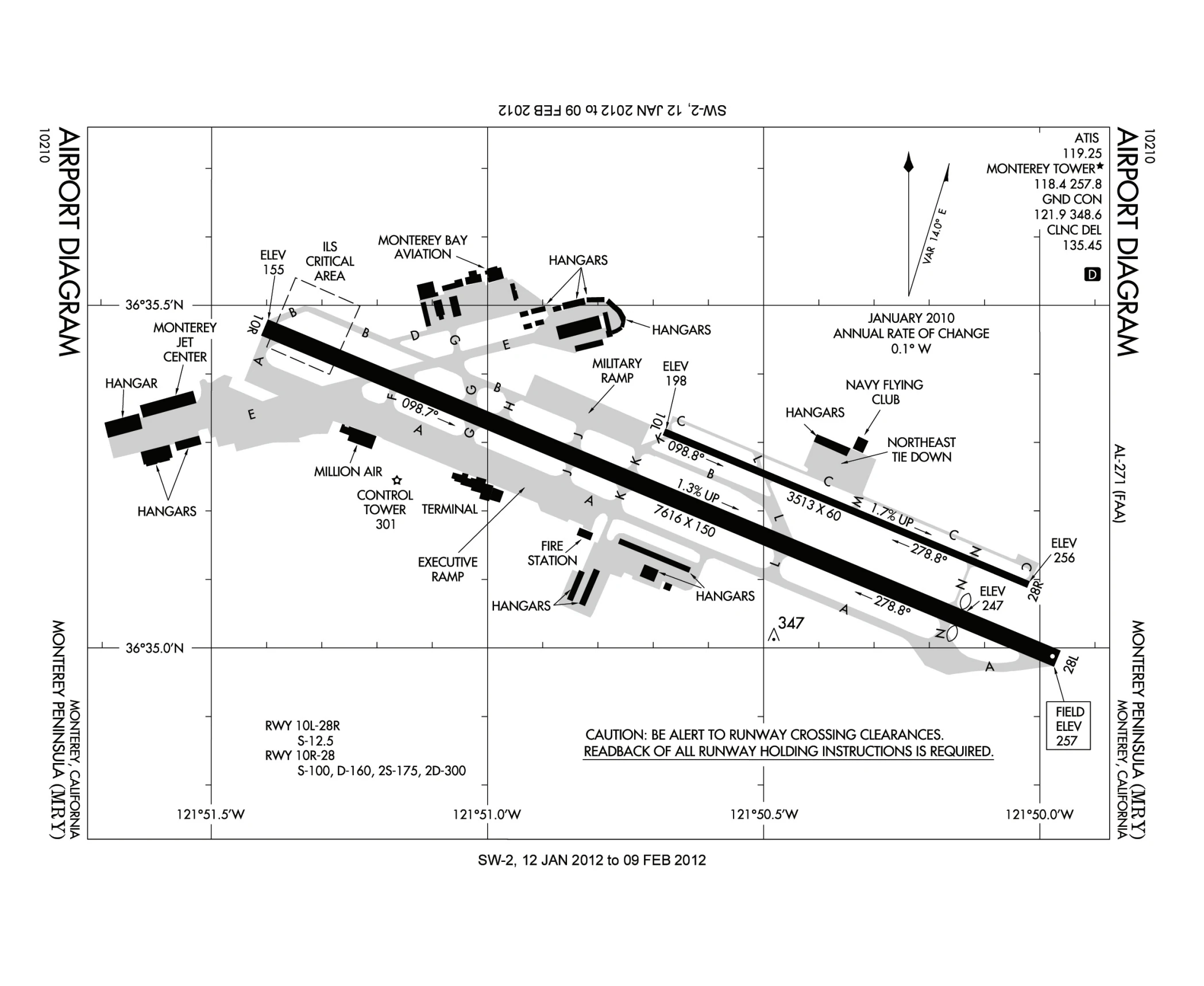
- The pilot should be familiar with the parking, ramp, and taxi environment. This can be done by having an airport diagram, if available, out and in view at all times. [Figure 2-14]
- Despite having familiarity with the airport, pilots should carefully review their complete taxi plan. For example, a pilot given the same taxi instructions by ATC, starts expecting those same instructions and might not realize that those instructions no longer apply. It only takes missing one instruction or turn to generate an accident. It is a human tendency to follow the same procedure over and over. This expectation bias has occurred to many pilots who did not stop and carefully consider and evaluate their taxi instructions.
- The pilot should be vigilant of the entire area around the airplane to ensure that the airplane clears all obstructions. If, at any time, there is doubt about a safe clearance from an object, the pilot should stop the airplane and check the clearance. It may be necessary to have the airplane towed or physically moved by a ground crew.
- When taxiing, the pilot’s eyes should be looking outside the airplane scanning from side to side while looking both near and far to assess routing and potential conflicts.
- A safe taxiing speed should be maintained. The primary requirements for safe taxiing are positive control, the ability to recognize any potential hazards in time to avoid them, and the ability to stop or turn where and when desired, without undue reliance on the brakes. Pilots should proceed at a cautious speed on congested or busy ramps. Normally, the speed should be at the rate where movement of the airplane is dependent on the throttle. That is, slow enough so when the throttle is closed, the airplane can be stopped promptly.
- The pilot should place the aircraft on the taxiway center. Some taxiways have above-ground taxi lights and signage that could impact the airplane or propellers if the pilot does not exercise accurate control. When yellow taxiway centerline stripes are present, the pilot should visually place the centerline stripe so it is under the center of the airplane fuselage.
- When taxiing, the pilot should slow down before attempting a turn. Sharp high-speed turns place undesirable side loads on the landing gear and may result in tire damage or an uncontrollable swerve or a ground loop. Swerves are most likely to occur when turning from a downwind heading toward an upwind heading. In moderate to high-wind conditions, the airplane may weathervane increasing the swerving tendency.
Steering is accomplished with rudder pedals and brakes. To turn the airplane on the ground, the pilot should apply the rudder in the desired direction of turn and use the appropriate power or brake to control the taxi speed. The rudder pedal should be held in the direction of the turn until just short of the point where the turn is to be stopped. Rudder pressure is then released or opposite pressure is applied as needed.
More engine power may be required to start the airplane moving forward, or to start a turn, than is required to keep it moving in any given direction. When using additional power, the throttle should immediately be retarded once the airplane begins moving to prevent excessive acceleration.
The brakes should be tested for proper operation as soon as the airplane is put in motion. Applying power to start the airplane moving forward slowly, then retarding the throttle and simultaneously applying just enough pressure to one side, then the other to confirm proper function and reaction of both brakes. This is best if the airplane has individual left/right brakes to stop the airplane. If braking performance is unsatisfactory, the engine should be shut down immediately.