
Chapter 4
Energy Management: Mastering Altitude and Airspeed Control
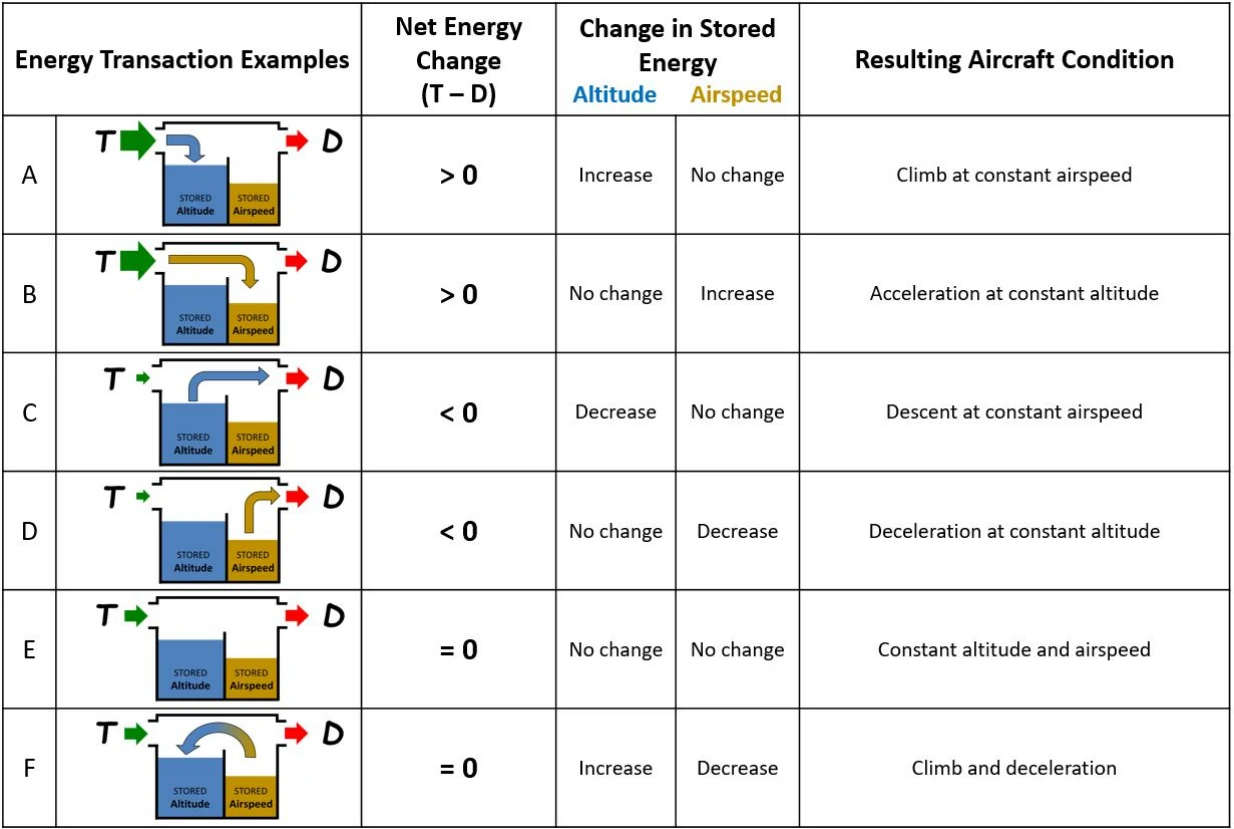
Energy can also be exchanged between altitude and airspeed. For example, when a pilot trades airspeed for altitude, as altitude increases, airspeed decreases. In other words, when energy is exchanged, altitude and airspeed always change in opposite directions (absent any other energy or control inputs). As one goes up, the other one comes down. Also note that even though the distribution of energy over altitude and airspeed may change dramatically during energy exchange, the total amount of mechanical energy can remain the same at the end of the exchange maneuver [Figure 4-1F], as long as thrust is adjusted to match drag as the latter varies with changes in airspeed.
Managing Energy is a Balancing Act
Since the airplane gains energy from engine thrust (T) and loses energy through aerodynamic drag (D), energy flows continuously into and out of the airplane while in flight. Usually measured as Specific Excess Power (PS), or rate of energy change, the net energy flow is a direct function of the difference between thrust and drag.
Ps = (T – D)V/W
Where,
- T = Thrust
- D = Drag
- V = velocity (airspeed)
- W = aircraft weight
More importantly, there is a fundamental relationship between changes in the airplane’s total energy resulting from this net energy flow on one hand, and changes in the energy stored as altitude and airspeed on the other. This fundamental relationship can be summarized through the airplane’s energy balance equation. [Figure 4-2]
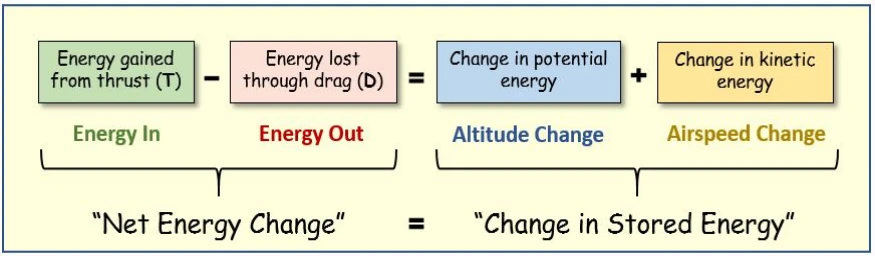
The left side of the energy balance equation represents the airplane’s net energy flow, while the right side reflects matching changes to the energy storage. Thus, changes to the airplane’s total energy affect the left side of the equation, while the right side shows possible changes in energy distribution between altitude and airspeed.
Note that a change in total energy resulting from the difference between thrust and drag (left side) always matches the change in total energy redistributed over altitude and airspeed (right side). Although rate of energy change, expressed as specific excess power (PS), varies during flight—becoming positive, negative, or zero—both sides of the equation are inexorably balanced regardless of whether the airplane is accelerating, decelerating, climbing, descending, or maintaining constant altitude and airspeed. (Note: This simplified balance equation does not account for long-term changes in total mechanical energy caused by the reduction in aircraft weight as fuel is gradually burned in flight. Although the effect of weight loss on total energy becomes critical when solving long-term aircraft performance problems such as range and endurance, it is negligible when considering short-term flight control problems.)
Of course, the pilot controls the change in total energy on the left side of the equation, as well as the distribution of any changes in energy over altitude and airspeed on the right side. How the pilot coordinates the throttle and elevator to achieve and maintain desired altitude and airspeed targets as well as avoid energy "crises" is at the core of energy management and is elaborated in the rest of the chapter.
Role of the Controls to Manage Energy State
An energy-centered approach clarifies the roles of the engine and flight controls beyond the simple “pitch for airspeed and power for altitude” by modeling how throttle and elevator inputs affect the airplane’s total mechanical energy. From an energy perspective, the problem of controlling vertical flight path and airspeed becomes one of handling the airplane’s energy state—the total amount of energy and its distribution over altitude and speed. Thus, rather than asking what controls altitude and what controls airspeed, a pilot can now ask what controls total energy and what controls its distribution over altitude and airspeed.
Primary Energy Role of the Throttle and Elevator
The throttle, by increasing or decreasing engine thrust against drag, regulates changes in total mechanical energy. As illustrated above, changing total energy is a function of both thrust and drag (T – D). However, drag mainly varies long-term due to airspeed changes, or by using high lift/drag devices which can only increase drag. Therefore, changes in total energy are normally initiated by changing thrust, not drag. When the throttle setting makes thrust greater than drag, an increase of total mechanical energy is the result. When the throttle setting makes thrust less than drag, a decrease of total mechanical energy is the result. Once the desired path-speed profile is established, the throttle sets engine thrust to match the total energy demanded by vertical flight path and airspeed combined. The throttle then is the total energy controller.
On the other hand, the elevator is an energy exchanger and distribution device whose primary job is to allocate changes in total energy between vertical flight path and airspeed by adjusting pitch attitude. Here, once the chosen path-speed profile is achieved, the elevator sets the appropriate pitch attitude to maintain the demanded distribution of total energy over vertical flight path and airspeed. Thus, the elevator is the energy distribution controller.
The throttle and elevator then are really energy state controls—neither one controls altitude nor airspeed independently since these two variables are inherently coupled through the airplane’s total mechanical energy. Instead, to control altitude and airspeed effectively, the pilot coordinates the use of both devices to manage the airplane’s energy state.
The reservoir analogy [Figure 4-3] illustrates the energy-based role of the throttle and the elevator. In this analogy, the throttle controls the “valve” regulating the net total energy flow while the elevator controls the “valve” regulating the distribution of energy into and out of the altitude and airspeed “reservoirs.” Referring back to the energy balance equation [Figure 4-2], it becomes clear then that the throttle controls the left side of the equation (total energy) and the elevator controls the right side (energy distribution).
As illustrated in Figure 4-3, when the throttle increases thrust above drag (T – D > 0) the airplane gains total energy, and when the throttle reduces thrust below drag (T – D < 0) the airplane loses total energy. The elevator then distributes this increase or decrease in total energy between altitude and airspeed. Finally, when the throttle adjusts thrust equal to drag (T – D = 0), there is no change in total energy, but the energy stored as altitude and airspeed can be exchanged between the two reservoirs using the elevator, while total energy, at least short-term, remains constant.