Chapter 4
Energy Management: Mastering Altitude and Airspeed Control
Mitigating Risks from Mismanagement of Energy
Besides learning the proper use of the controls for normal energy management tasks, pilots should be equipped with the ability to identify, assess, and mitigate two major risks associated with mismanagement of energy: 1) unwanted deviations from the desired energy state; and 2) unintentional, irreversible deceleration and/or sink rate causing depletion of mechanical energy. The first risk involves unintended altitude-airspeed deviations (refer to Managing Energy Errors section). The second risk entails unforeseen, continuous airspeed and/or altitude loss coupled with little or no available excess power in a given flight condition (refer to Preventing Irreversible Deceleration and/or Sink Rate section).
Two Energy Management Scenarios
Two flight scenarios illustrate the two major risks associated with failure to manage the airplane's energy state and how a pilot can identify, assess, and mitigate those risks.
Scenario 1
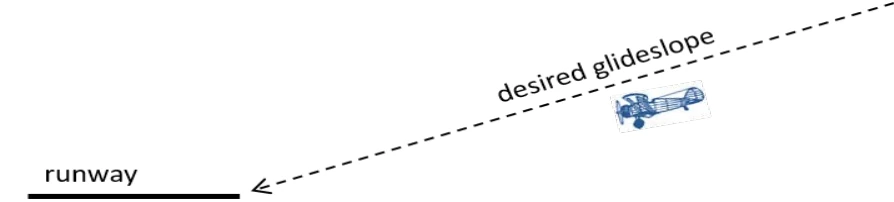
Unintentionally descending below the desired glideslope on final approach to landing and failing to make the proper correction. [Figure 4-9] To bring the airplane back to the desired glideslope, should the pilot pitch up, throttle up, or both?
Scenario 2
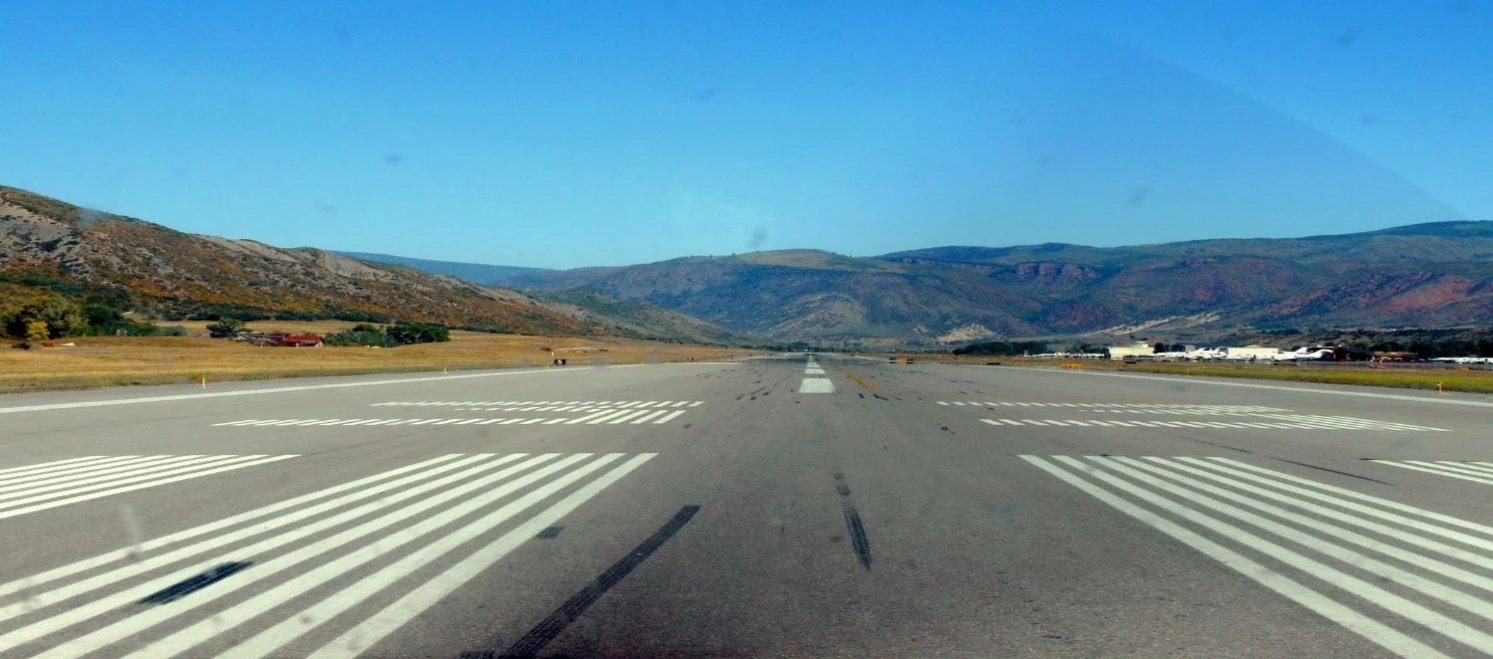
Flying toward rising terrain and not being able to fly up and over it before impacting terrain. [Figure 4-10] Note the rising terrain all along the departure corridor. What can the pilot do to prevent an impending crash?
For both scenarios, this section will demonstrate how proper energy management can provide the pilot with the skill to manage the associated risks and avoid tragic results.
Managing Energy Errors
In addition to learning effective techniques for maintaining stabilized path-speed profiles (e.g., tracking the glideslope) and transitioning from one profile to another during flight (e.g., leveling off from a descent), pilots should develop skills for managing unwanted deviations in vertical flight path and airspeed—returning the airplane to its target energy state. Since many inflight “energy crises” start as undetected, ignored or poorly managed path-speed deviations, pilots need the skills to recognize, correct and prevent these deviations.
Although the intention is to correct altitude and airspeed deviations, the pilot is always acting on the airplane’s energy state. Thus, it is important to translate altitude-speed deviations into energy errors. [Figure 4-11] Because the airplane’s total energy is distributed over altitude and airspeed, there are two types of energy errors: 1) total energy errors and 2) energy distribution errors.
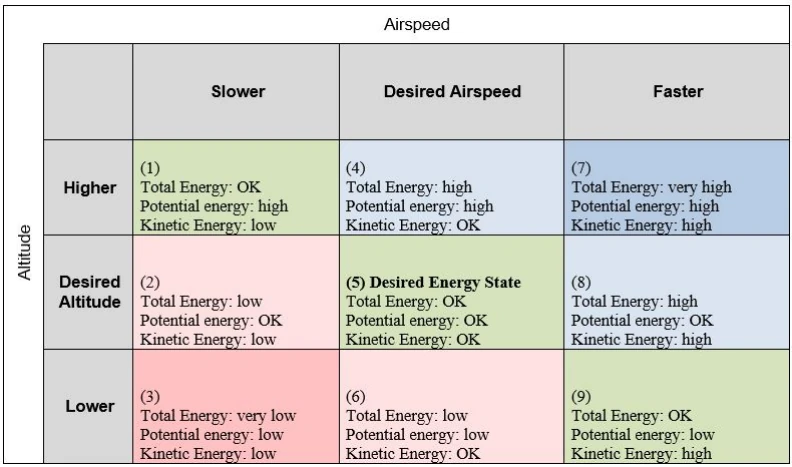
Monitoring the altimeter (or other flight path reference) and airspeed indicator allows the pilot to distinguish these two types of energy errors. In total energy errors, the airplane has too much energy (blue boxes) or too little energy (red boxes). The pilot will notice that altitude and speed deviate in the same direction (“lower-and-slower” or “higher-and-faster”). On the other hand, in energy distribution errors the airplane may have the correct amount of total energy (green boxes) but its distribution over altitude and speed is incorrect. Here, altitude and speed deviate in opposite directions (“higher-and-slower” or “lower-and-faster”). In this case, the pilot deals with relative deviations—not absolute altitude and speed.
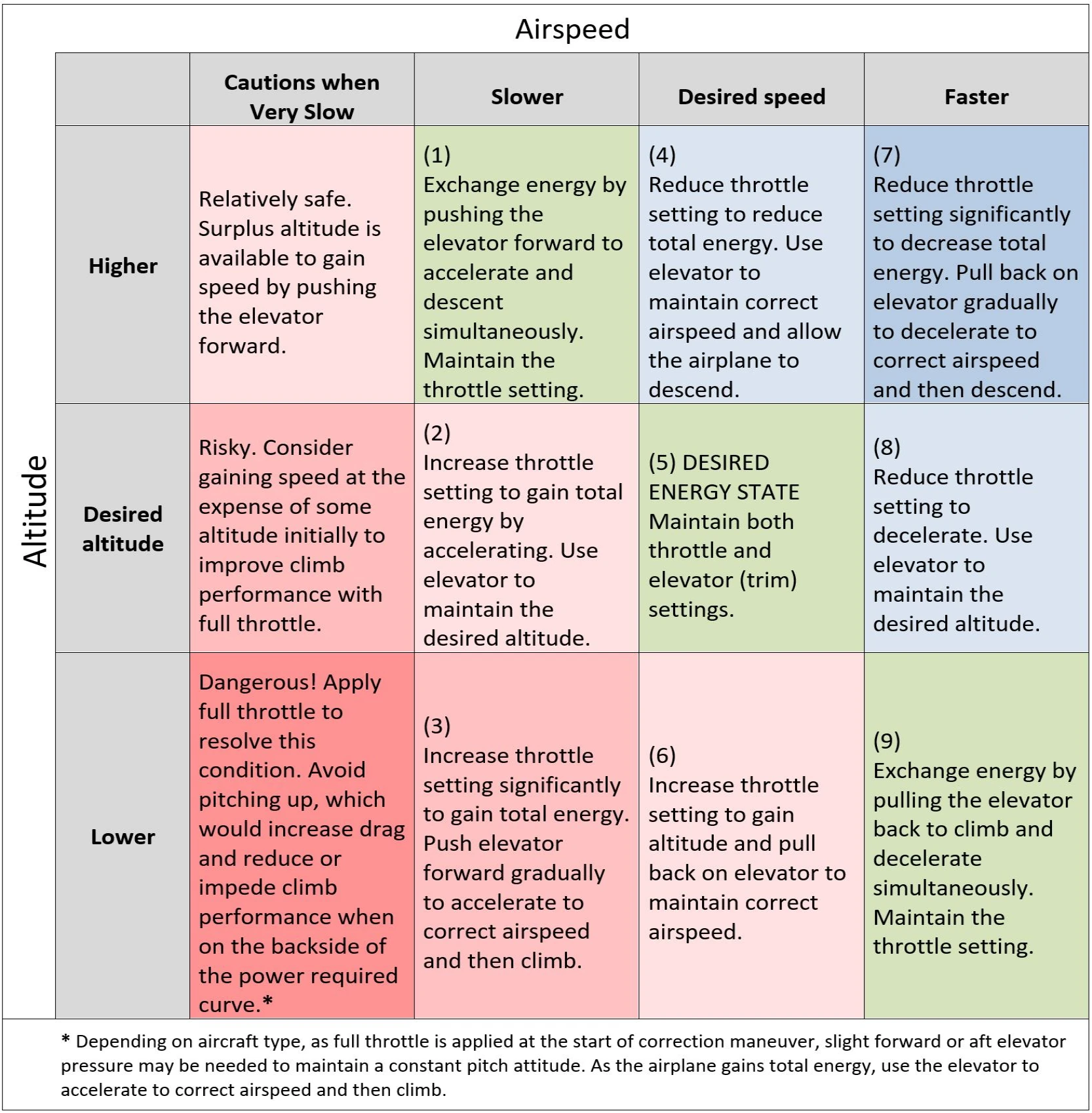
Following energy management principles, total energy errors are corrected by increasing or decreasing energy using the throttle, while energy distribution errors are corrected by exchanging energy between altitude and speed using the elevator. To correct a combination of total energy and distribution errors, both controls need to be used simultaneously. Figure 4-12 summarizes the control skills needed to correct total energy and energy distribution errors.
Scenario 1 [Figure 4-9] is a good example to illustrate energy errors and the skills needed to correct and avoid them. Figure 4-13 actually depicts three possible scenarios (B, C, and D) where an airplane on final approach to land has descended below its intended flight path. Should the pilot pitch up, throttle up, or both? It depends. The airplane is lower than desired, but the pilot should check the airspeed as well. Relative to the target airspeed, the actual speed may be slower (B), faster (D), or on target (C). In all three cases, the goal is to return the airplane to its correct energy state (A), following a deviation in altitude and/or airspeed.
Lower-and-slower (B) is fundamentally different from lower-and-faster (D). The former requires advancing the throttle forward to regain total energy (3 in Figure 4-12), while the latter requires pulling back on the yoke/stick to null the energy distribution error (9 in Figure 4-12).