
Chapter 8
Airport Traffic Patterns
The final approach leg is a descending flightpath starting from the completion of the base-to-final turn and extending to the point of touchdown. This is probably the most important leg of the entire pattern, because of the sound judgment and precision needed to accurately control the airspeed and descent angle while approaching the intended touchdown point.
The pilot on final approach focuses on making a safe approach. If there is traffic on the runway, there should be sufficient time for that traffic to clear. If it appears that there may be a conflict, an early go-around may be in order. A pilot may go around and inform the controller. This is also a good time to verify the correct landing surface and avoid lining up with the wrong runway, an airport road, or a taxiway.
The upwind leg is a course flown parallel to the landing runway in the same direction as landing traffic. The upwind leg is flown at controlled airports and after go-arounds. When necessary, the upwind leg is the part of the traffic pattern in which the pilot will transition from the final approach to the climb altitude to initiate a go-around. When a safe altitude is attained, the pilot should commence a shallow-bank turn to the upwind side of the airport. This allows better visibility of the runway for departing aircraft.
The departure leg of the rectangular pattern is a straight course aligned with, and leading from, the takeoff runway. This leg begins at the point the airplane leaves the ground and continues until the pilot begins the 90° turn onto the crosswind leg.
On the departure leg after takeoff, the pilot should continue climbing straight ahead and, if remaining in the traffic pattern, commence a turn to the crosswind leg beyond the departure end of the runway within 300 feet of the traffic pattern altitude. If departing the traffic pattern, the pilot should continue straight out or exit with a 45° turn (to the left when in a left-hand traffic pattern or to the right when in a right-hand traffic pattern) beyond the departure end of the runway after reaching the traffic pattern altitude.
The crosswind leg is the part of the rectangular pattern that is horizontally perpendicular to the extended centerline of the takeoff runway. The pilot should enter the crosswind leg by making approximately a 90° turn from the upwind leg. The pilot should continue on the crosswind leg, to the downwind leg position.
If the takeoff is made into the wind, the wind will now be approximately perpendicular to the airplane’s flightpath. As a result, the pilot should turn or head the airplane slightly into the wind while on the crosswind leg to maintain a ground track that is perpendicular to the runway centerline extension.
Non-Towered Airports
Non-towered airports traffic patterns are always entered at pattern altitude. How a pilot enters the pattern depends upon the direction of arrival. The preferred method for entering from the downwind leg side of the pattern is to approach the pattern on a course 45° to the downwind leg and join the pattern at midfield.
There are several ways to enter the pattern if the arrival occurs on the upwind leg side of the airport. One method of entry from the opposite side of the pattern is to announce intentions and cross over midfield at least 500 feet above pattern altitude (normally 1,500 feet AGL). However, if large or turbine aircraft operate at the airport, it is best to remain 2,000 feet AGL so as not to conflict with their traffic pattern. When well clear of the pattern—approximately 2 miles—the pilot should scan carefully for traffic, descend to pattern altitude, then turn right to enter at 45° to the downwind leg at midfield. [Figure 8-3A] An alternate method is to enter on a midfield crosswind at pattern altitude, carefully scan for traffic, announce intentions, and then turn downwind. [Figure 8-3B] This technique should not be used if the pattern is busy.
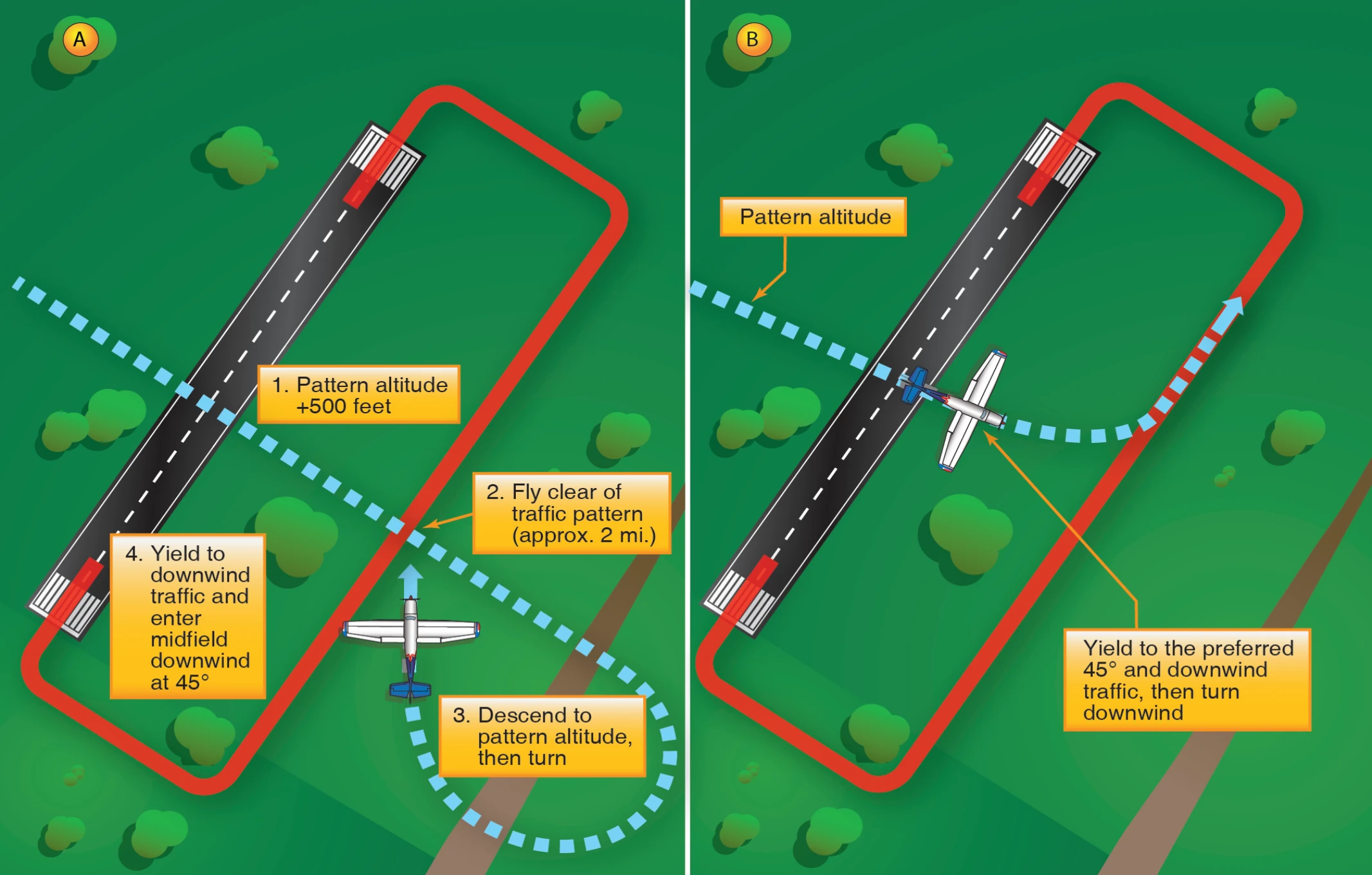
In either case, it is vital to announce intentions and to scan outside. Make course and speed adjustments that will lead to a successful pattern entry and give way to other aircraft on the preferred 45° entry or to aircraft already established on downwind.
Why is it advantageous to use the preferred 45° entry? If it is not possible to enter the pattern due to conflicting traffic, the pilot on a 45° entry can continue to turn away from the downwind, fly a safe distance away, and return for another attempt to join on the 45° entry—all while scanning for traffic.
Before joining the downwind leg, adjust course or speed to fit the traffic. Once fitting into the flow of traffic, adjust power on the downwind leg to avoid flying too fast or too slow. Speeds recommended by the airplane manufacturer should be used. They will generally fall between 70 to 90 knots for typical piston single-engine airplanes.
Safety Considerations
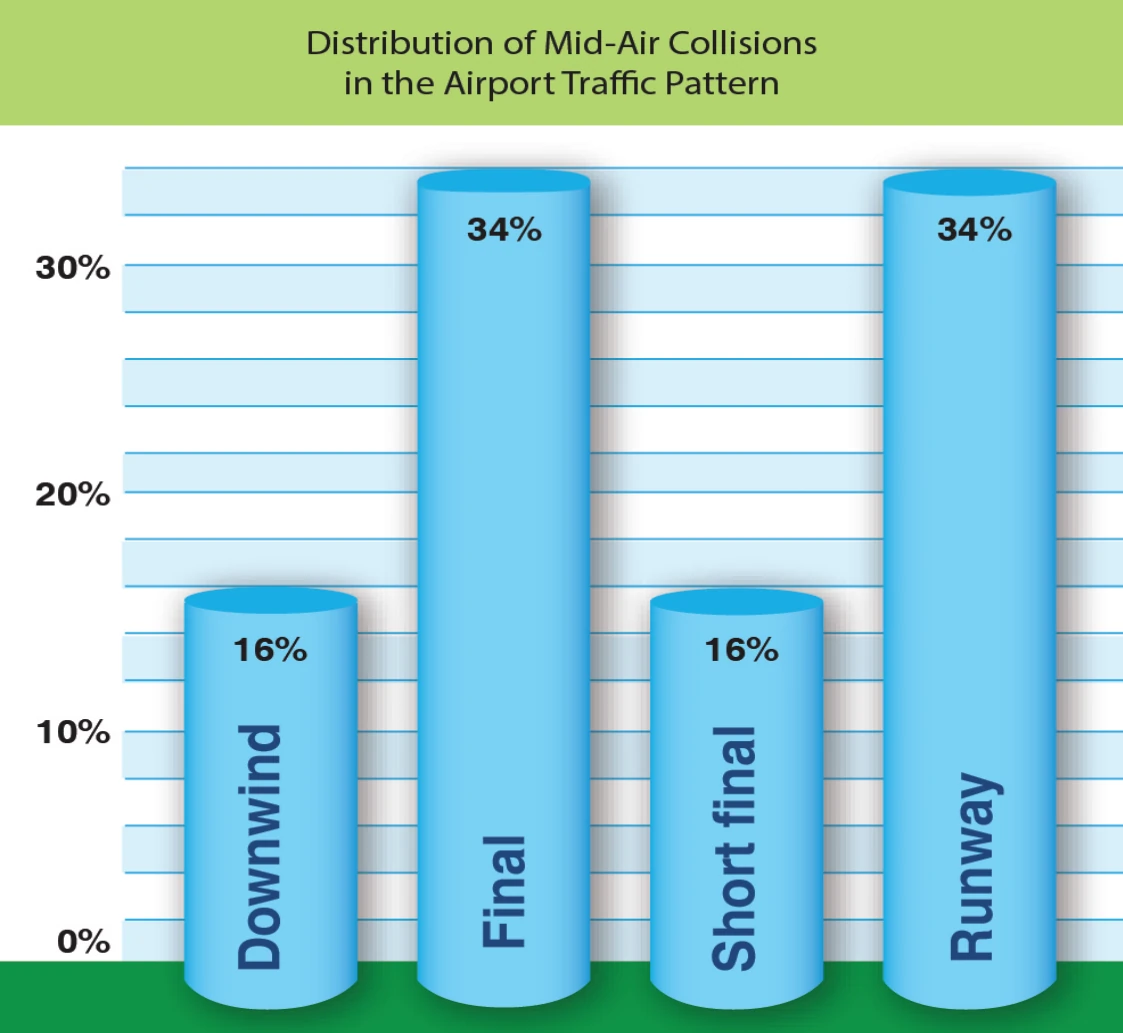
According to the National Transportation Safety Board (NTSB), the most probable cause of mid-air collisions is the pilot failing to see and avoid other aircraft. When near an airport, pilots should continue to scan for other aircraft and check blind spots caused by fixed aircraft structures, such as doorposts and wings. High-wing airplanes have restricted visibility above while low-wing airplanes have limited visibility below. The worst-case scenario is a low-wing airplane flying above a high-wing airplane. Banking from time to time can uncover blind spots. The pilot should also occasionally look to the rear of the airplane to check for other aircraft. Figure 8-4 depicts the greatest threat area for mid-air collisions in the traffic pattern. Listed below are important facts regarding mid-air collisions:
- Mid-air collisions generally occur during daylight hours—56 percent occur in the afternoon, 32 percent occur in the morning, and 2 percent occur at night, dusk, or dawn.
- Most mid-air collisions occur under good visibility.
- A mid-air collision is most likely to occur between two aircraft going in the same direction.
- The majority of pilots involved in mid-air collisions are not on a flight plan.
- Nearly all accidents occur at or near uncontrolled airports and at altitudes below 1,000 feet.
- Pilots of all experience levels can be involved in mid-air collisions.
The following are some important procedures that all pilots should follow when flying in a traffic pattern or in the vicinity of an airport.
- Tune and verify radio frequencies before entering the airport traffic area.
- Monitor the correct Common Traffic Advisory Frequency (CTAF).
- Report position 10 miles out and listen for reports from other inbound traffic.
- At a non-towered airport, report entering downwind, turning downwind to base, and base to final.
- Descend to traffic pattern altitude before entering the pattern.
- Maintain a constant visual scan for other aircraft.
- Be aware that there may be aircraft in the pattern without radios.
- Use exterior lights to improve the chances of being seen.