
Chapter 10
Teaching Practical Risk Management during Flight Instruction
Introduction
Examination of accident data leads to the inevitable conclusion that many aviation accidents involve poor risk management decisions. Therefore, effective risk management is one of the most important skills a pilot needs to learn, understand, and practice as a habit. Since flight instructors continually deal with risk, they quickly become subject matter experts.
Instructors know to increase the scope of risk management while teaching. For example, risk management during flight instruction includes a consideration of the dangers from maneuvers performed incorrectly by the learner close to the ground, in addition to all the other risks associated with the flight.
Chapter 1, Risk Management and Single-Pilot Resource Management, discussed the foundations of effective risk management, as well as other critical skills that are a part of single-pilot resource management (SRM). Flight instructors, however, may want additional practical guidance on teaching risk management to pilots of various experience levels and applying risk management to instructional flights. This chapter provides such practical guidance.
Poor Risk Management and Accident Causality
Traditional Accident Investigation Taxonomy
Aviation accidents are investigated by both the National Transportation Safety Board (NTSB) and the Federal Aviation Administration (FAA). The role of the NTSB is to determine the probable cause of accidents and make recommendations, while the FAA seeks to determine if the accident revealed deficiencies in pilot training, aircraft certification, air traffic control or another area of FAA responsibility. The two government entities are often assisted by other interested parties, such as aircraft and/or engine manufacturers, in an effort to determine the facts.
The NTSB role can be illustrated by looking at a typical accident report. [Figure 10-1] While this accident occurred several decades ago and the pilot had LORAN navigation, the lack of risk assessment by the pilot is typical. Pilots have confronted the same type of scenario and many have repeated similar behavior when faced with a significant and potentially lethal hazard.
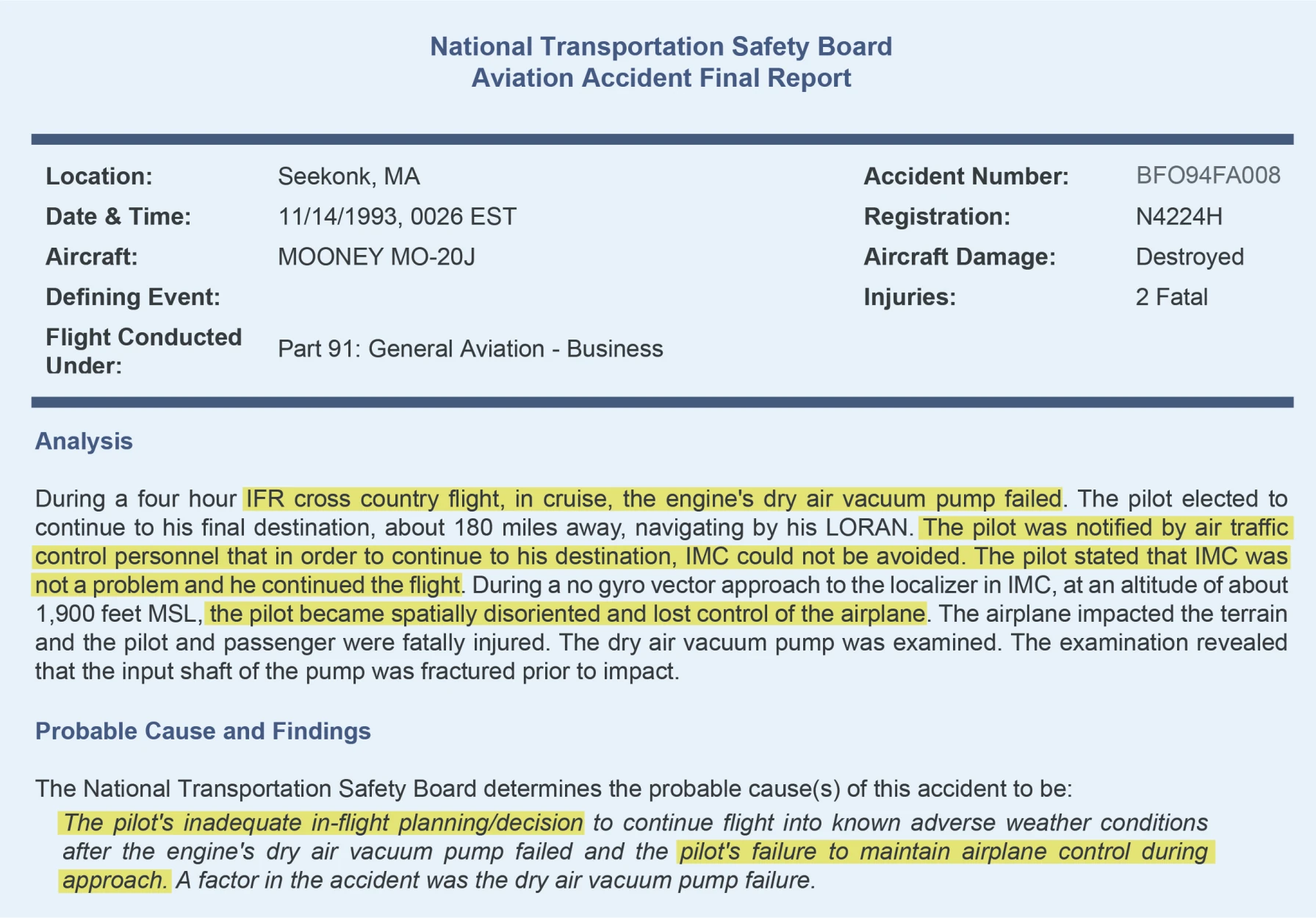
Key findings of the NTSB final report of the Mooney accident, highlighted in yellow, emphasized the pilot's loss of control of the aircraft and inadequate in-flight planning. These facts accurately described the final events of the flight leading to the loss of control. In fact, conventional accident analysis classifies accidents such as this one as pilot error due to loss of control.
Risk Analysis Using the PAVE Checklist
The NTSB report on the Mooney accident reviews the accident facts to arrive at its probable-cause finding. Yet, there is more to learn about the root causality of the accident by examining the pilot’s reaction to events during the flight using the PAVE acronym from Chapter 1.
The pilot knew about the vacuum pump failure and the instrument meteorological conditions (IMC) ahead of him. The faulty equipment generated an aircraft, or "A" hazard and IMC generated an environment or “V” hazard. The combination of those two hazards created an unacceptable risk once the pilot decided to penetrate the weather. In addition, it is possible that the pilot’s desire to get to his destination created an external pressure, or “E” hazard. Finally, the pilot’s assumption that he could control the aircraft with critical instruments inoperative created a pilot, or “P” hazard. The risk assessment matrix [Figure 10-2], indicates catastrophic consequences were possible from loss of control in IMC, and the likelihood of loss of control after a vacuum pump failure, was at least occasional or even probable. Thus, the overall risk presented was high or red and needed mitigation of some kind.
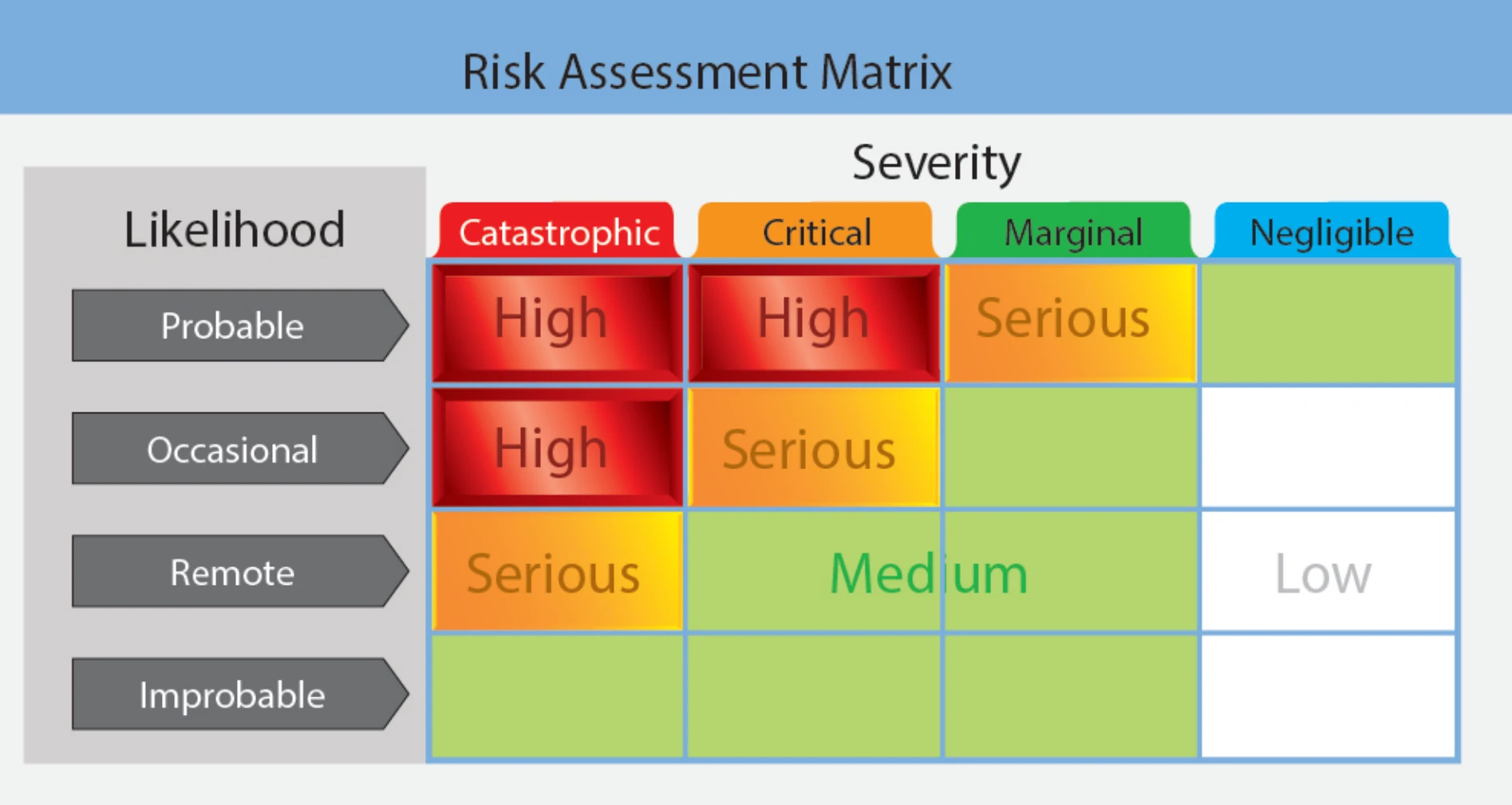
The pilot’s most effective mitigation may have been to divert and land while still in visual meteorological conditions (VMC). Why was the pilot unable to practice effective risk management on this flight? Lack of risk management training may have created an inability to cope with a difficult situation.
Instructors have a role and a responsibility to help pilots obtain the necessary risk management training and to adopt a safety culture that embraces risk management and mitigation of risk. The instructor’s role in risk management should be incorporated at all levels of training, from a new pilot with little experience to a multi-thousand-hour pilot taking recurrent training.
When to Teach Risk Management
The importance of risk management suggests that it should be taught at the very start of flight training and should be integrated into any actual flight training, rather than taught as a separate subject. However, it will be even more effective if the learner receives ground instruction on this topic prior to the first flight lesson. This preliminary instruction should also be part of any formal ground school.
Risk management activity and discussion should be included in all preflight and postflight briefings. Learners should be encouraged to participate and even lead such discussions as their experience increases.
Risk management training should not be confined to initial training. Recurrent, transition, flight reviews, instrument proficiency checks, and other training and currency events should also include risk management.