
Chapter 3
The Learning Process
Instructors and learners should be aware of a natural human tendency to resist learning from errors. That is, there is a tendency to “explain away” errors, dismissing them as one-time events that will likely never happen again. The same phenomenon occurs when observing errors made by others. Reading an accident or incident report, it is easy to spot where a pilot or mechanic made an error and regard the error as something that could never happen to the reader. It is important to note that this type of bias is not necessarily the result of ego or overconfidence; rather, it is something to which we are all susceptible. Psychologist Baruch Fischoff studied hindsight explanations given by people who were presented with descriptions of situations and their ultimate outcomes. When asked to provide explanations for events that had already occurred and for which the outcome was known, people explained that the outcomes were “obvious” and “predictable.” When the same events without the outcomes were presented to a second group, peoples’ prediction of the outcome was no better than chance guessing. The study nicely illustrates the popular adage that “hindsight is 20/20.”
Summary of Instructor Actions
To help learners learn from errors they make and be prepared for them in the future, an instructor should:
- Explain that pilots and mechanics at all levels of skill and experience make occasional errors.
- Explain that the magnitude and frequency of errors tend to decrease as skill and experience increases.
- Explain the difference between slips and mistakes and provide examples of each.
- Explain ways in which the learner can help minimize errors.
- Allow the learner to practice recovering from common errors.
- Point out errors when they occur and ask the learner to explain why they occurred.
Memory
Memory is the vital link between the learner learning/retaining information and the cognitive process of applying what is learned. It is the ability of people and other organisms to encode (initial perception and registration of information), store (retention of encoded information over time), and retrieve (processes involved in using stored information) information. [Figure 3-22] When a person successfully recalls a past experience (or skill), information about the experience has been encoded, stored, and retrieved.
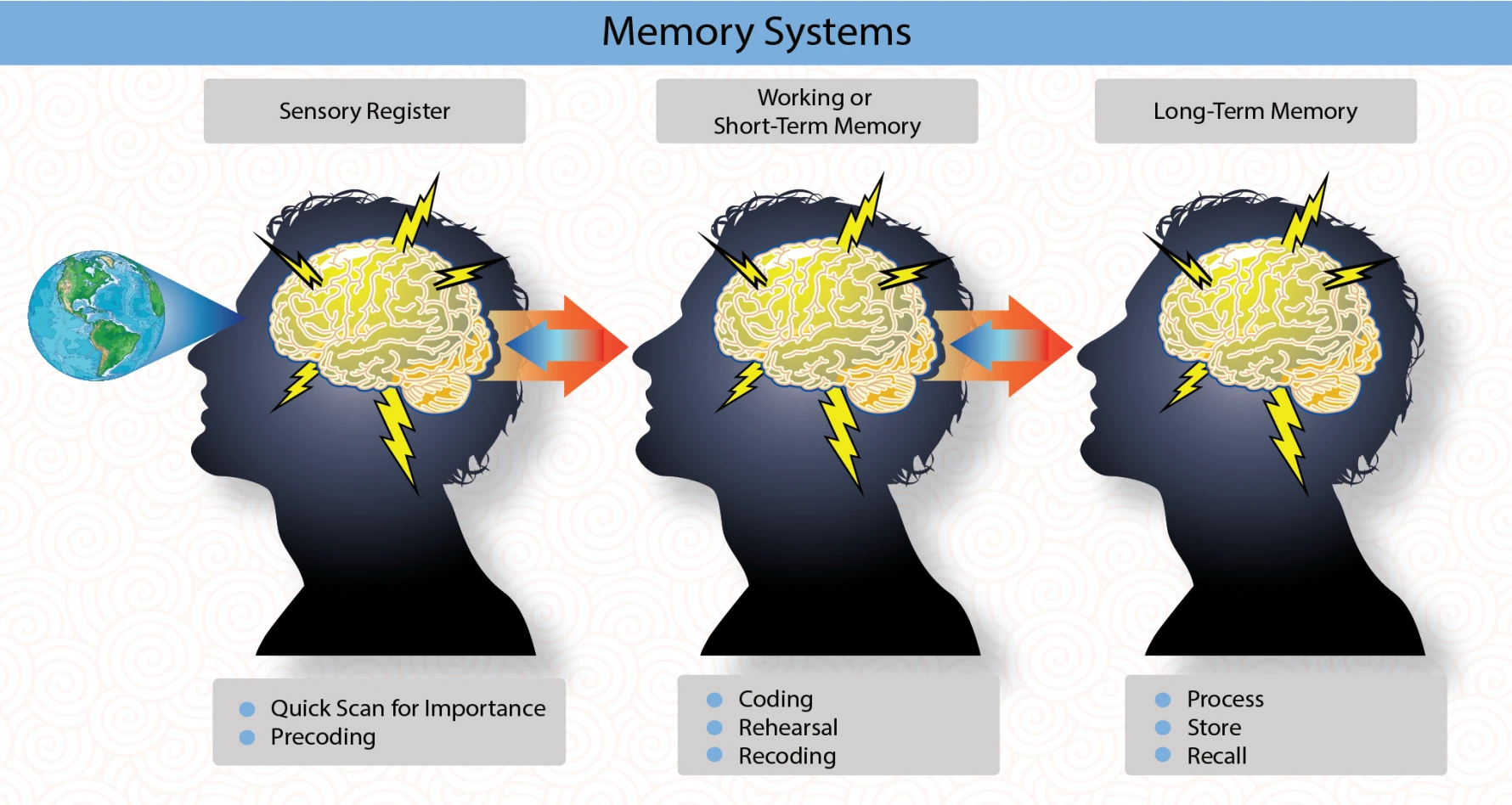
Although there is no universal agreement of how memory works, a widely accepted model has three components: sensory memory, short-term memory (STM), and long-term memory (LTM).
Sensory Memory
Sensory memory is the part of the memory system that receives initial stimuli from the environment and processes them according to the individual’s preconceived concept of what is important. Other factors can influence the reception of information by sensory memory. For example, if the input is dramatic and impacts more than one of the five senses, that information is more likely to make an impression. The sensory memory processes stimuli from the environment within seconds, discards what is considered extraneous, and processes what is determined by the individual to be relevant. This is a selective process where the sensory register is set to recognize certain stimuli and immediately transmit them to the STM for action. The process is called precoding. An example of sensory precoding is recognition of a fire alarm. No matter what is happening at the time, when the sensory register detects a fire alarm, the working memory is immediately made aware of the alarm and preset responses begin to take place. Sensory memory is capable of retaining information for only a very short period of time and within seconds the relevant information is passed to the STM.
Short-Term Memory (STM)
Short-term memory is the part of the memory system where information is stored for roughly 30 seconds, after which it may rapidly fade or be consolidated into long-term memory, depending on the individual’s priorities. Several common steps help retention in STM. These include rehearsal or repetition of the information and sorting or categorization into systematic chunks. The sorting process is usually called coding or chunking. A key limitation of STM is that it takes 5–10 seconds to properly code information and if the coding process is interrupted, that information is easily lost since it is stored for only 30 seconds. The goal of the STM is to put the information to immediate use.
STM is not only time-limited, it also has limited capacity, usually about seven bits or chunks of information. A seven-digit telephone number is an example. As indicated, the time limitation may be overcome by rehearsal. This means learning the information by a rote memorization process. Of course, rote memorization is subject to imperfections in both the duration of recall and in its accuracy. The coding process is more useful in a learning situation. In addition, the coding process may involve recoding to adjust the information to individual experiences. This is when actual learning begins to take place. Therefore, recoding may be described as a process of relating incoming information to concepts or knowledge already in memory.
Brain research has led to the conclusion that STM resembles the control tower of a major airport and is responsible for scheduling and coordinating all incoming and outgoing flights. STM has three basic operations: iconic memory, acoustic memory, and working memory. Iconic memory is the brief sensory memory of visual images. Acoustic memory is the encoded memory of a brief sound memory or the ability to hold sounds in STM. Of the two, acoustic memory can be held longer than iconic memory. Working memory is an active process to keep information until it is put to use (think of a phone number repeated until used). It is useful in remembering a spoken sentence or a string of digits.
Also called “scratch-pad” memory, working memory is of short duration and has limited capacity. It simultaneously stores and manipulates information. The goal of the working memory is not really to move the information from STM to LTM, but merely put the information to immediate use.
STM retention makes information available long enough for it to be rehearsed. For example, if the learner repeats the number to himself, it can be transferred to some sort of longer term storage. To retain information for extended periods of time, it needs to be transferred from STM to LTM. This process involves encoding or consolidation of information into LTM where it can then be retrieved.
Long-Term Memory (LTM)
LTM is relatively permanent storage of unlimited information, and it is possible for memories in LTM to remain there for a lifetime. What is stored in LTM affects a person’s perceptions of the world and affects what information in the environment is noticed. Information that passes from STM to LTM typically has some significance attached to it. For example, imagine how difficult it would be for a pilot to forget the first day he or she soloed. This is a significant day in any pilot’s training, so when the information was processed, significance was attached to it, the information was deemed important, and it was transferred into LTM.
There appear to be other reasons information is transferred to LTM because the average human brain stores numerous insignificant facts. One explanation is repetition; people tend to remember things the more they are rehearsed. Information also ends up in LTM because it is somehow attached to something significant. A person may remember the color of the clothing of the recipient of a wedding proposal. The color of the clothing plays no important role, but is attached to the memory of the experience.
For the stored information to be useful, some special effort was expended during the encoding or consolidation of information in STM. The encoding should provide meaning and connections between old and new information. If initial encoding is not properly accomplished, recall is distorted and it may be impossible. The more effective the encoding process, the easier the recall. However, it should be noted that the LTM is a reconstruction, not a pure recall of information or events. It is also subject to limitations, such as time, biases, and, in many cases, personal inaccuracies. This is one reason why two people who view the same event often have totally different recollections. Memory also applies to psychomotor skills. For example, with practice, a tennis player may be able to serve a tennis ball at a high rate of speed and with accuracy. This may be accomplished with very little thought. For a pilot, the ability to instinctively perform certain maneuvers or tasks that require manual dexterity and precision, provides obvious benefits. For example, it allows the pilot more time to concentrate on other essential duties such as navigation, communications with ATC facilities, and visual scanning for other aircraft.