
Chapter 6
Assessment
Acceptable
Consider that learners do not like negative feedback. What makes an honest assessment acceptable to the learner? A certificate or credential alone rarely suffices. Learners need to have confidence in the instructor’s qualifications, teaching ability, sincerity, competence, and authority. Usually, instructors have the opportunity to establish themselves with learners before the formal assessment arises. If not, however, the instructor’s manner, attitude, and familiarity with the subject at hand serves this purpose. Assessments presented fairly, with authority, conviction, sincerity, and from a position of recognizable competence tend to work well.
Comprehensive
A comprehensive assessment is not necessarily a long one, nor need it treat every aspect of the performance in detail. While it includes strengths as well as weaknesses, the degree of coverage of each should fit the situation. The instructor might report what most needs improvement, or only what the learner can reasonably be expected to improve. The instructor decides whether the greater benefit comes from a discussion of a few major points or a number of minor points.
Constructive
An assessment is pointless unless the learner benefits from it. Praise can capitalize on things that are done well and inspire the learner to improve in areas of lesser accomplishment. When identifying a mistake or weakness, the instructor needs to give positive guidance for correction. Praise for its own sake or negative comments that do not point toward improvement or a higher level of performance should be omitted from an assessment altogether.
Organized
An assessment must be organized. Almost any pattern is acceptable, as long as it is logical and makes sense to the learner. An effective organizational pattern might be the sequence of the performance itself. Sometimes an assessment can begin at the point at which a demonstration failed, and work backward through the steps that led to the failure. A success can be analyzed in similar fashion. Alternatively, a glaring deficiency can serve as the core of an assessment. Breaking the whole into parts, or building the parts into a whole, is another possible organizational approach.
Thoughtful
An effective assessment reflects the instructor’s thoughtfulness toward the learner’s need for self-esteem, recognition, and approval. The instructor refrains from minimizing the inherent dignity and importance of the individual. Ridicule, anger, or fun at the expense of the learner has no place in assessment. While being straightforward and honest, the instructor should always respect the learner’s personal feelings. For example, the instructor should try to deliver criticism in private.
Specific
The instructor’s comments and recommendations should be specific. Learners cannot act on recommendations unless they know specifically what the recommendations are. A statement such as, “Your second weld wasn’t as good as your first,” has little constructive value. Instead, the instructor should say why it was not as good and offer suggestions on how to improve the weld. If the instructor has a clear, well-founded, and supportable idea in mind, it should be expressed with firmness and authority, and in terms that cannot be misunderstood. At the conclusion of an assessment, learners should have no doubt about what they did well and what they did poorly and, most importantly, specifically how they can improve.
Traditional Assessment
As defined earlier, traditional assessment generally refers to written testing, such as multiple choice, matching, true/false, fill in the blank, etc. Learners typically complete written assessments within a specified time. There is a single, correct response for each item. The assessment, or test, assumes that all learners should learn the same thing, and relies on rote memorization of facts. Responses are often machine scored and offer little opportunity for a demonstration of the thought processes characteristic of critical thinking skills.
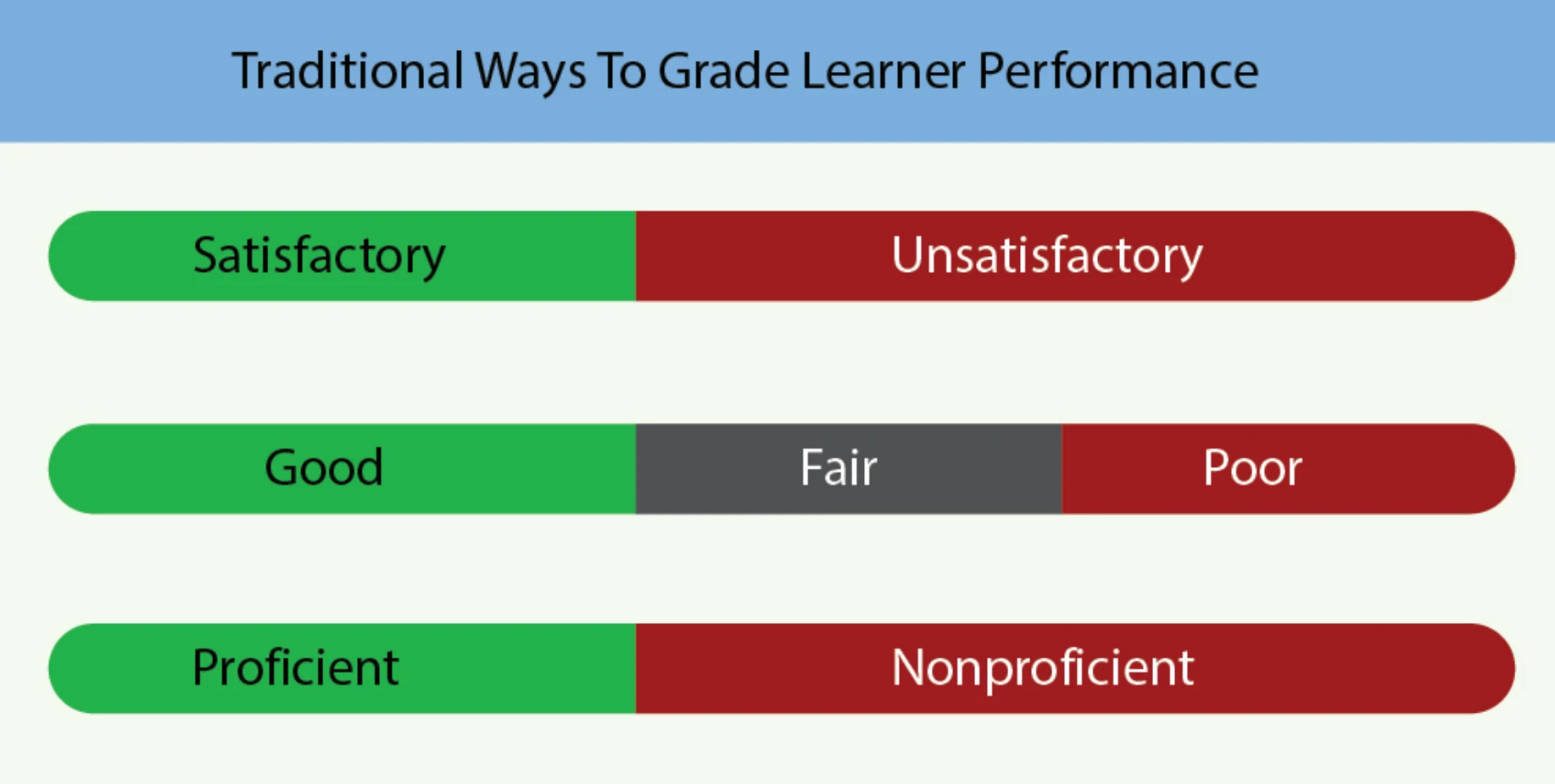
Traditional assessment lends itself to instructor centered teaching styles. The instructor teaches the material at a low level, and the measure of performance is limited. In traditional assessment, fairly simple grading matrices such as shown in Figure 6-2 are used. Due to this approach, a satisfactory grade for one lesson may not reflect a learner's ability to apply knowledge in a different situation.
Still, tests of this nature do have a place in the assessment hierarchy. Multiple choice, supply type, and other such tests are useful in assessing the learner’s grasp of information, concepts, terms, processes, and rules—factual knowledge that forms the foundation needed for the learner to advance to higher levels of learning.
Characteristics of a Good Written Assessment (Test)
Whether or not an instructor designs his or her own tests or uses commercially available test banks, it is important to know the components of an effective test. (Note: This section is intended to introduce basic concepts of written-test design. Please see Appendix A for testing and test-writing publications.)
A test is a set of questions, problems, or exercises intended to determine whether the learner possesses a particular knowledge or skill. A test can consist of just one test item, but it usually consists of a number of test items. A test item measures a single objective and calls for a single response. The test could be as simple as the correct answer to an essay question or as complex as completing a knowledge or practical test. Regardless of the underlying purpose, effective tests share certain characteristics. [Figure 6-3]