
Chapter 12
Hydraulic & Pneumatic Power Systems
Aircraft Hydraulic Systems
The word “hydraulics” is based on the Greek word for water and originally meant the study of the physical behavior of water at rest and in motion. Today, the meaning has been expanded to include the physical behavior of all liquids, including hydraulic fluid. Hydraulic systems are not new to aviation. Early aircraft had hydraulic brake systems. As aircraft became more sophisticated, newer systems with hydraulic power were developed.
Hydraulic systems in aircraft provide a means for the operation of aircraft components. The operation of landing gear, flaps, flight control surfaces, and brakes is largely accomplished with hydraulic power systems. Hydraulic system complexity varies from small aircraft that require fluid only for manual operation of the wheel brakes to large transport aircraft where the systems are large and complex. To achieve the necessary redundancy and reliability, the system may consist of several subsystems. Each subsystem has a power generating device (pump), reservoir, accumulator, heat exchanger, filtering system, etc. System operating pressure may vary from a couple hundred pounds per square inch (psi) in small aircraft and rotorcraft to 5,000 psi in large transports. Hydraulic systems have many advantages as power sources for operating various aircraft units; they combine the advantages of light weight, ease of installation, simplification of inspection, and minimum maintenance requirements. Hydraulic operations are also almost 100 percent efficient, with only negligible loss due to fluid friction.
Hydraulic Fluid
Hydraulic system liquids are used primarily to transmit and distribute forces to various units to be actuated. Liquids are able to do this because they are almost incompressible. Pascal’s Law states that pressure applied to any part of a confined liquid is transmitted with undiminished intensity to every other part. Thus, if a number of passages exist in a system, pressure can be distributed through all of them by means of the liquid.
Manufacturers of hydraulic devices usually specify the type of liquid best suited for use with their equipment in view of the working conditions, the service required, temperatures expected inside and outside the systems, pressures the liquid must withstand, the possibilities of corrosion, and other conditions that must be considered. If incompressibility and fluidity were the only qualities required, any liquid that is not too thick could be used in a hydraulic system. But a satisfactory liquid for a particular installation must possess a number of other properties. Some of the properties and characteristics that must be considered when selecting a satisfactory liquid for a particular system are discussed in the following paragraphs.
Viscosity
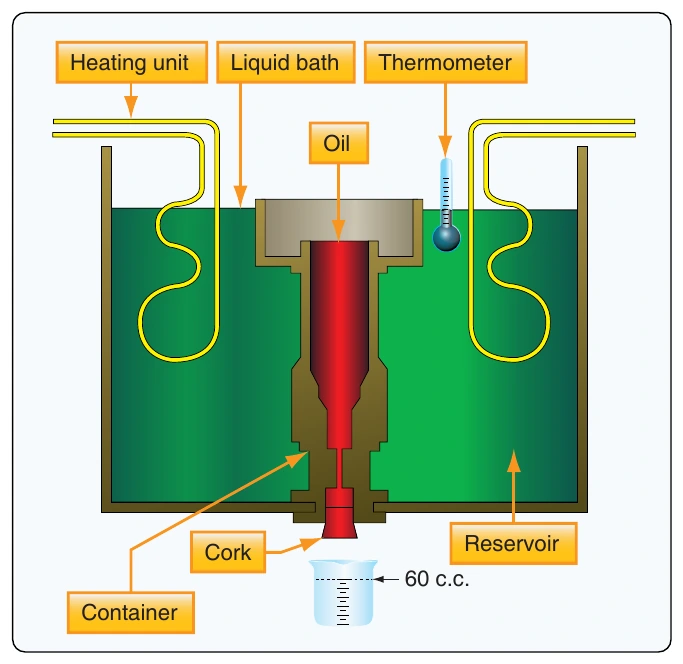
One of the most important properties of any hydraulic fluid is its viscosity. Viscosity is internal resistance to flow. A liquid such as gasoline that has a low viscosity flows easily, while a liquid such as tar that has a high viscosity flows slowly. Viscosity increases as temperature decreases. A satisfactory liquid for a given hydraulic system must have enough body to give a good seal at pumps, valves, and pistons, but it must not be so thick that it offers resistance to flow, leading to power loss and higher operating temperatures. These factors add to the load and to excessive wear of parts. A fluid that is too thin also leads to rapid wear of moving parts or of parts that have heavy loads. The instruments used to measure the viscosity of a liquid are known as viscometers or viscosimeters. Several types of viscometers are in use today. The Saybolt viscometer measures the time required, in seconds, for 60 milliliters of the tested fluid at 100 °F to pass through a standard orifice. The time measured is used to express the fluid’s viscosity, in Saybolt universal seconds or Saybolt FUROL seconds. [Figure 12-1]
Chemical Stability
Chemical stability is another property that is exceedingly important in selecting a hydraulic liquid. It is the liquid’s ability to resist oxidation and deterioration for long periods. All liquids tend to undergo unfavorable chemical changes under severe operating conditions. This is the case, for example, when a system operates for a considerable period of time at high temperatures. Excessive temperatures have a great effect on the life of a liquid. It should be noted that the temperature of the liquid in the reservoir of an operating hydraulic system does not always represent a true state of operating conditions. Localized hot spots occur on bearings, gear teeth, or at the point where liquid under pressure is forced through a small orifice. Continuous passage of a liquid through these points may produce local temperatures high enough to carbonize or sludge the liquid, yet the liquid in the reservoir may not indicate an excessively high temperature.
Liquids with a high viscosity have a greater resistance to heat than light or low-viscosity liquids that have been derived from the same source. The average hydraulic liquid has a low viscosity. Fortunately, there is a wide choice of liquids available for use within the viscosity range required of hydraulic liquids.
Liquids may break down if exposed to air, water, salt, or other impurities, especially if they are in constant motion or subject to heat. Some metals, such as zinc, lead, brass, and copper, have an undesirable chemical reaction on certain liquids. These chemical processes result in the formation of sludge, gums, and carbon or other deposits that clog openings, cause valves and pistons to stick or leak, and give poor lubrication to moving parts. As soon as small amounts of sludge or other deposits are formed, the rate of formation generally increases more rapidly. As they are formed, certain changes in the physical and chemical properties of the liquid take place. The liquid usually becomes darker in color, higher in viscosity, and acids are formed.
Flash Point
Flash point is the temperature at which a liquid gives off vapor in sufficient quantity to ignite momentarily or flash when a flame is applied. A high flash point is desirable for hydraulic liquids because it indicates good resistance to combustion and a low degree of evaporation at normal temperatures.
Fire Point
Fire point is the temperature at which a substance gives off vapor in sufficient quantity to ignite and continue to burn when exposed to a spark or flame. Like flash point, a high fire point is required of desirable hydraulic liquids.
Types of Hydraulic Fluids
To assure proper system operation and to avoid damage to nonmetallic components of the hydraulic system, the correct fluid must be used. When adding fluid to a system, use the type specified in the aircraft manufacturer’s maintenance manual or on the instruction plate affixed to the reservoir or unit being serviced.
The three principal categories of hydraulic fluids are: