
Chapter 7
Advanced Composite Materials
Types of Fiber
Fiberglass
Fiberglass is often used for secondary structure on aircraft, such as fairings, radomes, and wing tips. Fiberglass is also used for helicopter rotor blades. There are several types of fiberglass used in the aviation industry. Electrical glass, or E-glass, is identified as such for electrical applications. It has high resistance to current flow. E-glass is made from borosilicate glass. S-glass and S2-glass identify structural fiberglass that have a higher strength than E-glass. S-glass is produced from magnesia-alumina-silicate. Advantages of fiberglass are lower cost than other composite materials, chemical or galvanic corrosion resistance, and electrical properties (fiberglass does not conduct electricity). Fiberglass has a white color and is available as a dry fiber fabric or prepreg material.
Kevlar
Kevlar® is DuPont’s name for aramid fibers. Aramid fibers are light weight, strong, and tough. Two types of aramid fiber are used in the aviation industry. Kevlar® 49 has a high stiffness and Kevlar® 29 has a low stiffness. An advantage of aramid fibers is their high resistance to impact damage, so they are often used in areas prone to impact damage. The main disadvantage of aramid fibers is their general weakness in compression and hygroscopy. Service reports have indicated that some parts made from Kevlar® absorb up to 8 percent of their weight in water. Therefore, parts made from aramid fibers need to be protected from the environment. Another disadvantage is that Kevlar® is difficult to drill and cut. The fibers fuzz easily and special scissors are needed to cut the material. Kevlar® is often used for military ballistic and body armor applications. It has a natural yellow color and is available as dry fabric and prepreg material. Bundles of aramid fibers are not sized by the number of fibers like carbon or fiberglass but by the weight.
Carbon/Graphite
One of the first distinctions to be made among fibers is the difference between carbon and graphite fibers, although the terms are frequently used interchangeably. Carbon and graphite fibers are based on graphene (hexagonal) layer networks present in carbon. If the graphene layers, or planes, are stacked with three dimensional order, the material is defined as graphite. Usually extended time and temperature processing is required to form this order, making graphite fibers more expensive. Bonding between planes is weak. Disorder frequently occurs such that only two-dimensional ordering within the layers is present. This material is defined as carbon.
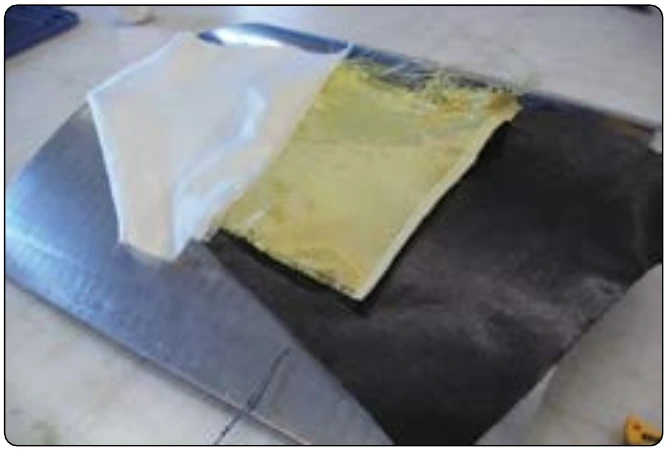
Carbon fibers are very stiff and strong, 3 to 10 times stiffer than glass fibers. Carbon fiber is used for structural aircraft applications, such as floor beams, stabilizers, flight controls, and primary fuselage and wing structure. Advantages include its high strength and corrosion resistance. Disadvantages include lower conductivity than aluminum; therefore, a lightning protection mesh or coating is necessary for aircraft parts that are prone to lightning strikes. Another disadvantage of carbon fiber is its high cost. Carbon fiber is gray or black in color and is available as dry fabric and prepreg material. Carbon fibers have a high potential for causing galvanic corrosion when used with metallic fasteners and structures. [Figure 7-7]
Boron
Boron fibers are very stiff and have a high tensile and compressive strength. The fibers have a relatively large diameter and do not flex well; therefore, they are available only as a prepreg tape product. An epoxy matrix is often used with the boron fiber. Boron fibers are used to repair cracked aluminum aircraft skins, because the thermal expansion of boron is close to aluminum and there is no galvanic corrosion potential. The boron fiber is difficult to use if the parent material surface has a contoured shape. The boron fibers are very expensive and can be hazardous for personnel. Boron fibers are used primarily in military aviation applications.
Ceramic Fibers
Ceramic fibers are used for high-temperature applications, such as turbine blades in a gas turbine engine. The ceramic fibers can be used to temperatures up to 2,200 °F.
Lightning Protection Fibers
An aluminum airplane is quite conductive and is able to dissipate the high currents resulting from a lightning strike. Carbon fibers are 1,000 times more resistive than aluminum to current flow, and epoxy resin is 1,000,000 times more resistive (i.e., perpendicular to the skin). The surface of an external composite component often consists of a ply or layer of conductive material for lightning strike protection because composite materials are less conductive than aluminum. Many different types of conductive materials are used ranging from nickel-coated graphite cloth to metal meshes to aluminized fiberglass to conductive paints. The materials are available for wet layup and as prepreg.
In addition to a normal structural repair, the technician must also recreate the electrical conductivity designed into the part. These types of repair generally require a conductivity test to be performed with an ohmmeter to verify minimum electrical resistance across the structure. When repairing these types of structures, it is extremely important to use only the approved materials from authorized vendors, including such items as potting compounds, sealants, adhesives, and so forth. [Figures 7-8 and 7-9]