Chapter 7
Advanced Composite Materials
Drilling
Unlike soft metal, acrylic plastic is a very poor conductor of heat. Make provisions for removing the heat when drilling. Deep holes need cooling, and water-soluble cutting oil is a satisfactory coolant since it has no tendency to attack the plastic.
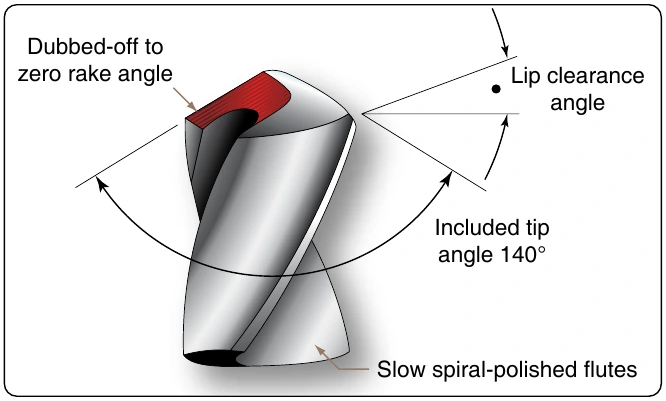
The drill used on acrylics must be carefully ground and free from nicks and burrs that would affect the surface finish. Grind the drill with a greater included angle than would be used for soft metal. The rake angle should be zero in order to scrape, and not cut. The length of the cutting edge (and hence the width of the lip) can be reduced by increasing the included angle of the drill. [Figure 7-91] Whenever holes are drilled completely through acrylic, the standard twist drills should be modified to a 60° tip angle, the cutting edge to a zero rake angle, and the back lip clearance angle increased to 12-15°. Drills specially modified for drilling acrylic are available from authorized distributors and dealers.
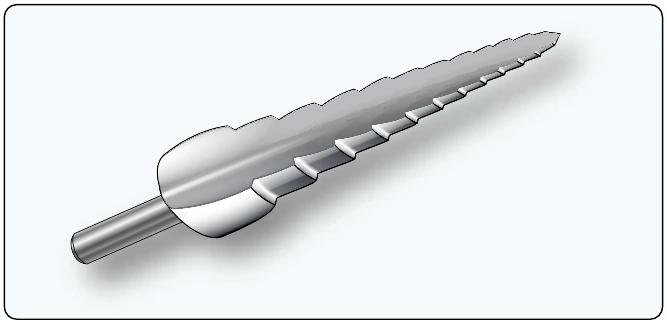
The patented Unibit® is good for drilling small holes in aircraft windshields and windows. [Figure 7-92] It can cut holes from 1⁄8 to ½-inch in 1⁄32-inch increments and produces good smooth holes with no stress cracks around their edges.
Cementing
Polymerizable cements are those in which a catalyst is added to an already thick monomer-polymer syrup to promote rapid hardening. Cement PS-30® and Weld-On 40® are polymerizable cements of this type. They are suitable for cementing all types of plexiglas acrylic cast sheet and parts molded from plexiglas molding pellets. At room temperature, the cements harden (polymerize) in the container in about 45 minutes after mixing the components. They harden more rapidly at higher temperatures. The cement joints are usually hard enough for handling within 4 hours after assembly. The joints may be machined within 4 hours after assembly, but it is better to wait 24 hours.
Application of Cement
PS-30® and Weld-On 40® joints retain excellent appearance and color stability after outdoor exposure. These cements produce clear, transparent joints and should be used when the color and appearance of the joints are important.
PS-30® and Weld-On 40® should be used at temperatures no lower than 65 °F. If cementing is done in a room cooler than 65 °F, it requires a longer time to harden and the joint strength is reduced.
The cement should be prepared with the correct proportions of components as given in the manufacturer’s instructions and thoroughly mixed, making sure neither the mixing container nor mixing paddle adds color or effects the hardening of the cement. Clean glass or polyethylene mixing containers are preferred. Because of their short pot life (approximately 45 minutes), Cement PS-30® and Weld-On 40® must be used quickly once the components are mixed. Time consumed in preparation shortens the effective working time, making it necessary to have everything ready to be cemented before the cements are mixed. For better handling, pour cement within 20 minutes of mixing. For maximum joint strength, the final cement joint should be free of bubbles. It is usually sufficient to allow the mixed cement to stand for 10 minutes before cementing to allow bubbles to rise to the surface. The gap joint technique can only be used with colorless plexiglas acrylic or in cases where joints are hidden. If inconspicuous joints in colored plexiglas acrylic are needed, the parts must be fitted closely, using closed V-groove, butt, or arc joints.
Cement forms, or dams, may be made with masking tape as long as the adhesive surface does not contact the cement. This is easily done with a strip of cellophane tape placed over the masking tape adhesive. The tape must be chosen carefully. The adhesive on ordinary cellophane tape prevents the cure of PS-30® and Weld-On 40®. Before actual fabrication of parts, sample joints should be tried to ensure that the tape system used does not harm the cement. Since it is important for all of the cement to remain in the gap, only contact pressure should be used.
Bubbles tend to float to the top of the cement bead in a gap joint after the cement is poured. These cause no problem if the bead is machined off. A small wire (not copper) or similar object may be used to lift some bubbles out of the joint; however, the cement joint should be disturbed as little as possible.
Polymerizable cements shrink as the cement hardens. Therefore, the freshly poured cement bead should be left above the surfaces being cemented to compensate for the shrinkage. If it is necessary for appearances, the bead may be machined off after the cement has set.
Repairs
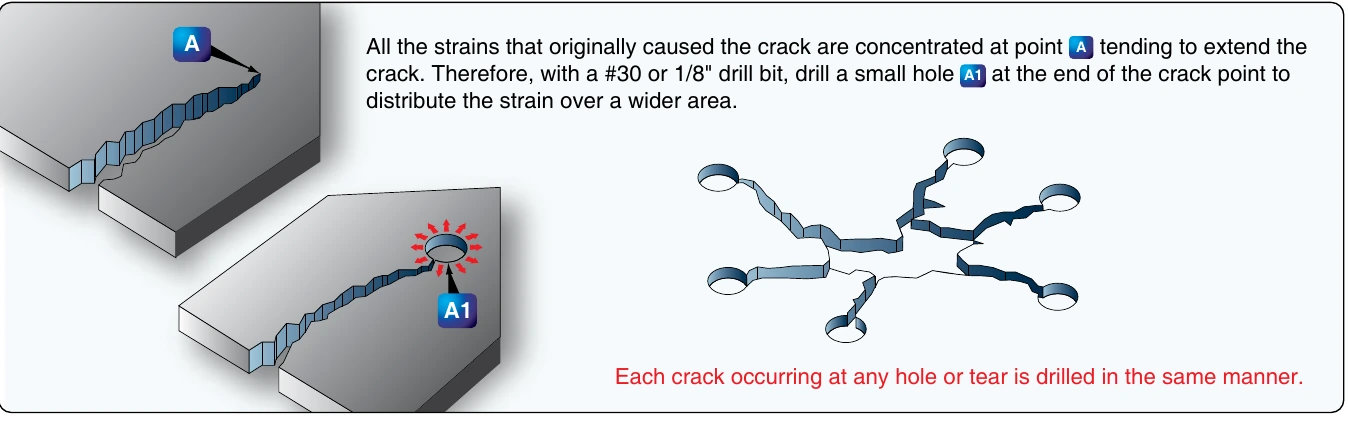
Whenever possible, replace, rather than repair, extensively damaged transparent plastic. A carefully patched part is not the equal of a new section, either optically or structurally. At the first sign of crack development, drill a small hole with a #30 or a 1⁄8-inch drill at the extreme ends of the cracks. [Figure 7-93] This serves to localize the cracks and to prevent further splitting by distributing the strain over a large area. If the cracks are small, stopping them with drilled holes usually suffices until replacement or more permanent repairs can be made.
Cleaning
Plastics have many advantages over glass for aircraft use, but they lack the surface hardness of glass and care must be exercised while servicing the aircraft to avoid scratching or otherwise damaging the surface. Clean the plastic by washing it with plenty of water and mild soap, using a clean, soft, grit-free cloth, sponge, or bare hands. Do not use gasoline, alcohol, benzene, acetone, carbon tetrachloride, fire extinguisher or deicing fluids, lacquer thinners, or window cleaning sprays. These soften the plastic and cause crazing.