
Chapter 7
Advanced Composite Materials
Paste Adhesives
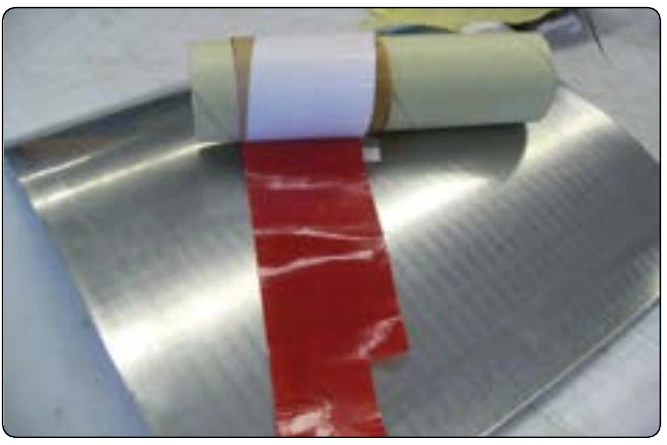
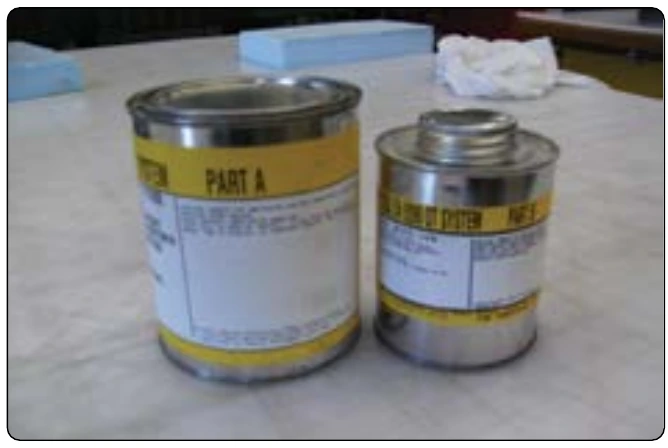
Paste adhesives are used as an alternative to film adhesive. These are often used to secondary bond repair patches to damaged parts and also used in places where film adhesive is difficult to apply. Paste adhesives for structural bonding are made mostly from epoxy. One part and two part systems are available. The advantages of paste adhesives are that they can be stored at room temperature and have a long shelf life. The disadvantage is that the bondline thickness is hard to control, which affects the strength of the bond. A scrim cloth can be used to maintain adhesive in the bondline when bonding patches with paste adhesive. [Figure 7-15]
Foaming Adhesives
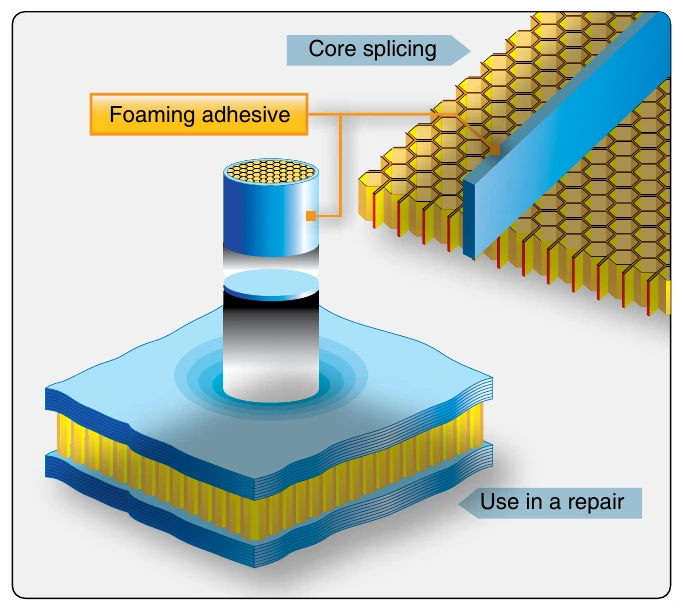
Most foaming adhesives are 0.025-inch to 0.10-inch thick sheets of B staged epoxy. Foam adhesives cure at 250 °F or 350 °F. During the cure cycle, the foaming adhesives expand. Foaming adhesives need to be stored in the freezer just like prepregs, and they have only a limited storage life. Foaming adhesives are used to splice pieces of honeycomb together in a sandwich construction and to bond repair plugs to the existing core during a prepreg repair. [Figure 7-16]
Description of Sandwich Structures
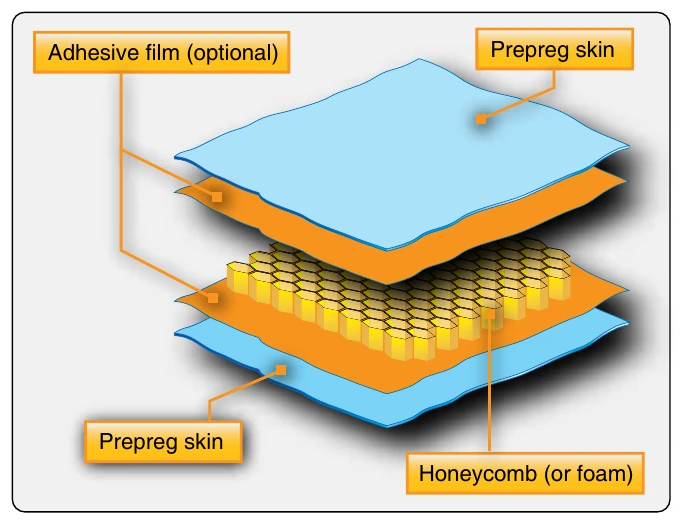
Theory A sandwich construction is a structural panel concept that consists in its simplest form of two relatively thin, parallel face sheets bonded to and separated by a relatively thick, lightweight core. The core supports the face sheets against buckling and resists out-of-plane shear loads. The core must have high shear strength and compression stiffness. Composite sandwich construction is most often fabricated using autoclave cure, press cure, or vacuum bag cure. Skin laminates may be precured and subsequently bonded to core, co-cured to core in one operation, or a combination of the two methods. Examples of honeycomb structure are: wing spoilers, fairings, ailerons, flaps, nacelles, floor boards, and rudders. [Figure 7-17]
Properties
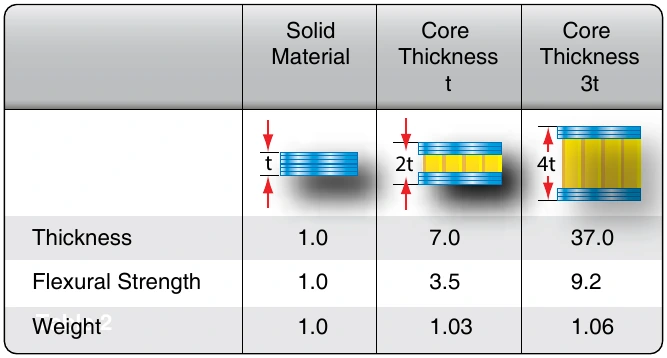
Sandwich construction has high bending stiffness at minimal weight in comparison to aluminum and composite laminate construction. Most honeycombs are anisotropic; that is, properties are directional. Figure 7-18 illustrates the advantages of using a honeycomb construction. Increasing the core thickness greatly increases the stiffness of the honeycomb construction, while the weight increase is minimal. Due to the high stiffness of a honeycomb construction, it is not necessary to use external stiffeners, such as stringers and frames. [Figure 7-18]
Facing Materials
Most honeycomb structures used in aircraft construction have aluminum, fiberglass, Kevlar®, or carbon fiber face sheets.
Carbon fiber face sheets cannot be used with aluminum honeycomb core material, because it causes the aluminum to corrode. Titanium and steel are used for specialty applications in high-temperature constructions. The face sheets of many components, such as spoilers and flight controls, are very thin—sometimes only 3 or 4 plies. Field reports have indicated that these face sheets do not have a good impact resistance.
Core Materials
Honeycomb
Each honeycomb material provides certain properties and has specific benefits. [Figure 7-19] The most common core material used for aircraft honeycomb structures is aramid paper (Nomex® or Korex®). Fiberglass is used for higher strength applications.