Chapter 8
Aircraft Painting & Finishing
Paint System Compatibility
The use of several different types of paint, coupled with several proprietary coatings, makes repair of damaged and deteriorated areas particularly difficult. Paint finishes are not necessarily compatible with each other. The following general rules for coating compatibility are included for information and are not necessarily listed in order of importance:
- Old type zinc chromate primer may be used directly for touchup of bare metal surfaces and for use on interior finishes. It may be overcoated with wash primers if it is in good condition. Acrylic lacquer finishes do not adhere to this material.
- Modified zinc chromate primer does not adhere satisfactorily to bare metal. It must never be used over a dried film of acrylic nitrocellulose lacquer.
- Nitrocellulose coatings adhere to acrylic finishes, but the reverse is not true. Acrylic nitrocellulose lacquers may not be used over old nitrocellulose finishes.
- Acrylic nitrocellulose lacquers adhere poorly to bare metal and both nitrocellulose and epoxy finishes. For best results, the lacquers must be applied over fresh, successive coatings of wash primer and modified zinc chromate. They also adhere to freshly applied epoxy coatings (dried less than 6 hours).
- Epoxy topcoats adhere to any paint system that is in good condition, and may be used for general touchup, including touchup of defects in baked enamel coatings.
- Old wash primer coats may be overcoated directly with epoxy finishes.A new second coat of wash primer must be applied if an acrylic finish is to be applied.
- Old acrylic finishes may be refinished with new acrylic if the old coating is softened using acrylic nitrocellulose thinner before touchup.
- Damage to epoxy finishes can best be repaired by using more epoxy, since neither of the lacquer finishes stick to the epoxy surface. In some instances, air-drying enamels may be used for touchup of epoxy coatings if edges of damaged areas are abraded with fine sandpaper.
Paint Touchup
Paint touchup may be required on an aircraft following repair to the surface substrate. Touchup may also be used to cover minor topcoat damage, such as scratches, abrasions, permanent stains, and fading of the trim colors. One of the first steps is to identify the paint that needs to be touched up.
Identification of Paint Finishes
Existing finishes on current aircraft may be any one of several types, a combination of two or more types, or combinations of general finishes with special proprietary coatings.
Any of the finishes may be present at any given time, and repairs may have been made using material from several different type coatings. Some detailed information for the identification of each finish is necessary to ensure the topcoat application does not react adversely with the undercoat. A simple test can be used to confirm the nature of the coatings present.
The following procedure aids in identification of the paint finish. Apply a coating of engine oil (MIL SPEC, MIL- PRF-7808, turbine oil, or equivalent) to a small area of the surface to be checked. Old nitrocellulose finishes soften within a period of a few minutes. Acrylic and epoxy finishes show no effects.
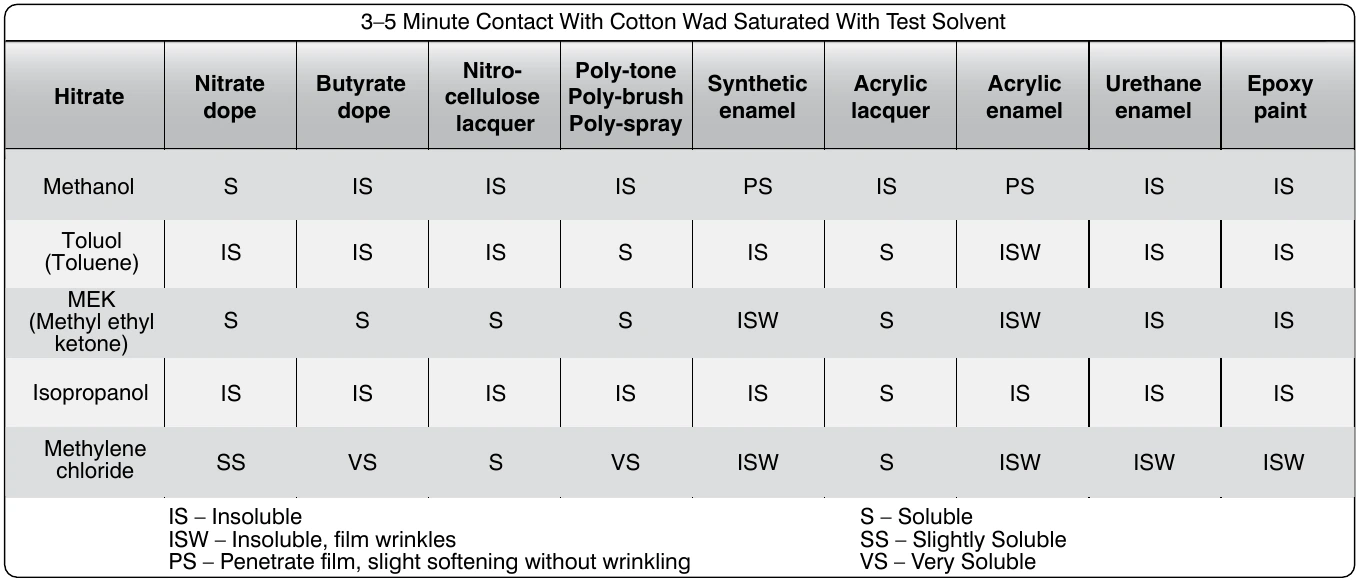
If still not identified, wipe a small area of the surface in question with a rag wet with MEK. The MEK picks up the pigment from an acrylic finish, but has no effect on an epoxy coating. Just wipe the surface, and do not rub. Heavy rubbing picks up even epoxy pigment from coatings that are not thoroughly cured. Do not use MEK on nitrocellulose finishes. Figure 8-22 provides a solvent test to identify the coating on an aircraft.
Surface Preparation for Touchup
In the case of a repair and touchup, once the aircraft paint coating has been identified, the surface preparation follows some basic rules.
The first rule, as with the start of any paint project, is to wash and wipe down the area with a degreaser and silicone wax remover before starting to sand or abrade the area.
If a whole panel or section within a seam line can be refinished during a touchup, it eliminates having to match and blend the topcoat to an existing finish. The area of repair should be stripped to a seam line and the finish completely redone from wash primer to the topcoat, as applicable. The paint along the edge of the stripped area should be hand-sanded wet and feathered with a 320-grade paper.
For a spot repair that requires blending of the coating, an area about three times the area of the actual repair will need to be prepared for blending of the paint. If the damaged area is through the primer to the substrate, the repair area should be abraded with 320 aluminum oxide paper on a double-action (D/A) air sander. Then, the repair and the surrounding area should be wet sanded using the air sander fitted with 1500 wet paper. The area should then be wiped with a tack cloth prior to spraying.
Apply a crosscoat of epoxy primer to the bare metal area, following the material data sheet for drying and recoat times. Abrade the primer area lightly with 1500 wet or dry, and then abrade the unsanded area around the repair with cutting compound. Clean and wipe the area with a degreasing solvent, such as isopropyl alcohol, and then a tack cloth.
Mix the selected topcoat paint that is compatible for the repair. Apply two light coats over the sanded repair area, slightly extending the second coat beyond the first. Allow time for the first coat to flash before applying the second coat. Then, thin the topcoat by one-third to one-half with a compatible reducer and apply one more coat, extending beyond the first two coats. Allow to dry according to the material data sheet before buffing and polishing the blended area.
If the damage did not penetrate the primer, and only the topcoat is needed for the finish, complete the same steps that would follow a primer coat.
Paint touchup procedures generally are the same for almost any repair. The end result, however, is affected by numerous variables, which include the preparation, compatibility of the finishing materials, color match, selection of reducers and/or retarders based on temperature, and experience and expertise of the painter.