
Chapter 10
Inspection Concepts & Techniques
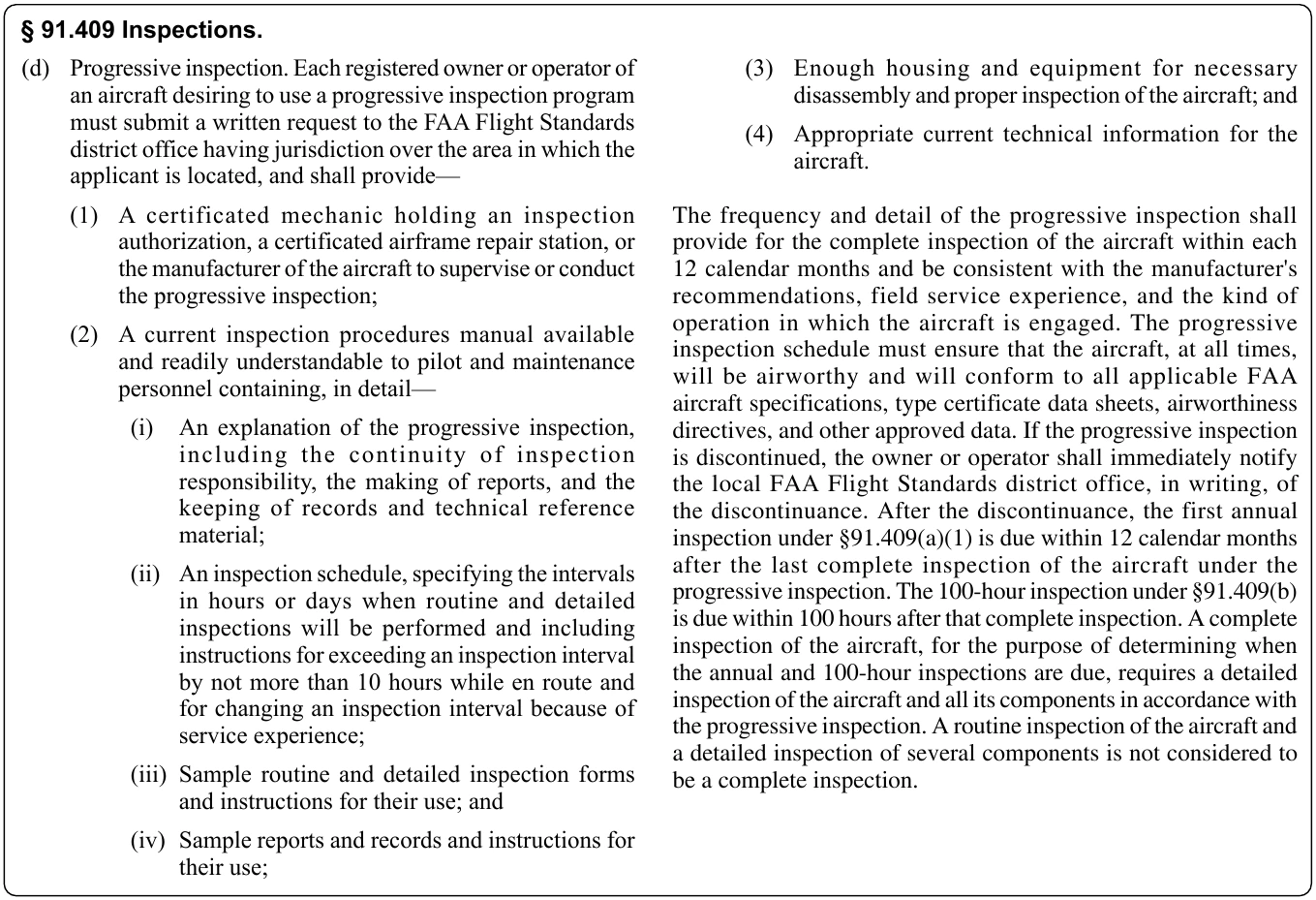
Each registered owner or operator of an aircraft desiring to use a progressive inspection program must submit a written request to the FAA Flight Standards District Office (FSDO) having jurisdiction over the area that the applicant is located. Section 91.409(d) of 14 CFR part 91 establishes procedures to be followed for progressive inspections. [Figure 10-3]
Continuous Inspections
Continuous inspection programs are similar to progressive inspection programs, except that they apply to large or turbine-powered aircraft and are therefore more complicated. Like progressive inspection programs, they require approval by the FAA Administrator. The approval may be sought based upon the type of operation and the CFR parts that the aircraft is operated under. The maintenance program for commercially operated aircraft must be detailed in the approved operations specifications (OpSpecs) of the commercial certificate holder.
Airlines utilize a continuous maintenance program that includes both routine and detailed inspections. However, the detailed inspections may include different levels of detail. Often referred to as “checks,” the A-checks, B-checks, C-checks, and D-checks involve increasing levels of detail. A-checks are the least comprehensive and occur frequently. D-checks, on the other hand, are extremely comprehensive, involving major disassembly, removal, overhaul, and inspection of systems and components. They might occur only three to six times during the service life of an aircraft.
Altimeter & Transponder Inspections
Aircraft that are operated in controlled airspace under instrument flight rules (IFR) must have each altimeter and static system tested in accordance with procedures described in 14 CFR part 43, Appendix E, within the preceding 24 calendar months. Aircraft having an air traffic control (ATC) transponder must also have each transponder checked within the preceding 24 months. All these checks must be conducted by appropriately certified individuals.
Air Transport Association iSpec 2200
In an effort to standardize the format in which maintenance information is presented in aircraft maintenance manuals, Air Transport Association (now Airlines for America)issued specifications for Manufacturers’ Technical Data. The original specification was called ATA Spec 100. Over the years, Spec 100 has been continuously revised and updated. Eventually, ATA Spec 2100 was developed for electronic documentation. These two specifications evolved into one document called ATA iSpec 2200, developed and managed by the ATA e-Business Program, a consensus-based industry standards organization administered by Airlines for America (A4A). As a result of this standardization, maintenance technicians can always find information regarding a particular system in the same section of an aircraft maintenance manual, regardless of manufacturer. For example, if seeking information about the electrical system on any aircraft, that information is always found in section (chapter) 24.
The ATA iSpec 2200 divides the aircraft into systems, such as air conditioning, that covers the basic air conditioning system (ATA 21). Numbering in each major system provides an arrangement for breaking the system down into several subsystems. [Figure 10-4] Late model aircraft, both over and under the 12,500-pound designation, have their parts manuals and maintenance manuals arranged according to the ATA-coded system. The following abbreviated table of ATA System, Subsystem, and Titles is included for familiarization purposes.
Keep in mind that not all aircraft have all these systems installed. Small and simple aircraft have fewer systems than larger, more complex aircraft.
Special Inspections
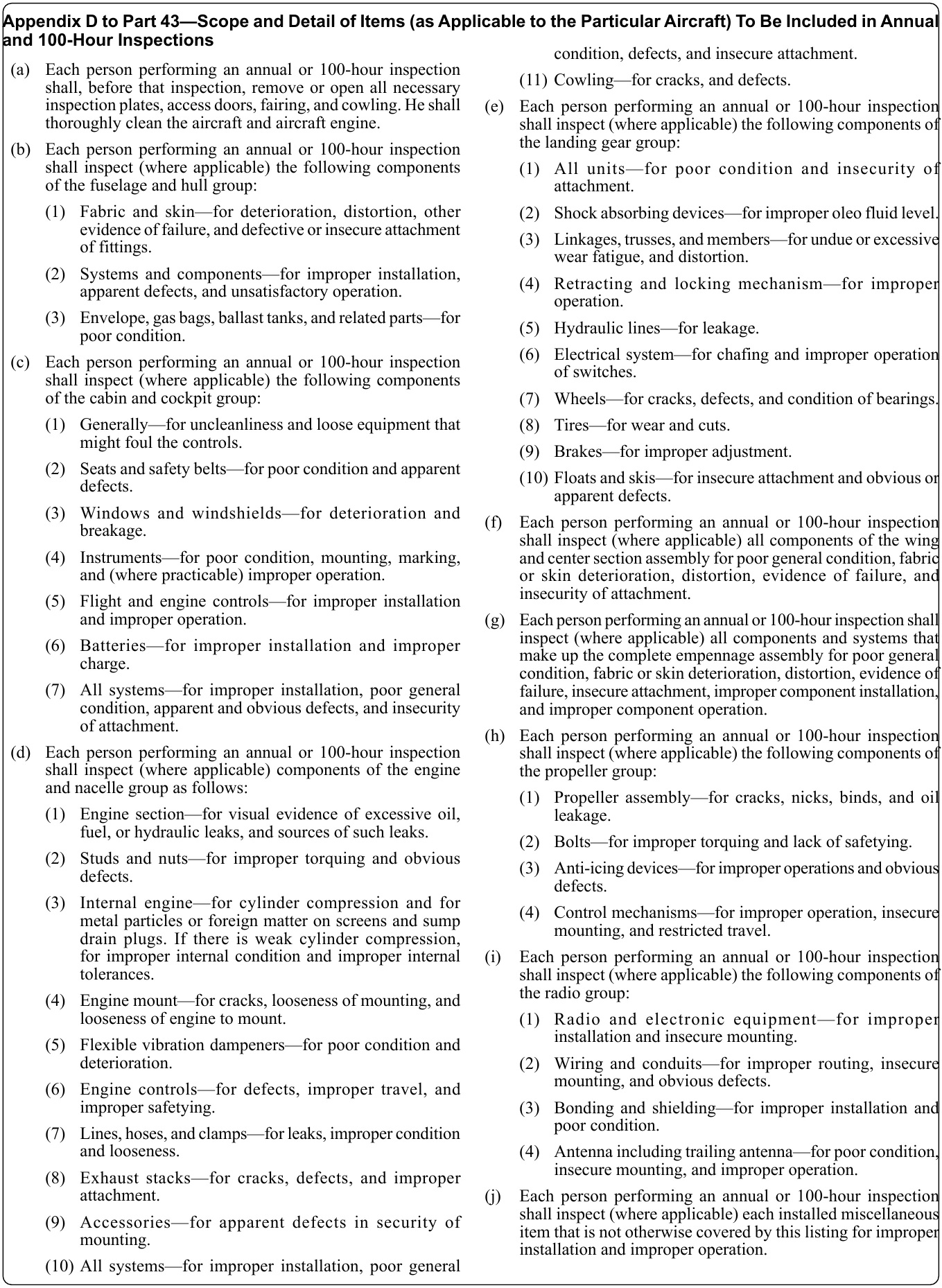
During the service life of an aircraft, occasions may arise when something out of the ordinary care and use of an aircraft could possibly affect its airworthiness. When these situations are encountered, special inspection procedures, also called conditional inspections, are followed to determine if damage to the aircraft structure has occurred. The procedures of items (as applicable to the particular aircraft) to be included in performing any of these special inspections, always follow the detailed procedures in the aircraft maintenance manual. In situations where the manual does not adequately address the situation, seek advice from other maintenance technicians who are highly experienced with them. The following paragraphs describe some typical types of special inspections.
Hard or Overweight Landing Inspection
The structural stress induced by a landing depends not only upon the gross weight at the time, but also upon the severity of impact. The hard landing inspection is for hard landings at or below the maximum design landing limits. An overweight landing inspection must be performed when an airplane lands at a weight above the maximum design landing weight. However, because of the difficulty in estimating vertical velocity at the time of contact, it is hard to judge whether or not a landing has been sufficiently severe to cause structural damage. For this reason, a special inspection is performed after a landing is made at a weight known to exceed the design landing weight or after a rough landing, even though the latter may have occurred when the aircraft did not exceed the design landing weight.
Wrinkled wing skin is the most easily detected sign of an excessive load having been imposed during a landing. Another indication easily detected is fuel leakage along riveted seams. Other possible locations of damage are spar webs, bulkheads, nacelle skin and attachments, firewall skin, and wing and fuselage stringers. If none of these areas show adverse effects, it is reasonable to assume that no serious damage has occurred. If damage is detected, a more extensive inspection and alignment check may be necessary.
Severe Turbulence Inspection/Over “G”
When an aircraft encounters a gust condition, the airload on the wings exceeds the normal wingload supporting the aircraft weight. The gust tends to accelerate the aircraft while its inertia acts to resist this change. If the combination of gust velocity and airspeed is too severe, the induced stress can cause structural damage.
A special inspection is performed after a flight through severe turbulence. Emphasis is placed upon inspecting the upper and lower wing surfaces for excessive buckles or wrinkles with permanent set. Where wrinkles have occurred, remove a few rivets and examine the rivet shanks to determine if the rivets have sheared or were highly loaded in shear.