
Chapter 2
Regulations, Maintenance Forms, Records, & Publications
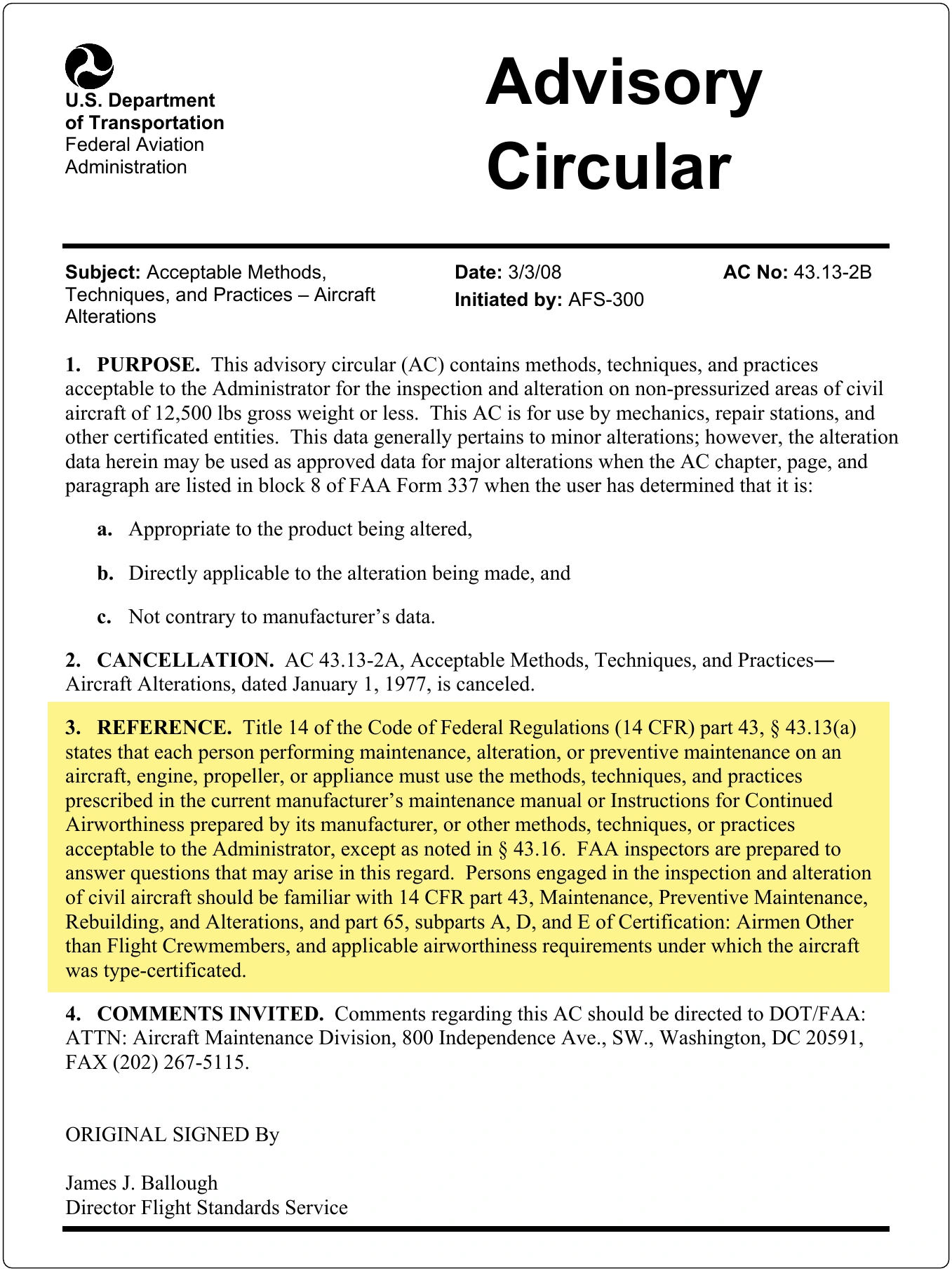
Aircraft maintenance technicians (AMTs) are highly skilled personnel, because aviation maintenance work requires great attention to detail. The complexity of technology on today’s aircraft demands a significant level of communication to properly accomplish maintenance, preventive maintenance, rebuilding, or alteration. This communication frequently comes in written form (i.e., manufacturer’s maintenance manuals or ICA). If neither of these documents provide the guidance the technician needs to perform maintenance, either AC 43.13 (AC 43.13-1 or AC 43.13-2) contain examples of “other methods, techniques, or practices acceptable to the Administrator” that may be sufficient. However, these ACs specifically state that the information is applicable to non-pressurized areas of civil aircraft weighing 12,500 lb gross weight or less.
In addition to the documentation, the technician must also use the proper tools, equipment, and test apparatus that ensures that the work complies with accepted industry practices. If the test equipment specified by the manufacturer is not available, equipment that is determined to be equivalent and acceptable to the Administrator may be used. The technician should be cautious, however, as “proving” the equivalence of test equipment may not be as simple as it seems.
Air carriers (commercial—“scheduled” airlines operating under 14 CFR part 121, the “commuter/on demand” aircraft operating under 14 CFR part 135, and foreign air carriers and operators of U.S.-registered aircraft under 14 CFR part 129) may use the maintenance manual required by the operations specifications to comply with the requirements of this section. The operator must provide a continuous airworthiness maintenance and inspection program acceptable to the Administrator.
Section 43.15—Additional Performance Rules for Inspections
This section presents general comments concerning the responsibility of conducting an inspection and then provides details of three separate conditions. They are rotorcraft, annual and 100-hour inspections, and progressive inspections.
- Rotorcraft—If a rotorcraft is being inspected, specific items, such as rotor transmissions and drive shafts, must be inspected.
- Annual and 100-hour inspections—When performing an annual or 100-hour inspection, a checklist must be used. This checklist may be a personal one or one from the manufacturer. Either way, it must include the scope and detail of the inspection in Appendix D. Specific engine performance is also required to be tested (or monitored) as part of RTS for an annual or 100-hour inspection. This applies whether the aircraft is reciprocating or turbine powered.
- Progressive inspection—If a progressive inspection is being conducted, it must be preceded by a complete aircraft inspection. (Note: A progressive inspection is the result of breaking down the large task of conducting a major inspection into smaller tasks that can be accomplished periodically without taking the aircraft out of service for an extended period of time.) Two new definitions are also presented: “routine” and “detailed.” A routine inspection is a visual examination or check of the item, but no disassembly is required. A detailed inspection is a thorough examination of the item, including disassembly. The overhaul of a component is considered to be a detailed inspection. If the aircraft is away from the station where inspections are normally conducted, an appropriately rated mechanic, a certificated repair station, or the manufacturer of the aircraft may perform inspections in accordance with the procedures and using the forms of the person who would otherwise perform the inspection.
Section 43.16—Airworthiness Limitations The technician performing inspection or maintenance actions on an aircraft must be certain they have all appropriate data available. Each person performing an inspection or other maintenance specified in an Airworthiness Limitations section of a manufacturer's maintenance manual or Instructions for Continued Airworthiness shall perform the inspection or other maintenance in accordance with that section, or in accordance with operations specifications approved by the Administrator under part 121 or 135, or an inspection program approved under 14 CFR part 91, section 91.409(e). ICAs, as required by 14 CFR part 21, section 21.50, must also be consulted when available. Since 1998, the FAA has required ICAs to be generated for all major alterations that are accomplished by the field approval process. This section specifies that the technician is responsible to perform inspections or maintenance specified in an airworthiness limitation in accordance with all the preceding instructions.
Section 43.17—Maintenance, preventive maintenance, or alterations performed on U.S. aeronautical products by certain Canadian persons
This section was significantly revised in 2005, as the result of a Bilateral Aviation Safety Agreement (BASA) between the United States and Canada. This section of 14 CFR part 43 defines some terms and gives specific limitations as to what an Aircraft Maintenance Engineer (AME is the Canadian equivalent to the U.S. A&P) may do to maintain U.S.-registered aircraft located in Canada. It also provides similar limitations for an Approved Maintenance Organization. (AMO is the Canadian equivalent to the U.S.-certified repair stations.)
Appendix A—Major Alterations, Major Repairs, and Preventive Maintenance
This appendix provides a comprehensive, but not exclusive, list of subjects. For instance, paragraph (a) is titled Major Alteration, and is further subdivided as follows:
- Airframe
- Powerplant
- Propeller
- Appliance
This same subdivision is used in paragraph (b), Major Repairs. Paragraph (c), Preventive Maintenance, identifies those maintenance actions that are defined as preventive maintenance, provided the maintenance does not involve complex assembly operations. Preventive maintenance work may be accomplished by the holder of at least a private pilot certificate provided they are the owner or operator of that aircraft, and it is not operated under 14 CFR part 121, 129, or 135.
Appendix B—Recording of Major Repairs and Major Alterations
In most cases when a major repair or alteration is accomplished, FAA Form 337, Major Repair or Alteration, is completed at least in duplicate with the original going to the aircraft owner and a copy sent to the FAA Aircraft Registration Branch in Oklahoma City where all civil aircraft information is compiled and retained. Note: Historically, the second copy was sent to the local FAA FSDO within 48 hours after RTS. This copy is reviewed by an ASI and then forwarded by the FSDO to FAA records in Oklahoma City. However, in the fall of 2005, the FAA made a significant change to this submittal process and now requires the technician to submit the Form 337 directly to the Aircraft Registration Branch in Oklahoma City. Although a third copy is not required, it makes good business sense for the technician or certified repair station to keep a copy of the work that was accomplished.
However, if a certificated (part 145) repair station completes a major repair, it may provide the customer with a signed copy of the work order and a maintenance release signed by an authorized representative of the repair station, instead of the FAA Form 337. If the major repair or alteration was done by an AME or AMO, the copy normally provided to the FAA-FSDO is sent directly to the FAA Aircraft Registration Branch.
However, if extended range tanks are installed in either passenger or cargo compartments, the technician must generate a third FAA Form 337 for the modification. This copy must be placed and retained in the aircraft. (Refer to 14 CFR part 91, section 91.417(d).)
Appendix C—(Reserved)
Appendix C is reserved for future use and therefore currently contains no information.