Chapter 2
Regulations, Maintenance Forms, Records, & Publications
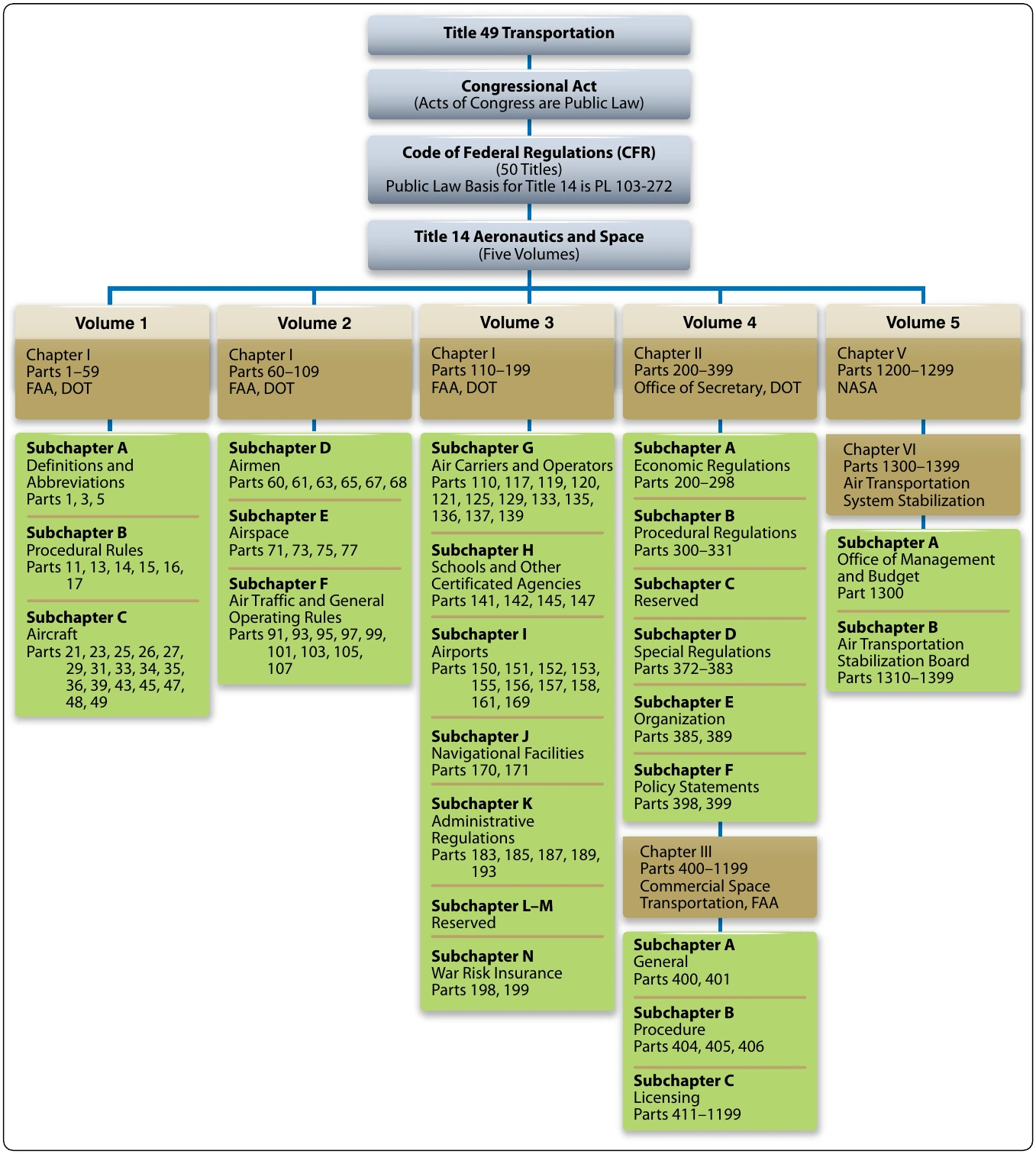
This section is a very comprehensive, but certainly not all inclusive, list of definitions that both pilots and mechanics must become familiar with. Many regulations often provide additional definitions that are unique to their use and interpretation in that specific part. Title 14 CFR part 1, section 1.2, Abbreviations and Symbols, tends to be highly focused on those abbreviations related to flight.
14 CFR Part 21—Certification Procedures for Products and Articles
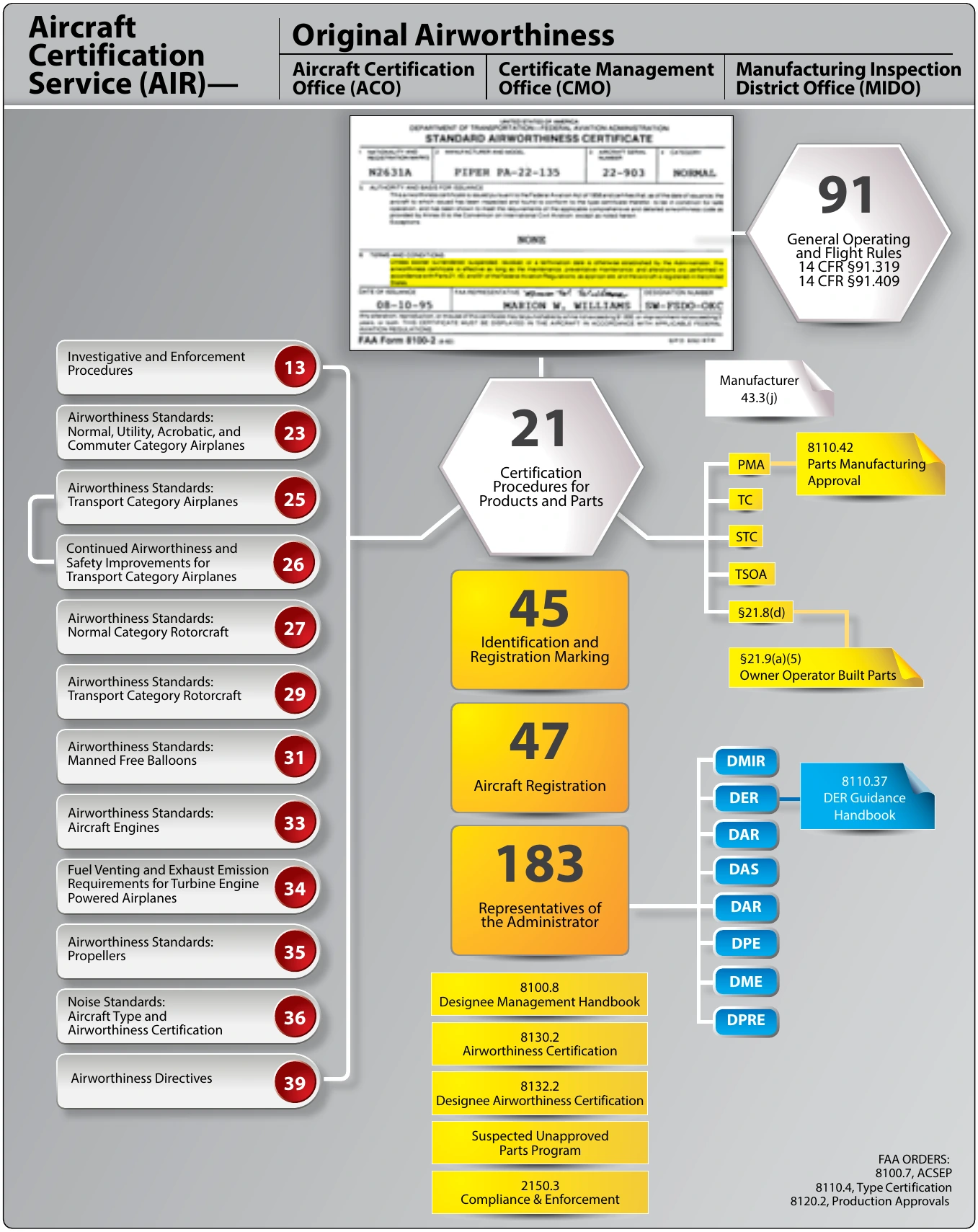
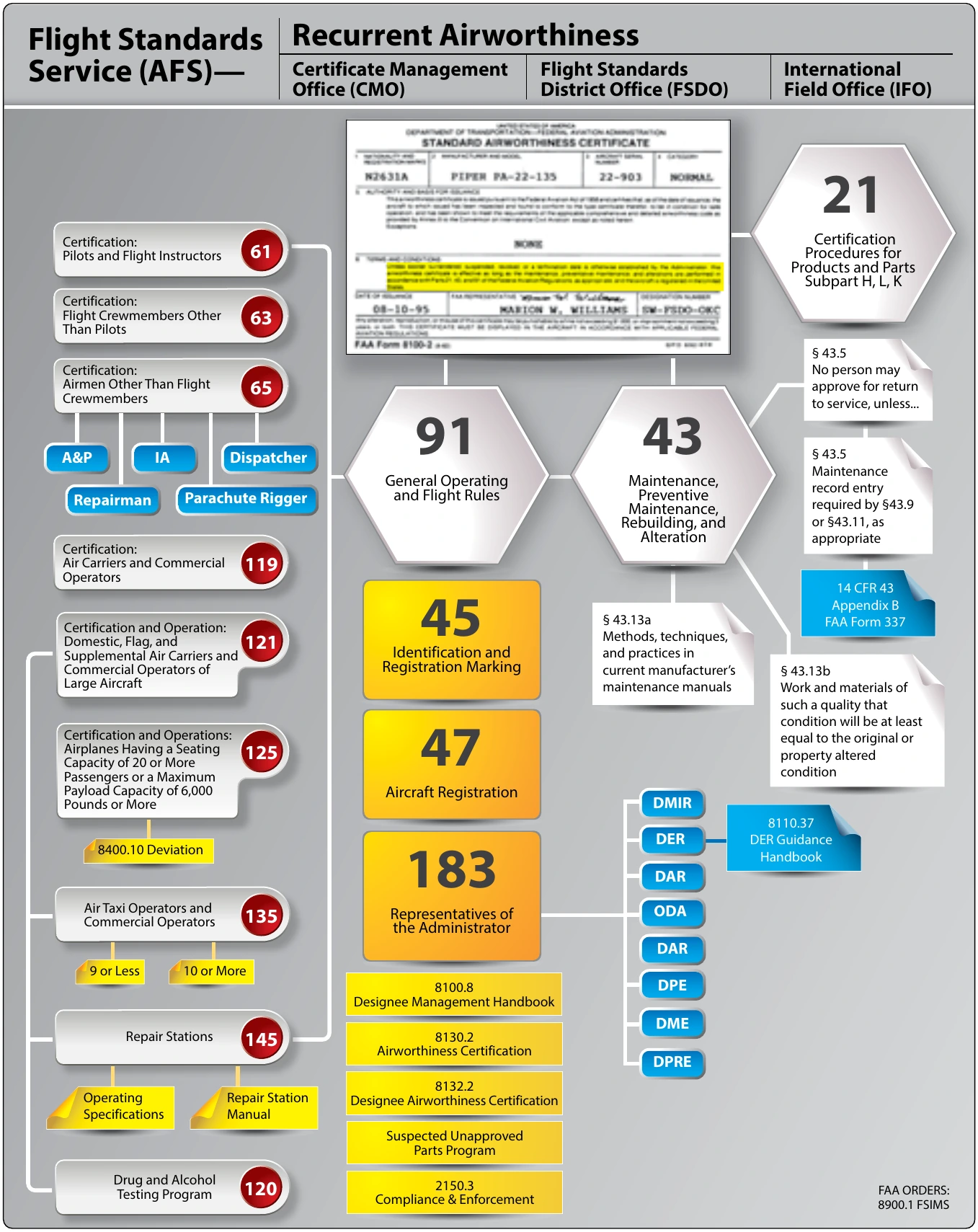
This regulation, the first of the three, identifies the requirements of and the procedures for obtaining type other major areas covered in this part are the procedures for obtaining a Part Manufacture Approval (PMA) or an authorization related to producing a Technical Standard Order (TSO) part. Note that part 21’s greatest significance is in the original airworthiness phase, although it has minor application in recurrent airworthiness. [Figure 2-5] One of the most important sections of this regulation is section 21.50, “Instructions for continued airworthiness and manufacturer’s maintenance manuals having airworthiness limitations sections.” When an aircraft is delivered new from the manufacturer, it comes with maintenance manuals that define the inspection and maintenance actions necessary to maintain the aircraft in airworthy condition. Also, any STC modification that was developed after 1981 must have, as part of the STC documentation, a complete set of instructions for continued airworthiness (ICA). This ICA contains inspection and maintenance information intended to be used by the technician in maintaining that part of the aircraft that has been altered since it was new. This ICA is comprised of 16 specific subjects. [Figure 2-7] An ICA developed in accordance with this checklist should be acceptable to the Aviation Safety Inspector (ASI) reviewing a major alteration.
14 CFR Part 23—Airworthiness Standards: Normal, Utility, Acrobatic, and Commuter Category Airplanes
Aircraft certificated under 14 CFR part 23 represent the greatest portion of what the industry refers to as “general aviation.” These aircraft vary from the small two-place piston engine, propeller-driven trainers that are frequently used for flight training, to turbine-powered corporate jets used to transport business executives. Seating capacity is limited to nine or less on all aircraft, except the commuter aircraft where the maximum passenger seating is 19, excluding the pilot and copilot seats.
This part specifies the airworthiness standards that must Part 23 aircraft are those aircraft that have a maximum certificated takeoff weight of 12,500 pounds or less, except for those aircraft in the commuter category. The maximum certificated takeoff weight limit rises to 19,000 pounds or less for these aircraft.
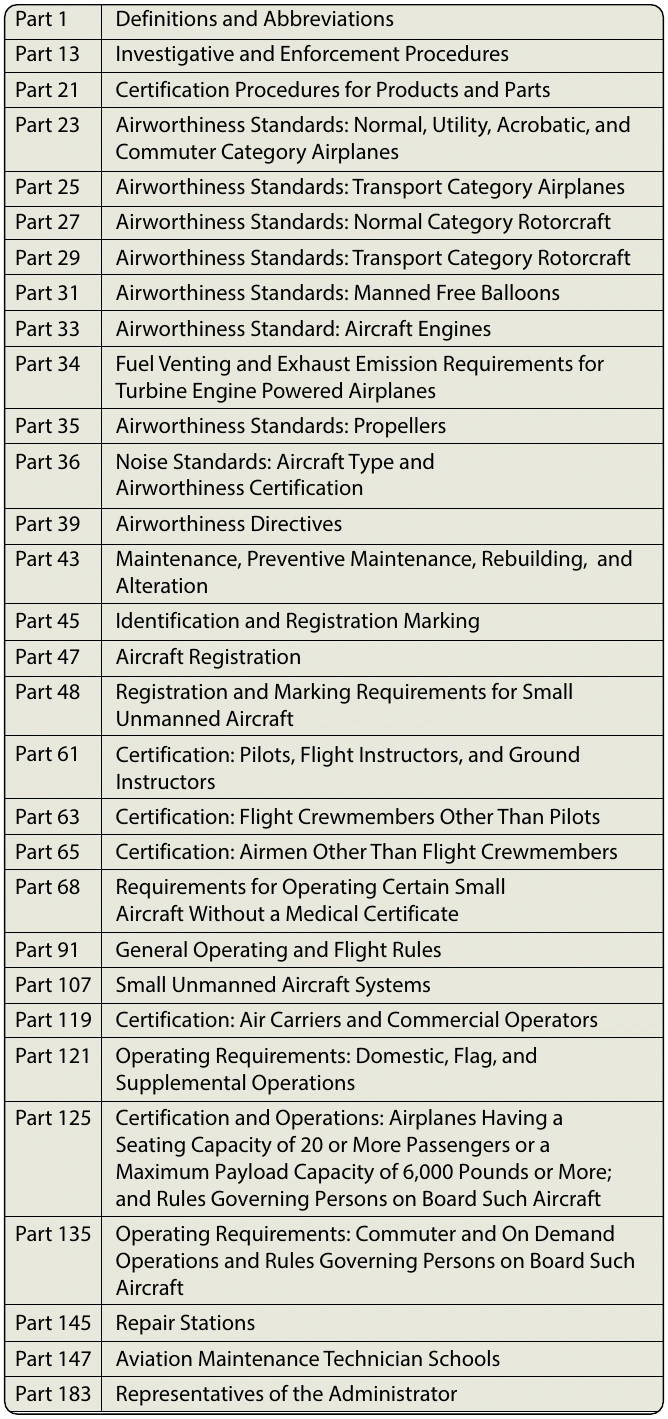
Part 23 has seven subparts, six of them providing detailed criteria for the design of these aircraft. The first, subpart A, defines the applicability of this regulation. The others are:
- Subpart B—Flight
- Subpart C—Structures
- Subpart D—Design and Construction
- Subpart E—Powerplant
- Subpart F—Equipment
- Subpart G—Flightcrew Interface and Other Information
Within each of these subparts are numerous sections that specify details, such as center of gravity (CG), gust load factors, removable fasteners, the shape of certain flight deck controls, engine and propeller requirements, fuel tank markings, flight deck instrumentation marking and placards, cabin aisle width, and flammability resistant standards.
14 CFR Part 25—Airworthiness Standards: Transport Category Airplanes
The standards in 14 CFR part 25 apply to large aircraft with a maximum certificated takeoff weight of more than 12,500 pounds. This segment of aviation is usually referred to as “commercial aviation” and includes most of the aircraft seen at a large passenger airport, except for the commuter aircraft included in 14 CFR part 23. However, the ability to carry passengers is not a requirement for aircraft certified to 14 CFR part 25. Many of these aircraft are also used to transport cargo. This chapter is subdivided into similar design subpart categories and the same sequence as the requirements specified in 14 CFR part 23.
14 CFR Part 27—Airworthiness Standards: Normal Category Rotorcraft
This regulation deals with the small rotor wing aircraft and is consistent with 14 CFR part 23 with limiting the passenger seating to nine or less. However, the maximum certificated weight is limited to 7,000 pounds. It contains similar design subparts identified in 14 CFR part 23 that provide the details for designing the aircraft.
14 CFR Part 29—Airworthiness Standards: Transport Category Rotorcraft
This section specifies those standards applicable to helicopters with a maximum certified weight greater than 7,000 pounds. However, it also includes additional parameters based upon seating capacity and an additional weight limit. Those parameters are passenger seating, (nine or less, ten or more) and whether the helicopter is over or under a maximum weight of 20,000 pounds. The design subparts of part 29 are similar to those in 14 CFR parts 23, 25, and 27.