
Chapter 2
Regulations, Maintenance Forms, Records, & Publications
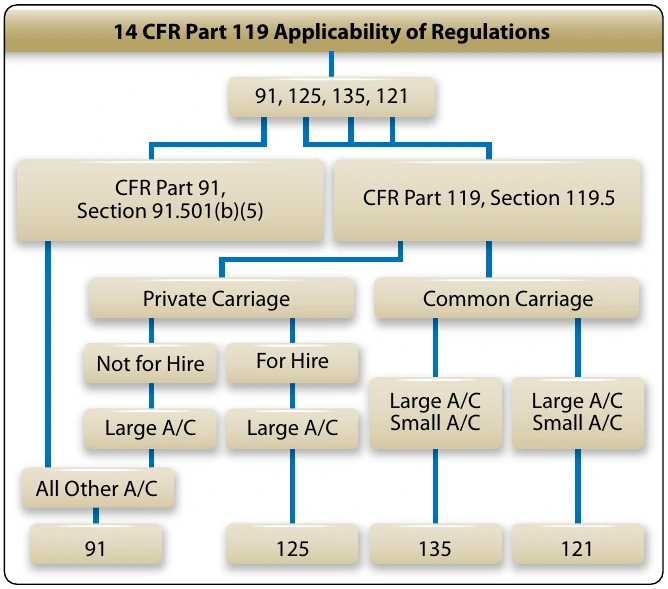
The determination of whether the aircraft is large or small is based upon the definition provided in 14 CFR part 1. If the aircraft has maximum certificated takeoff weight of 12,500 pounds or more, it is a large aircraft. All aircraft less than 12,500 maximum certificated takeoff weight are considered to be small aircraft.
It may also help the reader understand when 14 CFR parts 121, 125, and 135 regulations apply, by taking a brief look at a list of flight operations where 14 CFR part 119 does not apply.
- Student instruction
- Nonstop sightseeing flights with less than 30 seats and less than 25 nautical miles (NM) from the departure airport
- Ferry or training flights
- Crop dusting or other agricultural operations
- Banner towing
- Aerial photography or surveying
- Fire fighting
- Powerline or pipeline patrol
- Parachute operations on nonstop flights within 25 NM from the departure airport
- Fractional ownership in accordance with 14 CFR part 91, subpart K
14 CFR Part 121—Operating Requirements: Domestic, Flag, and Supplemental Operations
Title 14 CFR part 121 establishes the operational rules for air carriers flying for compensation or hire. A domestic operation is any scheduled operation (within the 48 contiguous states, the District of Columbia, or any territory or possession) conducted with either a turbo-jet aircraft, an airplane having 10 or more passenger seats, or a payload capacity greater than 7,500 pounds.
A “flag” operation means any scheduled operation (operating in Alaska or Hawaii to any point outside of those states, or to any territory or possession of the United States, or from any point outside the United States to any point outside the United States) conducted with either a turbo-jet aircraft, an airplane having 10 or more passenger seats, or a payload capacity greater than 7,500 pounds.
“Supplemental” operation means any common carriage operation conducted with airplanes having more than 30 passenger seats (if less than 30, the airplane must also be listed on the operations specifications of domestic and flag carriers), with a payload capacity of more than 7,500 pounds.
Part 121 operators are required by 14 CFR part 119 to have the following personnel:
- Director of Safety
- Director of Operations
- Director of Maintenance
- Chief Pilot
- Chief Inspector
There are 28 subparts and 16 appendices in this regulation. However, only subparts J and L are of concern for the mechanic. Subpart J—Maintenance, Preventive Maintenance, and Alterations, identifies Special Airworthiness Requirements that deals with many of the mechanical aspects of a passenger or cargo aircraft. Subpart L—Maintenance, Preventive Maintenance, and Alterations, requires that a part 121 operator have an operational manual that contains the following information:
- Organizational chart
- List of individuals who may perform required inspections
- Company maintenance, preventive maintenance, or alterations
- A system to both preserve and retrieve maintenance and inspection related information
Also, 14 CFR part 121, section 121.1105, establishes the requirement for conducting inspections on aging aircraft.
14 CFR Part 125—Certification and Operations: Airplanes Having a Seating Capacity of 20 or More Passengers or a Maximum Payload Capacity of 6,000 Pounds or More; and Rules Governing Persons on Board Such Aircraft
This regulation applies to private and noncommon carriage when such operations are conducted in airplanes having 20 or more seats (excluding crewmembers) or having a payload capacity of 6,000 pounds or more. There must also be “operations specifications” issued to the operator that include the following information:
- Kinds of operations authorized
- Types of aircraft and registration numbers of the airplanes authorized for use
- Approval of the provisions of the operator’s manual relating to airplane inspections, together with the necessary conditions and limitations
- Registration numbers of the airplanes that are to be inspected under an approved airplane inspection program (AAIP) under 14 CFR part 125, section 125.247
- Procedures for the control of weight and balance of airplanes
- Any other item that the administrator determines is necessary
Just as in 14 CFR part 121, subpart E identifies special airworthiness requirements dealing mostly with the mechanical devices of the aircraft.