
Chapter 7
Aircraft Materials, Hardware, & Processes
Carbon steel must be cooled to below 1,000 °F in less than 1 second when hardening. Should the time required for the temperature to drop to 1,000 °F exceed 1 second, the austenite begins to transform into fine pearlite. This pearlite varies in hardness, but is much harder than the pearlite formed by annealing and much softer than the martensite desired. After the 1,000 °F temperature is reached, the rapid cooling must continue if the final structure is to be all martensite.
The time limit for the temperature drop to 1,000 °F increases above the 1 second limit for carbon steels when alloys are added to steel. Therefore, a slower quenching medium produces hardness in alloy steels.
Because of the high internal stresses in the “as quenched” condition, steel must be tempered just before it becomes cold. The part should be removed from the quenching bath at a temperature of approximately 200 °F, since the temperature range from 200 °F down to room temperature is the cracking range.
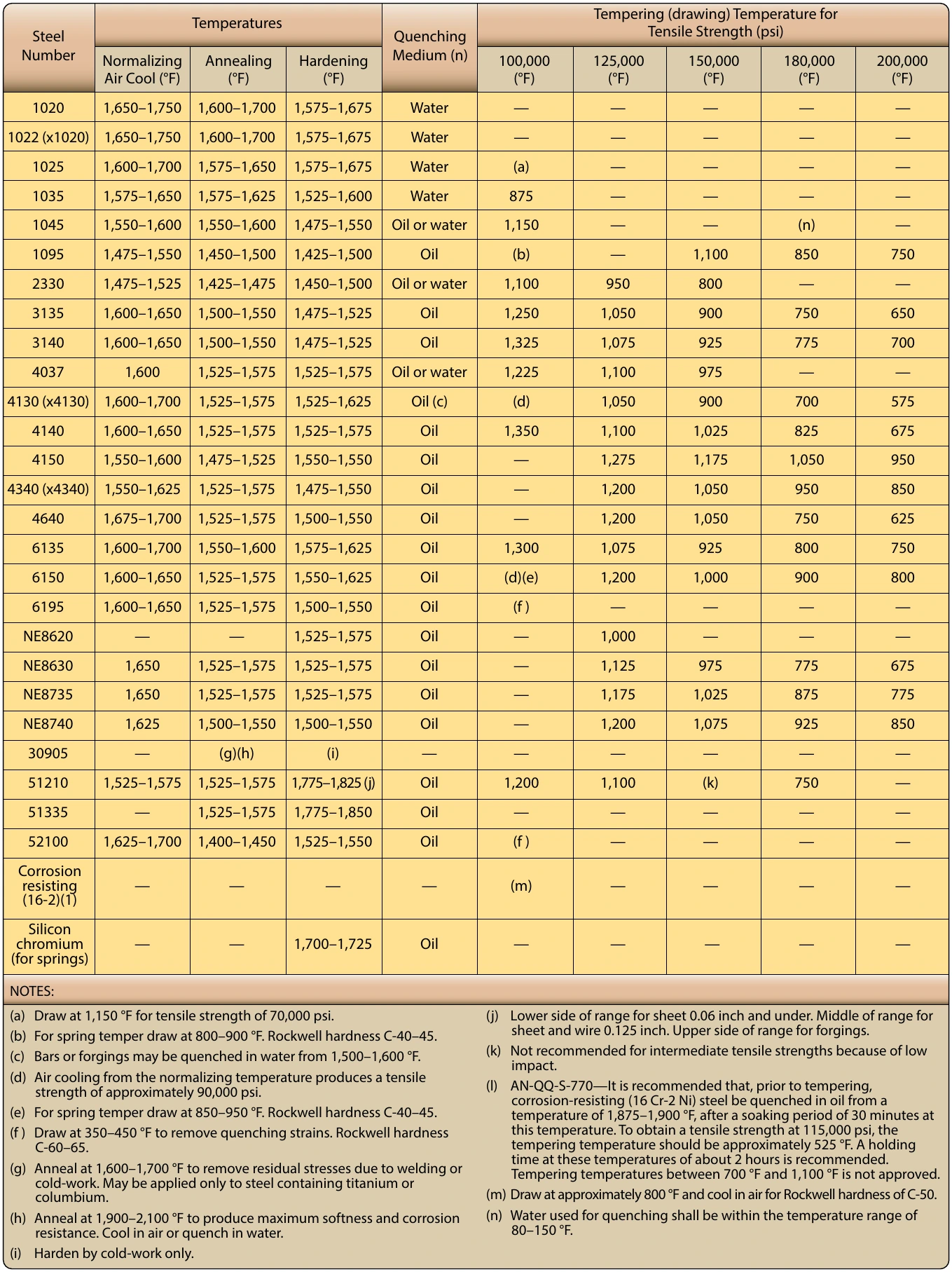
Hardening temperatures and quenching mediums for the various types of steel are listed in Figure 7-6.
Hardening Precautions
A variety of different shapes and sizes of tongs for handling hot steels is necessary. It should be remembered that cooling of the area contacted by the tongs is retarded and that such areas may not harden, particularly if the steel being treated is very shallow hardening. Small parts may be wired together or quenched in baskets made of wire mesh.
Special quenching jigs and fixtures are frequently used to hold steels during quenching in a manner to restrain distortion.
When selective hardening is desired, covering with alundum cement or some other insulating material may protect portions of the steel. Selective hardening may be accomplished by using water or oil jets designed to direct quenching medium on the areas to be hardened. This also is accomplished by the induction and flame hardening procedures previously described, particularly on large production jobs.
Shallow hardening steels, such as plain carbon and certain varieties of alloy steels, have such a high critical cooling rate that they must be quenched in brine or water to effect hardening. In general, intricately-shaped sections should not be made of shallow hardening steels because of the tendency of these steels to warp and crack during hardening. Such items should be made of deeper hardening steels capable of being hardened by quenching in oil or air.
Tempering
Tempering reduces the brittleness imparted by hardening and produces definite physical properties within the steel. Tempering always follows, never precedes, the hardening operation. In addition to reducing brittleness, tempering softens the steel.
Tempering is always conducted at temperatures below the low critical point of the steel. In this respect, tempering differs from annealing, normalizing, or hardening, all of which require temperatures above the upper critical point. When hardened steel is reheated, tempering begins at 212 °F and continues as the temperature increases toward the low critical point. By selecting a definite tempering temperature, the resulting hardness and strength can be predetermined. Approximate temperatures for various tensile strengths are listed in Figure 7-6. The minimum time at the tempering temperature should be 1 hour. If the part is over one inch in thickness, increase the time by 1 hour for each additional inch of thickness. Tempered steels used in aircraft work have from 125,000 to 200,000 psi ultimate tensile strength.
Generally, the rate of cooling from the tempering temperature has no effect on the resulting structure; therefore, the steel is usually cooled in still air after being removed from the furnace.
Annealing
Annealing of steel produces a fine-grained, soft, ductile metal without internal stresses or strains. In the annealed state, steel has its lowest strength. In general, annealing is the opposite of hardening.
Heating the metal to just above the upper critical point, soaking at that temperature, and cooling very slowly in the furnace accomplishes annealing of steel. (Refer to Figure 7-6 for recommended temperatures.) Soaking time is approximately 1 hour per inch of thickness of the material. To produce maximum softness in steel, the metal must be cooled very slowly. Slow cooling is obtained by shutting off the heat and allowing the furnace and metal to cool together to 900 °F or lower, then removing the metal from the furnace and cooling in still air. Another method is to bury the heated steel in ashes, sand, or other substance that does not conduct heat readily.
Normalizing
The normalizing of steel removes the internal stresses set up by heat-treating, welding, casting, forming, or machining. Stress, if not controlled, leads to failure. Because of the better physical properties, aircraft steels are often used in the normalized state, but seldom, if ever, in the annealed state.
One of the most important uses of normalizing in aircraft work is in welded parts. Welding causes strains to be set up in the adjacent material. In addition, the weld itself is a cast structure as opposed to the wrought structure of the rest of the material. These two types of structures have different grain sizes, and to refine the grain as well as to relieve the internal stresses, all welded parts should be normalized after fabrication.