
Chapter 7
Aircraft Materials, Hardware, & Processes
Reinforced plastic components of aircraft are formed of either solid laminates or sandwich-type laminates. Resins used to impregnate glass cloths are of the contact pressure type (requiring little or no pressure during cure). These resins are supplied as a liquid, which can vary in viscosity from water like consistency to thick syrup. Cure or polymerization is affected by the use of a catalyst, usually benzoyl peroxide.
Solid laminates are constructed of three or more layers of resin impregnated cloths “wet laminated” together to form a solid sheet facing or molded shape.
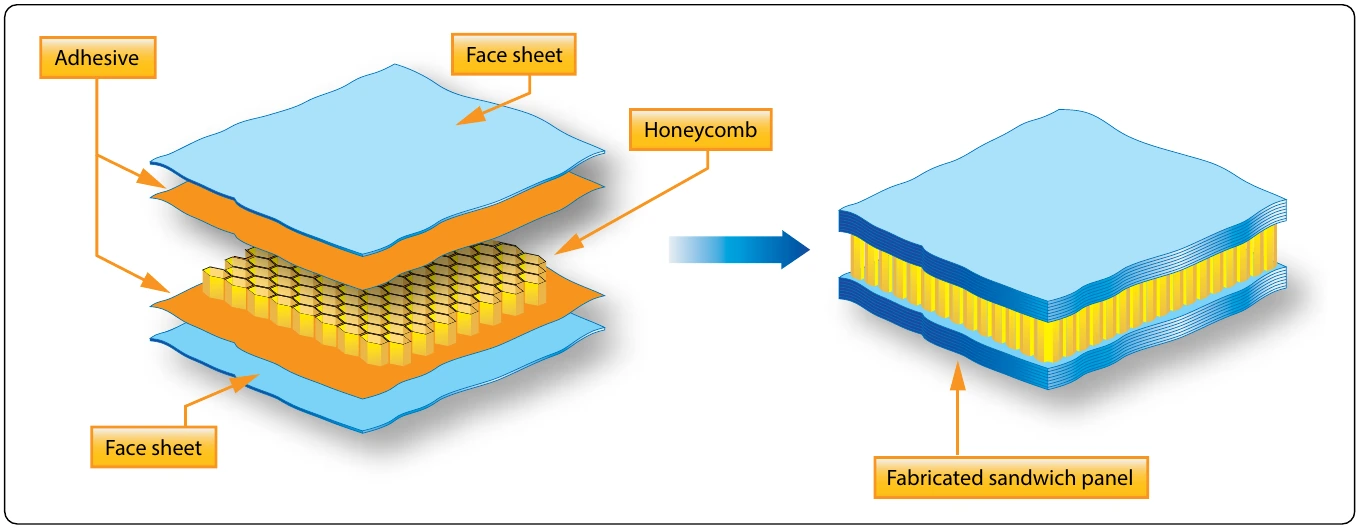
Sandwich-type laminates are constructed of two or more solid sheet facings or a molded shape enclosing a fiberglass honeycomb or foam-type core. Honeycomb cores are made of glass cloths impregnated with polyester or a combination of nylon and phenolic resins. The specific density and cell size of honeycomb cores varies over considerable latitude. Honeycomb cores are normally fabricated in blocks that are later cut to the desired thickness on a band saw.
Foam-type cores are formulated from combinations of alkyd resins and metatoluene di-isocyanate. Sandwich-type fiberglass components filled with foam-type cores are manufactured to exceedingly close tolerances on overall thickness of the molded facing and core material. To achieve this accuracy, the resin is poured into a close tolerance, molded shape. The resin formulation immediately foams up to fill the void in the molded shape and forms a bond between the facing and the core.
Rubber
Rubber is used to prevent the entrance of dirt, water, or air, and to prevent the loss of fluids, gases, or air. It is also used to absorb vibration, reduce noise, and cushion impact loads. The term “rubber” is as all-inclusive as the term “metal.” It is used to include not only natural rubber, but also all synthetic and silicone rubbers.
Natural Rubber
Natural rubber has better processing and physical properties than synthetic or silicone rubber. These properties include flexibility, elasticity, tensile strength, tear strength, and low heat buildup due to flexing (hysteresis). Natural rubber is a general-purpose product; however, its suitability for aircraft use is somewhat limited because of its inferior resistance to most influences that cause deterioration. Although it provides an excellent seal for many applications, it swells and often softens in all aircraft fuels and in many solvents (naphthas and so forth). Natural rubber deteriorates more rapidly than synthetic rubber. It is used as a sealing material for water/methanol systems.
Synthetic Rubber
Synthetic rubber is available in several types, each of which is compounded of different materials to give the desired properties. The most widely used are the butyls, Bunas, and neoprene.
Butyl is a hydrocarbon rubber with superior resistance to gas permeation. It is also resistant to deterioration; however, its comparative physical properties are significantly less than those of natural rubber. Butyl resists oxygen, vegetable oils, animal fats, alkalies, ozone, and weathering.
Like natural rubber, butyl swells in petroleum or coal tar solvents. It has a low water absorption rate and good resistance to heat and low temperature. Depending on the grade, it is suitable for use in temperatures ranging from −65 °F to 300 °F. Butyl is used with phosphate ester hydraulic fluids (Skydrol™), silicone fluids, gases, ketones, and acetones.
Buna-S rubber resembles natural rubber both in processing and performance characteristics. Buna-S is as water resistant as natural rubber, but has somewhat better aging characteristics. It has good resistance to heat, but only in the absence of severe flexing. Generally, Buna-S has poor resistance to gasoline, oil, concentrated acids, and solvents. Buna-S is normally used for tires and tubes as a substitute for natural rubber.
Buna-N is outstanding in its resistance to hydrocarbons and other solvents; however, it has poor resilience in solvents at low temperature. Buna-N compounds have good resistance to temperatures up to 300 °F and may be procured for low temperature applications down to −75 °F. Buna-N has fair tear, sunlight, and ozone resistance. It has good abrasion resistance and good breakaway properties when used in contact with metal. When used as a seal on a hydraulic piston, it does not stick to the cylinder wall. Buna-N is used for oil and gasoline hoses, tank linings, gaskets, and seals.
Neoprene can take more punishment than natural rubber and has better low-temperature characteristics. It possesses exceptional resistance to ozone, sunlight, heat, and aging. Neoprene looks and feels like rubber. Neoprene, however, is less like rubber in some of its characteristics than butyl or Buna. The physical characteristics of neoprene, such as tensile strength and elongation, are not equal to natural rubber but do have a definite similarity. Its tear resistance, as well as its abrasion resistance, is slightly less than that of natural rubber. Although its distortion recovery is complete, it is not as rapid as natural rubber.
Neoprene has superior resistance to oil. Although it is good material for use in nonaromatic gasoline systems, it has poor resistance to aromatic gasoline. Neoprene is used primarily for weather seals, window channels, bumper pads, oil resistant hose, and carburetor diaphragms. It is also recommended for resistance to deterioration but ranks the lowest in physical properties. Petroleum, hydrocarbons, esters, alcohols, gasoline, or water, in general, does not seriously affect Thiokols. Thiokols are ranked low in such physical properties as compression set, tensile strength, elasticity, and tear abrasion resistance. Thiokol is used for oil hoses, tank linings for aromatic aviation gasoline, gaskets, and seals.
Silicone rubbers are a group of plastic rubber materials made from silicon, oxygen, hydrogen, and carbon. The silicones have excellent heat stability and very low temperature flexibility. They are suitable for gaskets, seals, or other applications where elevated temperatures up to 600 °F are prevalent. Silicone rubbers are also resistant to temperatures down to −150 °F. Throughout this temperature range, silicone rubber remains extremely flexible and useful with no hardness or gumminess. Although this material has good resistance to oils, it reacts unfavorably to both aromatic and nonaromatic gasoline.
Silastic, one of the best-known silicones, is used to insulate electrical and electronic equipment. Because of its dielectric properties over a wide range of temperatures, it remains flexible and free from crazing and cracking. Silastic is also used for gaskets and seals in certain oil systems.