
Chapter 7
Aircraft Materials, Hardware, & Processes
Steel containing carbon in percentages ranging from 0.30 to 0.50 percent is classed as medium carbon steel. This steel is especially adaptable for machining or forging and where surface hardness is desirable. Certain rod ends and light forgings are made from SAE 1035 steel.
Steel containing carbon in percentages ranging from 0.50 to 1.05 percent is classed as high carbon steel. The addition of other elements in varying quantities adds to the hardness of this steel. In the fully heat-treated condition, it is very hard, withstands high shear and wear, and has little deformation. It has limited use in aircraft. SAE 1095 in sheet form is used for making flat springs and in wire form for making coil springs.
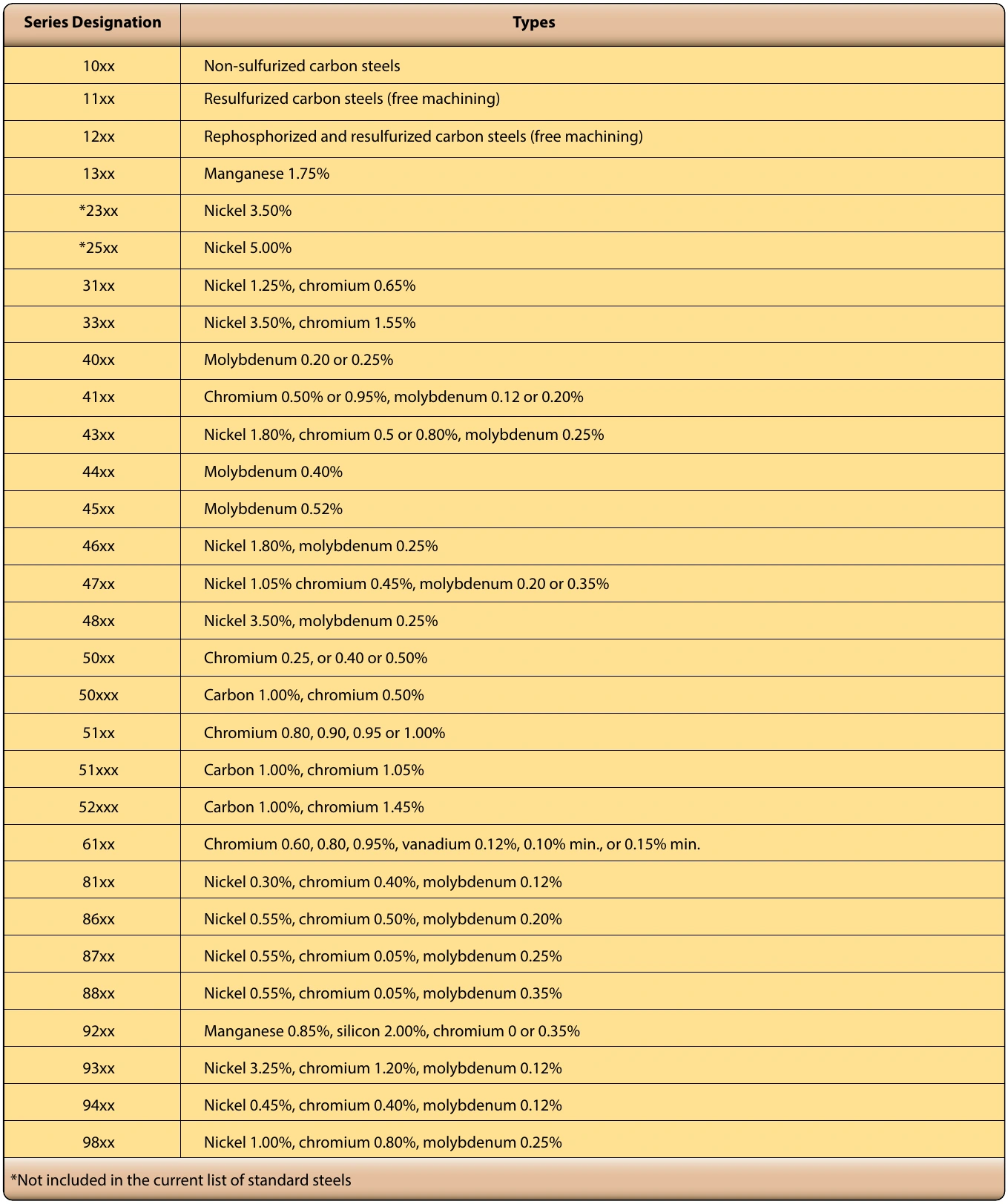
The various nickel steels are produced by combining nickel with carbon steel. Steels containing from 3 to 3.75 percent nickels are commonly used. Nickel increases the hardness, tensile strength, and elastic limit of steel without appreciably decreasing the ductility. It also intensifies the hardening effect of heat-treatment. SAE 2330 steel is used extensively for aircraft parts, such as bolts, terminals, keys, clevises, and pins.
Chromium steel is high in hardness, strength, and corrosion-resistant properties and is particularly adaptable for heat-treated forgings, which require greater toughness and strength than may be obtained in plain carbon steel. It can be used for articles such as the balls and rollers of antifriction bearings. Chrome-nickel or stainless steels are the corrosion resistant metals. The anticorrosive degree of this steel is determined by the surface condition of the metal, as well as by the composition, temperature, and concentration of the corrosive agent. The principal alloy of stainless steel is chromium. The corrosion resistant steel most often used in aircraft construction is known as 18-8 steel because its content is 18 percent chromium and 8 percent nickel. One of the distinctive features of 18-8 steel is that cold-working may increase its strength.
Stainless steel may be rolled, drawn, bent, or formed to any shape. Because these steels expand about 50 percent more than mild steel and conduct heat only about 40 percent as rapidly, they are more difficult to weld. Stainless steel can be used for almost any part of an aircraft. Some of its common applications are the fabrication of exhaust collectors, stacks and manifolds, structural and machined parts, springs, castings, tie rods, and control cables.
The chrome-vanadium steels are made of approximately 18 percent vanadium and about 1 percent chromium. When heat-treated, they have strength, toughness, and resistance to wear and fatigue. A special grade of this steel in sheet form can be cold formed into intricate shapes. It can be folded and flattened without signs of breaking or failure. SAE 6150 is used for making springs; chrome-vanadium with high carbon content, SAE 6195, is used for ball and roller bearings.
Molybdenum in small percentages is used in combination with chromium to form chrome-molybdenum steel, which has various uses in aircraft. Molybdenum is a strong alloying element. It raises the ultimate strength of steel without affecting ductility or workability. Molybdenum steels are tough and wear resistant, and they harden throughout when heat-treated. They are especially adaptable for welding and, for this reason, are used principally for welded structural parts and assemblies. This type steel has practically replaced carbon steel in the fabrication of fuselage tubing, engine mounts, landing gears, and other structural parts. For example, a heat-treated SAE X4130 tube is approximately four times as strong as an SAE 1025 tube of the same weight and size.
A series of chrome-molybdenum steel most used in aircraft construction is that series containing 0.25 to 0.55 percent carbon, 0.15 to 0.25 percent molybdenum, and 0.50 to 1.10 percent chromium. These steels, when suitably heat-treated, are deep hardening, easily machined, readily welded by either gas or electric methods, and are especially adapted to high temperature service.
Inconel is a nickel-chromium-iron alloy closely resembling stainless steel (corrosion resistant steel (CRES)) in appearance. Aircraft exhaust systems use both alloys interchangeably. Because the two alloys look very much alike, a distinguishing test is often necessary. One method of identification is to use an electrochemical technique, as described in the following paragraph, to identify the nickel (Ni) content of the alloy. Inconel has nickel content greater than 50 percent, and the electrochemical test detects nickel.
The tensile strength of Inconel is 100,000 pounds per square qualities like those of corrosion resistant steels.
Electrochemical Test
Prepare a wiring assembly as shown in Figure 7-2, and prepare the two reagents (ammonium fluoride and dimethylglyoxime solutions) placing them in separate dedicated dropper solution bottles. Before testing, you must thoroughly clean the metal for the electrolytic deposit to take place. You may use nonmetallic hand scrubbing pads or 320–600 grit “crocus cloth” to remove deposits and corrosion products (thermal oxide).
Connect the alligator clip of the wiring assembly to the bare metal being tested. Place one drop of a 0.05 percent reagent grade ammonium fluoride solution in deionized water on the center of a 1 inch × 1 inch sheet of filter paper. Lay the moistened filter paper over the bare metal alloy being tested. Firmly press the end of the aluminum rod over the center of the moist paper. Maintain connection for 10 seconds while rocking the aluminum rod on the filter paper. Ensure that the light emitting diode (LED) remains lit (indicating good electrical contact and current flow) during this period. Disconnect the wiring assembly and set it aside. Remove the filter paper and examine it to determine that a light spot appears where the connection was made.
Deposit one drop of 1.0 percent solution of reagent grade dimethylglyoxime in ethyl alcohol on the filter paper (same side that was in contact with the test metal). A bright, distinctly pink spot will appear within seconds on the filter paper if the metal being tested is Inconel. A brown spot will appear if the test metal is stainless steel. Some stainless-steel alloys may leave a very light pink color. However, the shade and depth of color will be far less than would appear for Inconel. For flat surfaces, the test spot will be circular while for curved surfaces, such as the outside of a tube or pipe, the test spot may appear as a streak. (Refer to Figure 7-3 for sample test results.) This procedure should not be used in the heat-affected zone of weldments or on nickel coated surfaces.
Nonferrous Aircraft Metals
The term “nonferrous” refers to all metals that have elements other than iron as its base or principal constituent. This group includes metals, such as aluminum, titanium, copper, and magnesium, as well as alloyed metals, such as Monel and Babbitt.
Aluminum & Aluminum Alloys
Commercially pure aluminum is a white lustrous metal, which stands second in the scale of malleability, sixth in ductility, and ranks high in its resistance to corrosion. Aluminum combined with various percentages of other metals forms alloys, which are used in aircraft construction. Aluminum alloys with principal alloying ingredients are manganese, chromium, or magnesium and silicon show little attack in corrosive environments. Alloys with which substantial percentages of copper are more susceptible to corrosive action. The total percentage of alloying elements is seldom more than 6 or 7 percent in the wrought alloys.
Aluminum is one of the most widely used metals in modern aircraft construction. It is vital to the aviation industry because of its high strength-to-weight ratio and its comparative ease of fabrication. The outstanding characteristic of aluminum is its lightweight. Aluminum melts at the comparatively low temperature of 1,250 °F. It is nonmagnetic and is an excellent conductor.