
Chapter 7
Aircraft Materials, Hardware, & Processes
The protective coating on a rivet is identified by its color. A rivet coated with zinc chromate is yellow, an anodized surface is pearl gray, and the metal sprayed rivet is identified by a silvery gray color. If a situation arises in which a protective coating must be applied on the job, paint the rivet with zinc chromate before it is used and again after it is driven.
Identification
Markings on the heads of rivets are used to classify their characteristics. These markings may be either a raised teat, two raised teats, a dimple, a pair of raised dashes, a raised cross, a single triangle, or a raised dash; some other heads have no markings.
The different markings indicate the composition of the rivet stock. As explained previously, the rivets have different colors to identify the manufacturers’ protective surface coating.
Roundhead rivets are used in the interior of the aircraft, except where clearance is required for adjacent members. The roundhead rivet has a deep, rounded top surface. The head is large enough to strengthen the sheet around the hole and, at the same time, resists tension.
The flathead rivet, like the roundhead rivet, is used on interior structures. It is used where maximum strength is needed and where there is not sufficient clearance to use a roundhead rivet. It is seldom, if ever, used on external surfaces. The brazier head rivet has a head of large diameter, which makes it particularly adaptable for riveting thin sheet stock (skin). The brazier head rivet offers only slight resistance to the airflow, and because of this factor, it is frequently used for riveting skin on exterior surfaces, especially on aft sections of the fuselage and empennage. It is used for riveting thin sheets exposed to the slipstream. A modified brazier head rivet is also manufactured; it is simply a brazier head of reduced diameter.
The universal head rivet is a combination of the roundhead, flathead, and brazier head. It is used in aircraft construction and repair in both interior and exterior locations. When replacement is necessary for protruding head rivets— roundhead, flathead, or brazier head—they can be replaced by universal head rivets.
The countersunk head rivet is flat topped and beveled toward the shank so that it fits into a countersunk or dimpled hole and is flush with the material’s surface. The angle at which the head slopes may vary from 78° to 120°. The 100° rivet is the most commonly used type. These rivets are used to fasten sheets over which other sheets must fit. They are also used on exterior surfaces of the aircraft, because they offer only slight resistance to the slipstream and help to minimize turbulent airflow.
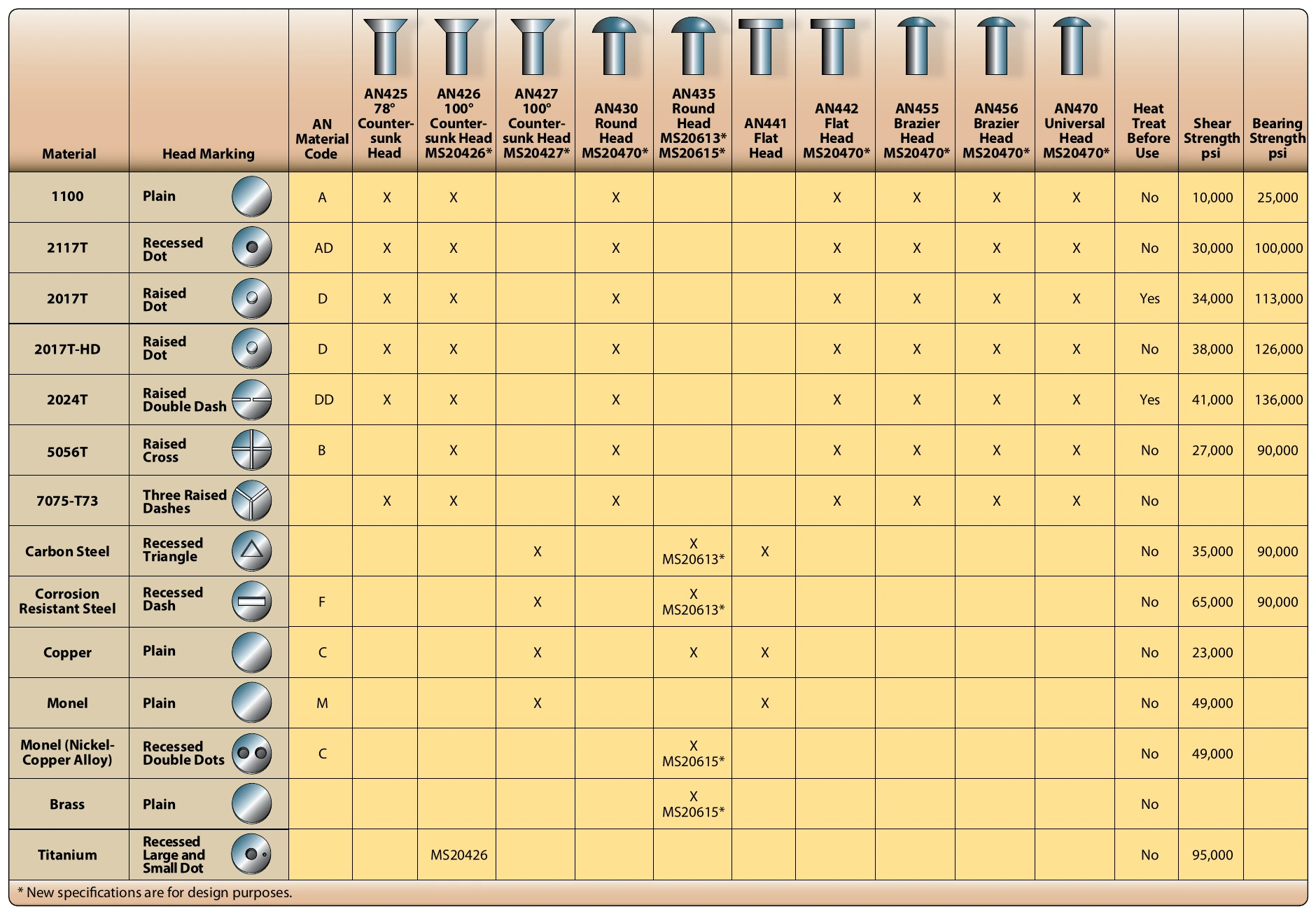
The markings on the heads of rivets indicate the material of which they are made and, therefore, their strength. Figure 7-37 identifies the rivet head markings and the materials indicated by them. Although there are three materials indicated by a plain head, it is possible to distinguish their difference by color. The 1100 is an aluminum color; the mild steel is a typical steel color; and the copper rivet is a copper color. Any head marking can appear on any head style of the same material.
A part number identifies each type of rivet so that the user can select the correct rivet for the job. The type of rivet head is identified by AN or MS standard numbers. The numbers selected are in series and each series represents a particular type of head.
The most common numbers and the types of heads they represent are:
AN426 or MS20426—countersunk head rivets (100°)
AN430 or MS20430—roundhead rivets
AN441—flathead rivets
AN456—brazier head rivets
AN470 or MS20470—universal head rivets
There are also letters and numbers added to a part number. The letters designate alloy content; the numbers designate rivet diameter and length. The letters in common uses for alloy designation are:
A—Aluminum alloy, 1100 or 3003 composition
AD—Aluminum alloy, 2117-T composition D—Aluminum alloy, 2017-T composition