
Chapter 2
Engine Fuel & Fuel Metering Systems
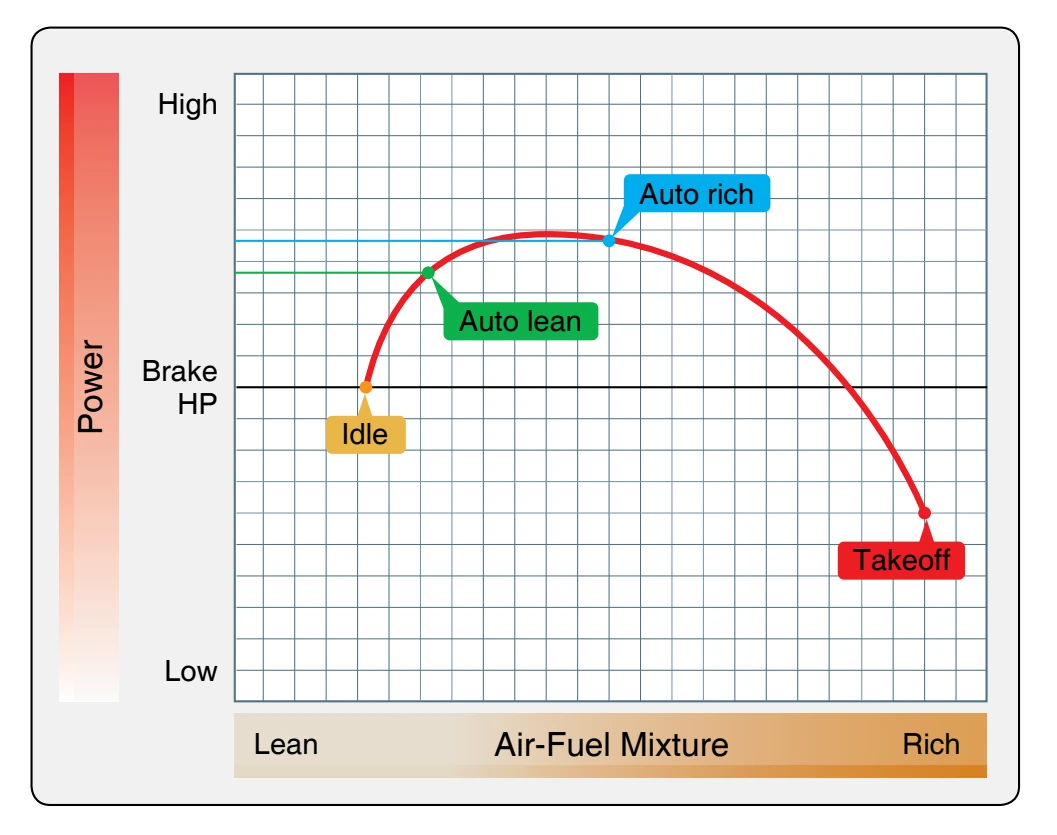
The rich mixture requirements for an aircraft engine are established by running a power curve to determine the airfuel mixture for obtaining maximum usable power. This curve is plotted at 100 rpm intervals from idle speed to
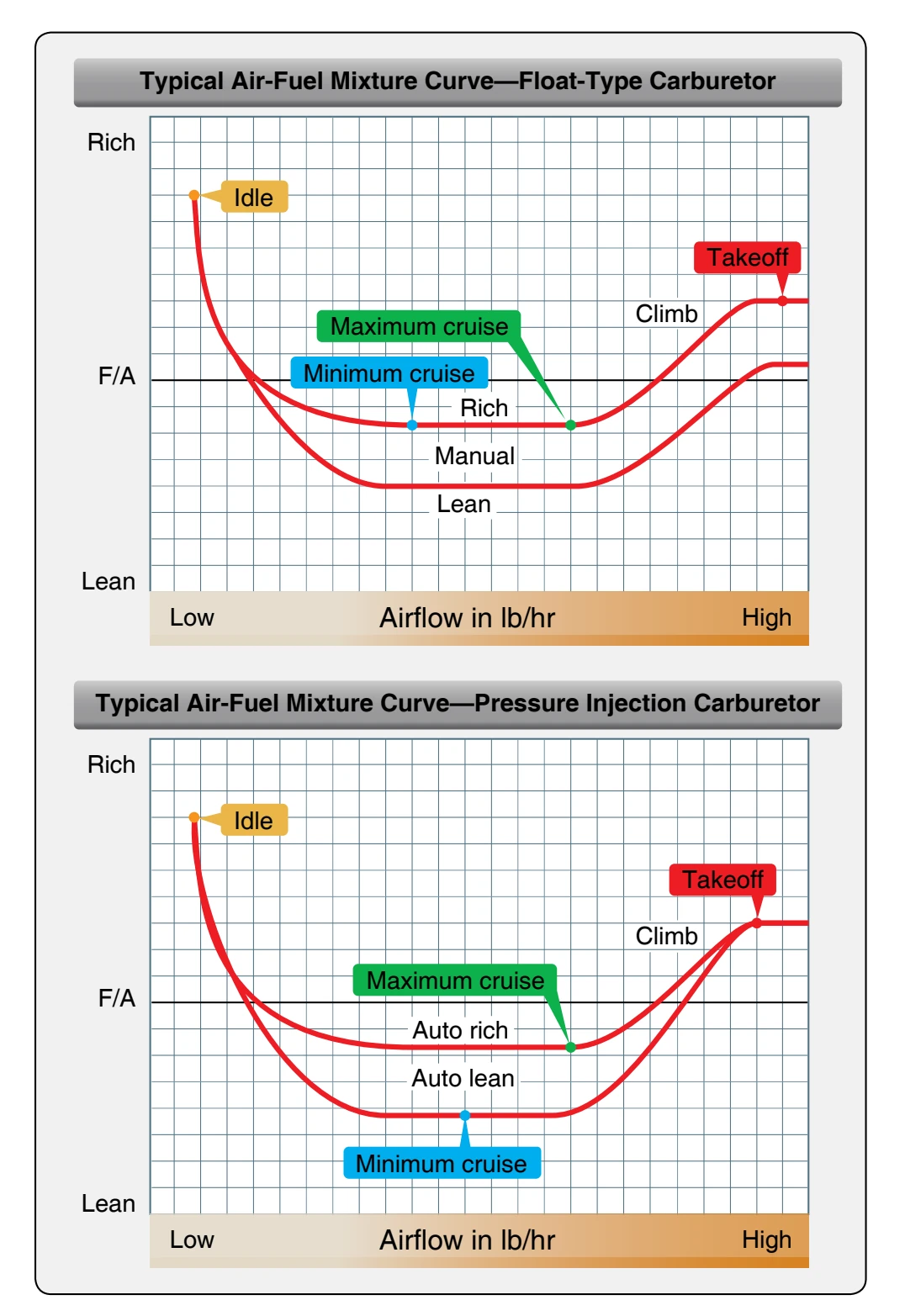
takeoff speed. [Figure 2-2] Since it is necessary in the power range to add fuel to the basic air-fuel mixture requirements to keep cylinder-head temperatures in a safe range, the fuel mixture must become gradually richer as powers above cruise are used. [Figure 2-1] In the power range, the engine runs on a much leaner mixture, as indicated in the curves. However, on the leaner mixture, cylinder-head temperature would exceed the maximum permissible temperatures and detonation would occur.
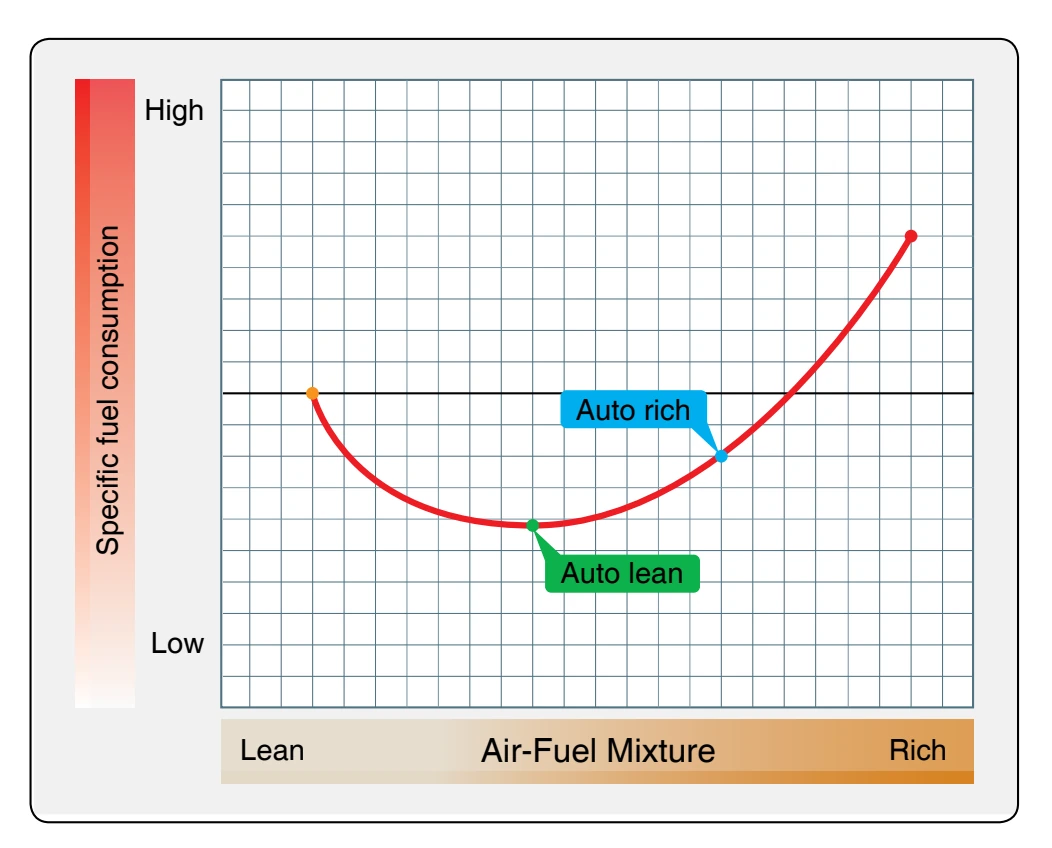
The best economy setting is established by running a series of curves through the cruise range, as shown in the graph in Figure 2-3, the low point (auto-lean) in the curve being the air-fuel mixture where the minimum fuel per horsepower is used. In this range the engine operates normally on slightly leaner mixtures and obviously operates on richer mixtures than the low-point mixture. If a mixture leaner than that specified for the engine is used, the leanest cylinder of the engine is apt to backfire because the slower burning rate of the lean mixture results in a continued burning in the cylinder when the next intake stroke starts.
Air-Fuel Mixtures
Gasoline and other liquid fuels do not burn at all unless they are mixed with air. If the mixture is to burn properly within the engine cylinder, the ratio of air to fuel must be kept within a certain range. It would be more accurate to state that the fuel is burned with the oxygen in the air. Seventy-eight percent of air by volume is nitrogen, which is inert and does not participate in the combustion process, and 21 percent is oxygen. Heat is generated by burning the mixture of gasoline and oxygen. Nitrogen and gaseous byproducts of combustion absorb this heat energy and turn it into power by expansion. The mixture proportion of fuel and air by weight is of extreme importance to engine performance. The characteristics of a given mixture can be measured in terms of flame speed and combustion temperature.
The composition of the air-fuel mixture is described by the mixture ratio. For example, a mixture with a ratio of 12 to 1 (12:1) is made up of 12 pounds of air and 1 pound of fuel. The ratio is expressed in weight because the volume of air varies greatly with temperature and pressure. The mixture ratio can also be expressed as a decimal. Thus, an air-fuel ratio of 12:1 and an air-fuel ratio of 0.083 describe the same mixture ratio. Mixtures of air and gasoline as rich as 8:1 and as lean as 16:1 will burn in an engine cylinder, but beyond these mixtures, either lean or rich blow out could occur. The engine develops maximum power with a mixture of approximately 12 parts of air and 1 part of gasoline by weight.
From a chemist’s point of view, the perfect mixture for combustion of fuel and air would be 0.067 pounds of fuel to 1 pound of air (mixture ratio of 15:1). The scientist calls this chemically correct combination a stoichiometric mixture (pronounced stoy-key-o-metric). With this mixture (given sufficient time and turbulence), all the fuel and all the oxygen in the air is completely used in the combustion process. The stoichiometric mixture produces the highest combustion temperatures because the proportion of heat released to a mass of charge (fuel and air) is the greatest. If more fuel is added to the same quantity of air charge than the amount giving a chemically perfect mixture, changes of power and temperature occur. The combustion gas temperature is lowered as the mixture is enriched, and the power increases until the air-fuel ratio is approximately 0.0725. For mixtures from 0.0725 air-fuel ratio to 0.080 air-fuel ratio, the power remains essentially constant even though the combustion temperature continues downward. Mixtures from 0.0725 air-fuel ratio to 0.080 air-fuel ratio are called best power mixtures, since their use results in the greatest power for a given airflow or manifold pressure. In this air-fuel ratio range, there is no increase in the total heat released, but the weight of nitrogen and combustion products is augmented by the vapor formed with the excess fuel. Thus, the working mass of the charge is increased. In addition, the extra fuel in the charge (over the stoichiometric mixture) speeds up the combustion process, which provides a favorable time factor in converting fuel energy into power.
If the air-fuel ratio is enriched above 0.080, there is loss of power and a reduction in temperature. The cooling effects of excess fuel overtake the favorable factor of increased mass. This reduced temperature and slower rate of burning lead to an increasing loss of combustion efficiency. If, with constant airflow, the mixture is leaned below 0.067, air-fuel ratio power and temperature decrease together. This time, the loss of power is not a liability but an asset. The purpose in leaning is to save fuel. Air is free and available in limitless quantities. The object is to obtain the required power with the least fuel flow. A measure of the economical use of fuel is called specific fuel consumption (SFC), which is the fuel weight in pounds per hour per horsepower.
Specific fuel consumption
Linear form: SFC = pounds fuel/hour / horsepower
By using this ratio, the engine’s use of fuel at various power settings can be compared. When leaning below 0.067 airfuel ratio with constant airflow, even though the power diminishes, the cost in fuel to support each horsepower hour (SFC) also is lowered. While the mixture charge is becoming weaker, this loss of strength occurs at a rate lower than that of the reduction of fuel flow. This favorable tendency continues until a mixture strength known as best economy is reached. With this air-fuel ratio, the required hp is developed with the least fuel flow or, to put it another way, the greatest power produced by a given fuel flow. The best economy air-fuel ratio varies somewhat with rpm and other conditions, but for cruise powers on most reciprocating engines, it is sufficiently accurate to define this range of operation as being from 0.060 to 0.065 air-fuel ratios on aircraft where manual leaning is practiced.
Below the best economical mixture strength, power and temperature continue to fall with constant airflow while the SFC increases. As the air-fuel ratio is reduced further, combustion becomes so cool and slow that power for a given manifold pressure gets so low as to be uneconomical. The cooling effect of rich or lean mixtures results from the excess fuel or air over that needed for combustion. Internal cylinder cooling is obtained from unused fuel when air-fuel ratios above 0.067 are used. The same function is performed by excess air when air-fuel ratios below 0.067 are used.
Varying the mixture strength of the charge produces changes in the engine operating condition affecting power, temperature, and spark-timing requirements. The best power air-fuel ratio is desirable when the greatest power from a given airflow is required. The best economy mixture results from obtaining the given power output with the least fuel flow. The air-fuel ratio which gives most efficient operation varies with engine speed and power output.
In the graph showing this variation in air-fuel ratio, note that the mixture is rich at both idling and high-speed operation and is lean through the cruising range. [Figure 2-1] At idling speed, some air or exhaust gas is drawn into the cylinder through the exhaust port during valve overlap. The mixture that enters the cylinder through the intake port must be rich enough to compensate for this gas or additional air. At cruising power, lean mixtures save fuel and increase the range of the airplane. An engine running near full power requires a rich mixture to prevent overheating and detonation. Since the engine is operated at full power for only short periods, the
high fuel consumption is not a serious matter. If an engine is operating on a mixture that is too lean, and adjustments are made to increase the amount of fuel, the power output of the engine increases rapidly at first, then gradually until maximum power is reached. With a further increase in the amount of fuel, the power output drops gradually at first, then more rapidly as the mixture is further enriched.
There are specific instructions concerning mixture ratios for each type of engine under various operating conditions. Failure to follow these instructions results in poor performance and often in damage to the engine. Excessively rich mixtures result in loss of power and waste of fuel. With the engine operating near its maximum output, very lean mixtures cause a loss of power and, under certain conditions, serious overheating. When the engine is operated on a lean mixture, the cylinder head temperature gauge should be watched closely. If the mixture is excessively lean, the engine may backfire through the induction system or stop completely. Backfire results from slow burning of the lean mixture. If the charge is still burning when the intake valve opens, it ignites the fresh mixture and the flame travels back through the combustible mixture in the induction system.