
Chapter 12
Vertical Motion and Clouds
12.1 Introduction
A cloud is a visible aggregate of minute water droplets and/or ice particles in the atmosphere above the Earth’s surface. Fog differs from clouds only in that the base of fog is at the Earth’s surface while clouds are above the surface. Clouds are like signposts in the sky that provide information on air motion, stability, and moisture. Clouds help pilots visualize weather conditions and potential weather hazards.
Clouds form in the atmosphere as a result of condensation of water vapor in rising currents of air, or by the evaporation of the lowest layer of fog. Rising currents of air are necessary for the formation of vertically deep clouds capable of producing precipitation heavier than light intensity.
12.2 Vertical Motion Effects on an Unsaturated Air Parcel
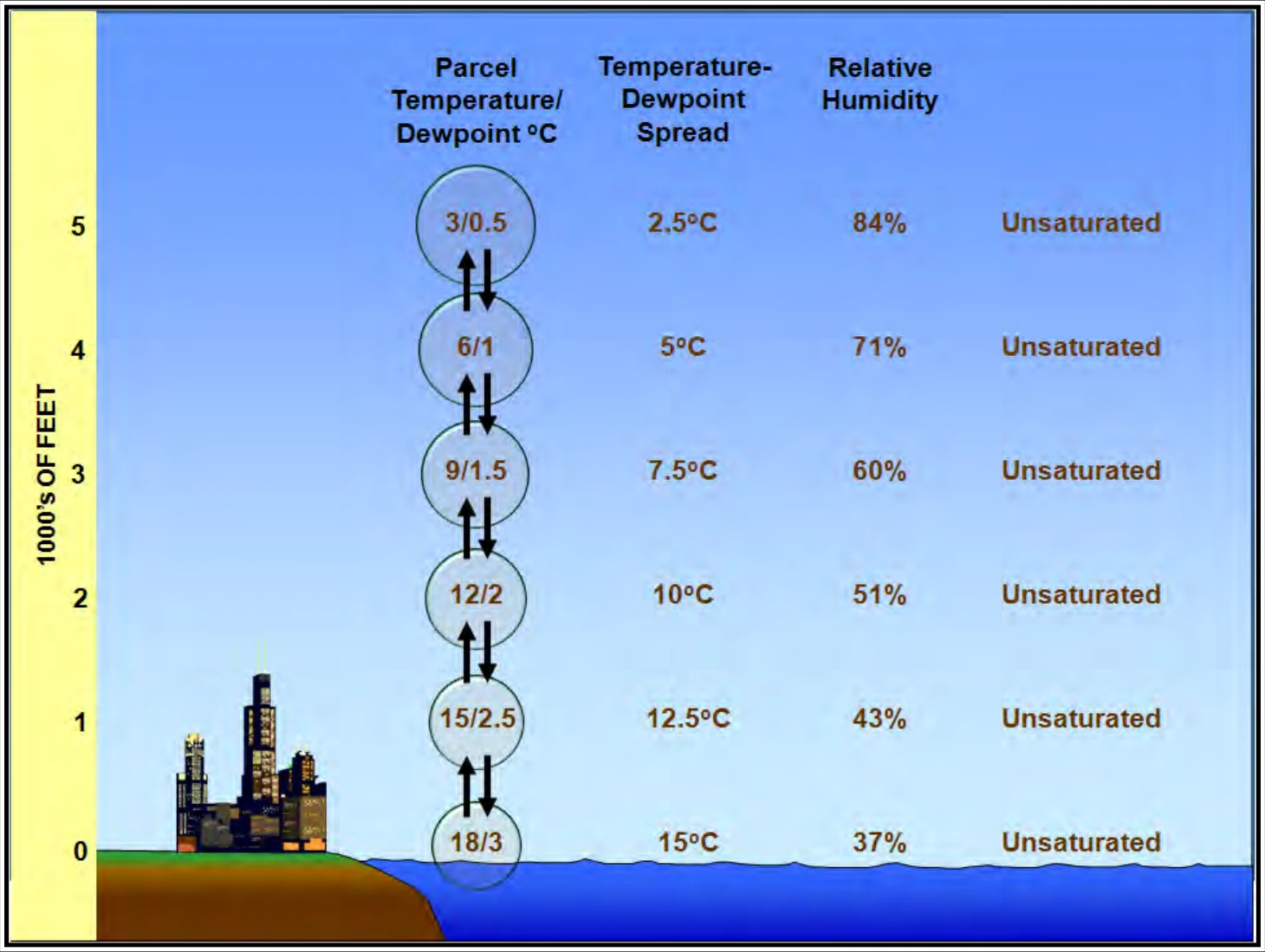
As a bubble or parcel of air ascends (rises), it moves into an area of lower pressure (pressure decreases with height). As this occurs, the parcel expands. This requires energy (or work), which takes heat away from the parcel, so the air cools as it rises (see Figure 12-1). This is called an adiabatic process. The term “adiabatic” means that no heat transfer occurs into, or out of, the parcel. Air has low thermal conductivity (see Table 5-3), so transfer of heat by conduction is negligibly small.
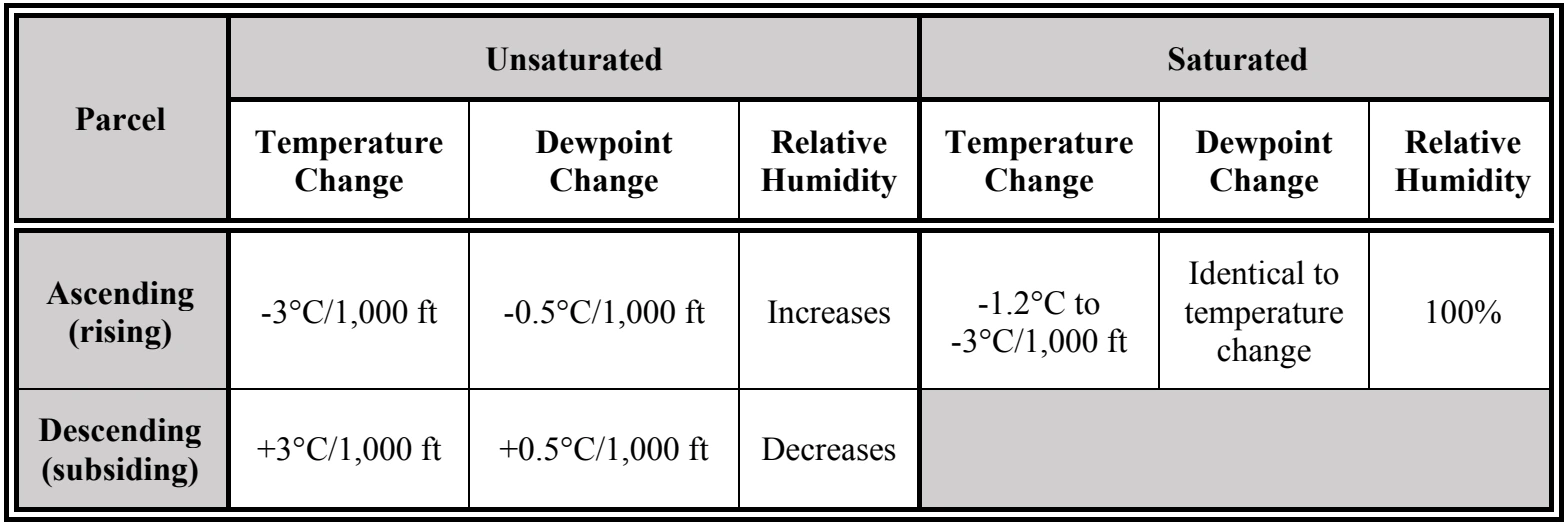
The rate at which the parcel cools as it is lifted is called the lapse rate. The lapse rate of a rising unsaturated parcel (air with relative humidity less than 100 percent) is approximately 3°C per 1,000 ft (9.8°C per km). This is called the dry adiabatic lapse rate. This means that for each 1,000-ft increase in elevation, the parcel’s temperature decreases by 3°C. Concurrently, the dewpoint decreases approximately 0.5°C per 1,000 ft (1.8°C per km). The parcel’s temperature-dewpoint spread decreases, while its relative humidity increases.
This process is reversible if the parcel remains unsaturated and, thus, does not lose any water vapor. A descending (subsiding) air parcel compresses as it moves into an area of higher pressure. The atmosphere surrounding the parcel does work on the parcel, and energy is added to the compressed parcel, which warms it. Thus, the temperature of a descending air parcel increases approximately 3°C per 1,000 ft (9.8°C per km). Concurrently, the dewpoint increases approximately 0.5°C per 1,000 ft (1.8°C per km). The parcel’s temperature-dewpoint spread increases, while its relative humidity decreases.
12.3 Vertical Motion Effects on a Saturated Air Parcel
The Lifted Condensation Level (LCL) is the level at which a parcel of moist air lifted dry adiabatically becomes saturated. At this altitude, the temperature-dewpoint spread is zero and relative humidity is 100 percent.
Further lifting of the saturated parcel results in condensation, cloud formation, and latent heat release. Because the heat added during condensation offsets some of the cooling due to expansion, the parcel now cools at the moist adiabatic lapse rate, which varies between approximately 1.2°C per 1,000 ft (4°C per km) for very warm saturated parcels to 3°C per 1,000 ft (9.8°C per km) for very cold saturated parcels. Concurrently, the parcel’s dewpoint decreases at an identical rate. For simplicity, examples shown in this handbook use a moist adiabatic lapse rate of 2°C per 1,000 ft. Regardless of temperature, the relative humidity remains constant at about 100 percent.
As the saturated air parcel expands and cools, its water vapor content decreases (see Figure 12-2). This occurs because some of the water vapor is condensed to water droplets or deposited into ice crystals to form a cloud. This process is triggered by the presence of microscopic cloud condensation (and ice) nuclei, such as dust, clay, soot, sulfate, and sea salt particles. The cloud grows vertically deeper as the parcel continues to rise.
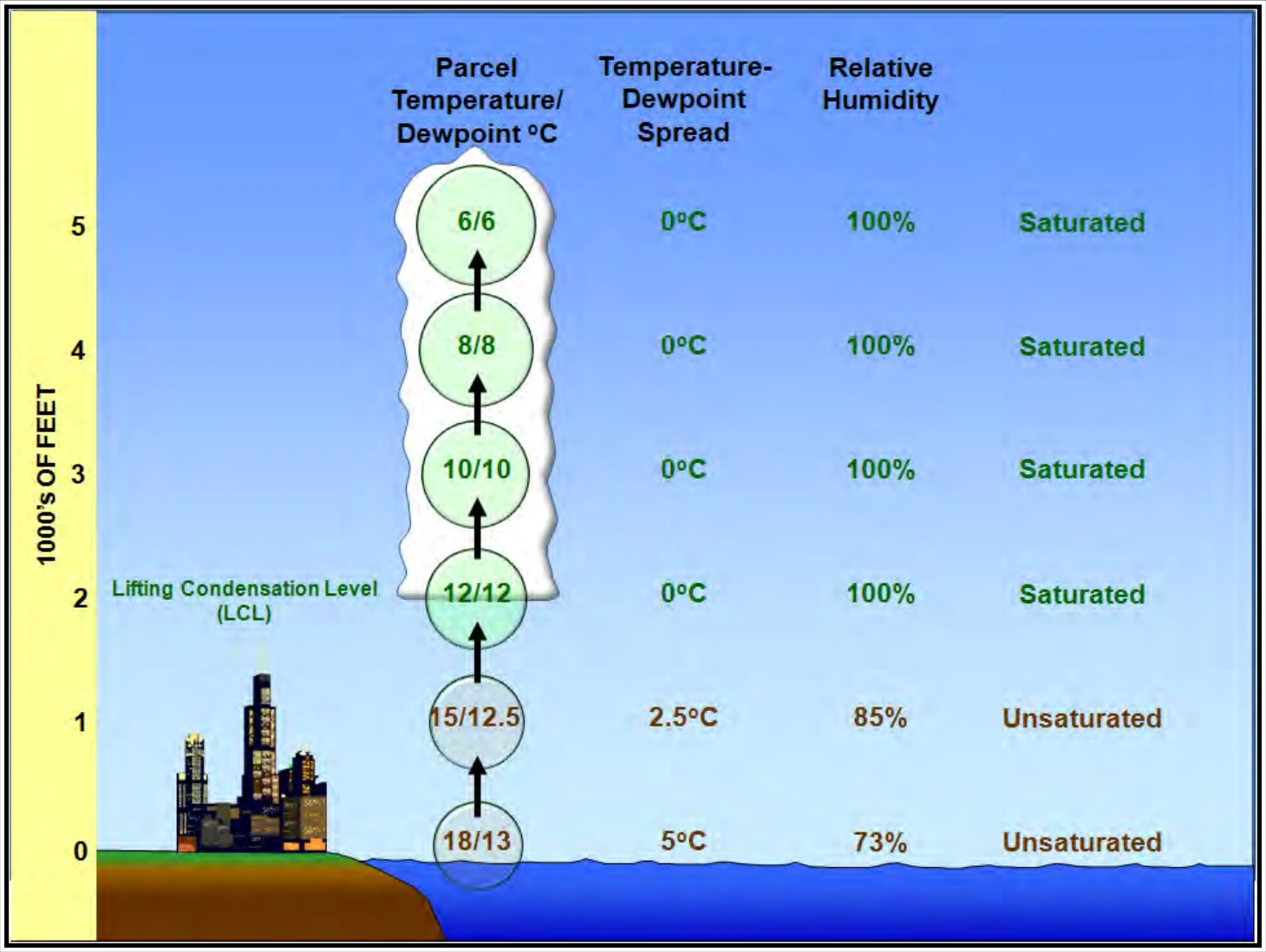
In Figure 12-2, at the surface the air parcel has a temperature of 18°C and a dewpoint of 13°C, indicating that it is unsaturated. As the parcel ascends, its temperature decreases at the dry adiabatic lapse rate of 3°C per 1,000 ft, while the dewpoint decreases at 0.5°C per 1,000 ft. The temperature-dewpoint spread decreases while relative humidity increases until the parcel achieves saturation at its LCL of 2,000 ft. As the parcel continues to ascend, condensation produces cloud formation. Because the heat added during condensation offsets some of the cooling due to expansion, the parcel now cools at the moist adiabatic lapse rate of 2°C per 1,000 ft. The parcel’s dewpoint decreases at an identical rate as the lost water vapor condenses to form the cloud. The relative humidity of the ascending saturated (i.e., cloudy) parcel remains constant at about 100 percent.
A descending saturated air parcel quickly becomes unsaturated (see Figure 12-3). Its temperature increases at 3°C per 1,000 ft, while its dewpoint increases at 0.5°C per 1,000 ft (see Table 12-1). The temperature-dewpoint spread increases while relative humidity decreases.
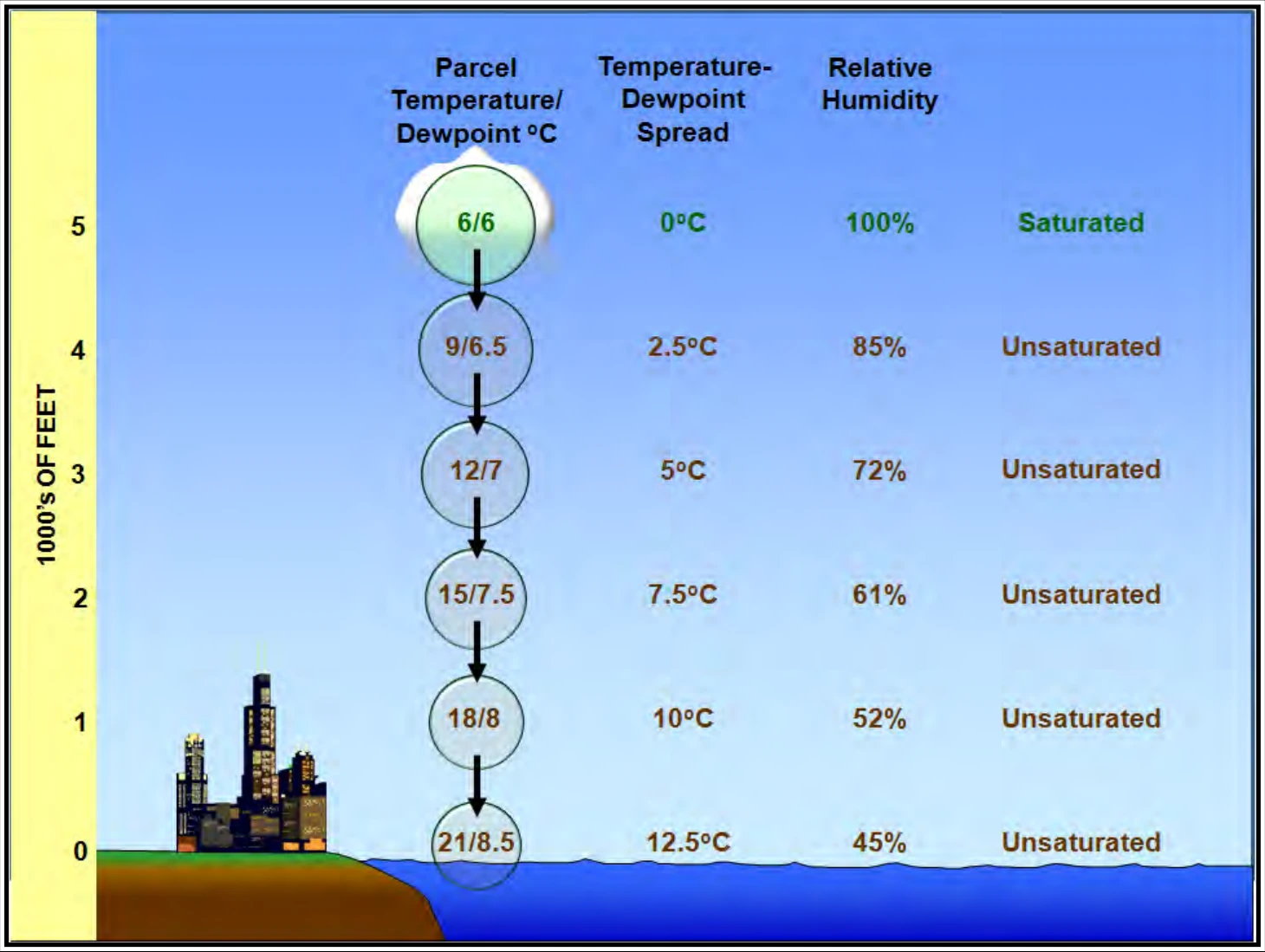
At 5,000 ft, both the temperature and dewpoint of the air parcel are 6°C, indicating that it is saturated. As the parcel descends, it quickly becomes unsaturated. Its temperature increases 3°C per 1,000 ft, while its dewpoint increases at 0.5°C per 1,000 ft. The temperature-dewpoint spread increases while relative humidity decreases until the parcel reaches the surface. Note that the parcel is now much warmer and drier at the surface than when it began the vertical motion process in Figure 12-2.
12.4 Common Sources of Vertical Motion
There are many sources of vertical motion in the atmosphere. Four of the most common types of vertical motion are orographic effects, frictional effects, frontal lift, and buoyancy.