
Chapter 14
Precipitation
14.4.4 Rain
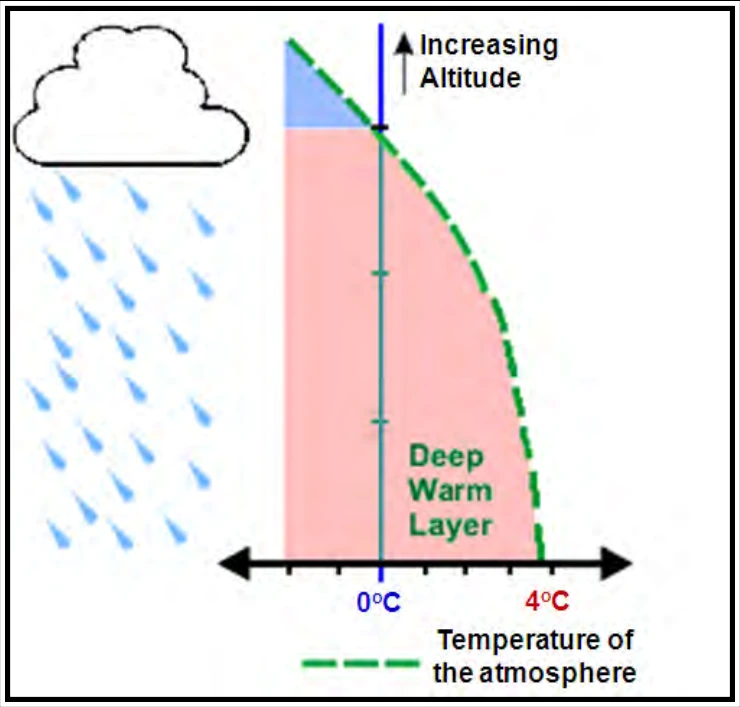
Rain occurs when there is a deep layer of above freezing air based at the surface (see Figure 14-5).
14.4.5 Hail
Hail is precipitation in the form of balls or other irregular lumps of ice produced by thunderstorms. Thunderstorms that are characterized by strong updrafts, large Supercooled Liquid Water Content (SLWC), large cloud-drop sizes, and great vertical height, are favorable to hail formation.
Hail forms when supercooled water droplets above the freezing level begin to freeze. Once a droplet has frozen, other droplets latch on and freeze to it, so the hailstone grows—sometimes into a huge ice ball. Large hail occurs with severe thunderstorms with strong updrafts that have built to great heights. Eventually, the hailstones fall and may be encountered in clear air several miles from the thunderstorm.
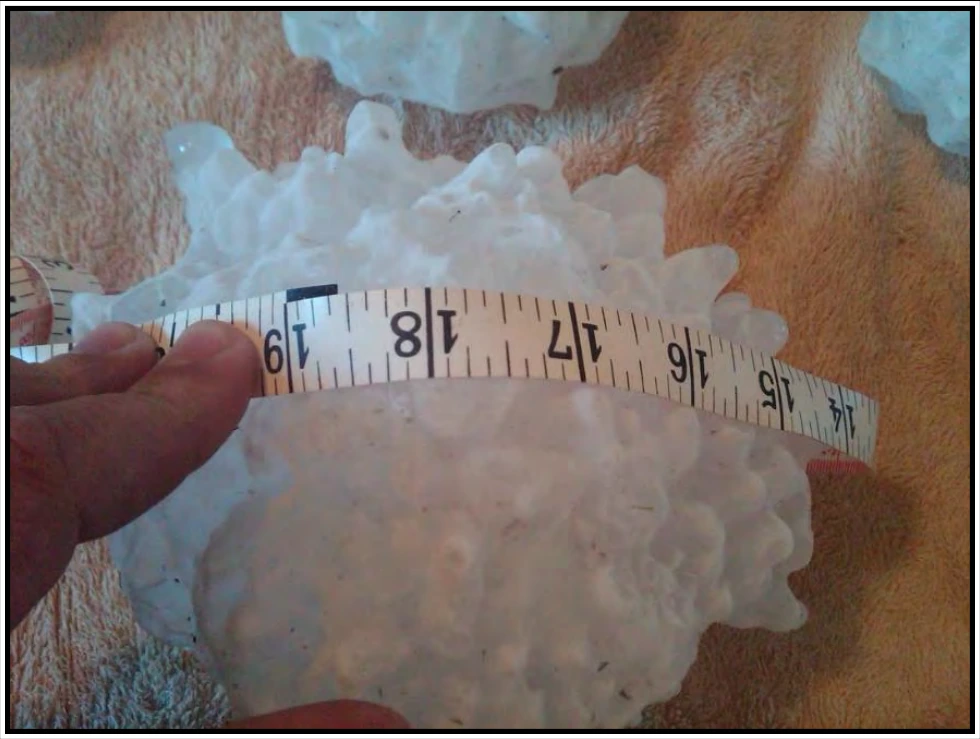
An individual unit of hail is called a hailstone. Hailstones can range in size from a pea (0.25-in diameter) to larger than a softball (4.5-in diameter). Hail competes with turbulence as the greatest thunderstorm hazard to aircraft. Hailstones that are 0.75 in in diameter and larger can cause significant damage to aircraft and make it difficult to control. A hailstone was collected at Vivian, SD, on July 23, 2010, that measured 8 in in diameter, 18.62 in in circumference, and weighed 1.93 lb (see Figure 14-6).
As hailstones fall through air with temperatures above 0°C, they begin to melt, and precipitation may reach the ground as either hail or rain. Rain at the surface does not mean the absence of hail aloft. Pilots should anticipate possible hail with any thunderstorm, especially beneath the anvil of a large cumulonimbus.
Hail is most frequently found in the interior of continents within the mid-latitudes and generally confined to higher elevations within the tropics. In the United States, hail is most common across the Great Plains region east of the Rocky Mountains. Hail is more common aloft and at higher elevations, because the stones begin to melt when they fall below the freezing level, and the smaller stones may melt into raindrops before they reach the surface.
When viewed from the air, it is evident that hail falls in paths known as hail swaths. They can range in size from a few acres to an area 10 mi wide and 100 mi long. Piles of hail in hail swaths have been deep enough to need a snowplow to remove them, and occasionally hail drifts have been reported.