
Chapter 21
Arctic Weather
21.1 Introduction
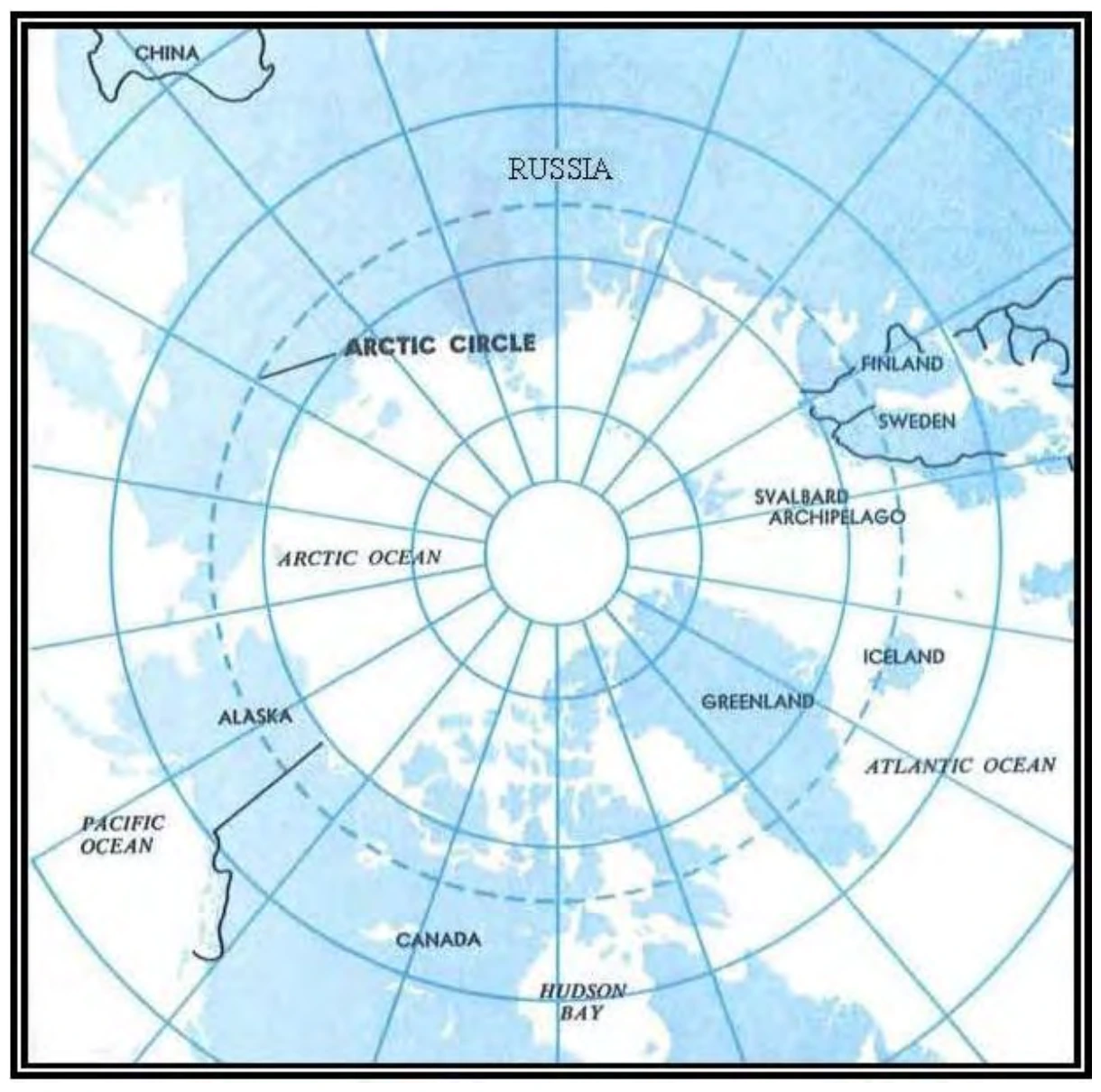
Strictly speaking, the Arctic is the region shown in Figure 21-1, which lies within the Arctic Circle (66.5° N latitude). However, it is loosely defined as the northern regions, in general. This chapter includes Alaska weather, even though much of Alaska lies south of the Arctic Circle.
As an introduction to Arctic weather, this chapter surveys climate, air masses, and fronts of the Arctic, and introduces some Arctic weather peculiarities.
This chapter also covers Arctic aviation weather hazards.
21.2 Climate, Air Masses, and Fronts
There are a number of factors that influence Arctic climate. Climate of any region, especially in the Arctic, is largely determined by the amount of energy received from the Sun; however, local characteristics of the area, such as mountains and ice cover, also influence climate.
21.2.1 Long Days and Nights
A profound seasonal change in length of day and night occurs in the Arctic because of the Earth’s tilt and its revolution around the Sun. Any point north of the Arctic Circle has autumn and winter days when the Sun stays below the horizon all day and has spring and summer days with 24 hours of sunshine when the Sun stays above the horizon. The number of these days increases toward the North Pole; there the Sun stays below the horizon for six months and shines continuously during the other six months.
Twilight in the Arctic is prolonged because of the shallow angle of the Sun below the horizon. In more northern latitudes, it persists for days when the Sun remains just below the horizon. This abundance of twilight often makes visual reference possible at night.
21.2.2 Land and Water
Figure 21-1 shows the water and the land distribution in the Arctic. Arctic mountain ranges are effective barriers to air movement. Large masses of air stagnate over inland continental areas; thus, Arctic continental areas are air mass source regions.
A large portion of the Arctic Ocean is covered throughout the year by a deep layer of ice, known as the permanent ice pack. This ice pack goes through a seasonal cycle where ice melts in the spring and summer and increases in the autumn and winter. Even though a large portion of the Arctic Ocean is ice-covered through much of the year, the ice and the water below contain more heat than the surrounding cold land, thus moderating the climate. Oceanic and coastal areas have a milder climate during winter and a cool climate during summer. As opposed to large water bodies, large land areas show a more significant seasonal temperature variation.
21.2.3 Temperature
As one would expect, the Arctic is very cold in winter, but due to local terrain and the movement of pressure systems, occasionally, some areas are surprisingly warm. During winter, coastal areas are warmer than the interior. During summer, interior areas are pleasantly warm due to many hours of sunshine, while coastal areas have relatively short, cool summers due to their proximity to water.
21.2.4 Clouds and Precipitation
Cloudiness over the Arctic is at a minimum during winter due to the ice pack being more widespread. Spring brings many cloudy days, with cloudiness reaching a maximum in summer and autumn when a portion of the sea ice melts and exposes additional water in the Arctic Ocean.
During summer afternoons, scattered cumulus clouds forming over the interior occasionally grow into thundershowers. These thundershowers move generally from northeast to southwest in the polar easterlies, which is opposite the general movement in the mid-latitudes.
During the winter, polar lows can form over the open ocean. Polar lows are small, intense low-pressure systems that can develop rapidly when cold air flows over warm water. They produce severe weather, strong surface winds, and heavy precipitation. Polar lows dissipate quickly once they move over land.
Precipitation in the Arctic can vary drastically per region but is generally light. Some areas are known as polar deserts. In winter, the only precipitation received in the Arctic is snow, while in summer precipitation falls mostly in the form of snow over ice caps and oceanic areas and rain over interior areas. Annual amounts of precipitation over the ice pack and along the coastal areas tend to be less than the interior areas.