Chapter 4
The Earth’s Atmosphere
Commercial aircraft often cruise in the lower stratosphere to avoid atmospheric turbulence and convection in the troposphere. Severe turbulence during the cruise phase of flight can be caused by the convective overshoot of thunderstorms from the troposphere below. The disadvantages of flying in the stratosphere can include increased fuel consumption due to warmer temperatures, increased levels of radiation, and increased concentration of ozone.
4.3.3 Mesosphere
The mesosphere extends from the stratopause to about 85 km (53 mi) above the Earth. The gases, including the number of oxygen molecules, continue to become thinner and thinner with height. As such, the effect of the warming by ultraviolet radiation also becomes less and less pronounced, leading to a decrease in temperature with height. On average, temperature decreases from about -3 °C (27 °F) to as low as -100 °C (-148 °F) at the mesopause. However, the gases in the mesosphere are thick enough to slow down meteorites hurtling into the atmosphere, where they burn up, leaving fiery trails in the night sky.
4.3.4 Thermosphere
The thermosphere extends from the mesopause to 690 km (430 mi) above the Earth. This layer is known as the upper atmosphere.
The gases of the thermosphere become increasingly thin compared to the mesosphere. As such, only the higher energy ultraviolet and x ray radiation from the Sun is absorbed. But because of this absorption, the temperature increases with height and can reach as high as 2,000 °C (3,600 °F) near the top of this layer.
Despite the high temperature, this layer of the atmosphere would still feel very cold to our skin because of the extremely thin air. The total amount of energy from the very few molecules in this layer is not sufficient enough to heat our skin.
4.3.5 Exosphere
The exosphere is the outermost layer of the atmosphere and extends from the thermopause to 10,000 km (6,200 mi) above the Earth. In this layer, atoms and molecules escape into space and satellites orbit the Earth. The transition boundary that separates the exosphere from the thermosphere is called the thermopause.
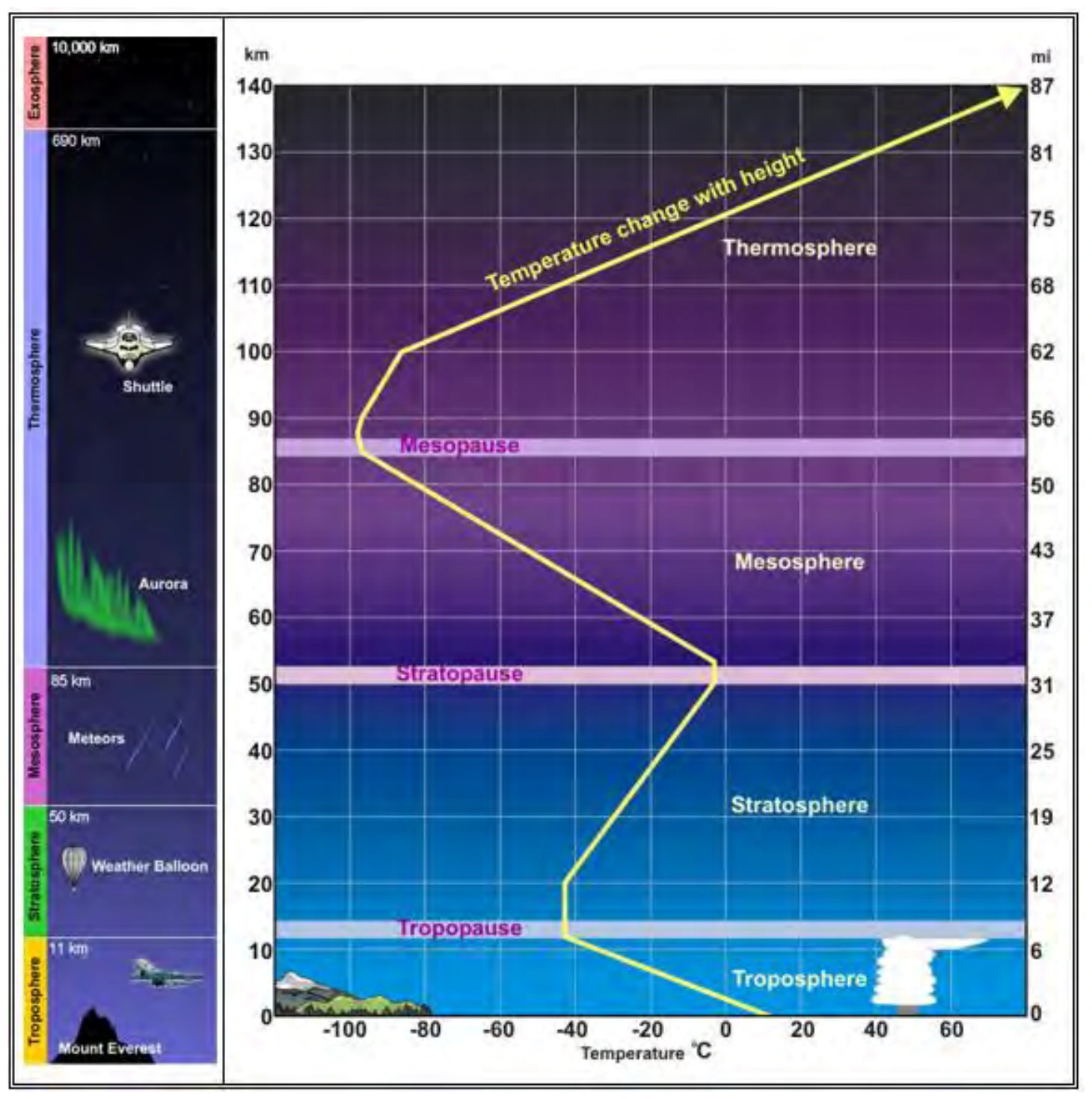
The regions of the stratosphere and the mesosphere, along with the stratopause and mesopause, are called the middle atmosphere. The transition boundary that separates the stratosphere from the mesosphere is called the stratopause. Please note that in this figure the temperature is not necessarily to scale with the height but provides an approximation of how the temperature changes with height.
4.4 The Standard Atmosphere
Continuous fluctuations of atmospheric properties create problems for engineers and meteorologists who need a fixed standard for reference. To solve this problem, they defined a standard atmosphere that represents an average of conditions throughout the atmosphere for all latitudes, seasons, and altitudes.
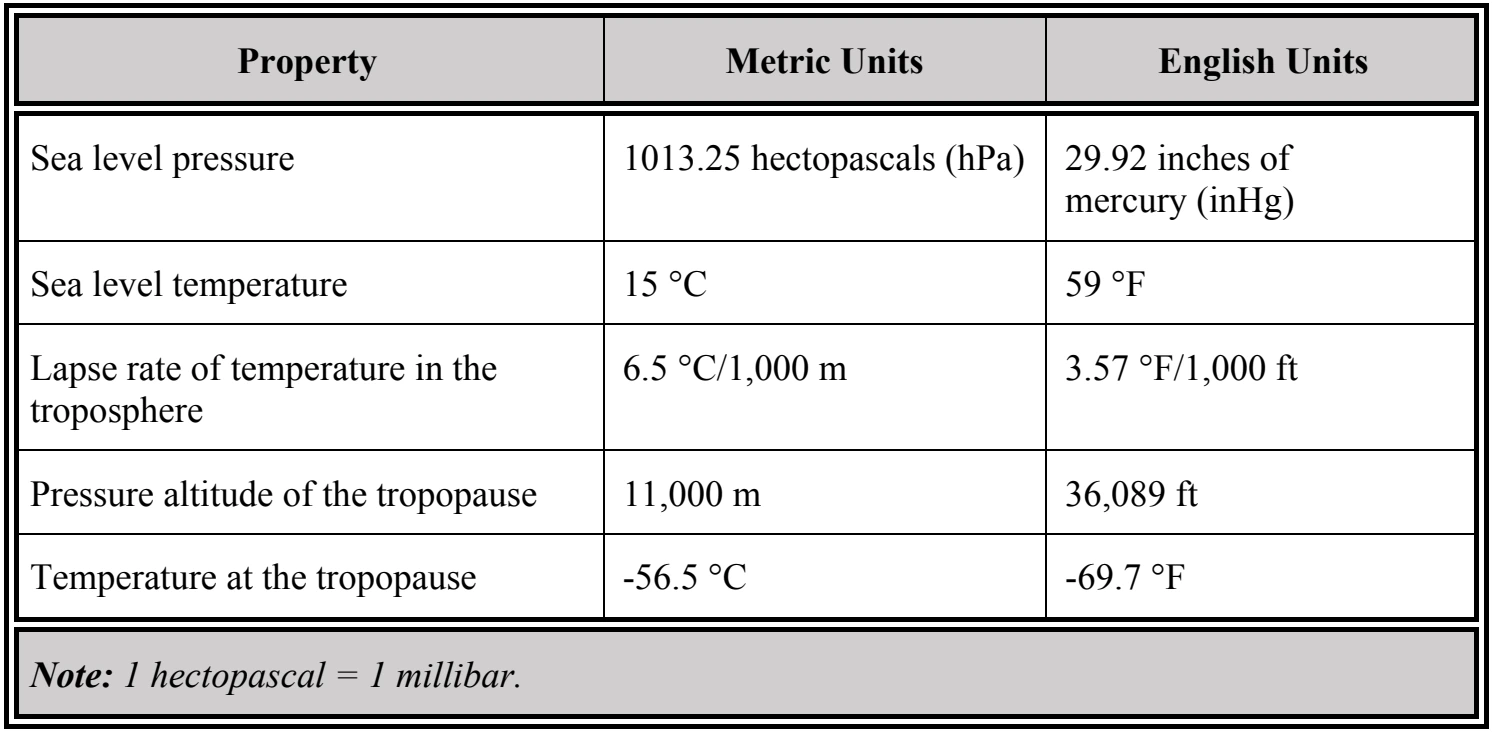
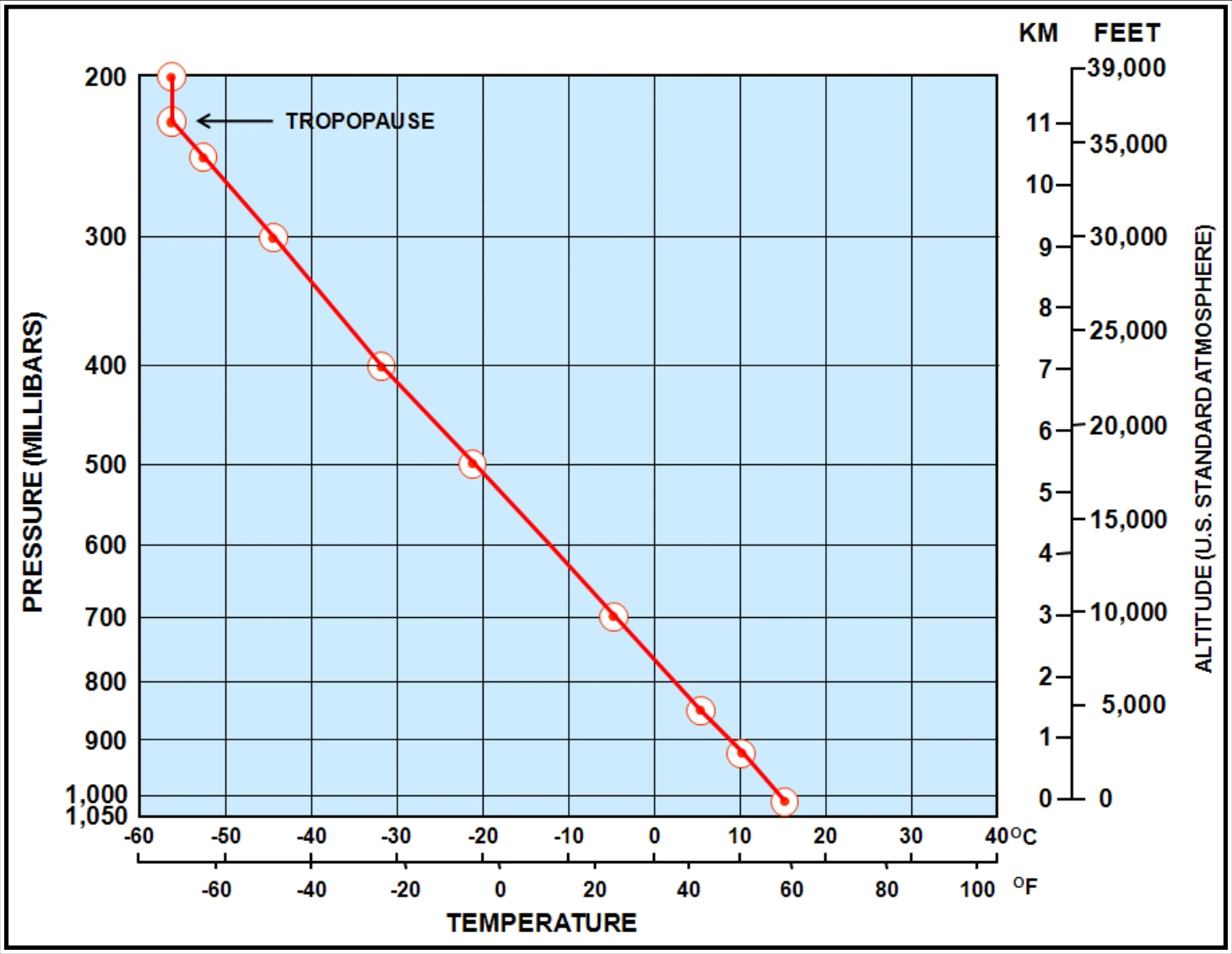
Standard atmosphere is a hypothetical vertical distribution of atmospheric temperature, pressure, and density that, by international agreement, is taken to be representative of the atmosphere for purposes of pressure altimeter calibrations, aircraft performance calculations, aircraft and missile design, ballistic tables, etc. (see Table 4-2 and Figure 4-2). Weather-related processes are generally referenced to the standard atmosphere, as are the examples in this handbook.