
Chapter 7
Earth-Atmosphere Heat Imbalances
The phase transition of water and associated latent heat exchanges are largely responsible for transferring the excess heat from the surface of the Earth into its atmosphere. As the Earth’s surface absorbs radiation, some of the heat produced is used to evaporate (vaporize) water from oceans, lakes, rivers, soil, and vegetation. The water absorbs heat energy due to the latent heat of vaporization. Some of this water vapor condenses to microscopic water droplets or deposits as ice crystals that are visible as clouds. During cloud formation, the water vapor changes state, and latent heat is released into the atmosphere. During this process, the excess heat is transferred from the Earth’s surface into its atmosphere.
7.4 Heat Imbalance Variations with Latitude
Global imbalances in radiational heating and cooling occur not only vertically between the Earth’s surface and its atmosphere but also horizontally with latitude. Since the Earth is essentially spherical, parallel beams of incoming solar radiation strike lower latitudes more directly than higher latitudes (see Figure 7-5); that is, the solar zenith angle is lower, and the Sun is more directly overhead in equatorial regions than at the poles. At higher latitudes, solar radiation is spread over a larger area and is less intense per unit surface area than at lower latitudes. Thus, the Earth absorbs more solar radiation at lower latitudes than higher latitudes, which creates heat imbalances and temperature gradients between the Equator and the poles.
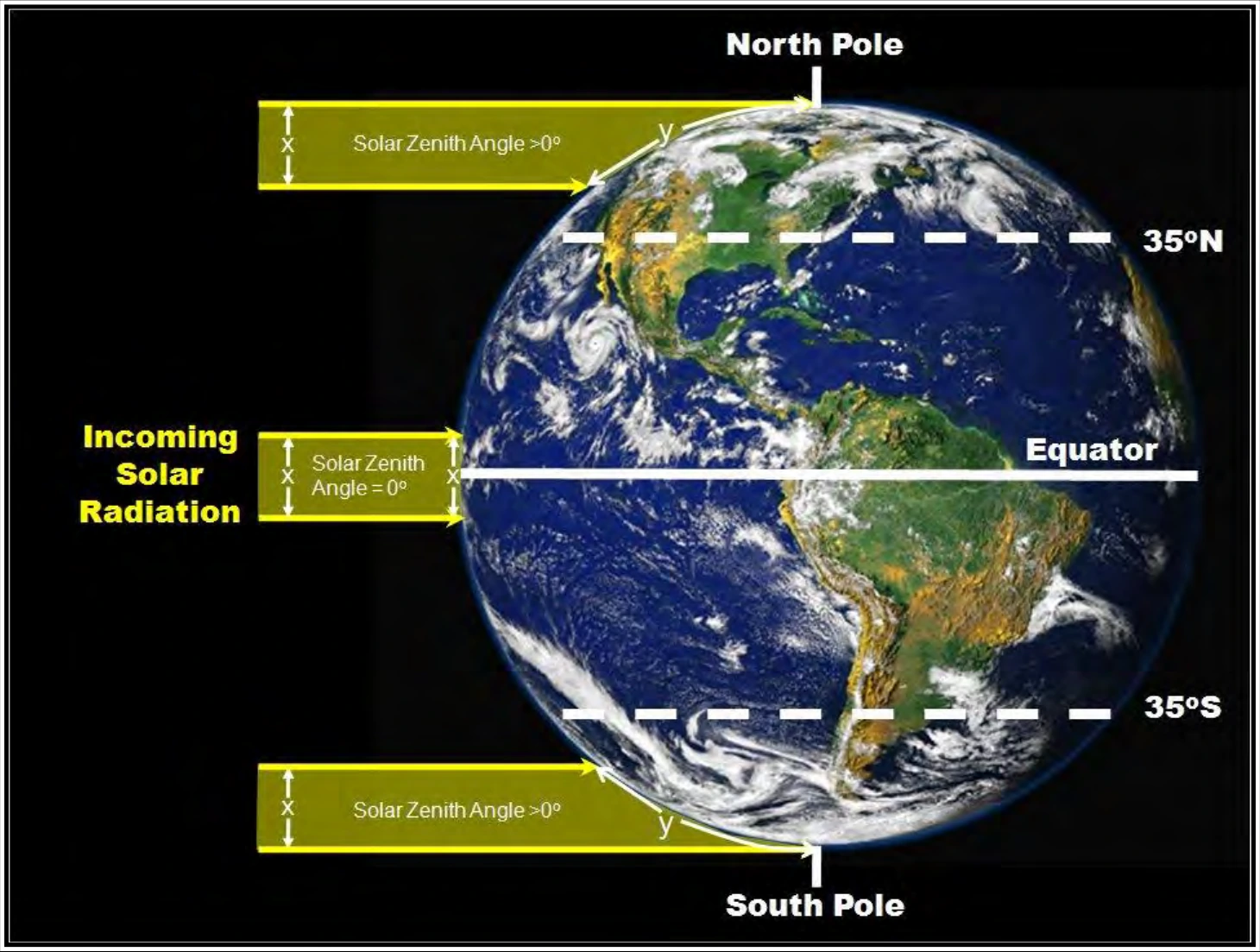
The emission of terrestrial radiation also varies by latitude, but less so than the absorption of solar radiation. Terrestrial radiation emission decreases with increasing latitude due to a drop in temperature with latitude. Thus, at higher latitudes, the annual rate of cooling exceeds the rate of warming, while the reverse is true at lower latitudes.
Averaged over all latitudes, incoming solar radiation must equal outgoing terrestrial radiation. Otherwise, the Earth would be unable to maintain a constant average temperature. About 35° latitude in both hemispheres is where incoming and outgoing radiation is equal. This implies there is annual net cooling at higher latitudes and net warming at lower latitudes; however, this is untrue. The excess heat in the tropics must be transported polar by some mechanism(s). This poleward heat transport is accomplished by atmospheric circulations, weather, and ocean currents.
7.5 Seasons
Seasons are caused by the tilt of the Earth’s rotational axis as the Earth orbits the Sun (see Figure 7-6). The Earth’s rotational axis is tilted by 23½° from the perpendicular drawn to the plane of the Earth’s orbit about the Sun and points the same direction in space all year long. The North Pole is tilted most directly toward the Sun during the summer solstice. Thus, in the Northern Hemisphere, the longest day of the year (lowest solar zenith angle) occurs on the summer solstice (approximately June 22), while the shortest day of the year (highest solar zenith angle) occurs on the winter solstice (approximately December 22). Day and night are of equal length (12 hours) worldwide on the vernal equinox (approximately March 21) and the autumnal equinox (approximately September 23).
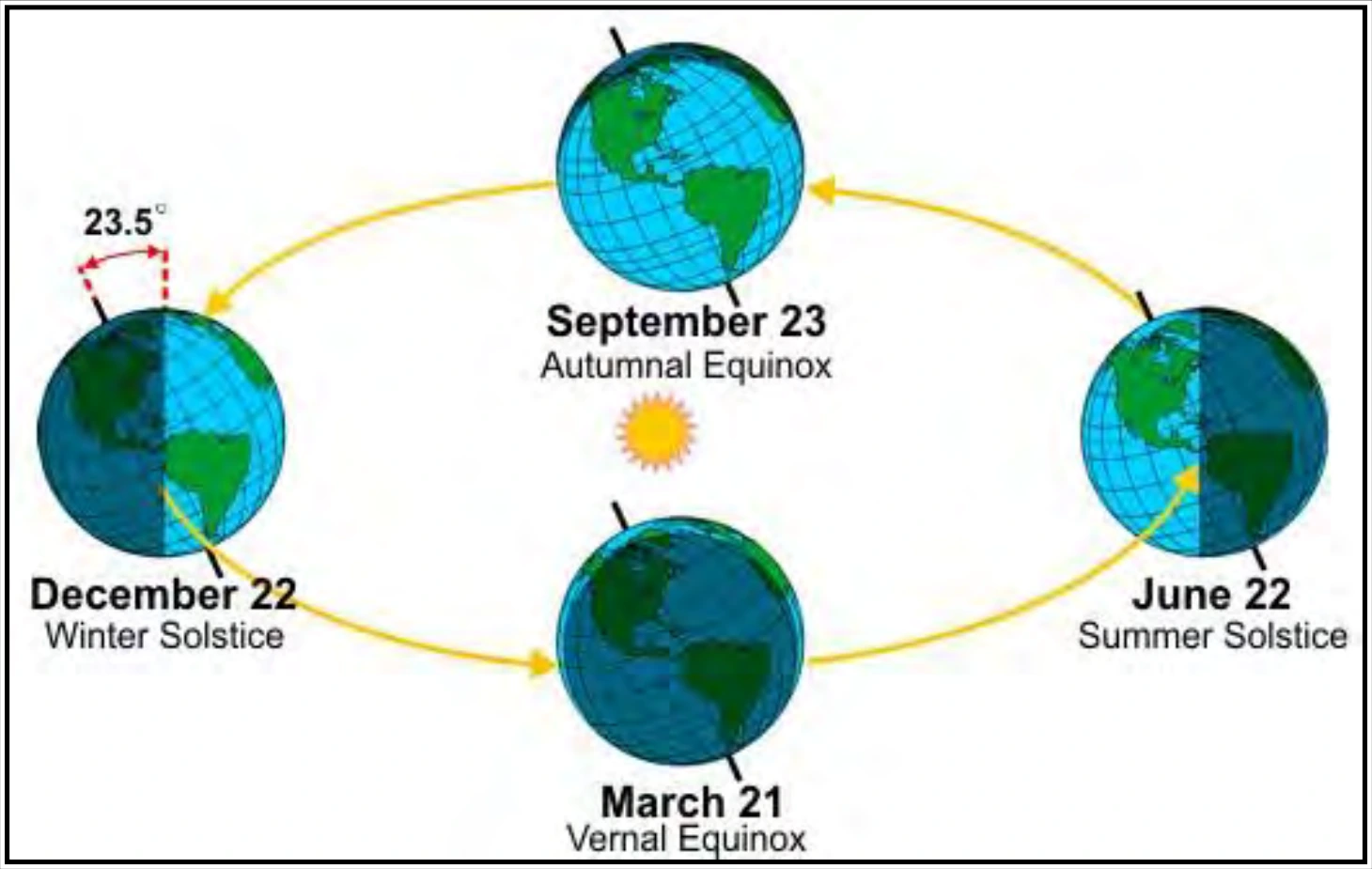
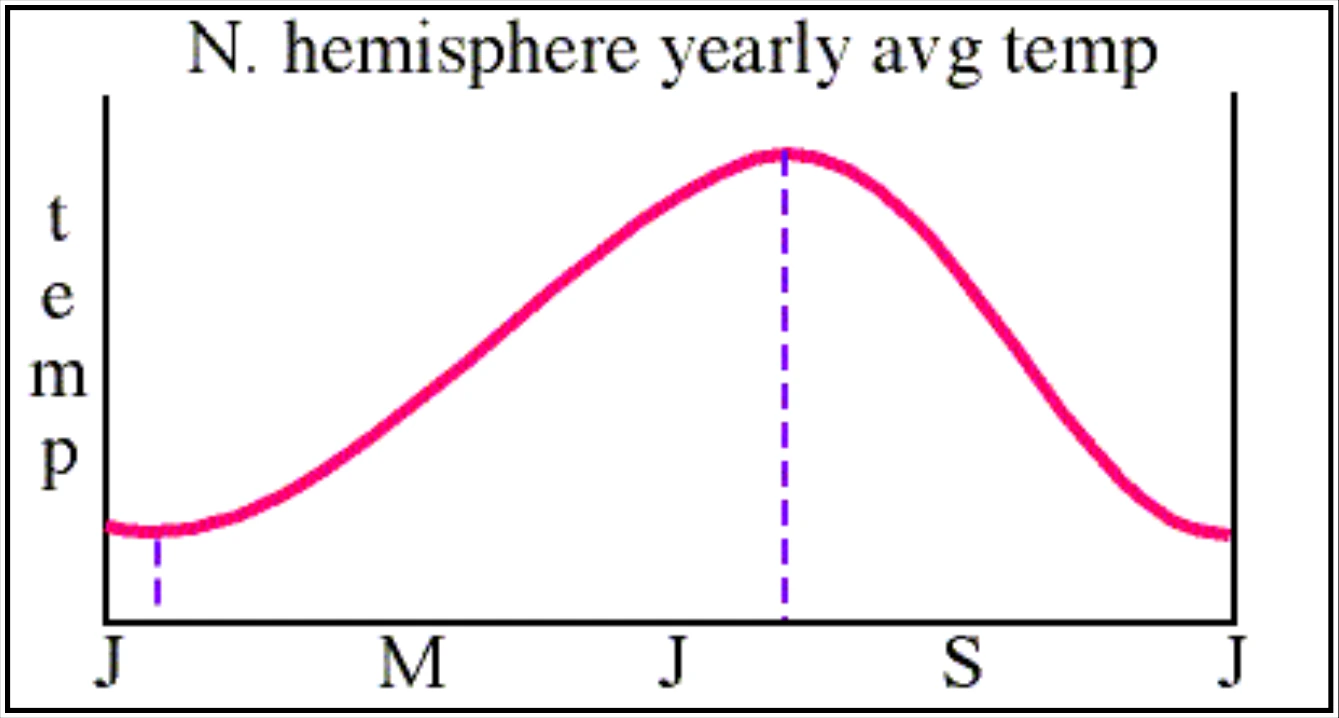
Figure 7-7 illustrates the average seasonal temperature variation in the Northern Hemisphere. Note that the warmest (coldest days) of the year occur after the summer (winter) solstice. This is due to the time lag necessary for heat flow processes to fully heat (cool) the surface of the Earth.
7.6 Diurnal Temperature Variation
Diurnal temperature variation is the daytime maximum and nighttime minimum of air temperature due to variations of insolation caused by the rising and setting of the Sun (i.e., variations of solar zenith angle) as the Earth rotates around its axis. Figure 7-8 depicts the typical diurnal temperature and radiation variations over land when the sky is clear.
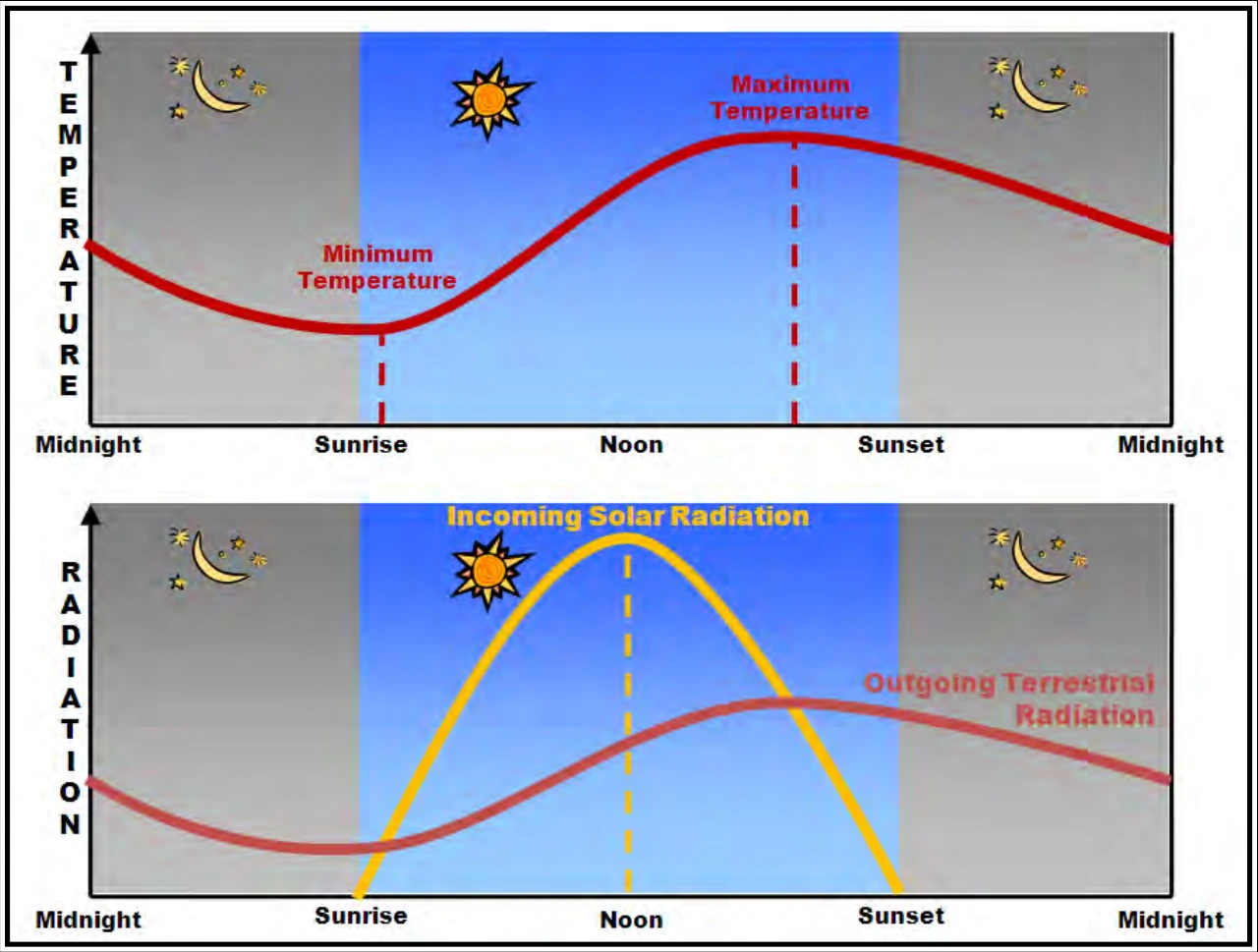
Warming and cooling of the Earth depend on an imbalance between solar and terrestrial radiation. The Earth receives heat during the day through incoming solar radiation. It loses heat to space by outgoing terrestrial radiation both day and night.
Shortly after sunrise, incoming solar radiation received at the Earth’s surface (insolation) becomes greater than outgoing terrestrial radiation and the Earth’s surface warms. Peak insolation occurs around noon, but maximum surface air temperature usually occurs during the midafternoon. This lag is necessary for the air near the ground to heat up due to conduction and convection with the surface. The Earth begins to cool once the rate of outgoing terrestrial radiation exceeds the rate of insolation.
At night, insolation is absent but outgoing terrestrial radiation continues, and the Earth’s surface continues to cool. Cooling continues until shortly after sunrise, when incoming solar radiation once again exceeds outgoing terrestrial radiation. Minimum surface air temperature usually occurs shortly after sunrise.
The magnitude of diurnal temperature variation is primarily influenced by surface type, latitude, sky cover (e.g., clouds or pollutants), water vapor content of the air, and wind speed. Temperature variation is maximized over land, at low latitudes, with a clear sky, dry air, and light wind. Conversely, temperature variation is minimized over water, at high latitudes, with a cloudy sky, moist air, and strong wind.