
Chapter 10
Advanced Flight Maneuvers
The maneuver requires a high degree of coordination of all controls. It is practiced at a height that permits a safe clearance between the tail rotor and the surface throughout the maneuver, especially at the point where the pitch attitude is highest. The height at completion should be no higher than the maximum safe hovering height prescribed by that particular helicopter’s manufacturer. In selecting a height at which to begin the maneuver, take into account the overall length of the helicopter and its height/velocity diagram. Even though the maneuver is called a rapid deceleration or quick stop, it is performed slowly and smoothly with the primary emphasis on coordination.
During training, always perform this maneuver into the wind [Figure 10-3, position 1]. After leveling off at an altitude between 25 and 40 feet, depending upon the manufacturer’s recommendations, accelerate to the desired entry speed, which is approximately 45 knots for most training helicopters (position 2). The altitude chosen should be high enough to avoid danger to the tail rotor during the flare, but low enough to stay out of the hazardous areas of that helicopter’s height-velocity diagram throughout the maneuver. In addition, this altitude should be low enough that the helicopter can be brought to a hover during the recovery.
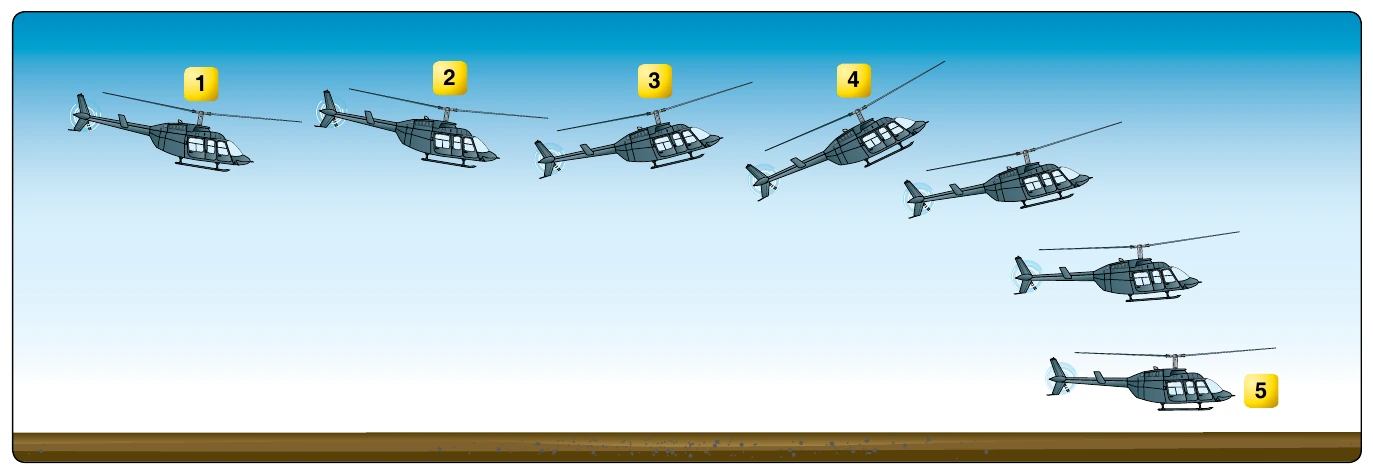
At position 3, initiate the deceleration by applying aft cyclic to reduce forward groundspeed. Simultaneously, lower the collective, as necessary, to counteract any climbing tendency. The timing must be exact. If too little collective is taken out for the amount of aft cyclic applied, the helicopter climbs. If too much downward collective is applied, the helicopter will descend. A rapid application of aft cyclic requires an equally rapid application of down collective. As collective is lowered, apply proper antitorque pedal pressure to maintain heading, and adjust the throttle to maintain rpm. The G loading on the rotor system depends on the pitch-up attitude. If the attitude is too high, the rotor system may stall and cause the helicopter to impact the surface.
After attaining the desired speed (position 4), initiate the recovery by lowering the nose and allowing the helicopter to descend to a normal hovering height in level flight and zero groundspeed (position 5). During the recovery, increase collective pitch, as necessary, to stop the helicopter at normal hovering height, adjust the throttle to maintain rpm, and apply proper antitorque pedal pressure, as necessary, to maintain heading. During the maneuver, visualize rotating about the tail rotor’s horizontal axis until a normal hovering height is reached.
Common Errors
- Initiating the maneuver by lowering the collective without aft cyclic pressure to maintain altitude.
- Initially applying aft cyclic stick too rapidly, causing the helicopter to balloon (climb).
- Failing to effectively control the rate of deceleration to accomplish the desired results.
- Allowing the helicopter to stop forward motion in a tail-low attitude.
- Failing to maintain proper rotor rpm.
- Waiting too long to apply collective pitch (power) during the recovery, resulting in an overtorque situation when collective pitch is applied rapidly.
- Failing to maintain a safe clearance over the terrain.
- Using antitorque pedals improperly, resulting in erratic heading changes.
- Using an excessively nose-high attitude.
Steep Approach
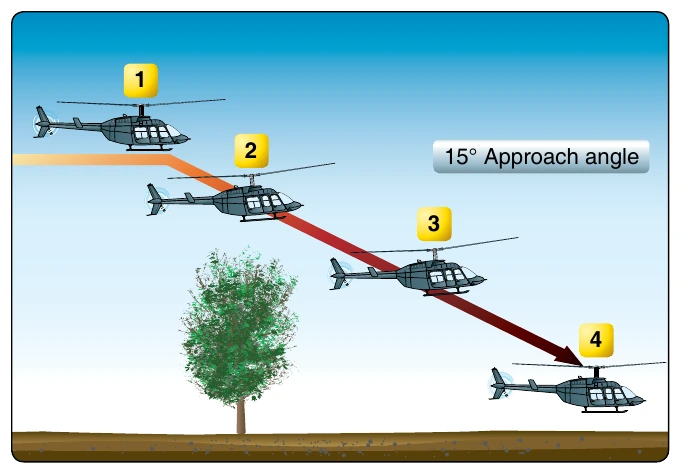
A steep approach is used primarily when there are obstacles in the approach path that are too high to allow a normal approach. A steep approach permits entry into most confined areas and is sometimes used to avoid areas of turbulence around a pinnacle. An approach angle of approximately 13° to 15° is considered a steep approach. [Figure 10-4] Caution must be exercised to avoid the parameters for vortex ring state (20–100 percent of available power applied, airspeed of less than 10 knots, and a rate of descent greater than 300 feet per minute (fpm)). For additional information on vortex ring state (formerly referenced as settling-with-power), refer to Chapter 11, Helicopter Emergencies and Hazards.
Technique
On final approach, maintain track with the intended touchdown point and into the wind as much as possible at the recommended approach airspeed [Figure 10-4, position 1]. When intercepting an approach angle of 13° to 15°, begin the approach by lowering the collective sufficiently to start the helicopter descending down the approach path and decelerating (position 2). Use the proper antitorque pedal for trim. Since this angle is steeper than a normal approach angle, reduce the collective more than that required for a normal approach. Continue to decelerate with slight aft cyclic and smoothly lower the collective to maintain the approach angle.
The intended touchdown point may not always be visible throughout the approach, especially when landing to a hover. Pilots must learn to cue in to other references that are parallel to the intended landing area that will help them maintain ground track and position.
Constant management of approach angle and airspeed is essential to any approach. Aft cyclic is required to decelerate sooner than with a normal approach, and the rate of closure becomes apparent at a higher altitude. Maintain the approach angle and rate of descent with the collective, rate of closure with the cyclic, and trim with antitorque pedals.
The helicopter should be kept in trim just prior to loss of effective translational lift (approximately 25 knots). Below 100 feet above ground level (AGL), the antitorque pedals should be adjusted to align the helicopter with the intended touchdown point. Visualize the location of the tail rotor behind the helicopter and fly the landing gear to 3 feet above the intended landing point. In small confined areas, the pilot must precisely position the helicopter over the intended landing area. Therefore, the approach must stop at that point.
Loss of effective translational lift occurs higher in a steep approach (position 3), requiring an increase in the collective to prevent settling, and more forward cyclic to achieve the proper rate of closure. Once the intended landing area is reached, terminate the approach to a hover with zero groundspeed (position 4). If the approach has been executed properly, the helicopter will come to a halt at a hover altitude of 3 feet over the intended landing point with very little additional power required to hold the hover.
The pilot must remain aware that any wind effect is lost once the aircraft has descended below the barriers surrounding a confined area, causing the aircraft to settle more quickly. Additional power may be needed on a strong wind condition as the helicopter descends below the barriers.
Common Errors
- Failing to maintain proper rpm during the entire approach.
- Using collective improperly in maintaining the selected angle of descent.
- Failing to make antitorque pedal corrections to compensate for collective pitch changes during the approach.
- Slowing airspeed excessively in order to remain on the proper angle of descent.
- Failing to determine when effective translational lift is being lost.
- Failing to arrive at hovering height and attitude, and zero groundspeed almost simultaneously.
- Utilizing low rpm in transition to the hover at the end of the approach.
- Using too much aft cyclic close to the surface, which may result in the tail rotor striking the surface.
- Failure to align landing gear with direction of travel no later than beginning of loss of translational lift.