
Chapter 6
Weight and Balance
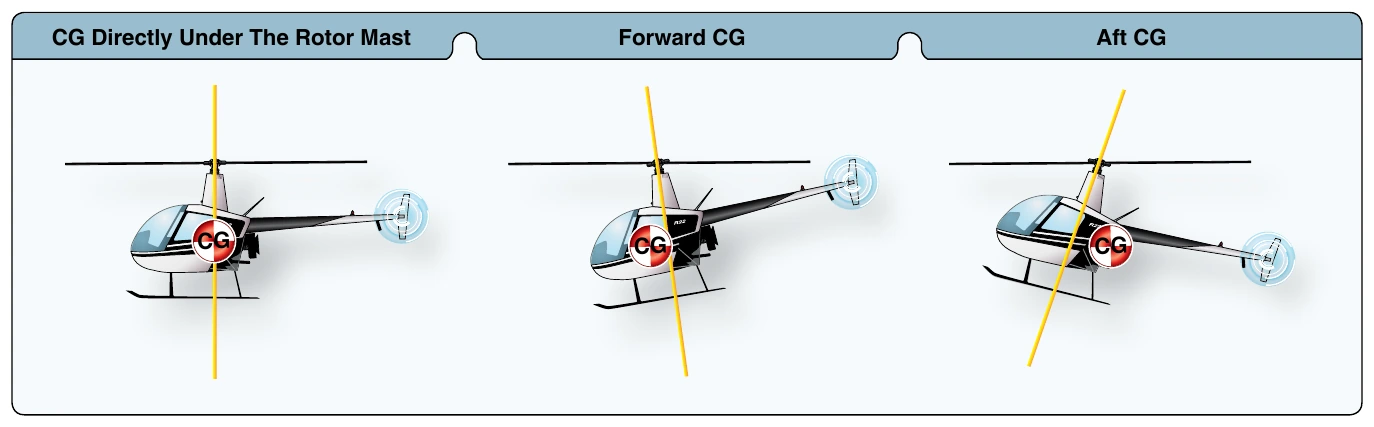
The pilot should ensure that the helicopter is properly balanced and within its center of gravity limitations, so that minimal cyclic input is required during hovering flight, except for any wind corrections. Since the fuselage acts as a pendulum suspended from the rotor, changing the CG changes the angle at which the aircraft hangs from the rotor. When the CG is directly under the rotor mast, the helicopter hangs horizontally; if the CG is too far forward of the mast, the helicopter hangs with its nose tilted down; if the CG is too far aft of the mast, the nose tilts up. [Figure 6-1]
CG Forward of Forward Limit
A forward CG may occur when a heavy pilot and passenger take off without baggage or proper ballast located aft of the rotor mast. This situation becomes worse if the fuel tanks are located aft of the rotor mast because as fuel burns the CG continues to shift forward.
This condition is easily recognized when coming to a hover following a vertical takeoff. The helicopter has a nose-low attitude, and excessive rearward displacement of the cyclic control is needed to maintain a hover in a no-wind condition. Do not continue flight in this condition, since a pilot could rapidly lose rearward cyclic control as fuel is consumed. A pilot may also find it impossible to decelerate sufficiently to bring the helicopter to a stop. In the event of engine failure and the resulting autorotation, there may not be enough cyclic control to flare properly for the landing.
A forward CG is not as obvious when hovering into a strong wind, since less rearward cyclic displacement is required than when hovering with no wind. When determining whether a critical balance condition exists, it is essential to consider the wind velocity and its relation to the rearward displacement of the cyclic control.
CG Aft of Aft Limit
Without proper ballast in the cockpit, exceeding the aft CG may occur when:
- A lightweight pilot takes off solo with a full load of fuel located aft of the rotor mast.
- A lightweight pilot takes off with maximum baggage allowed in a baggage compartment located aft of the rotor mast.
- A lightweight pilot takes off with a combination of baggage and substantial fuel where both are aft of the rotor mast.
A pilot can recognize the aft CG condition when coming to a hover following a vertical takeoff. The helicopter will have a tail-low attitude and will need excessive forward displacement of cyclic control to maintain a hover in a no-wind condition. When facing upwind, even greater forward cyclic is needed.
If flight is continued in this condition, it may be impossible to fly in the upper allowable airspeed range due to inadequate forward cyclic authority to maintain a nose-low attitude. In addition, with an extreme aft CG, gusty or rough air could accelerate the helicopter to a speed faster than that produced with full forward cyclic control. In this case, dissymmetry of lift and blade flapping could cause the rotor disk to tilt aft. With full forward cyclic control already applied, a pilot might not be able to lower the rotor disk, resulting in possible loss of control, or the rotor blades striking the tailboom.
Lateral Balance
For smaller helicopters, it is generally unnecessary to determine the lateral CG for normal flight instruction and passenger flights. This is because helicopter cabins are relatively narrow and most optional equipment is located near the centerline. However, some helicopter manuals specify the seat from which a pilot must conduct solo flight. In addition, if there is an unusual situation that could affect the lateral CG, such as a heavy pilot and a full load of fuel on one side of the helicopter, its position should be checked against the CG envelope. If carrying external loads in a position that requires large lateral cyclic control displacement to maintain level flight, fore and aft cyclic effectiveness could be limited dramatically. Manufacturers generally account for known lateral CG displacements by locating external attachment points opposite the lateral imbalance. Examples are placement of hoist systems attached to the side, and wing stores commonly used on military aircraft for external fuel pods or armament systems.
Weight and Balance Calculations
When determining whether a helicopter is properly loaded, two questions must be answered:
- Is the gross weight less than or equal to the maximum allowable gross weight?
- Is the CG within the allowable CG range, and will it stay within the allowable range throughout the duration of flight including all loading configurations that may be encountered?
To answer the first question, just add the weight of the items comprising the useful load (pilot, passengers, fuel, oil [if applicable] cargo, and baggage) to the basic empty weight of the helicopter. Ensure that the total weight does not exceed the maximum allowable gross weight.
To answer the second question, use CG or moment information from loading charts, tables, or graphs in the RFM. It is important to note that any weight and balance computation is only as accurate as the information provided. Therefore, ask passengers what they weigh and add a few pounds to account for the additional weight of clothing, especially during the winter months. Baggage should be weighed on a scale, if practical. If a scale is not available, compute personal loading values according to each individual estimate. Figure 6-2 indicates the standard weights for specific operating fluids. These values are used when computing a helicopter’s balance.
Reference Datum
Balance is determined by the location of the CG, which is usually described as a given number of inches from the reference datum. The horizontal reference datum is an imaginary vertical plane or point, arbitrarily fixed somewhere along the longitudinal axis of the helicopter, from which all horizontal distances are measured for weight and balance purposes. There is no fixed rule for its location. It may be located at the rotor mast, the nose of the helicopter, or even at a point in space ahead of the helicopter. [Figure 6-3]