
Chapter 9
Basic Flight Maneuvers
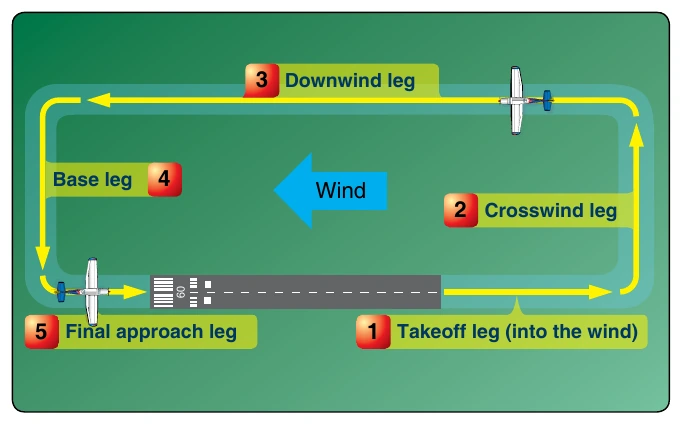
A normal airplane traffic pattern is rectangular, has five named legs, and a designated altitude, usually 1,000 feet AGL. While flying the traffic pattern, pilots should always keep in mind noise abatement rules and flying friendly to avoid dwellings and livestock. A pattern in which all turns are to the left is called a standard pattern. [Figure 9-18] The takeoff leg (item
- normally consists of the aircraft’s flightpath after takeoff.
This leg is also called the departure leg. Turn to the crosswind leg (item 2) after passing the departure end of the runway when at a safe altitude. Fly the downwind leg (item 3) parallel to the runway at the designated traffic pattern altitude and distance from the runway. Begin the base leg (item 4) at a point selected according to other traffic and wind conditions. If the wind is very strong, begin the turn sooner than normal. If the wind is light, delay the turn to base. The final approach (item 5) is the path the aircraft flies immediately prior to touchdown.
Flying a fixed wing traffic pattern at 1,000 feet AGL upon the request of ATC should not be a problem for a helicopter unless conducting specific maneuvers that require specific altitudes. There are variations at different localities and at airports with operating control towers. For example, ATC may have airplanes in a left turn pattern (as airplane pilots are usually seated in the left), seat and a right turn pattern for helicopters (as those pilots are usually in the right seat). This arrangement affords the best view from each of the respective cockpits. Always consult the Airport/Facility Directory for the traffic pattern procedures at your airport/heliport.
When approaching an airport with an operating control tower in a helicopter, it is possible to expedite traffic by stating intentions. The communication consists of:
- The helicopter’s call sign, “Helicopter 8340J.”
- The helicopter’s position, “10 miles west.”
- The “request for landing and hover to...”
To avoid the flow of fixed-wing traffic, the tower often clears direct to an approach point or to a particular runway intersection nearest the destination point. At uncontrolled airports, if at all possible, adhere to standard practices and patterns.
Traffic pattern entry procedures at an airport with an operating control tower are specified by the controller. At uncontrolled airports, traffic pattern altitudes and entry procedures may vary according to established local procedures. Helicopter pilots should be aware of the standard airplane traffic pattern and avoid it. Generally, helicopters make a lower altitude pattern opposite from the fixed wing pattern and make their approaches to some point other than the runway in use by the fixed wing traffic. Chapter 7 of the Airplane flying Handbook, FAA-H-8083-3 discusses this in greater detail. For information concerning traffic pattern and landing direction, utilize airport advisory service or UNICOM, when available.
The standard departure procedure when using the fixed-wing traffic pattern is usually a straight-out, downwind, or right-hand departure. When a control tower is in operation, request the type of departure desired. In most cases, helicopter departures are made into the wind unless obstacles or traffic dictate otherwise. At airports without an operating control tower, comply with the departure procedures established for that airport, if any.
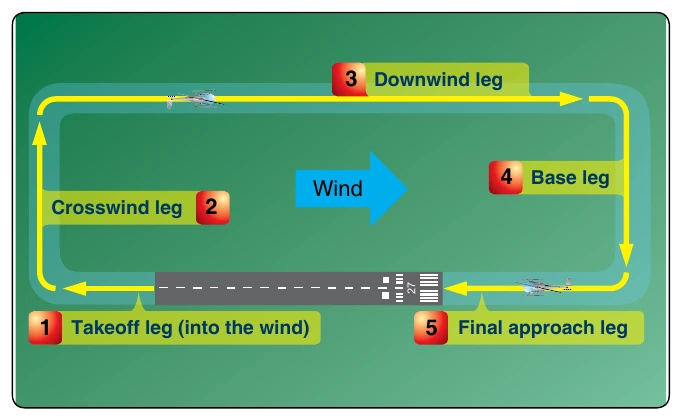
A helicopter traffic pattern is flown at 500-1,000 feet AGL depending on considerations such as terrain, obstacles, and other aircraft traffic. [Figure 9-19] This keeps the helicopter out of the flow of fixed-wing traffic. A helicopter may take off from a helipad into the wind with a turn to the right after 300 feet AGL or as needed to be in range of forced landing areas. When 500 feet AGL is attained, a right turn to parallel the takeoff path is made for the downwind. Then, as the intended landing point is about 45 degrees behind the abeam position of the helicopter, a right turn is made, and a descent is begun from downwind altitude to approximately 300 feet AGL for a base leg.
As the helicopter nears the final approach path, the turn to final should be made considering winds and obstructions. Depending on obstructions and forced landing areas, the final approach may need to be accomplished from as high as 500 feet AGL. The landing area should always be in sight and the angle of approach should never be too high (indicating that the base leg is too close) to the landing area or too low (indicating that the landing area is too far away).
Approaches
An approach is the transition from traffic pattern altitude to either a hover or to the surface. The approach should terminate at the hover altitude with the rate of descent and groundspeed reaching zero at the same time. Approaches are categorized according to the angle of descent as normal, steep, or shallow. In this chapter, concentration is on the normal approach. Steep and shallow approaches are discussed in the next chapter.
Use the type of approach best suited to the existing conditions. These conditions may include obstacles, size and surface of the landing area, density altitude, wind direction and speed, and weight. Regardless of the type of approach, it should always be made to a specific, predetermined landing spot.
Normal Approach to a Hover
A normal approach uses a descent angle of between 7° and 12°.
Technique
On final approach, at the recommended approach airspeed and at approximately 300 feet AGL, the helicopter should be on the correct ground track (or ground alignment) for the intended landing site, but the axis of the helicopter does not have to be aligned until about 50-100 feet AGL to facilitate a controlled approach. [Figure 9-20] Just prior to reaching the desired approach angle, begin the approach by lowering the collective sufficiently to get the helicopter decelerating and descending down the approach angle. With the decrease in the collective, the nose tends to pitch down, requiring aft cyclic to maintain the recommended approach airspeed attitude. Adjust antitorque pedals, as necessary, to maintain trim. Pilots should visualize the angle from the landing point to the middle of the skids or landing gear underneath them in the cockpit and maneuver the helicopter down that imaginary slope until the helicopter is at a hover centered over the landing point or touching down centered on the landing point. The most important standard for a normal approach is maintaining a consistent angle of approach to the termination point. The collective controls the angle of approach. Use the cyclic to control the rate of closure or how fast the helicopter is moving towards the touchdown point. Maintain entry airspeed until the apparent groundspeed and rate of closure appear to be increasing. At this point, slowly begin decelerating with slight aft cyclic, and smoothly lower the collective to maintain approach angle. Use the cyclic to maintain a rate of closure equivalent to a brisk walk.