Chapter 9
Basic Flight Maneuvers
To increase airspeed in straight-and-level flight, apply forward pressure on the cyclic and raise the collective as necessary to maintain altitude. To decrease airspeed, apply rearward pressure on the cyclic and lower the collective, as necessary, to maintain altitude.
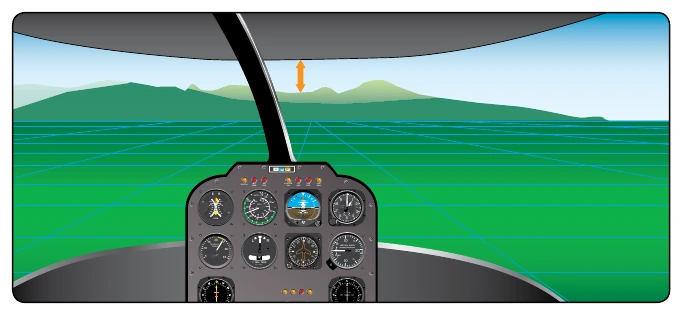
Although the cyclic is sensitive, there is a slight delay in control reaction, and it is necessary to anticipate actual movement of the helicopter. When making cyclic inputs to control the altitude or airspeed of a helicopter, take care not to overcontrol. If the nose of the helicopter rises above the level-flight attitude, apply forward pressure to the cyclic to bring the nose down. If this correction is held too long, the nose drops too low. Since the helicopter continues to change attitude momentarily after the controls reach neutral, return the cyclic to neutral slightly before the desired attitude is reached. This principle holds true for any cyclic input.
Since helicopters are not very stable, but are inherently very controllable, if a gust or turbulence causes the nose to drop, the nose tends to continue to drop instead of returning to a straight-and-level attitude as it would on a fixed-wing aircraft. Therefore, a pilot must remain alert and fly the helicopter at all times.
Common Errors
- Failure to trim the helicopter properly, tending to hold antitorque pedal pressure and opposite cyclic. This is commonly called cross-controlling.
- Failure to maintain desired airspeed.
- Failure to hold proper control position to maintain desired ground track.
- Failure to allow helicopter to stabilize at new airspeed.
Turns
A turn is a maneuver used to change the heading of the helicopter. The aerodynamics of a turn were previously discussed in Chapter 2, Aerodynamics of Flight.
Technique
Before beginning any turn, the area in the direction of the turn must be cleared not only at the helicopter’s altitude, but also above and below. To enter a turn from straight-and-level flight, apply sideward pressure on the cyclic in the direction the turn is to be made. This is the only control movement needed to start the turn. Do not use the pedals to assist the turn. Use the pedals only to compensate for torque to keep the helicopter in trim around the vertical axis. [Figure 9-2] Keeping the fuselage in the correct streamlined position around the vertical axis facilitates the helicopter flying forward with the least drag. Trim is indicated by a yaw string in the center, or a centered ball on a turn and slip indicator. A yaw string (also referred to as a slip string) is a tool used to indicate slip or skid during flight. It is simply a string attached to the nose or canopy of an aircraft so that it is visible to the pilot during flight. The string measures sideslip and offers a visual cue to the pilot in order to make yaw corrections.
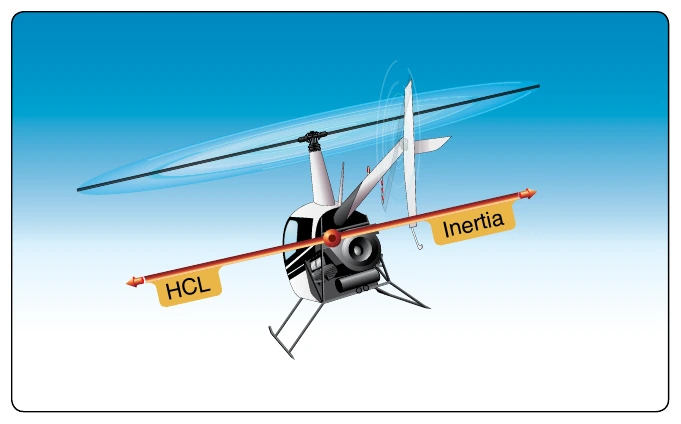
How fast the helicopter banks depends on how much lateral cyclic pressure is applied. How far the helicopter banks (the steepness of the bank) depends on how long the cyclic is displaced. After establishing the proper bank angle, return the cyclic toward the neutral position. When the bank is established, returning the cyclic to neutral (or holding it inclined relative to the horizon) will maintain the helicopter at that bank angle. Increase the collective and throttle to maintain altitude and rpm. As the torque increases, increase the proper antitorque pedal pressure to maintain longitudinal trim. Depending on the degree of bank, additional forward cyclic pressure may be required to maintain airspeed.
Rolling out of the turn to straight-and-level flight is the same as the entry into the turn, except that pressure on the cyclic is applied in the opposite direction. Since the helicopter continues to turn as long as there is any bank, start the rollout before reaching the desired heading.
The discussion on level turns is equally applicable to making turns while climbing or descending. The only difference is that the helicopter is in a climbing or descending attitude rather than that of level flight. If a so-called simultaneous entry (entering a turn while, at the same time, climbing or descending) is desired, merely combine the techniques of both maneuvers—climb or descent entry and turn entry. When recovering from a climbing or descending turn, the desired heading and altitude are rarely reached at the same time. If the heading is reached first, stop the turn and maintain the climb or descent until reaching the desired altitude. On the other hand, if the altitude is reached first, establish the level flight attitude and continue the turn to the desired heading.
Slips
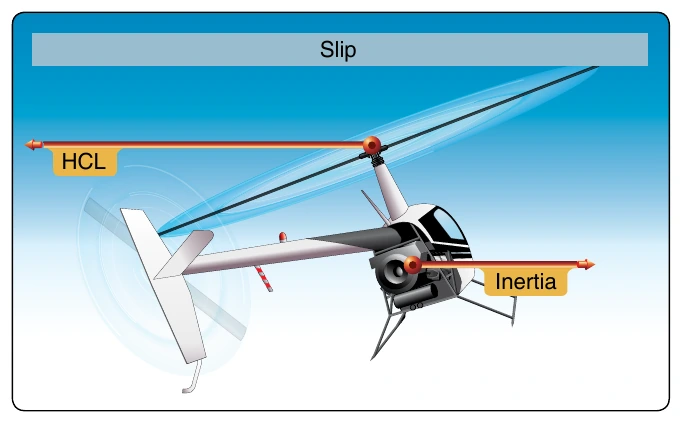
A slip occurs when the helicopter slides sideways toward the center of the turn. [Figure 9-3] It is caused by an insufficient amount of antitorque pedal in the direction of the turn, or too much in the direction opposite the turn, in relation to the amount of power used. In other words, if you hold improper antitorque pedal pressure, which keeps the nose from following the turn, the helicopter slips sideways toward the center of the turn.
Skids
A skid occurs when the helicopter slides sideways away from the center of the turn. [Figure 9-4] It is caused by too much antitorque pedal pressure in the direction of the turn, or by too little in the direction opposite the turn in relation to the amount of power used. If the helicopter is forced to turn faster with increased pedal pressure instead of by increasing the degree of the bank, it skids sideways away from the center of the turn instead of flying in its normal curved path.
In summary, a skid occurs when the rate of turn is too great for the amount of bank being used, and a slip occurs when the rate of turn is too low for the amount of bank being used. [Figure 9-5]