
Chapter 10
IFR Flight
IFR Flight Plan
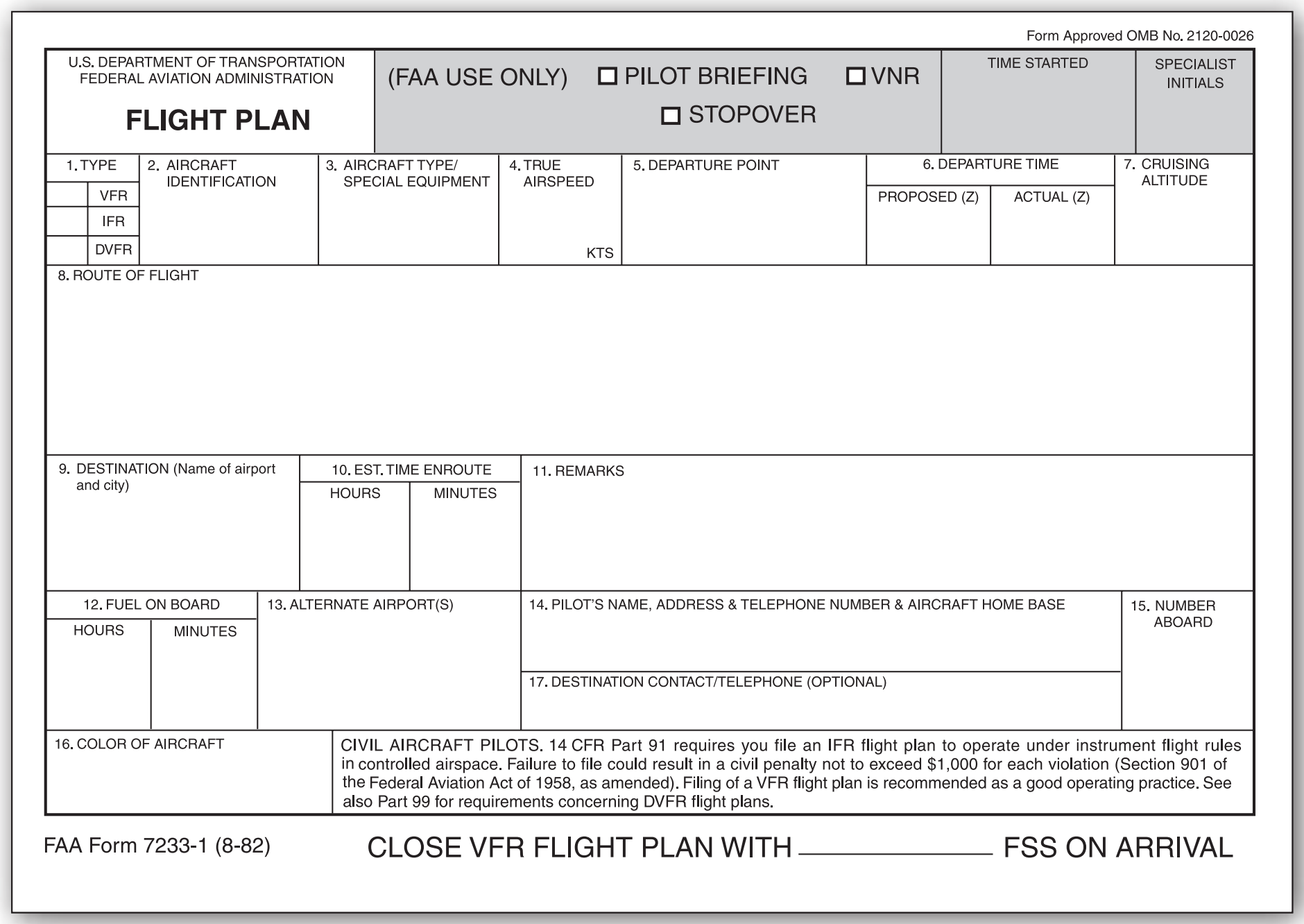
As specified in Title 14 of the Code of Federal Regulations (14 CFR) part 91, no person may operate an aircraft in controlled airspace under IFR unless that person has filed an IFR flight plan. Flight plans may be submitted to the nearest FSS or air traffic control tower (ATCT) either in person, by telephone (1-800-WX-BRIEF), by computer (using the direct user access terminal system (DUATS)), or by radio if no other means are available. Pilots should file IFR flight plans at least 30 minutes prior to estimated time of departure to preclude possible delay in receiving a departure clearance from ATC. The AIM provides guidance for completing and filing FAA Form 7233-1, Flight Plan. These forms are available at flight service stations (FSSs) and are generally found in flight planning rooms at airport terminal buildings. [Figure 10-1]
Filing in Flight
IFR flight plans may be filed from the air under various conditions, including:
- A flight outside controlled airspace before proceeding into IFR conditions in controlled airspace.
- A visual flight rules (VFR) flight expecting IFR weather conditions en route in controlled airspace.
In either of these situations, the flight plan may be filed with the nearest FSS or directly with the ARTCC. A pilot who files with the FSS submits the information normally entered during preflight filing, except for “point of departure,” together with present position and altitude. FSS then relays this information to the ARTCC. The ARTCC then clears the pilot from present position or from a specified navigation fix.
A pilot who files directly with the ARTCC reports present position and altitude, and submits only the flight plan information normally relayed from the FSS to the ARTCC. Be aware that traffic saturation frequently prevents ARTCC personnel from accepting flight plans by radio. In such cases, a pilot is advised to contact the nearest FSS to file the flight plan.
Cancelling IFR Flight Plans
An IFR flight plan may be cancelled any time a pilot is operating in VFR conditions outside Class A airspace by stating “cancel my IFR flight plan” to the controller or air-to-ground station. After cancelling an IFR flight plan, the pilot should change to the appropriate air-to-ground frequency, transponder code as directed, and VFR altitude/flight level.
ATC separation and information services (including radar services, where applicable) are discontinued when an IFR flight plan is cancelled. If VFR radar advisory service is desired, a pilot must specifically request it. Be aware that other procedures may apply when cancelling an IFR flight plan within areas such as Class C or Class B airspace.
When operating on an IFR flight plan to an airport with an operating control tower, a flight plan is cancelled automatically upon landing. If operating on an IFR flight plan to an airport without an operating control tower, the pilot is responsible for cancelling the flight plan. This can be done by telephone after landing if there is no operating FSS or other means of direct communications with ATC. When there is no FSS or air-to-ground communications are not possible below a certain altitude, a pilot may cancel an IFR flight plan while still airborne and able to communicate with ATC by radio. If using this procedure, be certain the remainder of the flight can be conducted under VFR. It is essential that IFR flight plans be cancelled expeditiously. This allows other IFR traffic to utilize the airspace.
Clearances
An ATC clearance allows an aircraft to proceed under specified traffic conditions within controlled airspace for the purpose of providing separation between known aircraft. A major contributor to runway incursions is lack of communication with ATC and not understanding the instructions that they give. The primary way the pilot and ATC communicate is by voice. The safety and efficiency of taxi operations at airports with operating control towers depend on this communication loop. ATC uses standard phraseology and require readbacks and other responses from the pilot in order to verify that clearances and instructions are understood. In order to complete the communication loop, the controllers must also clearly understand the pilot’s readback and other responses. Pilots can help enhance the controller’s understanding by responding appropriately and using standard phraseology. Regulatory requirements, the AIM, approved flight training programs, and operational manuals provide information for pilots on standard ATC phraseology and communications requirements.
Examples
A flight filed for a short distance at a relatively low altitude in an area of low traffic density might receive a clearance as follows: “Cessna 1230 Alpha, cleared to Doeville airport direct, cruise 5,000.”
The term “cruise” in this clearance means a pilot is authorized to fly at any altitude from the minimum IFR altitude up to and including 5,000 feet and may level off at any altitude within this block of airspace. A climb or descent within the block may be made at the pilot’s discretion. However, once a pilot reports leaving an altitude within the block, the pilot may not return to that altitude without further ATC clearance.
When ATC issues a cruise clearance in conjunction with an unpublished route, an appropriate crossing altitude is specified to ensure terrain clearance until the aircraft reaches a fix, point, or route where the altitude information is available. The crossing altitude ensures IFR obstruction clearance to the point at which the aircraft enters a segment of a published route or IAP.
Once a flight plan is filed, ATC issues the clearance with appropriate instructions, such as the following: “Cessna 1230 Alpha is cleared to Skyline airport via the Crossville 055 radial, Victor 18, maintain 5,000. Clearance void if not off by 1330.”
Or a more complex clearance, such as: “Cessna 1230 Alpha is cleared to Wichita Mid-continent airport via Victor 77, left turn after takeoff, proceed direct to the Oklahoma City VORTAC. Hold west on the Oklahoma City 277 radial, climb to 5,000 in holding pattern before proceeding on course. Maintain 5,000 to CASHION intersection. Climb to and maintain 7,000. Departure control frequency will be 121.05, Squawk 0412.”