
Chapter 5
Flight Instruments
When the alternate static source pressure is used, the following instrument indications are observed:
- The altimeter indicates a slightly higher altitude than actual.
- The ASI indicates an airspeed greater than the actual airspeed.
- The VSI shows a momentary climb and then stabilizes if the altitude is held constant.
For more information on static system blockages and how to best react to such situations, refer to the Pilot’s Handbook of Aeronautical Knowledge (FAA-H-8083-25A).
Effects of Flight Conditions
The static ports are located in a position where the air at their surface is as undisturbed as possible. But under some flight conditions, particularly at a high angle of attack with the landing gear and flaps down, the air around the static port may be disturbed to the extent that it can cause an error in the indication of the altimeter and ASI. Because of the importance of accuracy in these instruments, part of the certification tests for an aircraft is a check of position error in the static system.
The Pilot’s Operating Handbook (POH)/Aircraft Flight Manual (AFM) contains any corrections that must be applied to the airspeed for the various configurations of flaps and landing gear.
Pitot/Static Instruments
Sensitive Altimeter
A sensitive altimeter is an aneroid barometer that measures the absolute pressure of the ambient air and displays it in terms of feet or meters above a selected pressure level.
Principle of Operation
The sensitive element in a sensitive altimeter is a stack of evacuated, corrugated bronze aneroid capsules. [Figure 5-3] The air pressure acting on these aneroids tries to compress them against their natural springiness, which tries to expand them. The result is that their thickness changes as the air pressure changes. Stacking several aneroids increases the dimension change as the pressure varies over the usable range of the instrument.
Below 10,000 feet, a striped segment is visible. Above this altitude, a mask begins to cover it, and above 15,000 feet, all of the stripes are covered. [Figure 5-4]
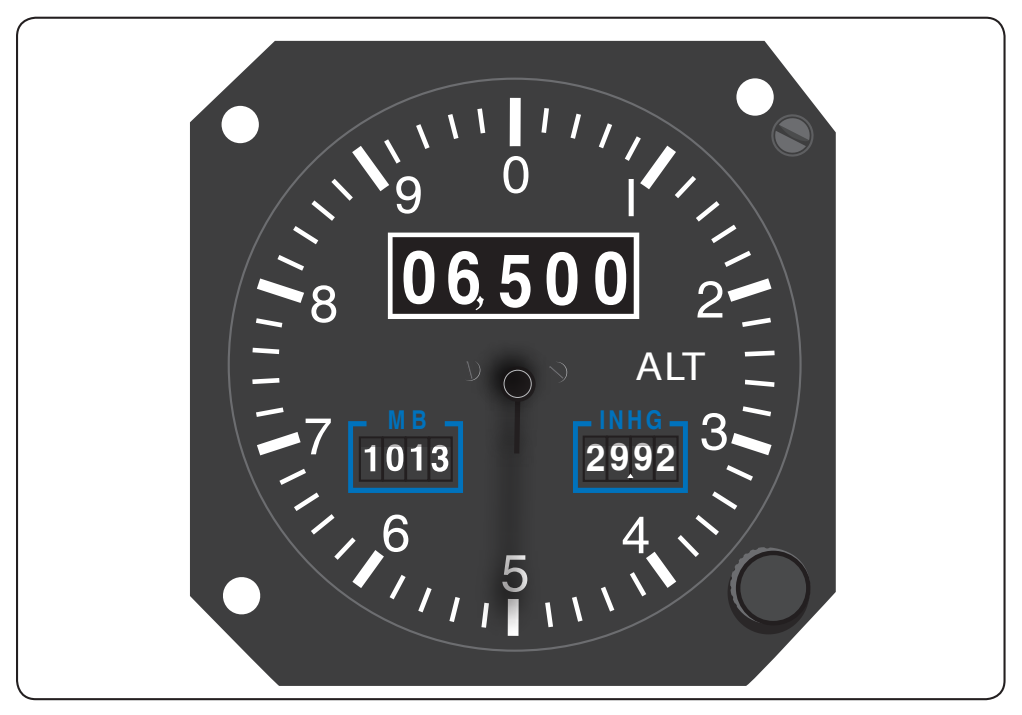
Another configuration of the altimeter is the drum-type. [Figure 5-5] These instruments have only one pointer that makes one revolution for every 1,000 feet. Each number represents 100 feet and each mark represents 20 feet. A drum, marked in thousands of feet, is geared to the mechanism that drives the pointer. To read this type of altimeter, first look at the drum to get the thousands of feet, and then at the pointer to get the feet and hundreds of feet.
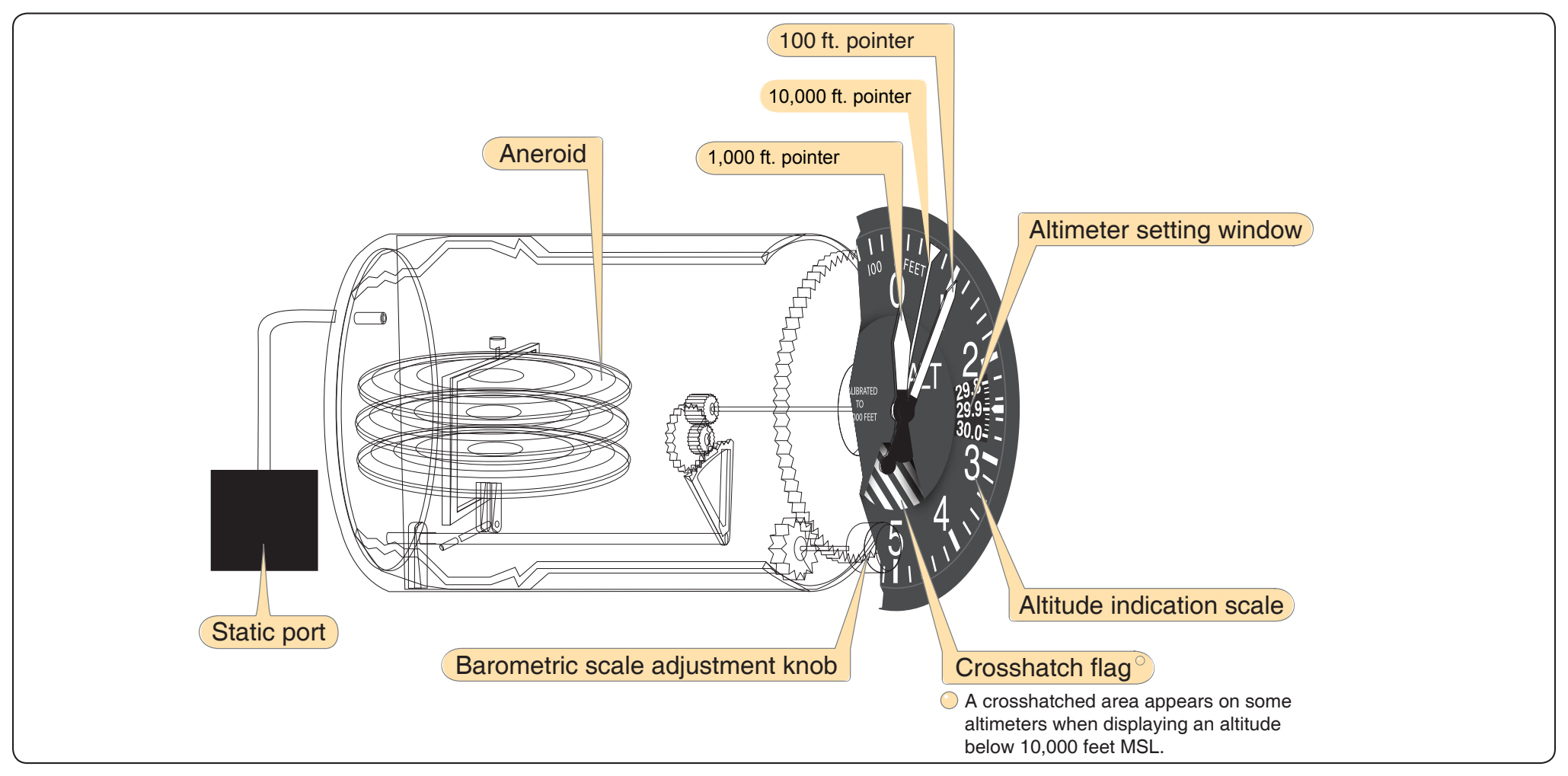
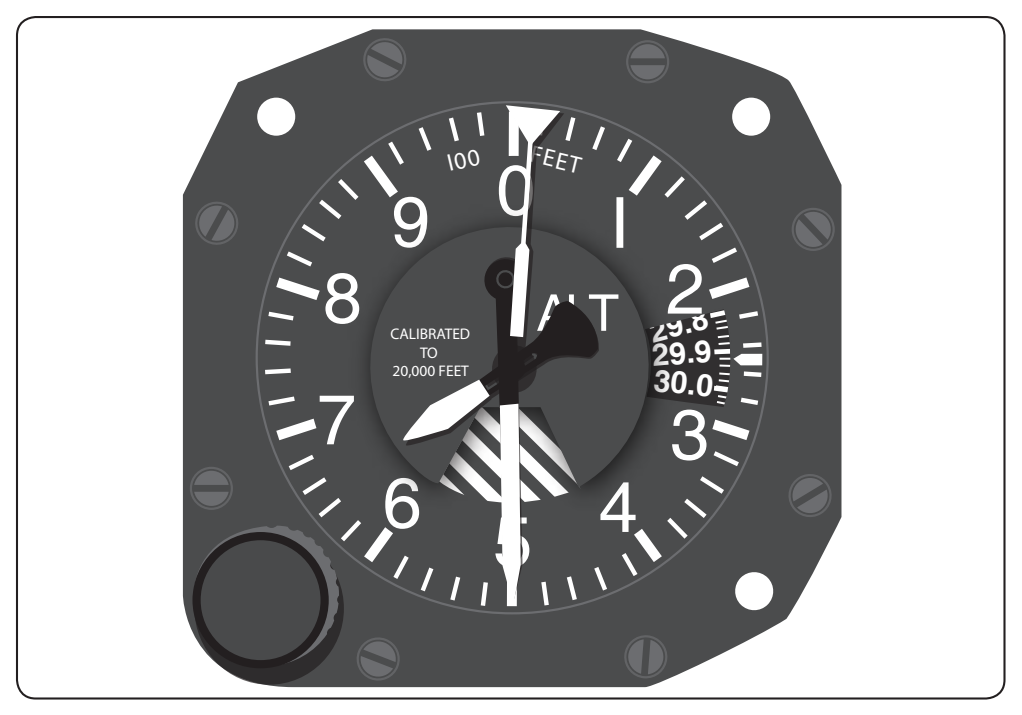
A sensitive altimeter is one with an adjustable barometric scale allowing the pilot to set the reference pressure from which the altitude is measured. This scale is visible in a small window called the Kollsman window. A knob on the instrument adjusts the scale. The range of the scale is from 28.00 to 31.00 inches of mercury ("Hg), or 948 to 1,050 millibars.
Rotating the knob changes both the barometric scale and the altimeter pointers in such a way that a change in the barometric scale of 1 "Hg changes the pointer indication by 1,000 feet. This is the standard pressure lapse rate below 5,000 feet. When the barometric scale is adjusted to 29.92 "Hg or 1,013.2 millibars, the pointers indicate the pressure altitude. The pilot displays indicate altitude by adjusting the barometric scale to the local altimeter setting. The altimeter then indicates the height above the existing sea level pressure.
Altimeter Errors
A sensitive altimeter is designed to indicate standard changes from standard conditions, but most flying involves errors caused by nonstandard conditions and the pilot must be able to modify the indications to correct for these errors. There are two types of errors: mechanical and inherent.