Chapter 3
Arrivals
The aircraft is being vectored to a published segment of the ILS final approach course, 3 NM from Alpha at 4,000 feet. The minimum vectoring altitude for this area is 4,000 feet. “Three miles from Alpha. Turn left heading two one zero. Maintain four thousand until established on the localizer.
Cleared ILS runway one eight approach.”
The ATC assigned altitude ensures IFR obstruction clearance from the point at which the approach clearance is issued until established on a segment of a published route or instrument approach procedure.
ATC tries to make frequency changes prior to passing the FAF, although when radar is used to establish the FAF, ATC informs the pilot to contact the tower on the local control frequency after being advised that the aircraft is over the fix. For example, “Three miles from final approach fix. Turn left heading zero one zero. Maintain two thousand until established on the localizer. Cleared ILS runway three six approach. I will advise when over the fix.”
“Over final approach fix. Contact tower one-one eight point one.”
Special Airport Qualification
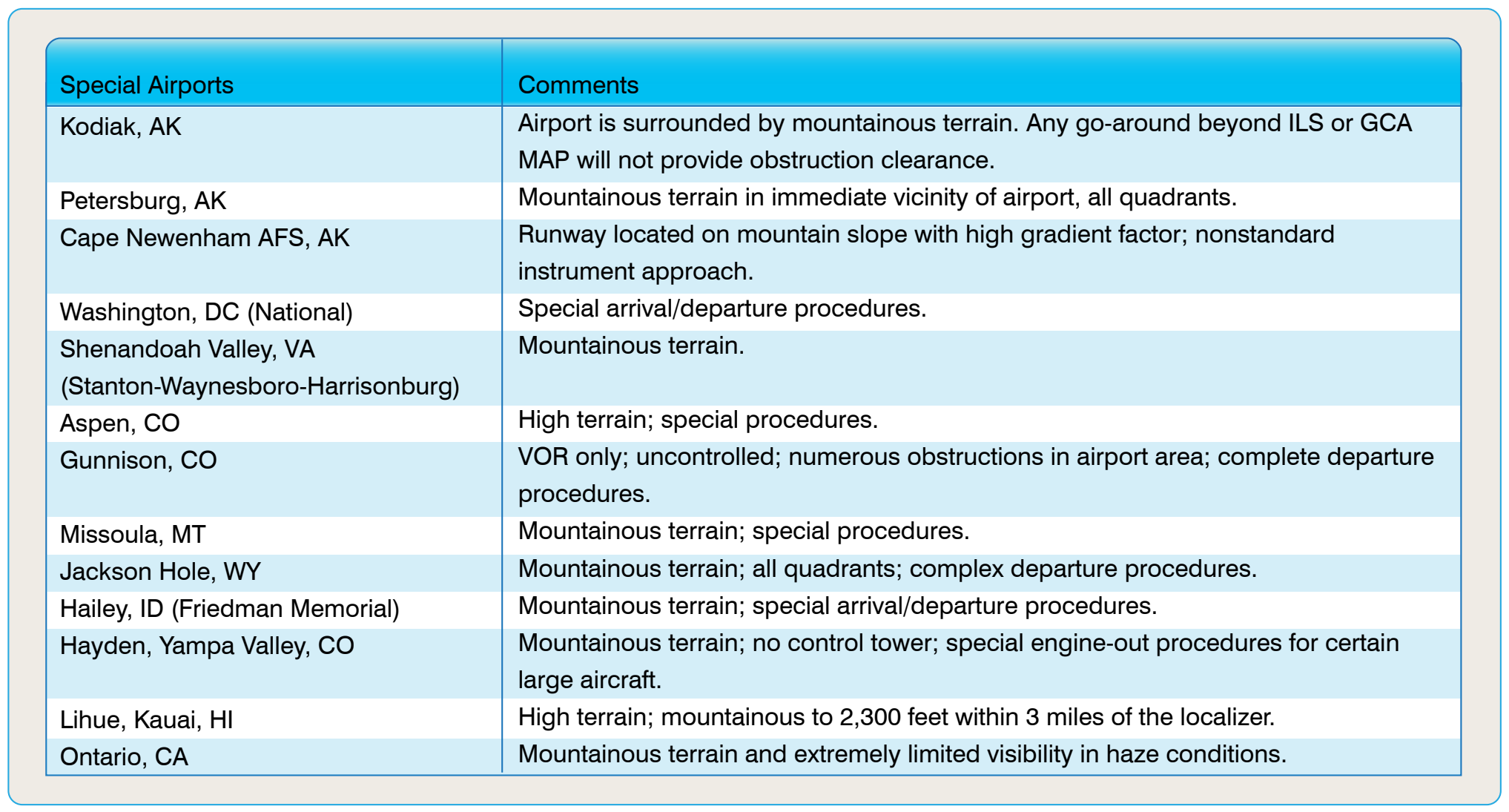
It is important to note an example of additional resources that are helpful for arrivals, especially into unfamiliar airports requiring special pilot or navigation qualifications. The operating rules governing domestic and flag air carriers require pilots in command to be qualified over the routes and into airports where scheduled operations are conducted, including areas, routes, and airports in which special pilot qualifications or special navigation qualifications are needed. For Part 119 certificate holders who conduct operations under 14 CFR Part 121, § 121.443, there are provisions in OpSpecs under which operators can comply with this regulation. Figure 3-27 provides some examples of special airports in the United States along with associated comments.