
Chapter 9
Ground Reference Maneuvers
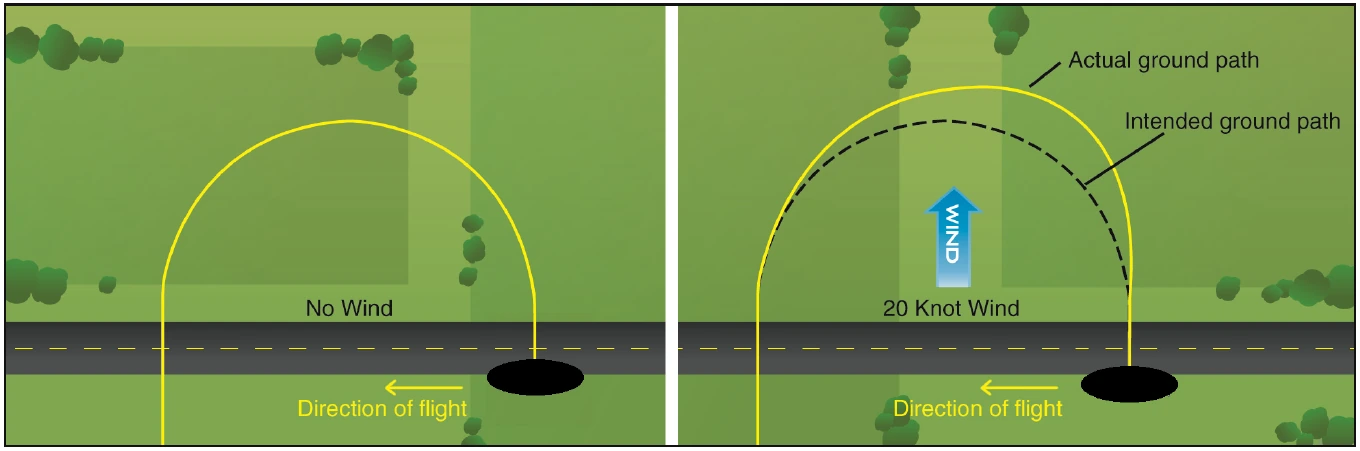
When there is no wind, it should be simple to fly along a ground track with an arc of exactly 180° and a constant radius because the flightpath and ground track would be identical. This can be demonstrated by approaching a road at a 90° angle and, when directly over the road, rolling into a medium-banked turn, then maintaining the same angle of bank throughout the 180° of turn. [Figure 9-2]
To complete the turn, the rollout should be started at a point where the canopy will become level as the powered parachute again reaches the road at a 90° angle and will be directly over the road just as the turn is completed. This would be possible only if there were absolutely no wind and if the angle of bank and the rate of turn remained constant throughout the entire maneuver.
If the turn were made with a constant angle of bank and a wind blowing directly across the road, it would result in a constant radius turn through the air. However, the wind effects would cause the ground track to be distorted from a constant radius turn or semicircular path. The greater the wind velocity, the greater would be the difference between the desired ground track and the flightpath. To counteract this drift, the flightpath can be controlled by the pilot in such a manner as to neutralize the effect of the wind, and cause the ground track to be a constant radius semicircle.
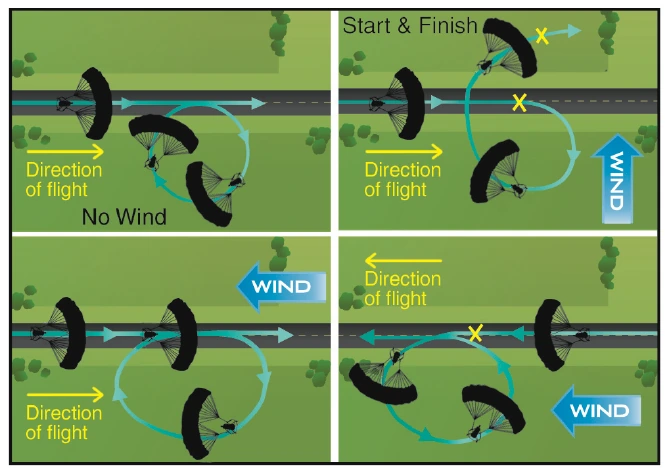
The effects of wind during turns can be demonstrated after selecting a road, railroad, or other ground reference that forms a straight line parallel to the wind. Fly into the wind directly over and along the line and then make a turn with a constant medium angle of bank for 360° of turn. [Figure 9-3] The powered parachute will return to a point directly over the line but slightly downwind from the starting point, the amount depending on the wind velocity and the time required to complete the turn. The path over the ground will be an elongated circle, although in reference to the air, it is a perfect circle. Straight flight during the upwind segment after completion of the turn is necessary to bring the powered parachute back to the starting position.
A similar 360° turn may be started at a specific point over the reference line, with the powered parachute headed directly downwind. In this demonstration, the effect of wind during the constant banked turn will drift the powered parachute to a point where the line is re-intercepted, but the 360° turn will be completed at a point downwind from the starting point.
Another reference line which lies directly crosswind may be selected and the same procedure repeated, showing that if wind drift is not corrected the powered parachute will, at the completion of the 360° turn, be headed in the original direction but will have drifted away from the line a distance dependent on the amount of wind.
From these demonstrations, you will see where and why it is necessary to increase or decrease the angle of bank and the rate of turn to achieve a desired track over the ground. The principles and techniques involved can be practiced and evaluated by the performance of the ground track maneuvers discussed in this chapter.
Rectangular Course
Normally, the rectangular course is the first ground reference maneuver the pilot is introduced to. [Figure 9-4]
The rectangular course is a training maneuver in which the ground track of the powered parachute is equidistant from all sides of a selected rectangular area on the ground. The maneuver simulates the conditions encountered in an airport traffic pattern. While performing the maneuver, the altitude should be held constant.
The maneuver assists the student pilot in perfecting:
- Practical application of the turn.
- The division of attention between the flightpath, ground objects, and the handling of the powered parachute.
- The timing of the start of a turn so that the turn will be fully established at a definite point over the ground.
- The timing of the recovery from a turn so that a definite ground track will be maintained.
- The establishing of a ground track and the determination of the appropriate “crab” angle.
Like those of other ground track maneuvers, one of the objectives is to develop division of attention between the flightpath and ground references, while controlling the powered parachute and watching for other aircraft in the vicinity. Another objective is to develop recognition of drift toward or away from a line parallel to the intended ground track. This will be helpful in recognizing drift toward or from an airport runway (landing area) during the various legs of the airport traffic pattern.
For this maneuver, a square or rectangular field, or an area bounded on four sides by section lines or roads, should be selected well away from other air traffic. The powered parachute should be flown parallel to and at a uniform distance from the field boundaries, not necessarily directly above the boundaries. For best results, the flightpath should be positioned outside the field boundaries just far enough that they may be easily observed from either pilot seat by looking out the side of the powered parachute. If an attempt is made to fly directly above the edges of the field, the pilot will have no usable reference points to start and complete the turns. The closer the track of the powered parachute is to the field boundaries, the steeper the bank necessary at the turning points. Also, the pilot should be able to see the edges of the selected field while seated in a normal position and looking out the side of the powered parachute during either a left-hand or right-hand course. The distance of the ground track from the edges of the field should be the same regardless of whether the course is flown to the left or right. All turns should be started when the powered parachute is abeam the corner of the field boundaries headed downwind where ground reference maneuvers are typically started. These should be the determining factors in establishing the distance from the boundaries for performing the maneuver.
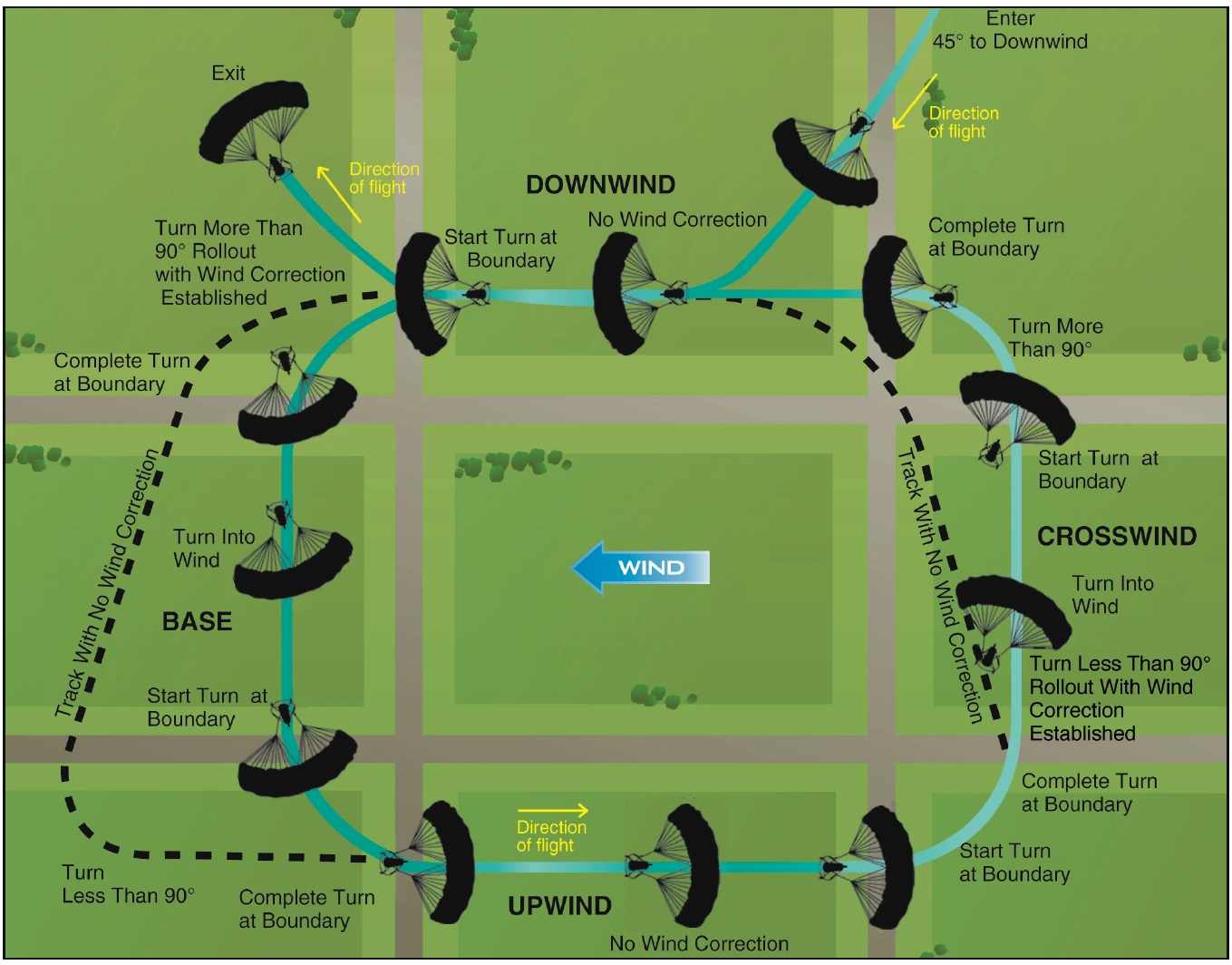
Although the rectangular course may be entered from any direction, this discussion assumes entry on a downwind.
On the downwind leg, the wind is a tailwind and results in an increased groundspeed. Consequently, the turn onto the next leg is entered with a fairly fast rate of turn and a higher (medium) bank. As the turn progresses, the bank angle is reduced gradually because the tailwind component is diminishing, resulting in a decreasing groundspeed. During and after the turn onto this leg (the equivalent of the base leg in a traffic pattern), the wind will tend to drift the powered parachute away from the field boundary. To compensate for the drift, the amount of turn will be more than 90°.
The rollout from this turn must be such that as the wing becomes level, the powered parachute is turned slightly toward the field and into the wind to correct for drift. The powered parachute should again be the same distance from the field boundary and at the same altitude, as on other legs. The base leg should be continued until the upwind leg boundary is being approached. Once more the pilot should anticipate drift and turning radius. Since drift correction was held on the base leg, it is necessary to turn less than 90° to align the powered parachute parallel to the upwind leg boundary. This turn should be started with a medium bank angle with a gradual reduction to a shallow bank as the turn progresses. The rollout should be timed to assure paralleling the boundary of the field as the canopy becomes level.