
Chapter 2
Personal Minimums
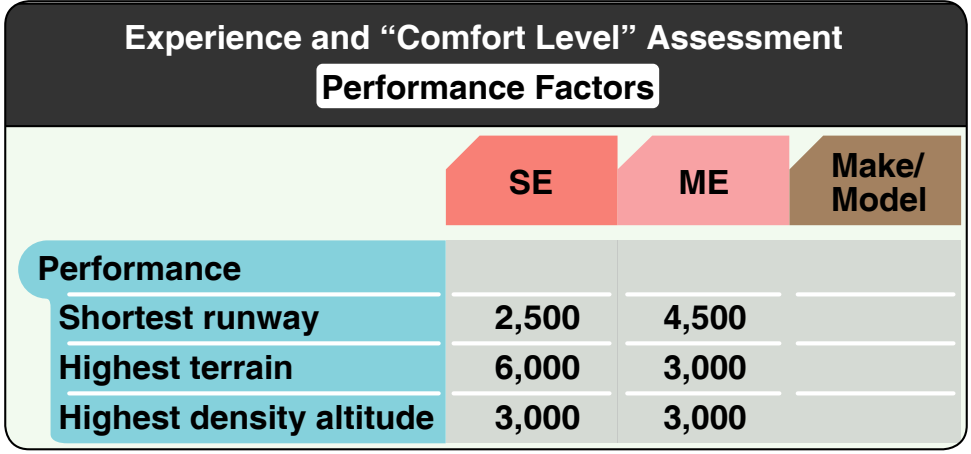
In addition to winds, “comfort level” inventory should also include factors related to aircraft performance. Completing the table with reference to the aircraft type and terrain typical for most flying [Figure 2-7] will establish a safety buffer. If the pilot has never operated an airplane from a runway shorter than 5,000 feet, the shortest runway box should say 5,000 feet.
Step 4—Assemble and Evaluate
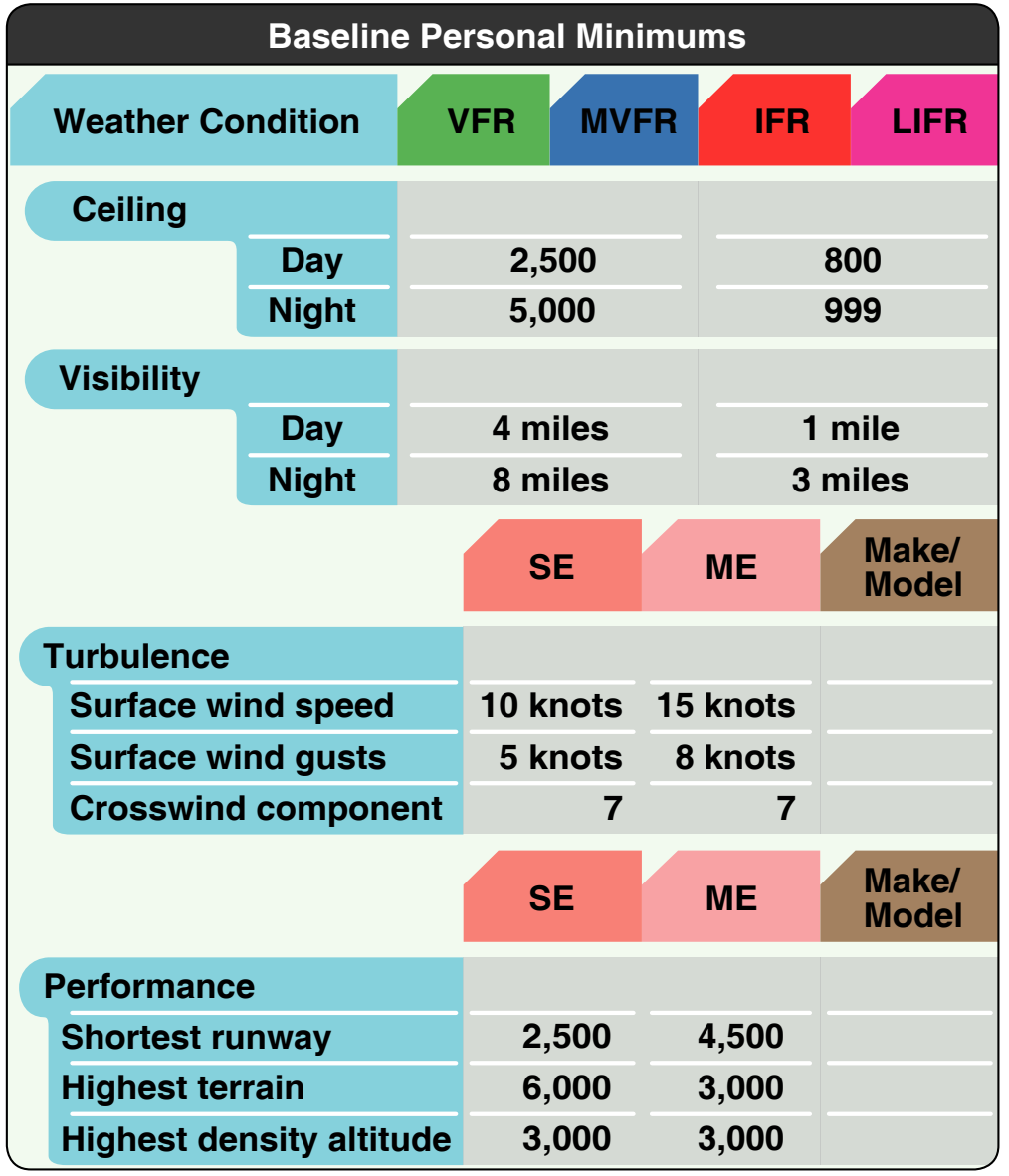
Combining all these numbers results in a baseline personal minimums table as shown in Figure 2-8.
Step 5—Adjust for Specific Conditions
Any flight a pilot makes involves an infinite combination of pilot skill, experience, conditions, and proficiency. Aircraft equipment and performance, environmental conditions, and external influences vary considerably. Both individually and in combination, these factors can compress or expand the safety buffer provided by baseline personal minimums. Consequently, a pilot should develop a practical way to adjust baseline personal minimums to accommodate specific conditions or aircraft.
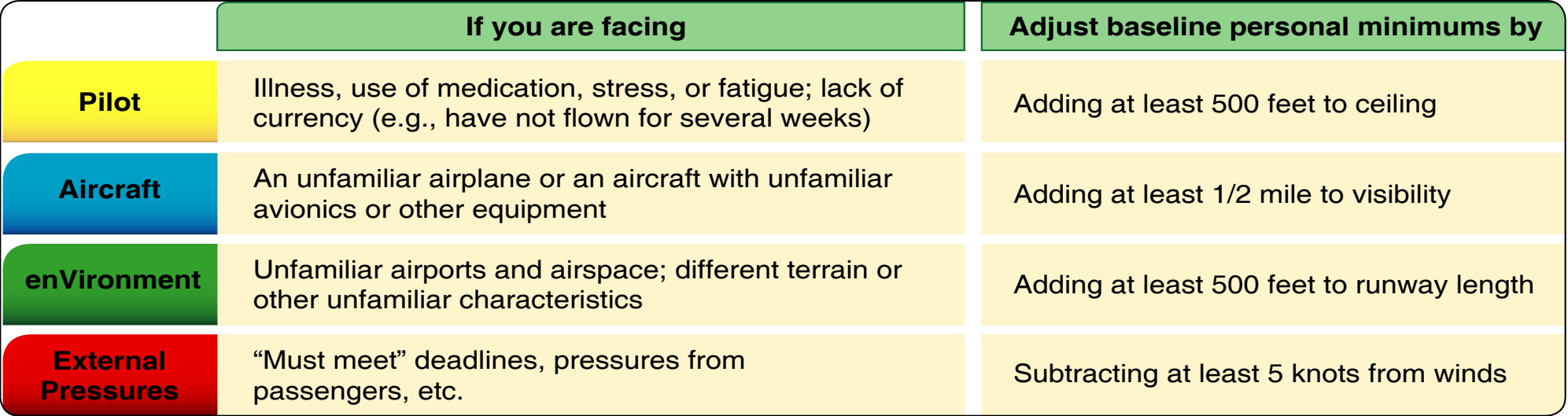
Note that the example situations and additional safety margins [Figure 2-9] only provide a starting point. Pilots may develop their own adjustment factors based on experience, aircraft capabilities, and operation. If flying experience is limited or infrequent, the adjustment magnitude could increase. If multiple special conditions apply, a pilot could make an adjustment for each factor. For example, suppose a pilot plans a night cross-country flight to an unfamiliar airport, departing after a full workday. The table in Figure 2-9 suggests raising baseline personal minimums by adding 1,000 feet to the ceiling value, one mile to visibility, and 1,000 feet to required runway length.
Here are several important cautions regarding personal minimums. The pilot should:
- Not adjust personal minimums to complete a specific flight. The time to consider adjustments is not while under pressure to fly, but rather when time and objectivity permits an honest self-analysis about skill, performance, and comfort level during the last few flights.
- Make adjustments to one variable at a time. For example, if the goal is to lower baseline personal minimums for visibility; the ceiling, wind, or other values should not change at the same time.
- Seek training and consult with a flight instructor before making a significant adjustment to personal minimums.
Step 6—Stick to the Plan
As many pilots know, adhering to personal minimums sometimes creates an ethical dilemma, especially when pressures exist to make a flight. Professional pilots live by the numbers, and so should general aviation pilots. Established personal minimums enable the pilot to make a no-go or divert decision rather than departing with a sense of unease regarding the outcome of a flight. In addition, a written set of personal minimums can also make it easier to explain tough decisions to passengers who depend on the pilot’s judgment.
Using the FAA WINGS Program for Risk Mitigation & Safety
The FAA maintains a safety program that provides courses on a variety of topics as a means to enhance safety. The WINGS Pilot Proficiency Program is based on the premise that pilots who maintain currency and proficiency will enjoy a safer and more stress-free flying experience. As an added bonus, completion of a phase of the WINGS Program can count for a flight review and participants may receive a discount on certain flight insurance policies. Pilots may create an account and watch a WINGS video using the following links:
- FAA WINGS Program ([source link](http://www.faasafety.gov))
- WINGS Pilot Proficiency Program Video ([source link](https://www.youtube.com/watch?v=KGgGzZ_HD1w))
Chapter Summary
Many GA pilots have freedom to choose when and where they fly. However, this freedom may also lead pilots to situations where lack of proficiency and equipment capability become a factor. Responsible pilots set personal minimums to help reduce the probability of experiencing an encounter that could lead to an incident or accident.
A copy of the charts used in this chapter can be found in Appendix B, Risk Assessment Tools. Pilots are encouraged to copy and use the charts in the appendix or use comparable tools on an electronic flight bag (EFB) before each flight.