
Appendix C: Accident Case Studies
The following details pertain to this accident:
- Location: Morristown, NJ
- Date: 12/20/2011
- NTSB Defining Event: Loss of control in-flight
- NTSB Case File Number: ERA12FA115
NTSB Probable Cause
The airplane’s encounter with severe icing conditions that were characterized by high ice accretion rates and the pilot’s failure to use command authority to depart the icing conditions in an expeditious manner, which resulted in a loss of airplane control.
NTSB Factual Summary Excerpts (edited)
The pilot departed Teterboro, NJ (TEB) on an IFR flight plan to Atlanta, GA (PDK). No evidence of a weather briefing was found, although the pilot may have obtained weather information from non-government sources. There was an AIRMET for moderate icing in northern New Jersey and westward from the freezing level (2,000 to 8,000 feet) to 20,000 feet. There were numerous pilot reports of moderate to severe icing and a Center Weather Advisory (CWA) issued, as depicted in Figure C-2.
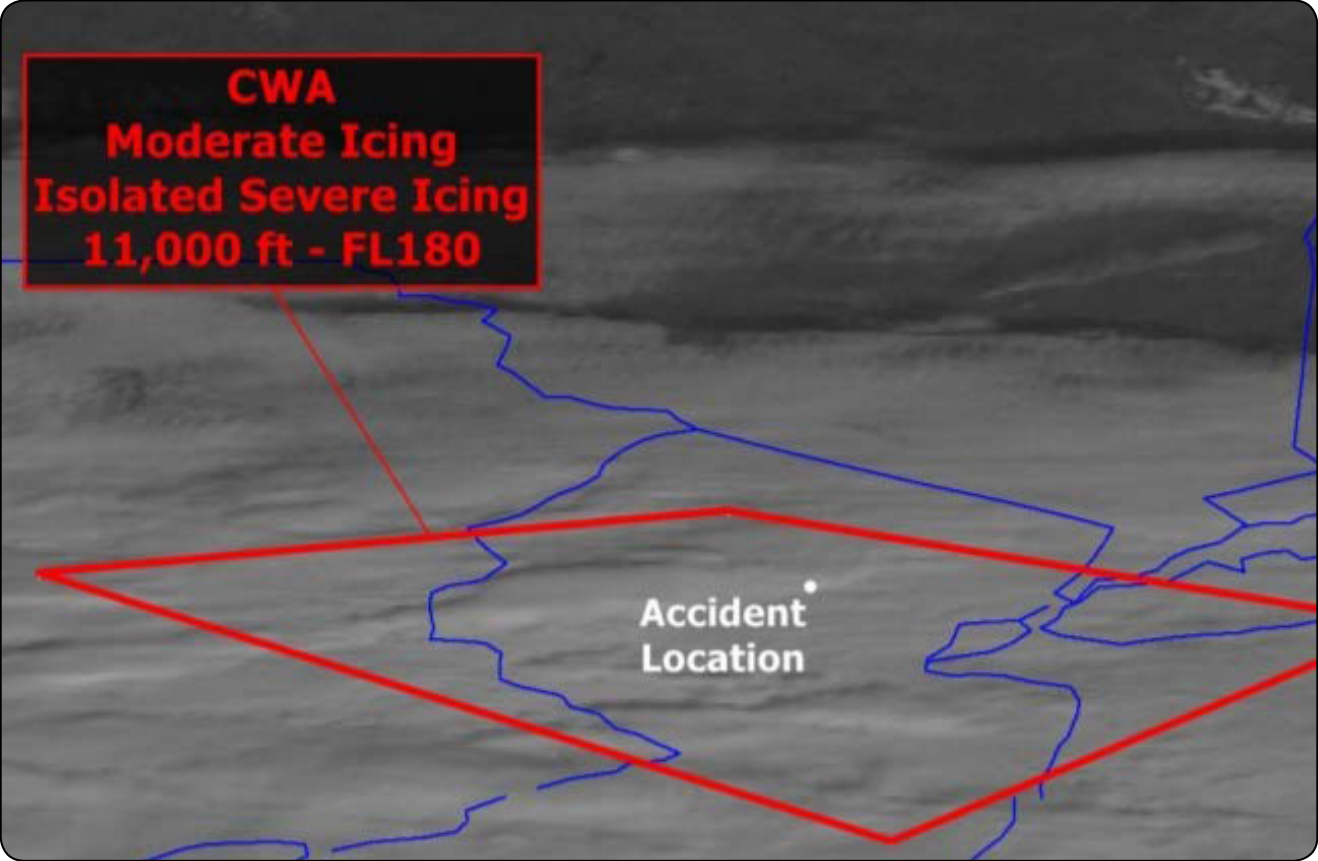
The pilot reported entering light icing at 16,800 feet and requested a higher altitude. There was a delay before air traffic control subsequently approved a climb to Flight Level 200. The radar track showed the airplane reached a peak altitude of 17,800 feet before beginning a rapid descent. The aircraft disintegrated during the descent and all five occupants perished. The airplane's flight manual included a warning that the aircraft was not approved for flight in severe icing conditions.
Risk Identification, Assessment, and Mitigation
No pilot risk factors were identified. The pilot was qualified in the aircraft and had recently attended recurrent training. As with any transportation flight, there may have been external pressures to complete the flight as planned.
The severity of the combined risk is catastrophic because it resulted in the loss of five lives. Given the severity of the icing, the length of exposure, and the warning in the airplane's flight manual, the likelihood of the event was at least “occasional,” meaning it would probably occur sometime. Thus, the overall risk level was high and needed mitigation.
How could the pilot have mitigated the risk factors on this flight? One way may have been to file for 10,000 feet to stay under the icing conditions. The pilot could maintain this altitude until exiting the severe icing area somewhere in southern New Jersey. This would have decreased fuel efficiency, but it would not have taken much time to reach an area without icing. At that time, the pilot could request a climb to a more fuel-efficient altitude. While the lower altitude may generate a requirement for a fuel stop, that stop represents an inconvenience only.
Accident Profile 3: Fatal Accident, Helicopter, Personal Flight
The following details pertain to this accident:
- Location: Panacea, FL
- Date: 02/08/2014
- NTSB Defining Event: Collision during takeoff/land
- NTSB Case File Number: ERA14FA115
NTSB Probable Cause
The pilot’s failure to maintain adequate clearance from trees during a takeoff at night. Contributing to the accident was the pilot’s lack of recent night flight experience.
NTSB Factual Summary Excerpts (edited)
The pilot and two passengers flew from the Tallahassee, FL airport (TLH) to the nearby Wakulla County Airport (2J0). The purpose of the flight was to dine at the restaurant across the street. It was dusk when they arrived at 2J0.
After dinner, they returned to the helicopter for the return flight. The Wakulla airport and the area around it were poorly lit, and after liftoff, the helicopter impacted 50-foot trees about 350 feet from the liftoff point. The pilot and one passenger suffered fatal injuries and the other passenger was severely injured.